Mental energy is the feeling of being willing and able to do mental work. Researchers measure it through mood scales and through tests of sustained attention and reaction time. It is drained by long stretches of demanding thinking, short sleep, constant task switching, sugary snacks and too little fluid, and it is protected by sleep, regular breaks, time outdoors and movement.
Key Takeaways
- Researchers define mental energy as a mood and as the ability or willingness to do cognitive work.1
- One group of researchers argue that feelings of energy and of fatigue may be separate states rather than two ends of one scale.2
- Long periods of demanding mental work made later physical tasks feel harder in a systematic review.3
- Six hours in bed for two weeks impaired attention as much as up to two nights without sleep.4
- Short breaks raised vigour and lowered fatigue in a meta-analysis.5
- Time in natural settings improved working memory and cognitive flexibility.6
- Under Regulation (EU) No 432/2012, zinc contributes to normal cognitive function, and thiamine, niacin, vitamin B6, vitamin B12, folate and biotin contribute to normal psychological function.
Some days your mind feels sharp and willing: you start the hard task first, ideas come easily, and the inbox feels manageable. Other days, the same work feels like wading through mud, even if you slept and ate well. That difference is what people mean by mental energy, or cognitive energy. It is a real and measurable experience, and it responds to how you structure your day. This article explains what researchers mean by the term, what drains it, and what protects it.
What is mental energy?
Mental energy has been a slippery concept in science. In a review of how to assess it, Lieberman described mental energy as a mood, but also as the ability or willingness to engage in cognitive work. He recommended measuring it with tests of vigilance, sustained attention and choice reaction time, because these are sensitive to the factors that raise and lower it, such as sleep loss, foods and drugs.1
O'Connor focused on the mood side. Feelings of energy matter because they shape behaviour: when people feel a lack of energy, they are more likely to avoid physical or mental work if they can. Validated questionnaires, such as the vigour scale of the Profile of Mood States, measure this feeling well, despite the limits of any self-report.7
Is mental energy the opposite of mental fatigue?
Not necessarily. Loy, Cameron and O'Connor argued that feelings of energy and feelings of fatigue are distinct states that should be measured on separate scales. They point to studies in which something changed people's energy without changing their fatigue, or the other way round.2 This is a hypothesis paper rather than a trial, but the idea is useful in daily life. Removing what tires you (fatigue) and adding what lifts you (energy) are two different jobs, and both are worth doing.
Why does the mind get tired?
Mental fatigue is the feeling that builds during long periods of demanding cognitive work. One influential review proposed that it reflects a running calculation in the brain: the expected rewards of continuing a task are weighed against the effort it costs, and when effort starts to outweigh reward, motivation to continue falls.8 That fits common experience. Tedious work tires you quickly; work you care about can absorb hours.
Mental fatigue also spills over into the body. A systematic review of 11 studies found that people who had done a prolonged, demanding cognitive task performed worse on endurance exercise afterwards, mainly because the exercise felt harder (higher perceived exertion). Heart rate, oxygen uptake and other physiological measures were not affected, and neither were maximal strength or short, explosive efforts.3 In other words, a draining day at the desk can make an evening run feel harder, even though your muscles and heart are unchanged.
Why do some tasks drain you more than others?
The effort-and-reward view helps explain a common puzzle: why two hours on a report you care about can feel lighter than twenty minutes of form-filling.8 The model predicts that tasks that feel pointless, or whose reward is far away, tire people faster.8 That suggests a few practical moves. Break long tasks into steps with visible progress, so the reward feels closer. Pair dull tasks with something that makes them easier, such as a set time limit or a change of location. And where you can, put demanding work in the part of the day when you have the most energy, rather than after a morning of meetings.
What are the signs your mental energy is running low?
Mental energy rarely runs out all at once. Everyday examples that many people recognise include rereading the same paragraph, putting off decisions, reaching for your phone more often, irritability with small interruptions, and a sudden urge for something sweet. These are not established clinical signs, and none of them is a problem in itself. Read as personal signals, they are a cue to take a break, step outside, drink some water or switch to an easier task for a while, rather than pushing through until the end of the day.
What drains mental energy?
| Drain | What the research shows | What to change |
|---|---|---|
| Long, unbroken mental effort | Prolonged demanding tasks raised perceived effort afterwards3 | Break work into blocks with pauses |
| Short sleep | Six hours a night impaired attention steadily4 | Seven hours or more, at regular times |
| Constant task switching | Heavy media multitaskers were more distractible9 | Batch messages, close unused tabs |
| Sugary snacks | Linked with more fatigue and less alertness within an hour10 | Pair carbohydrate with protein and fibre |
| Too little fluid | Mild fluid loss increased fatigue and slowed working memory11 | Water within reach all day |
| No breaks | Micro-breaks raised vigour and lowered fatigue5 | 5 to 10 minutes every 60 to 90 minutes |
Why does short sleep drain mental energy first?
Attention is one of the first things to suffer when sleep runs short. In a laboratory study, 48 healthy adults were randomised to 4, 6 or 8 hours in bed for 14 nights. On 6 hours, performance on attention and reaction-time tasks declined steadily, reaching levels similar to those seen after up to two nights without sleep. Their own ratings of sleepiness rose only a little after the first days, so they did not realise how impaired they were.4 Short sleep, in other words, drains mental energy quietly. Our guide to deep sleep and REM explains what happens across the night.
Does multitasking use up mental energy?
Switching between tasks has a cost. In a series of experiments, people who habitually used many media streams at once were more easily distracted by irrelevant information, both from their surroundings and from memory, and performed worse on a test of task switching than light media multitaskers.9 The study did not measure energy directly and cannot show cause and effect. But it is consistent with the end-of-day fog many people feel after hours of switching between email, chat and documents.
Do food and drink affect mental energy?
Two everyday habits stand out. First, the sugar rush is a myth. A meta-analysis of 31 studies with 1,259 participants found that carbohydrate did not improve any aspect of mood at any time point, and was linked with more fatigue and less alertness than placebo within the first hour.10 Second, fluid matters. In a controlled trial, 26 young men who lost about 1.6% of body weight in fluid through exercise reported more fatigue, made more errors on a vigilance task and had slower working memory responses than when they stayed topped up.11 The fluid loss was produced with exercise, so the result does not prove that office workers are short of fluid, but it suggests that ignoring thirst is not neutral.

How do you protect mental energy?
Take breaks before you need them
A meta-analysis of 22 study samples with 2,335 participants found that micro-breaks increased vigour (effect size 0.36) and reduced fatigue (0.35). The effect on overall performance was smaller and not significant, and tasks with heavy cognitive demands may need breaks longer than ten minutes.5 For mentally demanding work, that suggests planning pauses into the day rather than waiting until you hit a wall.
Get outside, ideally somewhere green
Attention Restoration Theory proposes that natural settings let the kind of directed attention used at work recover. A systematic review of 42 studies that measured cognitive performance objectively found that working memory and cognitive flexibility, and less consistently attentional control, improved after exposure to nature, with low to moderate effect sizes. Real outdoor settings appeared to work better than virtual ones.6 A walk in a park at lunchtime combines a break, movement, daylight and nature.
Design your day around your best hours
Because mental fatigue builds with sustained effort and depends on how rewarding a task feels,8 the order of your day matters. Put the most demanding work in the hours when you usually feel sharpest, batch shallow tasks such as email into set times, and give yourself a clear finish so the next day starts fresh. Our article on supporting cognitive longevity without supplements covers longer-term habits for the brain.
Protect sleep above everything
Sleep has one of the clearest effects on attention.4 Seven hours or more, at regular times, with caffeine kept to the morning and the last hour of the evening away from bright screens, is the foundation that the other habits build on.
Do nutrients play a role in mental energy?
Yes, as part of normal brain function, though not as a shortcut. Under EU rules (Regulation (EU) No 432/2012), the authorised wording is specific: zinc contributes to normal cognitive function, and thiamine, niacin, vitamin B6, vitamin B12, folate, biotin, vitamin C and magnesium contribute to normal psychological function. These claims describe normal function where intake falls short; they do not promise a sharper mind on demand.
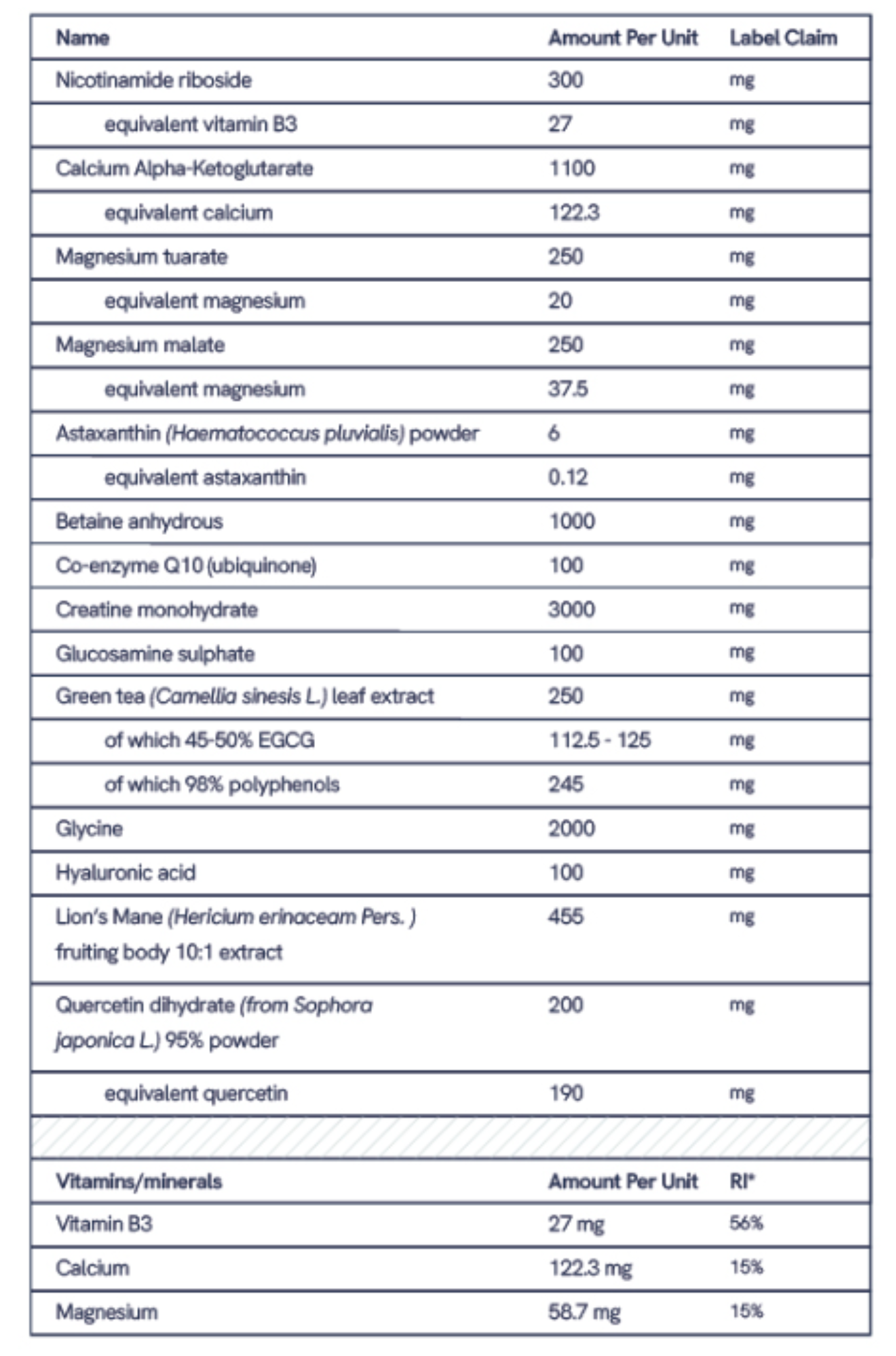
For transparency, our own daily formula, Longevity One, contains 8 mg of zinc (80% of the reference intake) alongside B vitamins, vitamin C (100 mg) and magnesium as malate (150 mg, 40%), among 24 ingredients with every dose printed. It contains no caffeine, so it does not act as a stimulant. It is independently tested by Eurofins and NZVT certified. For background on the B vitamins, see our guide to B vitamins and energy metabolism.
When is low mental energy worth a GP visit?
See your GP if you feel mentally drained most days for several weeks, if the change is severe or new, or if it comes with low mood or loss of interest lasting more than two weeks, memory changes that others notice, weight loss or anything else you cannot explain. These are reasons for a proper check, not something to manage with habits alone.
A daily mental energy routine
- Start with your hardest task, in the hours you feel sharpest.
- Work in blocks of 60 to 90 minutes, then take a 5 to 10 minute break away from the screen.5
- Batch messages into set times rather than answering as they arrive.9
- Walk outside at lunchtime, ideally somewhere green.6
- Keep water on your desk and go easy on sugary snacks.11,10
- Finish work at a set time and protect seven hours of sleep.4
Q&A: Mental Energy
What is cognitive energy?
It is the feeling of being willing and able to do mental work. Researchers describe it both as a mood and as the ability or willingness to engage in cognitive tasks.1 It is measured with mood scales and attention tests.
How is mental energy measured?
Through validated mood questionnaires, such as the vigour scale of the Profile of Mood States.7 Researchers also use tests of vigilance, sustained attention and reaction time.1 Both approaches are needed. Each captures a different side.
Is mental fatigue the same as low mental energy?
Not quite. Some researchers argue that energy and fatigue are separate states that can change independently.2 In practice, reducing what tires you and adding what lifts you are two different jobs.
Why does my brain feel tired after a long day?
Sustained demanding work builds mental fatigue. One model suggests motivation drops when the effort of continuing outweighs the expected reward.8 Breaks and a varied day help.
Can mental tiredness affect exercise?
Yes. After prolonged demanding mental tasks, endurance exercise felt harder and performance dropped, while heart rate and oxygen uptake were unchanged.3 Strength and short efforts were not affected.
How can I increase my mental energy?
Protect sleep, take short breaks, get outside and keep task switching to a minimum. Micro-breaks raised vigour and reduced fatigue in a meta-analysis.5 There is no single shortcut to more mental energy.
Does lack of sleep reduce mental energy?
Clearly. Six hours in bed for two weeks impaired attention as much as up to two nights without sleep.4 People barely noticed the decline themselves.
Does nature help a tired mind?
It appears to help attention. Working memory and cognitive flexibility improved after time in natural settings in a systematic review.6 Real outdoor settings worked better than images.
Do sugary snacks help mental energy?
No. Carbohydrate was linked with more fatigue and less alertness within an hour, with no lift in mood.10 Protein and fibre with carbohydrate is a better choice.
Does drinking water help mental energy?
It may help you avoid a dip. Mild fluid loss of about 1.6% of body weight increased fatigue and slowed working memory in young men.11 The fluid loss was produced with exercise. Keeping water within reach is a sensible habit.
Frequently Asked Questions
Can I take supplements with my medication?
The label advises consulting your doctor if you use medication. Ask your GP or pharmacist and bring the label.
Does caffeine increase mental energy?
Many people use caffeine to feel more alert, but timing matters. In a home study, 400 mg of caffeine taken six hours before bed still disturbed sleep compared with placebo,12 and short sleep impaired attention in the lab.4 Keep it to the morning and early afternoon.
Does multitasking make you mentally tired?
It costs attention. Heavy media multitaskers were more distractible and worse at switching tasks.9 Batching messages reduces the load.
What does Longevity One taste like?
It has a mango and pineapple flavour. Mix one level scoop in 250 to 500 ml of water, or stir it into a smoothie or yogurt.
When should I see a doctor about mental tiredness?
If you feel mentally drained most days for several weeks, if it is severe or new, or if it comes with low mood or memory changes, see your GP. Short sleep is a common hidden cause, so check it first.4
References
- Lieberman HR. Cognitive methods for assessing mental energy. Nutr Neurosci. 2007;10(5-6):229-242. View on PubMed ↗
- Loy BD, Cameron MH, O'Connor PJ. Perceived fatigue and energy are independent unipolar states: supporting evidence. Med Hypotheses. 2018;113:46-51. View on PubMed ↗
- Van Cutsem J, Marcora S, De Pauw K, Bailey S, Meeusen R, Roelands B. The effects of mental fatigue on physical performance: a systematic review. Sports Med. 2017;47(8):1569-1588. View on PubMed ↗
- Van Dongen HP, Maislin G, Mullington JM, Dinges DF. The cumulative cost of additional wakefulness: dose-response effects on neurobehavioral functions and sleep physiology from chronic sleep restriction and total sleep deprivation. Sleep. 2003;26(2):117-126. View on PubMed ↗
- Albulescu P, Macsinga I, Rusu A, Sulea C, Bodnaru A, Tulbure BT. "Give me a break!" A systematic review and meta-analysis on the efficacy of micro-breaks for increasing well-being and performance. PLoS One. 2022;17(8):e0272460. View on PubMed ↗
- Stevenson MP, Schilhab T, Bentsen P. Attention Restoration Theory II: a systematic review to clarify attention processes affected by exposure to natural environments. J Toxicol Environ Health B Crit Rev. 2018;21(4):227-268. View on PubMed ↗
- O'Connor PJ. Mental energy: assessing the mood dimension. Nutr Rev. 2006;64(7 Pt 2):S7-S9. View on PubMed ↗
- Boksem MA, Tops M. Mental fatigue: costs and benefits. Brain Res Rev. 2008;59(1):125-139. View on PubMed ↗
- Ophir E, Nass C, Wagner AD. Cognitive control in media multitaskers. Proc Natl Acad Sci U S A. 2009;106(37):15583-15587. View on PubMed ↗
- Mantantzis K, Schlaghecken F, Sünram-Lea SI, Maylor EA. Sugar rush or sugar crash? A meta-analysis of carbohydrate effects on mood. Neurosci Biobehav Rev. 2019;101:45-67. View on PubMed ↗
- Ganio MS, Armstrong LE, Casa DJ, McDermott BP, Lee EC, Yamamoto LM, et al. Mild dehydration impairs cognitive performance and mood of men. Br J Nutr. 2011;106(10):1535-1543. View on PubMed ↗
- Drake C, Roehrs T, Shambroom J, Roth T. Caffeine effects on sleep taken 0, 3, or 6 hours before going to bed. J Clin Sleep Med. 2013;9(11):1195-1200. View on PubMed ↗
Disclaimer: Educational content only. Not medical advice. Food supplements should not be used as a substitute for a varied, balanced diet and a healthy lifestyle. If you use medication, consult your doctor.