A stim-free pre-workout can help a little, if its ingredients are at studied doses. Citrulline and nitrate show small effects in meta-analyses, and the "pump" evidence is thin. Beta-alanine and creatine work too, but only after weeks of daily intake. You will not feel a caffeine-style lift, and that is the trade for better sleep.
Key Takeaways
- Across 100 top-selling pre-workouts, beta-alanine averaged 2.0 g per serving, below the studied dose.1
- In a meta-analysis of 12 studies, citrulline of at least 3 g gave a small benefit for strength and power (effect size 0.20).2
- Evidence that citrulline improves blood flow to muscle, the basis of the "pump", is scarce and inconsistent.3
- Across 80 studies, nitrate improved exercise performance by a small amount, with no clear effect in well-trained endurance athletes.4
- Beta-alanine needs 4 to 6 g a day for at least 2 to 4 weeks, and its tingling is a side effect, not a sign it is working.5
- Creatine is among the few supplements with good evidence, and it works through daily intake.6,7
- Music during exercise improved mood, performance and perceived effort in a meta-analysis of 139 studies.8
Maybe caffeine keeps you awake after an evening session. Maybe it makes you shaky, or you have simply had enough of needing it. A stim-free pre-workout promises the focus and the pump without the stimulant. The fair question is whether the ingredients that remain do anything you would notice, and at what dose. This article looks at the human evidence for the common stim-free ingredients: citrulline, nitrate, beta-alanine and creatine.
One note on scope. Some caffeine-free products contain herbal extracts with stimulant effects of their own. Those are outside this article. Here, "stim-free" means no stimulant of any kind.
What is in a stim-free pre-workout?
Most stim-free products are standard pre-workouts with the caffeine removed. In a label analysis of the 100 top-selling pre-workouts, the most common ingredients after caffeine were beta-alanine (in 87% of products, averaging 2.0 g per serving), citrulline (71%, averaging 4.0 g), tyrosine (63%), taurine (51%) and creatine (49%, averaging 2.1 g).1 The authors noted that the average beta-alanine dose was below the effective dose, and that 44.3% of all ingredients sat in proprietary blends with no amount stated.1
So the first test of any stim-free product is whether the ingredients are there at the doses used in trials. The second is timing, because some ingredients work from a single dose before training and others only from regular daily use.
Does citrulline give you a pump?
Citrulline is the main "pump" ingredient. It is an amino acid found mainly in watermelon, and the body converts it to arginine, which is used to make nitric oxide, a molecule that relaxes blood vessels.3 Taking citrulline or citrulline malate raises blood citrulline, arginine, nitrate and nitrite levels, so the first step of the theory holds.3
Labels use both forms. L-citrulline is the amino acid on its own, while citrulline malate combines it with malic acid, so the label should state how much citrulline the serving provides. Studies have used both, and the review authors call for more work on which form and dose work best.3,2 When you compare products, check which form the label states.
What the trials show for performance
A systematic review and meta-analysis pooled 12 placebo-controlled studies with 13 samples and 198 healthy men and women.2 It included only studies that gave at least 3 g of citrulline at least 30 minutes before testing, and excluded products that mixed citrulline with caffeine, creatine or nitrate.2 Citrulline improved high-intensity strength and power outcomes compared with placebo, but the effect was small, a standardised mean difference of 0.20, and the confidence interval of every individual study crossed the line of no effect.2 The authors suggested the result may matter most for high-level athletes, where small margins decide outcomes.2
What the trials show for the pump itself
The visible pump is what many people buy citrulline for, and here the evidence is weakest. A review of the human literature concluded that evidence for acute improvements in vasodilation and muscle blood flow after citrulline is scarce and inconsistent, even though some studies reported better performance.3 So citrulline may help with a few extra repetitions, but trials have not reliably shown a bigger pump.
Does nitrate help without caffeine?
Dietary nitrate, usually from beetroot juice or concentrated vegetable extracts, is the other route to nitric oxide. A systematic review and meta-analysis of 80 randomised, placebo-controlled crossover studies in young, healthy adults found that nitrate improved exercise performance compared with placebo, with a small effect size of 0.174.4 The benefit was clear in recreationally active young men. It was not seen in studies that included only women, which were few, or in well-trained endurance athletes.4
Dose and timing matter. An expert consensus of 12 researchers recommended 8 to 16 mmol of nitrate as a single dose, or 4 to 16 mmol a day over several days, with the final dose taken 2 to 4 hours before exercise.9 That timing does not match a scoop taken 20 minutes before training. The panel also advised that athletes increase their nitrate intake mainly from vegetables and vegetable juices, from a safety perspective.9 Many stim-free products do not state their nitrate content in mmol, which makes it hard to compare with these doses.
Does beta-alanine work as a pre-workout?
Beta-alanine works, but not in the way a pre-workout implies. It raises carnosine in muscle, which helps buffer acid during hard efforts. The ISSN position stand states that four weeks of 4 to 6 g a day increases muscle carnosine, and that 4 to 6 g a day for at least 2 to 4 weeks improves exercise performance, especially in efforts of 1 to 4 minutes.5 It is a daily-loading supplement, so the timing of the scoop on training days matters little.
A meta-analysis of 40 double-blind, placebo-controlled studies with 1,461 participants found a small overall benefit, an effect size of 0.18, with larger effects for exercise capacity in efforts lasting 30 seconds to 10 minutes.10 The effect did not depend on training status, on whether the exercise was continuous or intermittent, or on the total amount taken.10 Taking beta-alanine together with sodium bicarbonate, another buffering agent, gave the largest effect in the analysis, 0.43 compared with placebo.10 That is still a modest effect, and it again depends on weeks of daily loading.
The tingle is not the effect
Beta-alanine often causes paraesthesia, a tingling of the skin, which the ISSN lists as the only reported side effect.5 Many people read the tingle as a sign the product is working. It is not: the benefit comes from carnosine built up over weeks, and the tingle can be reduced by splitting the daily amount into smaller doses of about 1.6 g.5 A typical pre-workout serving of 2.0 g, taken only on training days, falls short of the studied daily intake.1,5

Creatine: the one with the strongest case
Of the stim-free ingredients, creatine has the deepest evidence. The IOC consensus statement on supplements lists it among the few products with good evidence of benefit, alongside caffeine, specific buffering agents and nitrate.6 The ISSN position stand reports that creatine supplementation consistently increases the creatine stored in muscle, which may explain improvements in high-intensity exercise performance and larger training adaptations.7 It also describes doses of up to 30 g a day for five years as safe and well tolerated in healthy people.7 Several authors of that position stand work with supplement companies.
Like beta-alanine, creatine is used as a daily supplement, because its effects are linked to the creatine stored in muscle.7 The EU authorises health claims for creatine at 3 g a day, listed in Regulation (EU) No 432/2012 as amended. Creatine increases physical performance in successive bursts of short-term, high intensity exercise. The second authorised claim applies only to adults over 55 who do resistance training. The average pre-workout contained 2.1 g per serving, below that amount, and only about half of products contained any.1 Read more in Creatine Beyond the Gym.
So, does a stim-free pre-workout work?
| Ingredient | Studied dose and timing | What trials found | Typical pre-workout amount |
|---|---|---|---|
| Citrulline | At least 3 g, 30 minutes or more before2 | Small benefit for strength and power; pump evidence thin2,3 | 4.0 g average1 |
| Nitrate | 8 to 16 mmol, 2 to 4 hours before9 | Small benefit, mainly in recreationally active men4 | Often not stated in mmol |
| Beta-alanine | 4 to 6 g a day for 2 to 4 weeks or more5 | Small benefit, mostly in 30-second to 10-minute efforts10 | 2.0 g average, below studied dose1 |
| Creatine | 3 g or more a day, every day7 | Good evidence for high-intensity training6 | 2.1 g average, in about half of products1 |
The table splits the ingredients in two. The acute ingredients, citrulline and nitrate, have small effects, and nitrate is timed hours before training. The ingredients with clearer benefits, beta-alanine and creatine, are daily supplements that happen to be sold in a pre-workout tub. A stim-free pre-workout can therefore work, but mostly as a vehicle for daily ingredients, and only if the doses are adequate.
What you give up is the felt lift. Caffeine improves alertness and exercise performance at 3 to 6 mg per kg of body weight11, and none of the stim-free ingredients replaces that sensation. What you gain is your sleep: in a meta-analysis of 24 studies, caffeine cut total sleep by 45 minutes, and a standard pre-workout serving would need to be taken at least 13.2 hours before bed to avoid that loss.12 For evening trainers, that trade is often worth it.
How do you judge a stim-free label?
- Look for each ingredient in grams per serving. Avoid proprietary blends that hide amounts.1
- Citrulline: at least 3 g, taken 30 minutes or more before training.2
- Nitrate: stated in mmol or mg, ideally 8 to 16 mmol, taken 2 to 4 hours before.9
- Beta-alanine: count your daily total. You need 4 to 6 g a day for weeks, not 2 g on training days.5
- Creatine: 3 g or more, every day, including rest days.7
- Check that the product contains no stimulant of any kind if that is what you want.
- If you compete under anti-doping rules, choose batch-tested products: the IOC warns that supplements can lead to an anti-doping rule violation.6
Our guide on how to read a supplement label covers the rest of the label.
How can you get energy for a workout without caffeine?
The most reliable sources of training energy are not in a tub. Sleep, a meal with some carbohydrate a few hours before, and a well-planned session do most of the work. One simple, well-studied aid is music. A meta-analysis of 139 studies with 3,599 participants found that listening to music during exercise improved how people felt (effect size 0.48), improved physical performance (0.31) and reduced perceived exertion (0.22), with faster music giving larger performance effects.8
A structured warm-up, a clear plan for the session and training at a time of day when you feel alert also help, even if they are less studied as "energy" tools. Our complete longevity exercise programme shows how to structure strength, Zone 2 and higher-intensity work across the week. If you feel too tired to train most days for weeks, or the tiredness is severe or new, see your GP rather than looking for a stronger product.
Where does a daily formula fit?
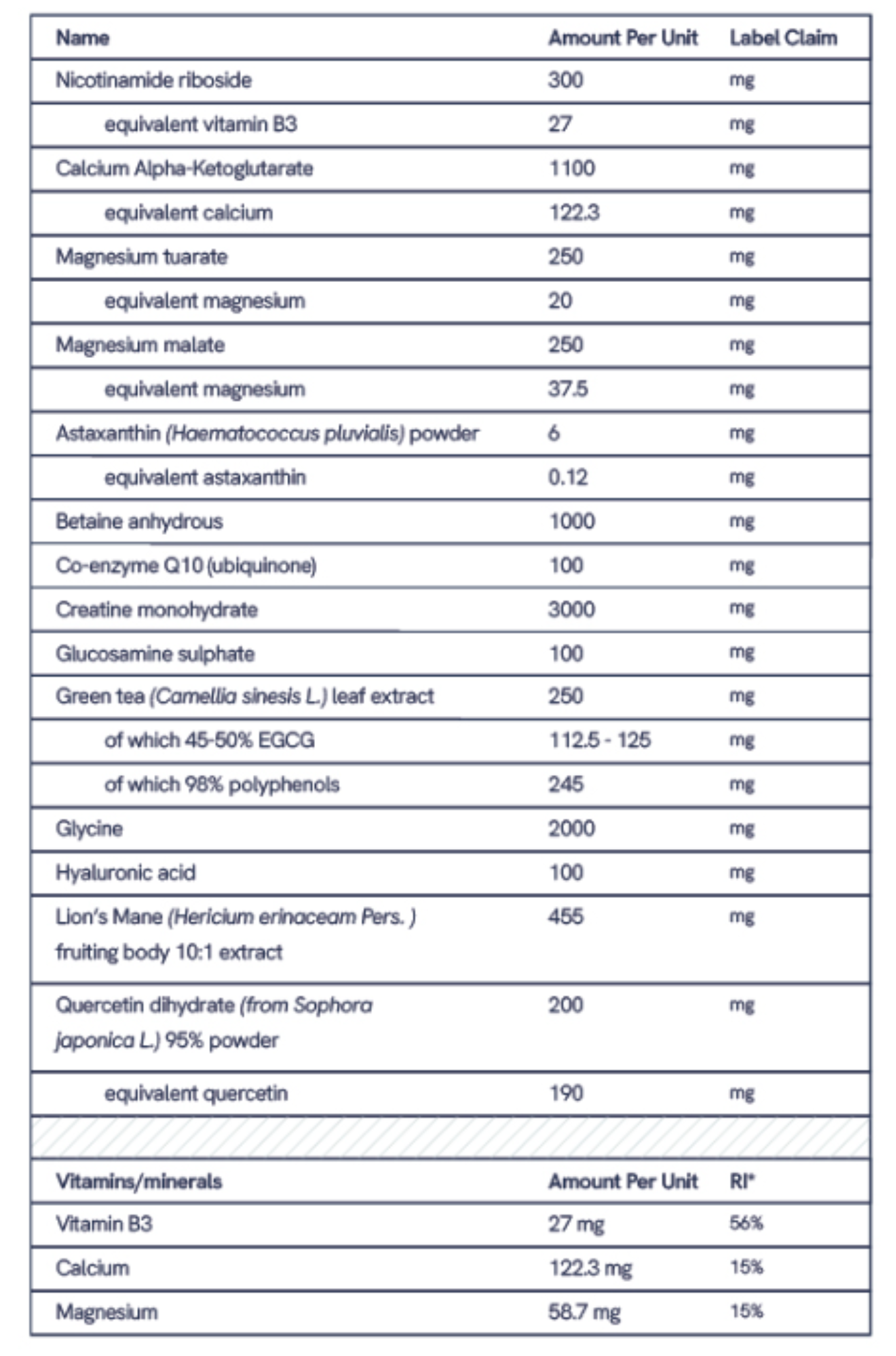
Because the stim-free ingredients with the clearest evidence are daily supplements, a daily routine is where they belong. For transparency, Longevity One contains no caffeine and no stimulant. It contains 3,000 mg of creatine monohydrate per daily serving. Creatine increases physical performance in successive bursts of short-term, high intensity exercise. It does not contain citrulline, nitrate or beta-alanine, and it is not a pre-workout. It also contains magnesium. Magnesium contributes to normal muscle function. Magnesium contributes to a reduction of tiredness and fatigue.
Q&A: Stim-Free Pre-Workout
Do stim-free pre-workouts actually work?
Some ingredients do, at the right dose. Citrulline and nitrate show small acute benefits.2,4 Beta-alanine and creatine work through daily intake rather than a single scoop.5,7
What gives you a pump without caffeine?
Citrulline and nitrate are the usual pump ingredients. Citrulline raises blood arginine and nitrate levels, but evidence that it improves muscle blood flow is scarce and inconsistent.3
How much citrulline should a stim-free pre-workout contain?
The meta-analysis included studies using at least 3 g taken at least 30 minutes before testing.2 The average pre-workout contained 4.0 g.1
Does beetroot juice work as a pre-workout?
Nitrate gave a small performance benefit across 80 studies, mainly in recreationally active men.4 Experts advise taking the final dose 2 to 4 hours before exercise, not just before.9
Why does beta-alanine make me tingle?
The tingling is called paraesthesia and is the only reported side effect.5 It is not a sign the product is working. Splitting the daily amount into doses of about 1.6 g reduces it.5
Should I take beta-alanine only on training days?
The studied approach is 4 to 6 g every day for at least 2 to 4 weeks.5 A 2.0 g serving on training days only falls short of that.1
Is creatine a stimulant?
No. Creatine supplementation raises the creatine stored in muscle and has no stimulant effect.7 It is among the few supplements with good evidence of benefit.6
Will I feel a stim-free pre-workout?
Not in the way you feel caffeine. Caffeine produces the noticeable lift11, while the stim-free ingredients have small or slow effects. The tingle from beta-alanine is the main thing most people notice.5
Is a stim-free pre-workout better for evening training?
For sleep, yes. A standard caffeinated serving would need to be taken at least 13.2 hours before bed to avoid losing sleep.12
What else gives energy for a workout without caffeine?
Music is one of the best studied aids: in a meta-analysis it improved mood, performance and perceived effort during exercise.8 Good sleep and a pre-training meal matter more than any product.
Frequently Asked Questions
Can I take stim-free pre-workout ingredients with medication?
Ask your GP or pharmacist first and bring the product label. Citrulline acts on the nitric oxide pathway, which relaxes blood vessels.3 For Longevity One, the label advises consulting your doctor if you use medication.
Does Longevity One work as a stim-free pre-workout?
No. It contains no stimulant. It contains 3,000 mg of creatine, which is studied as a daily supplement that raises the creatine stored in muscle.7 It does not contain citrulline, nitrate or beta-alanine.
What does Longevity One taste like?
It has a mango and pineapple flavour. Mix one scoop into 250 to 500 ml of water, or into a smoothie or yogurt.
Is beta-alanine safe?
The ISSN describes beta-alanine as appearing safe in healthy people at recommended doses, with tingling as the only reported side effect.5
Are stim-free pre-workouts allowed in tested sport?
The ingredients in this article are not banned, but any supplement can be contaminated. The IOC advises athletes to be aware of this risk and to trial supplements in training first.6
References
- Jagim AR, Harty PS, Camic CL. Common ingredient profiles of multi-ingredient pre-workout supplements. Nutrients. 2019;11(2):254. View on PubMed ↗
- Trexler ET, Persky AM, Ryan ED, Schwartz TA, Stoner L, Smith-Ryan AE. Acute effects of citrulline supplementation on high-intensity strength and power performance: a systematic review and meta-analysis. Sports Med. 2019;49(5):707-718. View on PubMed ↗
- Gonzalez AM, Trexler ET. Effects of citrulline supplementation on exercise performance in humans: a review of the current literature. J Strength Cond Res. 2020;34(5):1480-1495. View on PubMed ↗
- Senefeld JW, Wiggins CC, Regimbal RJ, Dominelli PB, Baker SE, Joyner MJ. Ergogenic effect of nitrate supplementation: a systematic review and meta-analysis. Med Sci Sports Exerc. 2020;52(10):2250-2261. View on PubMed ↗
- Trexler ET, Smith-Ryan AE, Stout JR, Hoffman JR, Wilborn CD, Sale C, et al. International society of sports nutrition position stand: beta-alanine. J Int Soc Sports Nutr. 2015;12:30. View on PubMed ↗
- Maughan RJ, Burke LM, Dvorak J, Larson-Meyer DE, Peeling P, Phillips SM, et al. IOC consensus statement: dietary supplements and the high-performance athlete. Br J Sports Med. 2018;52(7):439-455. View on PubMed ↗
- Kreider RB, Kalman DS, Antonio J, et al. International Society of Sports Nutrition position stand: safety and efficacy of creatine supplementation in exercise, sport, and medicine. J Int Soc Sports Nutr. 2017;14:18. View on PubMed ↗
- Terry PC, Karageorghis CI, Curran ML, Martin OV, Parsons-Smith RL. Effects of music in exercise and sport: a meta-analytic review. Psychol Bull. 2020;146(2):91-117. View on PubMed ↗
- Shannon OM, Allen JD, Bescos R, Burke L, Clifford T, Easton C, et al. Dietary inorganic nitrate as an ergogenic aid: an expert consensus derived via the modified Delphi technique. Sports Med. 2022;52(10):2537-2558. View on PubMed ↗
- Saunders B, Elliott-Sale K, Artioli GG, Swinton PA, Dolan E, Roschel H, et al. β-alanine supplementation to improve exercise capacity and performance: a systematic review and meta-analysis. Br J Sports Med. 2017;51(8):658-669. View on PubMed ↗
- Guest NS, VanDusseldorp TA, Nelson MT, Grgic J, Schoenfeld BJ, Jenkins NDM, et al. International society of sports nutrition position stand: caffeine and exercise performance. J Int Soc Sports Nutr. 2021;18(1):1. View on PubMed ↗
- Gardiner C, Weakley J, Burke LM, Roach GD, Sargent C, Maniar N, et al. The effect of caffeine on subsequent sleep: a systematic review and meta-analysis. Sleep Med Rev. 2023;69:101764. View on PubMed ↗
Disclaimer: Educational content only. Not medical advice. Food supplements should not be used as a substitute for a varied, balanced diet and a healthy lifestyle. If you use medication, consult your doctor.