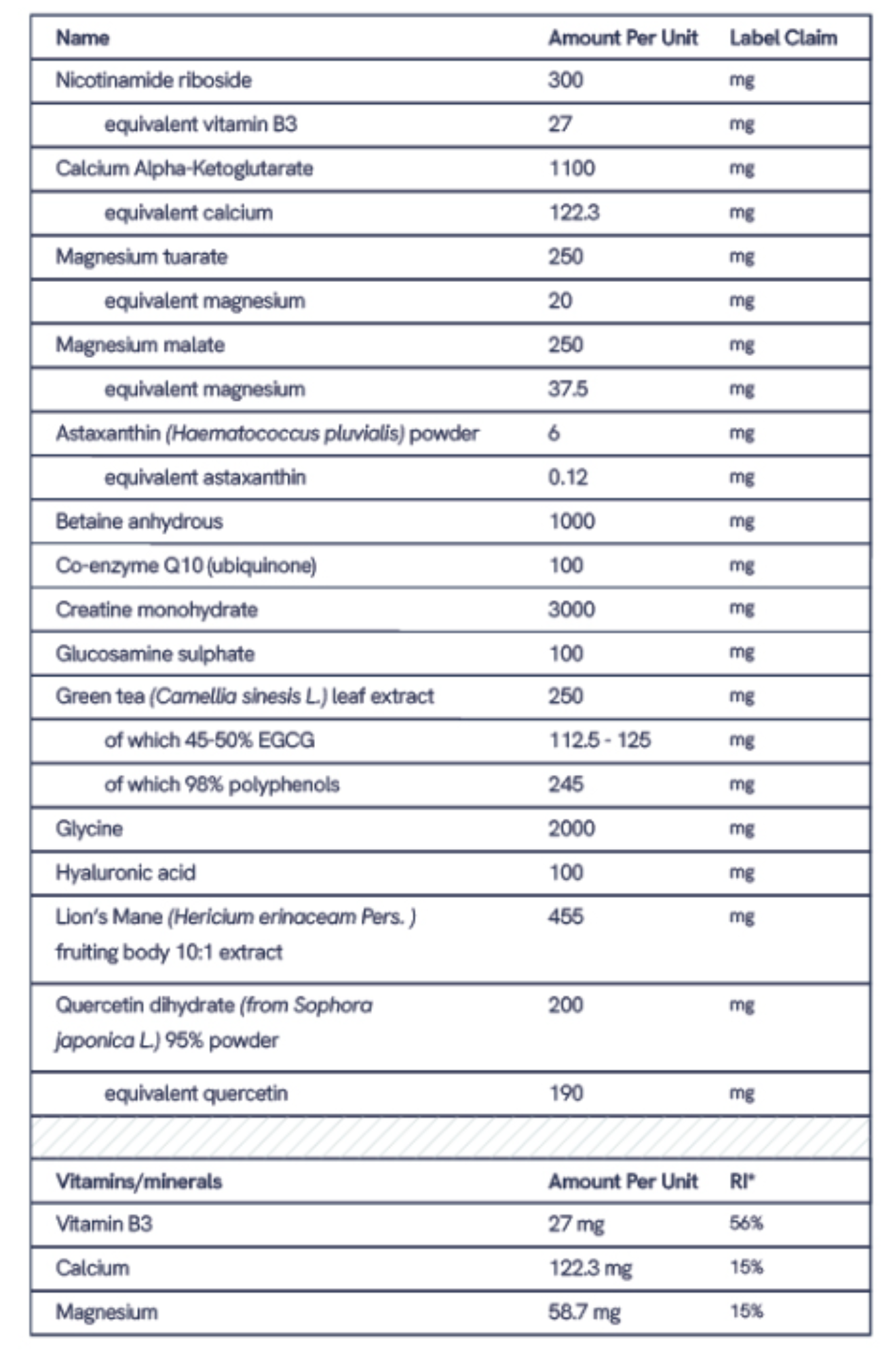
Multi-ingredient longevity formulas work by addressing multiple biological pathways simultaneously: energy production, antioxidant defence, immune support, and cellular maintenance. The strongest formulas contain ingredients with individual human evidence at studied doses, supported by regulatory-approved health claims. Understanding how these components interact, and how to evaluate the evidence behind them, is the foundation of informed supplementation decisions.
Key Takeaways
- Multi-ingredient longevity formulas are designed to support several biological pathways at once, which reflects the complexity of healthy ageing.
- The hierarchy of evidence places systematic reviews and meta-analyses of human RCTs at the highest level, followed by individual RCTs, observational studies, and preclinical data.1
- EFSA-approved health claims represent the strongest regulatory standard for ingredient credibility in Europe, and are only granted after scientific review of human evidence.
- Documented ingredient synergies exist in human research: Vitamin D and K working together has been shown to produce greater effects on bone mineral density than either nutrient alone.2
- B vitamins (B6, B12, and folate) are well established as a group for supporting normal homocysteine metabolism; human trials confirm they work more effectively in combination than individually.3
- Red flags in formula design include proprietary blends, sub-clinical dosing, absence of third-party testing, and claims that exceed the available evidence.
- Scientifically credible formulas align ingredient inclusion with EFSA-approved or otherwise well-evidenced human research, declare all doses transparently, and publish independent laboratory results.
Why Multi-Ingredient Approaches Make Sense
Healthy ageing does not depend on a single mechanism. Research in the biology of ageing identifies numerous hallmarks that contribute to the gradual functional decline observed over time: mitochondrial dysfunction, oxidative stress, nutrient sensing imbalances, immune changes, cellular senescence, and more. Each hallmark represents a distinct biological pathway, and each pathway may benefit from different nutritional inputs.
This biological complexity is one of the core scientific arguments in favour of multi-ingredient formulas. A single nutrient, however well studied, cannot simultaneously support energy metabolism, antioxidant defence, bone maintenance, and immune function. A thoughtfully designed multi-ingredient formula aims to address several of these pathways together, rather than leaving most of them without nutritional support.
There is also a practical nutritional reality underpinning this approach. Modern dietary patterns often result in inadequate intake of multiple micronutrients at once. Large population surveys across Europe and North America consistently identify widespread insufficiency in vitamin D, magnesium, zinc, folate, and several B vitamins. Addressing multiple gaps simultaneously through a well-formulated product can be both practical and efficient.
It is important to be clear about what a multi-ingredient approach cannot do: it cannot compensate for poor lifestyle foundations such as inadequate sleep, physical inactivity, or highly processed diets. Supplementation is most appropriately understood as a complement to healthy lifestyle behaviours, not a replacement for them.
What "Scientifically Backed" Actually Means
The phrase "scientifically backed" is used extensively in supplement marketing. Understanding what it genuinely means, and what it does not, is one of the most valuable tools a consumer can possess.
The Evidence Hierarchy
Not all scientific evidence is of equal quality. Medical and nutritional research is organised into a hierarchy that reflects the probability of bias and the reliability of conclusions.1 From strongest to weakest, the levels are:
Systematic reviews and meta-analyses of human RCTs: These pool data from multiple randomised controlled trials to generate the most statistically robust conclusions. They represent the highest standard of evidence.
Individual randomised controlled trials (RCTs): Participants are randomly assigned to an intervention or a control group, minimising the influence of confounding variables. Well-designed, adequately powered RCTs in human participants form the backbone of supplement evidence.
Observational studies and cohort data: These track groups of people over time and identify associations, but cannot establish causation. They are useful for generating hypotheses and providing context, but should not be the primary basis for health claims.
Animal studies and cell culture research (preclinical): These studies explore mechanisms and generate hypotheses. They are important for basic science but cannot be directly extrapolated to human health outcomes. Many compounds that show promise in preclinical research do not demonstrate the same effects in humans.
When a supplement brand states that an ingredient is "scientifically backed," the consumer should ask: backed by what type of evidence, at what dose, in what population, and for how long?
EFSA Health Claims: A Regulatory Standard
In the European Union, the European Food Safety Authority (EFSA) maintains one of the most rigorous scientific review processes for food and supplement health claims globally. For a health claim to receive EFSA approval, it must be substantiated by a body of human evidence demonstrating that the relationship between the nutrient and the claimed function is well established.
EFSA-approved claims do not emerge from single studies or from animal data. They reflect scientific consensus across a body of human research. As a result, they serve as a meaningful indicator of ingredient credibility. When a formula incorporates ingredients with EFSA-approved health claims at the stated doses, this provides a measurable standard of evidence that separates it from products relying on marketing language alone.
Examples of EFSA-approved claims relevant to longevity-oriented formulas include: Magnesium, Vitamin B1, B3, B6, B12 and Vitamin C contribute to normal energy-yielding metabolism; Vitamin D, K, Calcium, Magnesium and Zinc contribute to maintenance of normal bones; Vitamin C, D, B6, B12, Folate, Zinc and Selenium contribute to normal immune function; and Vitamin C, Zinc and Selenium contribute to protection of cells from oxidative stress.
It is important to note that EFSA approval does not mean a supplement will produce dramatic or guaranteed outcomes. These are support claims, describing the role of nutrients in maintaining normal physiological function, not claims of treating or reversing disease states.
Marketing Language vs. Scientific Evidence
Common phrases in supplement marketing that lack specific scientific meaning include: "revolutionary formula," "targets all ageing pathways," "clinically proven results," and "reverses the signs of ageing." These statements are not tied to specific human evidence and should be viewed with appropriate scepticism.
Meaningful scientific language in supplement communication includes: specific reference to the type and quantity of evidence, transparency about the populations studied, acknowledgement of limitations, and use of regulatory-approved claim language where applicable.
Ingredient Synergies: What Human Research Shows
One of the strongest arguments for multi-ingredient formulas is the existence of documented ingredient synergies in human research. Several combinations have been studied and shown to produce greater effects together than individually.
Vitamin D and Vitamin K
The relationship between Vitamin D and Vitamin K is one of the most well-studied examples of nutrient synergy relevant to healthy ageing. Vitamin D promotes the production of vitamin K-dependent proteins, including osteocalcin (involved in bone mineralisation) and matrix Gla protein (involved in regulating calcium deposition in soft tissues). These proteins require vitamin K for carboxylation to function correctly.4
A 2020 meta-analysis of eight randomised controlled trials involving 971 participants found that combined vitamin K and vitamin D supplementation significantly increased total bone mineral density compared to either nutrient alone or placebo, with a pooled effect size of 0.316 (95% CI 0.031 to 0.601). The combined group also showed significantly greater reductions in undercarboxylated osteocalcin, a marker of vitamin K activity.2
A narrative review on calcium, vitamin D, vitamin K2, and magnesium found that these four nutrients all play interconnected roles in skeletal health and that their combined presence may support bone quality in a way that no single nutrient achieves independently.5 This reflects the EFSA-approved principle that Vitamin D, K, Calcium, Magnesium and Zinc each contribute to maintenance of normal bones.
An early RCT in postmenopausal women with osteoporosis showed that combined administration of vitamin D3 and vitamin K2 produced significantly greater increases in lumbar spine bone mineral density compared to calcium alone, and significantly greater increases compared to either vitamin D or vitamin K supplemented individually.6 These data illustrate the biological rationale for including multiple bone-relevant nutrients in a single formula.
B Vitamins and Homocysteine Metabolism
Vitamins B6, B12, and folate operate within the same one-carbon metabolic pathway. All three are required for the normal metabolism of homocysteine, an amino acid that accumulates when any of these vitamins is deficient. EFSA has approved claims for each of these nutrients individually in relation to normal homocysteine metabolism.
Human research demonstrates that these vitamins function synergistically. A 2025 meta-analysis of 13 randomised controlled trials involving 14,539 participants found that combined B-vitamin supplementation (folate with vitamin B complex) significantly reduced serum homocysteine levels compared to any single-nutrient regimen, with a mean difference of -2.36 micromol/L (95% CI -3.09 to -1.62).3 This provides direct human evidence that the combination produces a greater biochemical effect than individual supplementation.
A systematic review examining the effects of vitamins B6, B12, and folate in patients with mild cognitive impairment found statistically significant reductions in homocysteine levels across all eight included studies, with a mean decline of 31.9% in intervention arms.7 The review noted that all three vitamins, not just one, were part of the most effective protocols.
It is important to be transparent about limitations here. While combined B-vitamin supplementation effectively lowers homocysteine, this does not automatically translate into reductions in clinical endpoints such as cardiovascular events. A large RCT (the WAFACS study, involving 5,442 women) found that a combination of folic acid, vitamin B6, and vitamin B12 significantly reduced homocysteine levels but did not reduce major cardiovascular events over 7.3 years of follow-up.8 This nuance is important: lowering a biomarker does not always equate to a change in health outcomes. The EFSA-approved claim for these nutrients is specifically for homocysteine metabolism, not for cardiovascular outcomes, and this distinction matters.
Vitamin C and Iron Absorption
Vitamin C enhances the absorption of non-haem iron through a well-characterised mechanism: it reduces ferric iron (Fe3+) to ferrous iron (Fe2+), the form more readily absorbed in the intestinal lumen. This interaction is relevant both for dietary planning and for supplement formulation. When iron is included in a multi-ingredient formula, or when iron-rich foods are consumed, adequate vitamin C status supports more efficient uptake. This is an established nutritional science principle included in European food safety guidance.
The Practical Implications for Formula Evaluation
Documented synergies like those described above mean that evaluating a multi-ingredient product requires looking beyond individual ingredient profiles. The question is not only whether each ingredient has evidence in isolation, but whether the combination has been considered with biological rationale. Formulas that include nutritionally complementary combinations, such as D3 with K2, or the full B vitamin triad for homocysteine metabolism, reflect a more sophisticated approach to formulation than simply assembling a list of popular ingredients.
Red Flags in Formula Design
Understanding what to avoid in multi-ingredient formulas is as valuable as knowing what to look for.
Proprietary Blends
A proprietary blend lists a group of ingredients under a collective name and declares the total weight of the blend, without disclosing the individual amount of each ingredient. This practice makes it impossible for a consumer to determine whether any single ingredient is present at a dose consistent with human research. Proprietary blends are not illegal, but they are a significant transparency concern and should be treated as a caution signal.
Sub-Clinical Dosing
Including an ingredient at a dose far below what has been studied in human trials is a common tactic for making a formula appear more comprehensive than it is. For example, including 10 mg of an ingredient when human trials have used 200-500 mg provides little more than label appeal. When evaluating a formula, compare declared doses against the dose ranges used in the referenced human studies for each ingredient.
Kitchen-Sink Formulation
Adding a very large number of ingredients, each at low doses, is sometimes used to create the impression of broad-spectrum coverage. This approach can result in a product where no single ingredient is present at a meaningful level. A formula with 30 or more ingredients, each at a trace amount, is generally less useful than one with 15 to 20 ingredients at physiologically relevant doses, each chosen with biological rationale.
Absence of Third-Party Testing
Third-party testing by an independent, accredited laboratory verifies that a product contains what its label states, at the declared dose, and is free from contamination with heavy metals, microbial agents, and residual solvents. A Certificate of Analysis (COA) from a named laboratory is the expected standard for credible supplement brands. Products that cannot or do not provide this documentation offer the consumer no basis for trusting label accuracy.
For products used by athletes or individuals subject to anti-doping regulations, certification programmes such as NZVT (doping-free certification) provide an additional layer of verification. The Longevity Store applies Eurofins laboratory testing and makes Certificates of Analysis available, reflecting a commitment to transparency as a foundational quality principle.
Claims That Exceed the Evidence
Legitimate multi-ingredient formulas use language that reflects the actual state of the science. Any product that claims to "reverse ageing," "extend lifespan," or guarantee specific clinical outcomes is making claims that are not supported by human evidence and, in most European regulatory contexts, are not permitted. The presence of such language is a reliable indicator that a brand prioritises marketing over scientific accuracy.
Q&A: The Science Behind Longevity Formulas
Are longevity mix ingredients scientifically backed?
The answer depends entirely on which ingredients and what type of evidence is cited. Some ingredients in longevity formulas have robust human evidence with regulatory-approved claims; others are supported mainly by preclinical or observational data. A credible formula will clearly distinguish between these levels. The appropriate question is not whether a formula uses a scientific-sounding name, but whether each ingredient's inclusion is supported by human RCT data at the declared dose.1
Are longevity support products scientifically proven?
Individual ingredients within well-designed longevity formulas can be backed by substantial human evidence. EFSA-approved health claims represent a regulatory confirmation of that evidence for specific nutrient-function relationships. However, "proven" is a high bar that implies certainty and universal applicability, which is rarely appropriate for nutritional supplements. The more accurate framing is that certain ingredients at appropriate doses are well supported by human research for specific physiological functions.
Are longevity science supplements backed by research?
When supplements contain ingredients with EFSA-approved claims or that have been studied in well-designed human RCTs at the included dose, the answer is yes. Vitamins D, K, C, B6, B12, folate, magnesium, zinc, calcium, and selenium all have substantial bodies of human research supporting their roles in normal physiological function. The research quality diminishes significantly for newer or more exotic compounds that rely primarily on preclinical data.1
How do longevity science supplements improve health?
Supplements designed around longevity science contribute to normal physiological function across multiple systems when they contain evidence-backed ingredients at appropriate doses. For example, ingredients such as Vitamin D, K, Calcium, and Magnesium contribute to maintenance of normal bones; B vitamins contribute to normal energy-yielding metabolism; and Vitamin C, Zinc, and Selenium contribute to protection of cells from oxidative stress. These effects reflect normal body function being supported by adequate nutrient availability, not a therapeutic intervention.
How do longevity support products work?
Multi-ingredient longevity products work by providing nutrients that support several biological pathways in parallel. Vitamins and minerals are cofactors in enzymatic reactions, structural components of cells, or regulators of gene expression. When any of these nutrients is insufficient, the associated biological pathway operates sub-optimally. A multi-ingredient formula addresses multiple potential insufficiencies simultaneously, supporting the body's own maintenance systems rather than imposing a pharmacological effect.5
Why are ingredient synergies important in a longevity formula?
Because some nutrients work together in the same biological pathway, their combined presence can produce a greater functional effect than any single nutrient achieves alone. The Vitamin D and K2 relationship in bone health is a well-documented example: K2 is required to activate the vitamin K-dependent proteins that vitamin D stimulates, and human RCT evidence confirms a synergistic effect on bone mineral density when both are supplemented together.2,4
What dose of B vitamins is needed for homocysteine metabolism?
Human studies on combined B-vitamin supplementation for homocysteine have used a range of doses. Common research protocols include 0.8 mg of folic acid, 0.5 mg of vitamin B12, and 3 mg of vitamin B6 per day, though higher doses have also been studied. The key finding from the human evidence is that combination supplementation of all three nutrients is more effective for homocysteine reduction than supplementing any single B vitamin alone.3,7
Can a longevity formula replace a balanced diet?
No. A well-designed multi-ingredient formula can help support nutritional adequacy where dietary gaps exist, but it cannot replicate the full nutritional complexity of a varied diet, nor compensate for consistently poor dietary patterns. The value of supplementation is greatest when it complements dietary foundations rather than replacing them. This is consistent with the principle that supplements are designed to supplement, not substitute, a healthy lifestyle.
What is the difference between EFSA-approved claims and other health claims?
EFSA-approved health claims have been reviewed by the European Food Safety Authority, which evaluates the totality of human evidence for the specific relationship between a nutrient and a physiological function. Other health claims, including those found in product marketing, may be based on preliminary, preclinical, or cherry-picked data. The distinction matters significantly for consumers: EFSA approval indicates regulatory-level scientific consensus, while broader marketing claims may have no formal verification.1
How should I evaluate a longevity formula before buying?
A structured evaluation should include: checking whether each ingredient has human research at the listed dose; verifying that all individual ingredient doses are disclosed (no proprietary blends); confirming that third-party testing is available and a Certificate of Analysis can be accessed; reviewing whether health claims are within regulatory bounds; and checking whether the brand's scientific communication acknowledges uncertainty and limitations rather than guaranteeing results. These criteria collectively separate evidence-led formulas from marketing-led ones.
FAQ
What makes a longevity formula scientifically credible?
A scientifically credible longevity formula includes ingredients with human evidence at the declared dose, uses EFSA-approved claim language where applicable, discloses all individual ingredient amounts, and supports its claims with third-party testing documentation. The strength of evidence behind each ingredient should be clearly communicated, with appropriate acknowledgement of what is established versus what is still being studied.1
Why do longevity formulas contain so many ingredients?
Healthy ageing involves multiple biological pathways, and individual nutrients support specific aspects of normal physiological function. A well-designed formula includes each ingredient because it contributes to a particular pathway, not simply to add label appeal. The best formulas balance comprehensive coverage with meaningful doses, ensuring no single ingredient is included at a token level.
Do vitamins D and K really work better together?
Human research suggests they do for bone health outcomes. A meta-analysis of eight RCTs (971 participants) found that combined vitamin D and K supplementation produced significantly greater increases in bone mineral density than either nutrient alone.2 This reflects their connected roles in calcium metabolism: vitamin D promotes calcium absorption, while vitamin K activates the proteins that direct calcium into bone tissue.
What is a Certificate of Analysis and why does it matter?
A Certificate of Analysis (COA) is a document from an accredited independent laboratory confirming that a product contains what its label states at the declared dose, and that it is free from contaminants including heavy metals, microbial agents, and residual solvents. It is the primary tool for verifying that a supplement's quality matches its marketing. Credible brands make COAs available to customers on request or proactively on their website.
How is EFSA different from other health claim approval bodies?
EFSA is the European Food Safety Authority, which conducts rigorous scientific reviews of health claims for foods and supplements sold in the EU. Its evaluation process examines the totality of human evidence, not selected studies, before approving a claim. Approved claims represent the European regulatory standard for evidence-based nutrition communication. Products using EFSA-approved language are operating within one of the most rigorous regulatory frameworks globally.
Is a longer ingredient list always better in a longevity formula?
No. A longer ingredient list does not automatically indicate greater efficacy. A formula with many ingredients at low, sub-clinical doses provides limited support compared to one with fewer ingredients, each included at a dose consistent with human research. Quality of formulation is determined by the evidence behind each ingredient and the transparency of dosing, not by the volume of ingredients on the label.
References
- Bhatt DL, et al. Hierarchy of evidence within the medical literature. Hosp Pediatr. 2022;12(9):e298-e301. View on PubMed ↗
- Jiang Y, et al. The combination effect of vitamin K and vitamin D on human bone quality: a meta-analysis of randomized controlled trials. Food Funct. 2020;11(4):3281-3297. View on PubMed ↗
- Wu Y, et al. Combined B-vitamin supplementation on homocysteine and vascular outcomes in coronary heart disease: a meta-analysis. Cardiovasc Ther. 2025. View on PubMed ↗
- van Ballegooijen AJ, et al. The synergistic interplay between vitamins D and K for bone and cardiovascular health: a narrative review. Int J Endocrinol. 2017;2017:7454376. View on PubMed ↗
- Rizzoli R, et al. Calcium, vitamin D, vitamin K2, and magnesium supplementation and skeletal health. Maturitas. 2021;143:38-39. View on PubMed ↗
- Iwamoto J, et al. Effect of combined administration of vitamin D3 and vitamin K2 on bone mineral density of the lumbar spine in postmenopausal women with osteoporosis. J Orthop Sci. 2000;5(6):546-551. View on PubMed ↗
- Burckhardt M, et al. Impact of supplementation with vitamins B6, B12, and/or folic acid on the reduction of homocysteine levels in patients with mild cognitive impairment: a systematic review. Nutr Neurosci. 2021;24(12):943-956. View on PubMed ↗
- Albert CM, et al. Effect of folic acid and B vitamins on risk of cardiovascular events and total mortality among women at high risk for cardiovascular disease: a randomized trial. JAMA. 2008;299(17):2027-2036. View on PubMed ↗