Choosing a longevity supplement requires evaluating five factors: the quality of evidence behind each ingredient, dosage transparency, independent third-party testing, a clean and minimal formulation, and marketing claims that comply with regulatory standards. Understanding each of these criteria allows you to assess any product objectively, regardless of its branding or price point.
Key Takeaways
- Human clinical evidence -- ideally from randomised controlled trials, systematic reviews, or meta-analyses -- provides a more reliable foundation for ingredient selection than animal or cell-based studies alone.1
- Proprietary blends, which conceal individual ingredient amounts, make it impossible to verify whether a product contains each ingredient at a dose that has actually been studied in humans.2
- Independent laboratory testing through a Certificate of Analysis (COA) confirms that a supplement contains what its label states, at the declared quantity, and without harmful contaminants.3
- Studies have found that a substantial proportion of supplement products contain mislabelled or undisclosed ingredients, making third-party verification a critical consumer safeguard.4
- Regulatory frameworks such as EFSA in Europe define precise, approved health claim language. Products that exceed this language with disease claims or guaranteed outcomes are making non-compliant marketing statements.
- The presence of unnecessary fillers, artificial colours, or undeclared allergens in a product's "other ingredients" section signals lower formulation standards.
- A practical checklist approach -- covering evidence, dosing, testing, labelling, and claims -- can be applied consistently to evaluate any longevity supplement before purchase.
Why a Framework Matters Before You Buy
The longevity supplement market has expanded rapidly over the past decade. With growth comes diversity -- some products are formulated around strong human clinical evidence and transparent manufacturing practices; others rely on preclinical data, proprietary blends that hide ingredient doses, and marketing language that implies far more than the science currently supports.
Navigating this landscape without a clear evaluation framework can lead to unnecessary expenditure on products that either do not contain ingredients at studied doses, have not been independently tested for purity, or make claims that exceed what regulators permit. This guide provides a five-step, science-based framework for assessing any longevity supplement or formula, applicable whether you are evaluating a powder blend, capsule formula, or drink mix.
Step 1: Check the Evidence Behind Each Ingredient
The first question to ask about any supplement ingredient is: what type of evidence supports its inclusion, and in what population was it studied?
Understanding the Evidence Hierarchy
Not all scientific evidence is equal. In nutrition and supplement science, the most reliable evidence comes from human clinical trials, particularly randomised controlled trials (RCTs), systematic reviews, and meta-analyses. These study designs are specifically intended to establish whether an intervention produces a measurable effect in humans, while controlling for other variables.
Animal studies and cell culture (in vitro) studies provide mechanistic context -- they help researchers understand biological pathways -- but they do not confirm that the same effects occur in humans at supplemental doses. A supplement ingredient may have extensive animal or cell data without a single human trial confirming an equivalent effect. Always ask: has this been studied in people, at the dose used in this product?1
Where to Verify
PubMed (pubmed.ncbi.nlm.nih.gov) is the world's largest freely accessible database of peer-reviewed biomedical research. Searching an ingredient name alongside terms such as "randomised controlled trial" or "human" filters toward the most directly applicable evidence. European Food Safety Authority (EFSA) opinion documents are also publicly available and detail the scientific basis for each approved or rejected health claim.
Red Flags in Marketing Language
Phrases such as "clinically proven," "scientifically backed," and "shown to reverse ageing" are frequently used in supplement marketing without specific citation. True evidence-based communication references the actual study design, population, dose, and outcome measured. Be cautious of brands that cite only animal or in vitro research as primary evidence for a supplement benefit, or that do not cite sources at all.
Equally, an ingredient's biological plausibility -- meaning there is a sensible reason why it might have an effect in the body -- is not the same as demonstrated efficacy in humans. Strong biological rationale is a necessary starting point for research interest, not a substitute for human evidence.
Step 2: Verify Third-Party Testing and Quality Transparency
Manufacturing quality and ingredient testing are as important as the ingredient list itself. A product is only as valuable as its actual contents, and these may differ substantially from what appears on the label.
What a Certificate of Analysis Confirms
A Certificate of Analysis (COA) is a document issued by an independent, accredited laboratory confirming the results of testing on a specific product batch. A comprehensive COA covers four areas: identity (the ingredient is what it claims to be), potency (the declared amount is present within an acceptable tolerance range), purity (no undeclared substances), and contaminant screening (testing for heavy metals such as lead, cadmium, mercury, and arsenic; microbial contamination such as E. coli and Salmonella; and solvent residues from manufacturing).3
Research published in JAMA Network Open analysed supplement products marketed for immune support and found that labelling was frequently inaccurate, with quality control measures appearing insufficient for a significant proportion of products.3 A separate analysis of weight-loss dietary supplements found that 80% of products had ingredients listed on the label that were not detected in laboratory testing, meaning their labels were misbranded.4
These findings highlight a structural issue with the supplement category: unlike pharmaceutical products, supplements in most countries are not required to demonstrate identity or potency before reaching retail sale. Independent testing by the brand, and ideally by a second party, provides an important additional quality layer.
Key Certification Bodies and What They Cover
Several third-party certification programmes exist for dietary supplements. Eurofins is an internationally accredited analytical laboratory that performs identity, potency, and contaminant testing. NSF International offers certification that covers label claim verification, contaminant screening, and Good Manufacturing Practice (GMP) compliance. USP Verified covers label accuracy and contaminant limits. NZVT (New Zealand Veterinary Testing) provides doping-free certification specifically relevant for athletes and those tested under anti-doping programmes.
No single certification covers everything, and organisations differ in scope. A brand that publishes COAs from an accredited laboratory for each batch provides a meaningful level of transparency. Requesting access to this documentation before purchasing is a reasonable step for a discerning consumer.
The Longevity Store Approach
Longevity Complete is tested by Eurofins, an internationally accredited analytical laboratory, with batch-level COAs available on request. The product also holds NZVT doping-free certification, relevant for athletes and those subject to testing. These quality measures reflect a formulation philosophy built on ingredient transparency and independent verification, rather than brand self-reporting alone.
Step 3: Evaluate Dosage and Ingredient Form
Confirming that an ingredient appears on a label is necessary but not sufficient. The dose at which an ingredient has been studied in humans, and the specific form used, are equally relevant considerations.
Clinically Studied Doses vs. Pixie-Dusting
"Pixie-dusting" is an informal term within the supplement industry for including an ingredient at a dose far below the quantity studied in clinical trials, purely to justify its presence on the label. The ingredient name appears, but at an amount unlikely to produce the effects observed in research. Without label transparency -- including exact milligram amounts per serving for every ingredient -- consumers cannot verify whether the doses present align with human evidence.
An analysis of 100 top-selling pre-workout supplements found that 44.3% of all ingredients were included as part of proprietary blends with undisclosed amounts. Of the ingredients that did list amounts, several were on average below the doses shown to be effective in human studies. The researchers concluded that it may be in the consumer's best interest to select products that disclose all ingredient amounts and contain dosages that correspond to those used in the relevant research.2
Proprietary Blends and Transparency
A proprietary blend groups multiple ingredients under a single collective name and discloses only the total combined weight, not the individual amounts of each component. From a regulatory standpoint in most markets, this is permissible. From an evidence-assessment standpoint, it makes meaningful evaluation impossible: a consumer cannot determine whether any individual ingredient is present at a dose studied in humans, or at a token amount.5
Full-label transparency -- where every ingredient is listed with its exact amount per serving -- is the standard that allows consumers and researchers to meaningfully compare a product's formulation against the clinical evidence base.
Bioavailability and Form Matters
Not all forms of a given ingredient are absorbed equally. Magnesium glycinate, for example, has demonstrated superior tolerability and bioavailability compared to magnesium oxide in some human studies. Ubiquinol (the reduced form of CoQ10) has shown higher blood levels following oral supplementation compared to ubiquinone in certain populations. When evaluating a longevity formula, checking not just the ingredient name but the specific chemical form used, and whether that form matches the form studied in trials, provides a more complete picture of potential value.
Step 4: Read the Full Label Carefully
The supplement facts panel is only part of the label information relevant to quality evaluation. The "other ingredients" section, often printed in small text, can reveal important details about formulation philosophy.
What to Look for in Other Ingredients
Other ingredients typically include excipients: substances added during manufacturing to aid production, stability, or delivery. Some excipients serve a legitimate functional purpose -- for example, microcrystalline cellulose as a bulking agent in capsules, or silicon dioxide as an anti-caking agent in powders. Others serve primarily aesthetic functions, such as artificial colours or flavourings, which add no nutritional value.
A quality-focused formulation will use the minimum number of excipients necessary for stability and delivery, will avoid artificial colours and sweeteners where possible, and will clearly declare any common allergens such as gluten, soy, dairy, and nuts. The label should also state the country of manufacture and whether production occurs in a GMP-certified facility.
GMP Certification
Good Manufacturing Practice (GMP) certification means that a manufacturing facility follows standardised quality systems for production, including consistent procedures, equipment validation, personnel training, and batch record-keeping. GMP certification does not guarantee the contents of a product, but it does confirm that a quality system is in place. Look for products that clearly state GMP-compliant manufacturing, ideally verified by a recognised certification body.
Step 5: Assess Claims and Marketing Language
The language a brand uses to describe its product reveals a great deal about its scientific and regulatory integrity. In Europe, the European Food Safety Authority (EFSA) maintains a register of approved health claims for food and supplement products. A claim may only appear on a product if EFSA has assessed the submitted scientific evidence and determined it to be sufficient for that specific ingredient-function relationship, at the studied dose, in a defined population.
What EFSA-Approved Claims Look Like
EFSA-approved claims use specific, measured language. For example: "Magnesium contributes to normal energy-yielding metabolism." Or: "Vitamin D contributes to the normal function of the immune system." These claims are precise, relate to a specific nutrient function, and do not imply disease prevention or treatment. They represent the language that regulators have determined to be supported by the available human evidence for that ingredient.
Examples of EFSA-approved claims relevant to longevity-focused formulas include:
For energy and fatigue: Magnesium, Vitamin B1, B3, B6, B12, and Vitamin C contribute to normal energy-yielding metabolism. Magnesium, Vitamin B6, and B12 help reduce tiredness and fatigue.
For immune function: Vitamin C, D, B6, B12, Folate, Zinc, and Selenium contribute to normal immune function.
For muscle and bone: Calcium and Magnesium contribute to normal muscle function. Vitamin D, K, Calcium, Magnesium, and Zinc contribute to maintenance of normal bones.
For cognitive function: Magnesium, Vitamin B1, B3, B6, B12, Biotin, and Vitamin C contribute to normal psychological and nervous system function. Zinc contributes to normal cognitive function.
These claims represent the ceiling of what can be stated about these ingredients under current European regulation. Anything beyond this language -- such as claims that a product reverses cognitive decline, treats fatigue disorders, or prevents bone disease -- exceeds the regulatory standard and enters the domain of medicinal claims, which supplements are not permitted to make.
Red Flag Phrases to Watch For
The following types of language in supplement marketing should prompt closer scrutiny. "Reverses ageing" or "anti-ageing" used as a direct outcome claim. "Clinically proven to [specific health outcome]" without citation of the actual study. "Fights," "beats," "cures," or "eliminates" any named condition. "Used by thousands with guaranteed results." "Replaces your medication." None of these phrases are consistent with either the evidence base for supplements or the regulatory framework that governs their marketing.
Brands that use calm, qualified language -- "has been studied for," "is associated with," "contributes to," "plays a role in" -- are communicating within the boundaries of what current science supports, rather than overstating certainty for commercial effect.
A Practical Checklist for Your Next Purchase
The following ten-point checklist summarises the five steps above into a practical tool you can apply before making any longevity supplement purchase.
1. Human evidence exists for each ingredient. The key ingredients have been studied in human trials, not only in animals or cell cultures.
2. The evidence type is appropriate. RCTs, systematic reviews, or meta-analyses are cited or available on PubMed. Observational studies and preclinical data are contextualised, not presented as proof of effect.
3. Individual ingredient amounts are disclosed. Every ingredient lists its exact amount per serving. No proprietary blend conceals individual doses.2
4. Doses align with human research. The amounts used in the product correspond to the doses studied in the referenced human trials, or the brand provides a clear rationale for any difference.
5. A Certificate of Analysis is available. The brand can provide or publicly discloses batch-level COA data from an accredited, independent laboratory.3
6. Contaminant testing is confirmed. The COA includes results for heavy metals (lead, cadmium, mercury, arsenic), microbial limits, and where relevant, solvent residues.
7. The "other ingredients" are minimal and declared. Excipients are functional and necessary. No artificial colours, undeclared allergens, or unnecessary additives are present.
8. GMP/IFS manufacturing is confirmed. The product is manufactured in a facility with verifiable GMP/IFS certification.
9. All claims comply with regulatory standards. Health claims use EFSA-approved (or equivalent) language. No disease claims, guaranteed outcomes, or language that implies medical use appears anywhere on the product or in brand communications.
10. The brand is transparent and contactable. Full company and manufacturer information is available. Requests for COA documentation or sourcing information receive a clear, documented response.
Common Pitfalls When Evaluating Longevity Supplements
Beyond the five steps above, several specific evaluation traps are worth naming directly.
Conflating ingredient presence with effective dosing. A formula may contain a well-studied ingredient at a fraction of the dose used in clinical trials. This is technically truthful labelling but may not reflect the evidence for that ingredient. Always compare the per-serving amount to the dose range studied in humans.
Treating brand authority as a substitute for evidence. Premium pricing, extensive advertising spend, endorsements from public figures, and a large social media following are not scientific evidence. Evaluate the ingredient evidence and testing documentation independently of brand reputation.
Assuming "natural" means safe. Plant-derived, botanical, and "all-natural" supplements can carry risks of heavy metal contamination, herb-drug interactions, or adulteration with undeclared substances. A 2019 study on dietary supplements in UAE markets found heavy metal contamination in a proportion of products tested, highlighting that "natural" origin does not eliminate contaminant risk.6 Third-party contaminant testing applies equally to botanical and synthetic ingredients.
Overweighting anecdotal reports. Individual testimonials and online reviews describe personal experience, not controlled outcomes. Positive subjective reports are consistent with placebo response, expectation effects, lifestyle changes occurring concurrently with supplementation, or genuine ingredient effects -- it is not possible to determine which from a testimonial alone.
Accepting preclinical data as equivalent to human evidence. A substantial proportion of supplement claims that reference "studies" or "research" are drawing on animal or cell culture work. This is not inherently dishonest -- preclinical research is scientifically valuable -- but it should be clearly labelled as such and should not substitute for human clinical evidence in consumer-facing claims.1
How Longevity Complete Reflects These Principles
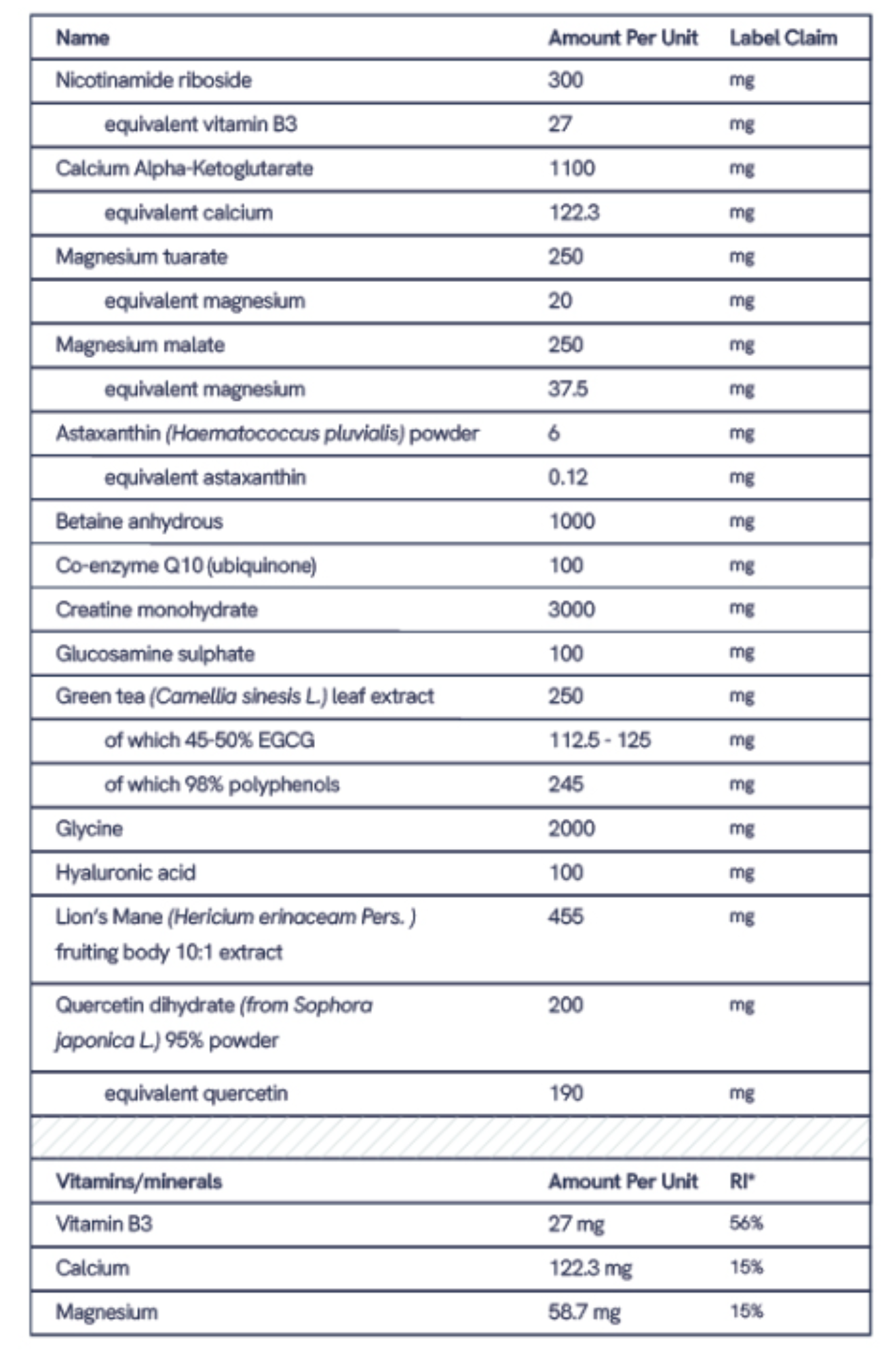
Longevity Complete is formulated around ingredients with established EFSA-approved claims, each included at transparently declared amounts. The product discloses all ingredient quantities per serving, with no proprietary blends. Batch-level COA documentation from Eurofins is available, and the formulation holds NZVT doping-free certification. These features are consistent with the evidence, dosing, testing, and transparency criteria outlined in this guide.
The approved claims relevant to Longevity Complete's formulation include: Magnesium, Vitamin B1, B3, B6, B12, and Vitamin C contribute to normal energy-yielding metabolism; Magnesium, Vitamin B6, and B12 help reduce tiredness and fatigue; Vitamin D, Calcium, Magnesium, and Zinc contribute to maintenance of normal bones; Vitamin C, D, B6, B12, Folate, Zinc, and Selenium contribute to normal immune function; and Zinc contributes to normal cognitive function.
This product mention is provided as a contextual example of how the five evaluation criteria described in this guide translate to a real formulation, not as a claim of superiority over any other product.
Q&A: Choosing a Longevity Supplement
What type of research should I look for when evaluating a supplement ingredient?
Prioritise human clinical evidence: randomised controlled trials, systematic reviews, and meta-analyses. These designs are specifically built to determine whether an ingredient produces an effect in people, while controlling for other variables. Animal studies and cell-based research provide useful mechanistic background but are not a substitute for human evidence when assessing a supplement benefit.1
Why does it matter whether ingredient doses are disclosed on the label?
Without exact per-serving amounts for each ingredient, it is impossible to verify whether any component is present at a dose studied in human trials. Research has documented that a high proportion of multi-ingredient supplement products include ingredients in proprietary blends with undisclosed amounts, making evidence comparison impossible.2 Full label transparency is a precondition for meaningful evaluation.
What is a Certificate of Analysis and why should I care about it?
A COA is an independent laboratory report confirming that a specific product batch contains what its label states, at the declared quantity, and without harmful contaminants. It typically covers identity, potency, heavy metal levels, and microbial testing. Given published evidence of widespread mislabelling in the supplement industry, COA availability from an accredited laboratory is a meaningful quality indicator.3
What does EFSA approval mean for a supplement health claim?
EFSA approval means that the European Food Safety Authority has reviewed the submitted scientific evidence for a specific ingredient-function relationship and determined it sufficient to support a precisely worded health claim. Claims must use EFSA-approved language exactly. Claims that go beyond this wording -- particularly those involving disease names, reversal of biological decline, or guaranteed outcomes -- are not EFSA-compliant and should be treated with caution.
What are proprietary blends, and why are they a concern?
A proprietary blend lists multiple ingredients under a collective name with only the total combined weight disclosed. Individual ingredient amounts are not revealed. This makes it impossible to assess whether any single ingredient is present at a dose studied in human trials, raising questions about whether the product delivers what its marketing implies.5
Are "natural" supplements automatically safer or better?
Not necessarily. "Natural" origin does not eliminate contaminant risk or guarantee efficacy. Botanical and plant-based supplements can carry risks of heavy metal contamination, particularly where raw materials are sourced from regions with high soil metal content.6 Independent third-party testing applies equally to all supplement types regardless of their ingredient origin.
How do I know if a supplement claim is compliant with regulations?
Compliant claim language in Europe stays within EFSA-approved wording for each specific ingredient, uses qualified terms such as "contributes to," "supports," or "is associated with," and never references named diseases or guaranteed outcomes. Claims that include terms such as "reverses," "cures," "prevents," or "treats" in relation to a health condition exceed the regulatory framework for supplements and should raise questions about the brand's overall communication standards.
Does GMP certification guarantee product quality?
GMP certification confirms that a manufacturing facility follows standardised quality systems -- consistent procedures, equipment validation, personnel training, and batch records. It is an important indicator of production rigour, but it does not independently verify that a finished product matches its label. Third-party testing of the finished product, with a COA, provides additional independent verification of actual contents.3
What should I look for in the "other ingredients" section of a supplement label?
Look for functional excipients that serve a clear manufacturing purpose, with minimal use of artificial colours, flavourings, or additives that provide no nutritional benefit. Common allergens (gluten, soy, dairy, shellfish) should be clearly declared. A shorter "other ingredients" list with recognisable, functional substances generally indicates a more carefully considered formulation approach.
How do I compare two longevity supplements that list similar ingredients?
Compare on four dimensions: exact ingredient amounts per serving versus researched doses, form of each ingredient (bioavailability differences matter), third-party testing documentation availability, and compliance of marketing claims with EFSA or equivalent regulatory standards. A product with transparent dosing, independently tested contents, and regulatory-compliant claims provides a more verifiable quality baseline than one relying solely on brand marketing.
Is it worth paying more for a premium longevity supplement?
Price does not reliably indicate quality. The evaluation criteria in this guide -- human evidence, dose transparency, COA testing, clean formulation, compliant claims -- are the indicators that matter. A premium-priced product without COA documentation or with proprietary blends does not offer more assurance than a modestly priced product that meets all five criteria transparently.
What does "pixie-dusting" mean and how do I identify it?
Pixie-dusting refers to including an ingredient at a dose far below what has been studied in human trials, purely to justify its presence on the label. The clearest way to identify it is to compare the per-serving amount on the label to the dose range used in relevant human RCTs. Where label amounts are not disclosed at all (proprietary blends), identifying pixie-dusting is not possible, which is itself a reason to prefer full-transparency products.2
Frequently Asked Questions
How do I choose the best longevity supplement?
Evaluate five factors in sequence: the quality of human evidence for each ingredient, whether individual doses are disclosed and align with clinical research, whether the product is independently tested with a Certificate of Analysis, whether the formulation is clean with minimal unnecessary additives, and whether all health claims comply with regulatory standards such as EFSA. No single factor is sufficient alone -- a combination of all five provides the most complete picture.3
How do I find reliable longevity formulas?
Look for formulas where every ingredient lists an exact per-serving amount, where that amount is traceable to human clinical research, and where the brand provides access to a Certificate of Analysis from an accredited independent laboratory. Brands that publish their COAs, name their testing laboratory, and use only EFSA-approved or equivalent health claim language are demonstrating a commitment to transparency that distinguishes them from marketing-led competitors.4
How do I find high-quality longevity stacks?
High-quality stacks disclose all ingredient amounts, match those amounts to studied human doses, and have been tested by an independent laboratory. Avoid stacks that use proprietary blends for multi-ingredient combinations, as these prevent verification of individual doses.2 NZVT, Eurofins, NSF International, or USP Verified certification provides additional verification layers beyond brand self-reporting.
How do I choose a longevity superfood blend or drink mix?
Apply the same evaluation criteria as for any supplement: evidence basis, dose transparency, third-party testing, clean formulation, and compliant claims. Powdered blends and drink mixes face the same quality variation as capsule products. Confirm that all ingredients list individual amounts, that a COA is available for the specific formulation, and that the product does not contain undisclosed allergens or excessive artificial additives.
How do I find the best longevity support product for my needs?
Begin by identifying your specific goals -- for example, supporting energy metabolism, immune function, or muscle maintenance -- and then look for products that include ingredients with EFSA-approved claims for those specific functions. Cross-reference the per-serving amounts against human research, confirm third-party testing, and consult a healthcare professional if you have existing health conditions or take medications.
What makes a longevity drink mix high-quality?
High-quality drink mixes list all ingredient amounts individually, use ingredients backed by human clinical evidence at studied doses, provide independent COA testing documentation, avoid proprietary blends, and use only EFSA-compliant health claim language.3 The presence of unnecessary artificial colours, flavours, or undeclared allergens is a signal of lower formulation standards.
References
- Harty PS, Zabriskie HA, Erickson JL, Molling PE, Kerksick CM, Jagim AR. Multi-ingredient pre-workout supplements, safety implications, and performance outcomes: a brief review. J Int Soc Sports Nutr. 2018;15(1):41. doi:10.1186/s12970-018-0247-6. View on PubMed ↗
- Jagim AR, Harty PS, Camic CL. Common ingredient profiles of multi-ingredient pre-workout supplements. Nutrients. 2019;11(2):254. doi:10.3390/nu11020254. View on PubMed ↗
- Crawford C, Avula B, Lindsey AT, Walter A, Katragunta K, Khan IA, Deuster PA. Analysis of select dietary supplement products marketed to support or boost the immune system. JAMA Netw Open. 2022;5(8):e2226040. doi:10.1001/jamanetworkopen.2022.26040. View on PubMed ↗
- Crawford C, Lindsey AT, Avula B, Katragunta K, Khan IA, Deuster PA. Label accuracy of weight loss dietary supplements marketed online with military discounts. Nutrients. 2024;16(10):1431. doi:10.3390/nu16101431. View on PubMed ↗
- Dwyer JT, Saldanha LG. Perspectives on the use of proprietary blends in dietary supplements. J Acad Nutr Diet. 2023;123(7):e1. doi:10.1016/j.jand.2023.03.016. View on PubMed ↗
- Abdulla NM, Adam B, Blair I, Oulhaj A. Heavy metal contamination of dietary supplements products available in the UAE markets and the associated risk. BMC Complement Altern Med. 2019;19(1):276. doi:10.1186/s12906-019-2693-3. View on PubMed ↗