No. Human trials of oxygenated water found no effect on oxygen uptake, blood lactate or endurance, and breathing pure oxygen from a mask between bouts of exercise did not speed recovery. We found no human trials of oxygen pills for tiredness. In healthy people, blood oxygen is already near its maximum, so tiredness usually has other causes, such as sleep, iron or activity.
Key Takeaways
- In a double-blind crossover trial, 20 men who drank 1.5 litres of oxygenated water a day for two weeks showed no change in aerobic capacity or lactate.1
- A dose of superoxygenated water before cycling did not change blood oxygen, lactate or time-trial performance in 11 active men.2
- Breathing 100% oxygen during short recovery periods did not improve recovery or the next bout of exercise in two controlled trials with athletes.3,4
- In a study of sprinters, haemoglobin oxygen saturation was already about 95% before exercise and dropped only during very intense intervals.5
- Breathing oxygen-enriched air during exercise in a laboratory does improve performance, which is a different situation from a few breaths from a can at rest.6
- Low iron stores are a testable reason for tiredness: in adults with low stores but normal haemoglobin, iron was linked with lower self-reported fatigue. Iron should be tested first, with your GP.7
A bottle of water promises "up to ten times more oxygen". A small can of oxygen is sold for a mid-afternoon pick-me-up. Drops and capsules claim to deliver "stabilised oxygen" to tired cells. For a label reader, the fair question is whether you can drink, swallow or sniff your way to more energy. This article checks each product against human studies and explains how oxygen actually reaches your cells. Then it points to what does make a difference.
How does oxygen reach your cells?
Oxygen enters your body through your lungs, not your stomach. In the lungs, oxygen binds to haemoglobin, the iron-containing protein in red blood cells, which picks it up as blood passes through the lungs and releases it as blood circulates through the tissues.8 Inside cells, at the last step of energy production in the mitochondria, low-energy electrons are combined with oxygen to make water, which allows the cell to make most of its ATP.8 That review, of vitamins and minerals in energy and fatigue, was written mainly by employees of a pharmaceutical company.
In healthy people at sea level, this system is already close to full. In a study of sprinters, haemoglobin oxygen saturation measured from fingertip blood was about 95% before exercise. It dropped to about 89% only during very intense repeated running, and breathing oxygen-enriched air kept it at about 96%.5 In other words, at rest and in everyday activity, there is very little room to load more oxygen into the blood. The limit is usually how much blood and haemoglobin you have, how well your heart pumps and how fit your muscles are. The amount of oxygen in the air is rarely the limit.
Does oxygenated water give you energy?
What the trials found
Oxygenated water has been tested in at least two controlled human trials. In the first, 20 healthy young men took part in a double-blind crossover study. For two weeks, they drank 1.5 litres a day of either highly oxygenated water or ordinary water from the same spring, then switched after a two-week washout. Exhausting cycle tests showed no significant effect on aerobic measures or lactate metabolism at submaximal or maximal effort.1 The authors concluded that oxygenated water does not enhance aerobic performance or lactate kinetics.1
In the second, 11 active men drank 15 ml of superoxygenated water or a placebo drink 30 minutes before 45 minutes of steady cycling and a 15-minute time trial, in a randomised, double-blind design. There were no differences in oxygen uptake, blood oxygen, blood lactate or heart rate, and the distance covered in the time trial was the same (9.01 km with placebo, 8.96 km with the oxygenated water).2
Why it does not work
In a short expert commentary, an opinion piece rather than a study, a physiologist concluded that claims for oxygenated water improving exercise "cannot be taken seriously".9 The two trials above are the evidence, and they point the same way.1,2 The body's route for oxygen is the lungs, where haemoglobin picks it up as blood passes through.8 Drinking water is good for you, but in these trials adding oxygen to it did not add energy.
Does canned oxygen help with tiredness?
Trials in athletes
Canned and bottled oxygen are often sold for recovery, and the idea comes from the sidelines of professional sport. It has been tested. In a randomised, double-blind trial, 12 professional football players did two bouts of exhausting exercise separated by five minutes of rest, breathing either room air or 100% oxygen during the rest. Oxygen had no effect on blood lactate or on performance in the second bout, and the players could not tell which gas they had received.3
In a second study, 13 male athletes did two five-minute efforts and then a run to exhaustion, with four-minute recovery periods in which they breathed room air, 100% oxygen, or oxygen for two minutes followed by air. Breathing oxygen did not change how quickly breathing and heart rate recovered, did not improve the final effort and did not change how hard the exercise felt.4
Where oxygen does make a difference
The picture is different when people breathe oxygen-enriched air throughout exercise, through a mask connected to a large supply. A meta-analysis of 51 studies found that breathing enriched air during exercise improved performance, with larger effects at higher oxygen concentrations; 30% oxygen or more was enough for a small effect. Evidence for training or recovery with oxygen was limited and too variable to draw firm conclusions.6 In sprinters, enriched air helped mainly in those whose blood oxygen dropped most during very intense intervals.5
None of this applies to a few breaths from a small can while you sit at your desk. At rest your blood is already nearly saturated,5 the amount of oxygen in a can is small, and the trials of oxygen during recovery found no benefit.3,4 If a can makes you feel fresher, the pause, the deep breaths and the expectation are the likely reasons.
The football trial makes this point well. Under double-blind conditions, the players could not tell whether they were breathing oxygen or room air, and their recovery was the same either way.3 When people know they are breathing oxygen, they may feel a benefit that the measurements do not show. That is a good reason to look for blinded, placebo-controlled trials before paying for any product that promises energy.
What about oxygen pills and "stabilised oxygen" drops?
We searched for human trials of oxygen pills, capsules or "stabilised oxygen" drops for tiredness and found none. That absence matters: these products make a physiological claim that has not been tested in people. The products themselves vary, and the ingredient list is the only way to know what is in them. Whatever they contain, the body's route for taking up oxygen into the blood is the lungs.8
If a product lists a chlorite, a peroxide or an "ozonated" ingredient, that ingredient is not oxygen gas. Do not take it without first asking a pharmacist or your GP.
| Product | What it claims | Human evidence | Verdict |
|---|---|---|---|
| Oxygenated water | More oxygen, more energy and better performance | Two controlled trials: no effect on aerobic measures, lactate or time-trial performance1,2 | Does not work |
| Canned or bottled oxygen (a few breaths) | Faster recovery, less tiredness | Two controlled trials of 100% oxygen in recovery: no benefit3,4 | Does not work for recovery or tiredness |
| Oxygen-enriched air throughout exercise (lab setting) | Better performance | Meta-analysis of 51 studies: performance improved during exercise6 | Works in the lab, not relevant to everyday tiredness |
| Oxygen pills, capsules and drops | Oxygen to cells, more energy | No human trials found | Unproven; check the ingredients |

Why do you feel tired if it is not a lack of oxygen?
For most healthy people, everyday tiredness is not caused by a lack of oxygen in the air or the blood. More common reasons include short or poor sleep, irregular meals, low activity, stress and, in some people, low iron stores. Iron matters here because it is part of haemoglobin, the molecule that carries oxygen.8 A systematic review included 18 trials in adults with low iron stores but normal haemoglobin. In the four trials that measured fatigue (714 participants), iron was associated with lower self-reported fatigue, but across the trials it was not associated with better objective measures of physical capacity, such as maximal oxygen uptake.7 That is a testable cause with a clear answer. Iron should always be tested first, with your GP, before you take it.
Shortness of breath, tiredness on light exertion, chest discomfort or blue-tinged lips are not something to manage with an oxygen product. They need a doctor.
What actually improves oxygen delivery?
Your body becomes better at delivering and using oxygen when you train it to. Regular aerobic exercise raises maximal oxygen uptake: a meta-analysis of 28 controlled trials in 723 healthy adults aged 18 to 45 found large gains with both steady endurance training and interval training.10 Our article on zone 2 cardio explains a simple way to build that base. Breathing practices will not raise blood oxygen in a healthy person, whose blood is already nearly saturated at rest,5 but in a systematic review of 15 studies in healthy people, slow breathing (fewer than 10 breaths a minute) was linked with more comfort and relaxation.11 See our beginner's guide to breathwork. And because iron is the part of haemoglobin that carries oxygen,8 a diet with enough iron-rich foods, and a test if you suspect low stores, does more for oxygen transport than any oxygen product.7
How do you read an oxygen product label?
- Ask how the oxygen gets in. Oxygen enters the blood through the lungs; a drink or a pill does not provide a meaningful route.8
- Look for human trials. For oxygenated water and canned oxygen, the trials that exist show no benefit.1,2,3,4
- Check the active ingredient. Chlorite, peroxide or ozonated compounds are not oxygen gas; ask a pharmacist before taking them.
- Be wary of "cellular oxygen" language. It sounds scientific but rarely comes with evidence.
- Check for testing. Independent testing tells you what is in a product, though not whether it works; see our article on third-party testing.
- Use the label basics. Our guide to reading a supplement label covers doses and red flags.
How our own formula fits
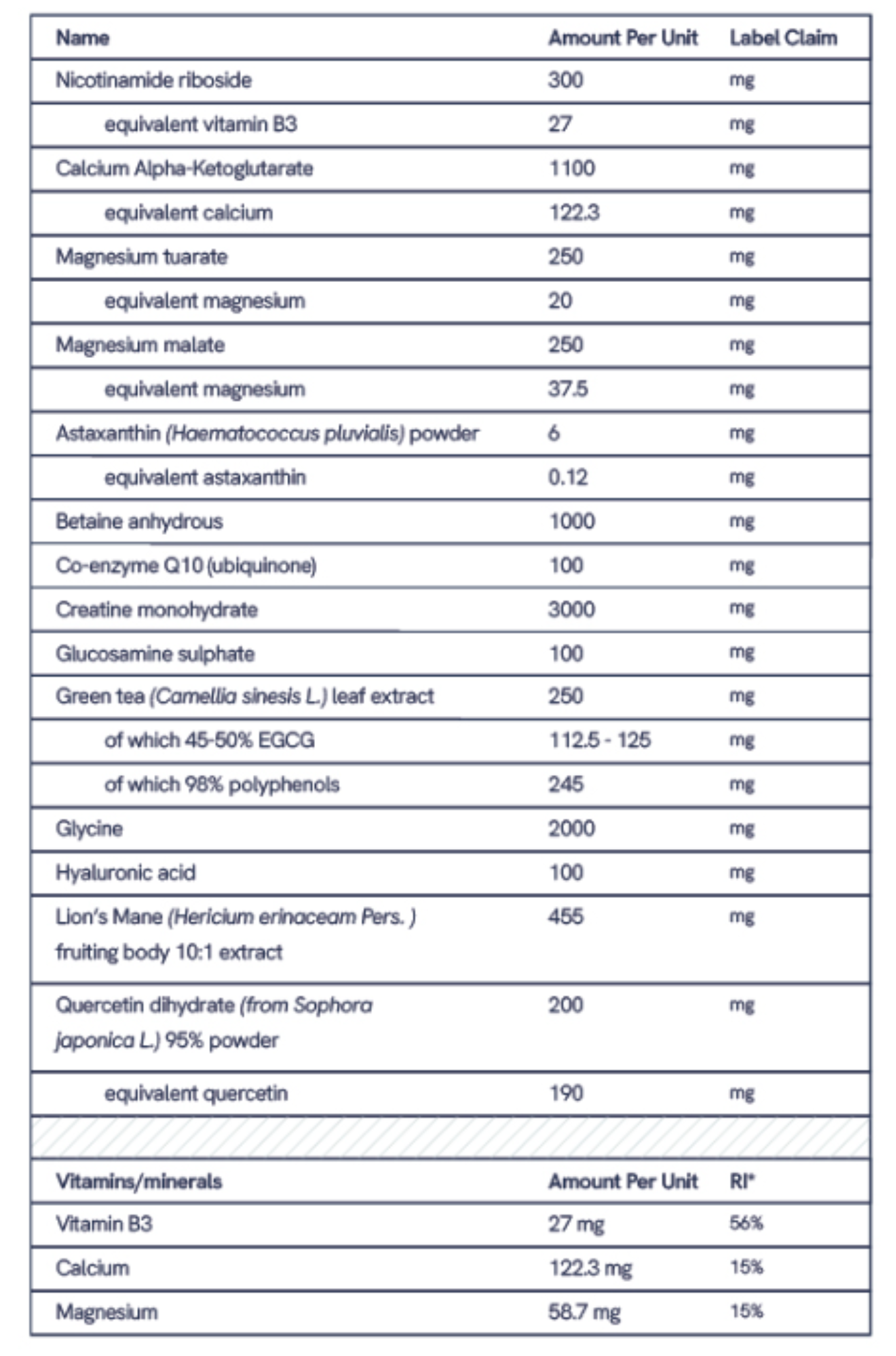
For transparency, here is how this applies to our own product. Longevity One does not claim to raise oxygen in your blood, and it contains no oxygen product, no iron and no caffeine source. It contains vitamin B6 (1.4 mg), vitamin B12 (2.5 mcg) and folate (300 mcg), and vitamin C (100 mg). Vitamin C increases iron absorption. It also provides magnesium, and magnesium contributes to a reduction of tiredness and fatigue. Neither claim is about extra oxygen. It is independently tested by Eurofins and NZVT certified.
When should you see your GP?
See your GP if tiredness is persistent, severe or new, or if it comes with breathlessness, chest discomfort, a fast heartbeat, pale skin or swelling. These need a proper assessment, and your GP can check iron stores and other causes.7 Seek urgent help for severe breathlessness or chest pain.
Q&A: Oxygen Products and Tiredness
Do oxygen pills work for tiredness?
We found no human trials of oxygen pills or drops for tiredness. Oxygen enters the blood through the lungs, not the gut.8 Without evidence, there is no reason to expect them to help.
Does oxygenated water give you more energy?
No. In a two-week crossover trial in 20 men, 1.5 litres a day of oxygenated water did not change aerobic capacity or lactate.1 A second trial found no effect on cycling performance.2
Does canned oxygen help you recover faster?
Not in the controlled trials. Breathing 100% oxygen during short rest periods did not change lactate, recovery or the next bout of exercise in professional football players or male athletes.3,4 The players could not even tell which gas they had breathed.3
Why do athletes use oxygen on the sidelines?
Mostly out of habit and belief. A controlled trial in professional football players found no benefit for recovery or performance.3 Oxygen-enriched air helps during exercise in the lab, which is a different situation.6
Is my blood low in oxygen when I feel tired?
Usually not. In a study of sprinters, haemoglobin was already about 95% saturated before exercise, and it dropped mainly during very intense running.5 Tiredness usually has other causes, such as sleep or low iron.7
Can low iron make you feel short of oxygen?
Iron is part of haemoglobin, so low iron can reduce how much oxygen your blood carries.8 In a review of trials in adults with low iron stores, iron was linked with lower self-reported fatigue in the four trials that measured it.7 Test first, with your GP.
Does deep breathing increase oxygen in the blood?
Not much in healthy people, because blood is already nearly saturated at rest.5 Slow breathing has been linked with more relaxation in healthy people.11 It is not a way to load extra oxygen.
Is breathing extra oxygen ever helpful?
Yes, in specific settings. In laboratory studies, breathing oxygen-enriched air during exercise improved performance.6 Medical oxygen is also prescribed for people who need it, which is a matter for doctors, not supplements.
Are oxygen products safe?
Oxygenated water showed no effect in trials.1 Oxygen pills and drops have not been tested in human trials, so neither their benefit nor their safety is established. Ask a pharmacist before taking them.
What helps more than oxygen products for tiredness?
Regular sleep, regular meals, aerobic exercise and a check of iron stores if you are often tired.7 These address the common causes. Oxygen products do not.
Frequently Asked Questions
Can I use oxygen products if I take medication?
Ask your GP or pharmacist first and bring the product label. If you have a heart or lung condition, follow your doctor's advice on oxygen.
Is oxygenated water better than ordinary water?
Not for energy or performance. Two controlled trials found no difference.1,2 Ordinary water is just as good for drinking.
Do oxygen bars work for tiredness?
Oxygen bars offer a few minutes of oxygen-enriched air at rest. There are no trials of oxygen bars for tiredness, and trials of 100% oxygen during rest periods in athletes found no benefit for recovery.3,4 At rest, blood is already nearly saturated.5
Does Longevity One contain oxygen or iron?
No. It contains no oxygen product and no iron. Vitamin C increases iron absorption. Iron itself should be tested first, with your GP.7
What does Longevity One taste like?
It has a mango and pineapple flavour. Mix one level scoop in 250 to 500 ml of water, or into a smoothie or yogurt.
References
- Leibetseder V, Strauss-Blasche G, Marktl W, Ekmekcioglu C. Does oxygenated water support aerobic performance and lactate kinetics? Int J Sports Med. 2006;27(3):232-235. View on PubMed ↗
- McNaughton LR, Kenney S, Siegler J, Midgley AW, Lovell RJ, Bentley DJ. The effect of superoxygenated water on blood gases, lactate, and aerobic cycling performance. Int J Sports Physiol Perform. 2007;2(4):377-385. View on PubMed ↗
- Winter FD Jr, Snell PG, Stray-Gundersen J. Effects of 100% oxygen on performance of professional soccer players. JAMA. 1989;262(2):227-229. View on PubMed ↗
- Robbins MK, Gleeson K, Zwillich CW. Effect of oxygen breathing following submaximal and maximal exercise on recovery and performance. Med Sci Sports Exerc. 1992;24(6):720-725. View on PubMed ↗
- Nummela A, Hämäläinen I, Rusko H. Effect of hyperoxia on metabolic responses and recovery in intermittent exercise. Scand J Med Sci Sports. 2002;12(5):309-315. View on PubMed ↗
- Mallette MM, Stewart DG, Cheung SS. The effects of hyperoxia on sea-level exercise performance, training, and recovery: a meta-analysis. Sports Med. 2018;48(1):153-175. View on PubMed ↗
- Houston BL, Hurrie D, Graham J, Perija B, Rimmer E, Rabbani R, et al. Efficacy of iron supplementation on fatigue and physical capacity in non-anaemic iron-deficient adults: a systematic review of randomised controlled trials. BMJ Open. 2018;8(4):e019240. View on PubMed ↗
- Tardy AL, Pouteau E, Marquez D, Yilmaz C, Scholey A. Vitamins and minerals for energy, fatigue and cognition: a narrative review of the biochemical and clinical evidence. Nutrients. 2020;12(1):228. View on PubMed ↗
- Piantadosi CA. "Oxygenated" water and athletic performance. Br J Sports Med. 2006;40(9):740-741. View on PubMed ↗
- Milanović Z, Sporiš G, Weston M. Effectiveness of high-intensity interval training (HIT) and continuous endurance training for VO2max improvements: a systematic review and meta-analysis of controlled trials. Sports Med. 2015;45(10):1469-1481. View on PubMed ↗
- Zaccaro A, Piarulli A, Laurino M, Garbella E, Menicucci D, Neri B, et al. How breath-control can change your life: a systematic review on psycho-physiological correlates of slow breathing. Front Hum Neurosci. 2018;12:353. View on PubMed ↗
Disclaimer: Educational content only. Not medical advice. Supplements are not intended to diagnose, treat, cure, or prevent any disease. Consult a qualified healthcare professional if you have a medical condition or take medication.