In everyday speech the words overlap, but researchers separate them. Tiredness is the broad everyday word. Sleepiness is a pull towards sleep. Fatigue is a lack of physical or mental energy, which can be present without feeling sleepy. Exhaustion is the far end, when you cannot carry on. Fatigue that persists, or exhaustion without a clear cause, is a reason to see your GP.
Key Takeaways
- Researchers distinguish sleepiness, a tendency to fall asleep, from fatigue, a lack of energy; the everyday word "tired" merges the two.1
- Fatigue can only be measured by self-report, and researchers separate how tired you feel from how much your performance actually drops.2
- A widely used fatigue scale, developed in general practice, splits fatigue into a physical and a mental part.3
- In a national survey of US workers, 37.9% reported fatigue in the previous two weeks.4
- In an experiment, mental fatigue shortened the time people could keep cycling hard, by making the effort feel harder.5
- Across 19 studies, sleep loss affected mood even more than it affected thinking or movement.6
- Fatigue that persists, or exhaustion without a clear reason, deserves a GP check, even though a serious physical cause is uncommon.7
"I am so tired." "I feel fatigued." "I am exhausted." Most of us use these words as if they meant the same thing, and in daily life that works well enough. Researchers and doctors, though, use them more carefully, because each points to a slightly different state, with different causes and different answers. Knowing which one you are dealing with makes it easier to choose what to change, and to know when to ask for help.
This article sets out how research defines tiredness, sleepiness, fatigue and exhaustion, how each is measured, and how to tell them apart in yourself. It is part of our series on tiredness, which starts with the hub article on feeling tired all the time.
Is there a difference between tiredness and fatigue?
Yes, although the line is not sharp. A review in Sleep Medicine Reviews describes sleepiness and fatigue as two related but distinct states that are often used interchangeably, or merged under the more general lay term "tired".1 In that framework, sleepiness is set apart from fatigue by a presumed impairment of the normal arousal system: a sleepy person is being pulled towards sleep. Fatigue is described as an equally complex state with many definitions, and its measurement has remained subjective, with no agreed gold standard.1
Nursing researchers who set up a centre for the study of fatigue reached a similar conclusion. They describe a long history of problems in defining and measuring fatigue, identify several distinct characteristics captured by different measures, and stress that researchers must be clear about which aspect they are measuring.8 So when you search for the difference between tiredness and fatigue, part of the honest answer is that even experts use the words in more than one way.
For everyday purposes, a working distinction looks like this:
- Tiredness is the broad, everyday word. It can mean sleepy, low on energy, or both.
- Sleepiness is a pull towards sleep. You might doze off if you sat still.
- Fatigue is a lack of physical or mental energy, a sense of weariness that is not necessarily sleepy.
- Exhaustion is the far end: the point at which you cannot carry on with a task, or a severe fatigue that rest does not touch.
What is sleepiness?
Sleepiness is the state most directly linked to sleep, and it is the easiest to measure. The Epworth Sleepiness Scale, a short questionnaire, asks how likely you would be to doze off in eight everyday situations, such as reading, watching television or sitting as a passenger in a car. In its first study, 180 adults completed it, and the total score clearly separated people without sleep problems from patients with different sleep complaints. Scores also matched the time it took people to fall asleep in laboratory tests.9
Sleepiness has a catch: it is a poor judge of its own effects. In a laboratory study, adults who were limited to 6 hours or less in bed for two weeks built up steady declines in attention, yet their own sleepiness ratings rose only slightly after the first days.10 In other words, you can feel only a little sleepy while your performance is clearly worse. The main answer to sleepiness is more, or better-timed, sleep. Our guide Deep Sleep and REM Explained covers how to get more of the restorative kind.
What is fatigue?
Fatigue is broader. Two exercise scientists, Roger Enoka and Jacques Duchateau, proposed a unified definition: fatigue is a symptom in which physical and mental function is limited by the interaction between two things, performance fatigability (how much your actual output declines) and perceived fatigability (how much effort and weariness you feel).2 Because fatigue is a symptom, it can only be measured by self-report, either as a trait (how you usually feel) or as a state (how you feel now).2 This explains a common experience: you can feel completely drained while your performance is still fine, or perform worse without feeling much different.
How is fatigue measured?
The most widely used questionnaires ask about energy, effort and weariness rather than about falling asleep. One of them, the Chalder fatigue scale, was developed with 274 new patients registering at a general practice and a further 100 people attending the same practice. It has 14 items, proved reliable and valid, and its structure split naturally into two factors: physical fatigue and mental fatigue.3 Another, the Fatigue Severity Scale, asks how fatigue affects daily activities, and in a Swiss population study of 2,848 adults aged 45 to 86, 21.9% scored in the fatigue range for the previous week.11
How common is fatigue?
Very common, and it has real costs. In a national telephone survey of US workers, the two-week prevalence of fatigue was 37.9%. Workers with fatigue were more than twice as likely to report health-related lost productive time as those without it, 65.7% compared with 26.4%.4 Surveys like this rely on self-report and on one definition of fatigue, so the exact figures vary between studies, but the pattern is consistent: fatigue is one of the most frequent complaints adults have.
What does exhaustion mean?
The word has two uses. In exercise science, exhaustion has a precise meaning: the point at which you can no longer continue a task at the required intensity. Researchers measure "time to exhaustion", for example how long someone can keep cycling at a set, hard workload.
A well-known experiment shows how closely mental fatigue and physical exhaustion are linked. Sixteen volunteers cycled to exhaustion at 80% of their peak power, once after 90 minutes of a demanding mental task and once after 90 minutes of watching neutral documentaries. After the mental task, they reported mental fatigue and gave up sooner: 640 seconds on average, compared with 754 seconds after the documentaries. Heart rate, oxygen uptake and other physical measures were largely the same. What differed was perceived effort, which was rated higher and rose at the same rate as in the control session, so they reached their personal limit earlier.5 It was a small laboratory study, but it makes the point that exhaustion is shaped by the brain as well as the muscles.
In everyday speech, people use exhaustion for the severe end of fatigue: being so drained that ordinary tasks feel impossible. That kind of exhaustion, especially if it lasts or appears without a clear reason, is not something to push through on your own. See the GP section below.
How do tiredness, sleepiness, fatigue and exhaustion compare?
| State | What it feels like | How researchers measure it | What usually helps first |
|---|---|---|---|
| Tiredness | The everyday word for being low on energy, sleepy, or both1 | Not a research term; it merges the states below1 | Work out which state you mean, then act on that |
| Sleepiness | A pull towards sleep; you might doze off if you sat still | Questionnaires such as the Epworth scale, and laboratory sleep tests9 | More or better-timed sleep |
| Fatigue | Weariness and low physical or mental energy, not necessarily sleepy | Self-report only, as a trait or a state2; scales with physical and mental parts3 | Look at sleep, load, movement and breaks; gentle exercise often helps12 |
| Exhaustion | Unable to carry on with a task, or severe fatigue that rest does not touch | In research, time to exhaustion in a set task5 | Stop and recover; if it persists without a clear cause, see your GP |

Why does the difference matter?
Because what helps is different. If you are sleepy, the most direct answer is sleep. If you are fatigued without being sleepy, extra hours in bed may not change much, and the answers are more likely to be in your workload, your breaks, your movement and your mood. A randomised trial in inactive young adults with persistent fatigue found that six weeks of low-intensity exercise reduced feelings of fatigue more than moderate-intensity exercise did, and both raised feelings of energy.12 For many people, that is a counter-intuitive but useful finding.
The difference also matters because the two often travel together. Sleep loss does not only make people sleepy. A meta-analysis of 19 studies, with a total sample of 1,932 people, found that sleep deprivation strongly impairs human functioning and that mood is affected more than either thinking or movement. Partial sleep deprivation, the everyday kind, had a more profound effect than short-term or long-term total deprivation.6 So a run of short nights can show up as fatigue and low mood rather than as obvious sleepiness.
How can you tell which one you have?
Ask yourself these questions over a week. The answers do not give a diagnosis, but they help you see which state is most prominent and what to try first.
- Would you doze off if you sat down to read or watch television in the afternoon? If yes, sleepiness is likely part of the picture.
- Do you feel drained even after a good night of sleep, without wanting to sleep? That points more towards fatigue.
- Is the weariness mainly in your body (heavy legs, low drive to move) or in your head (hard to concentrate, everything takes effort)? That tells you whether fatigue feels more physical or mental.
- Does a short walk, a break or a change of task make you feel better? If so, use them more; if only sleep helps, sleepiness may be the bigger part.
- Is the tiredness out of proportion to what you have done, or does it last for weeks? That is a reason to see your GP.
Is fatigue physical or mental?
Often both. The Chalder scale found two separate factors, physical and mental fatigue, in people attending general practice.3 At the same time, the cycling experiment above showed that mental fatigue can reduce physical output by raising perceived effort.5 Enoka and Duchateau even argue that researchers should avoid putting adjectives such as "mental" or "muscle" in front of the word fatigue to suggest where it comes from, unless they have tested the mechanism.2 Our separate article on physical versus mental tiredness goes into the practical self-check and what helps each type.
When should you see your GP?
Most tiredness and fatigue have everyday causes. In a systematic review of 26 primary care studies, a serious physical cause was found in about 4.3% of patients who consulted for tiredness, against 18.5% for a mood-related cause, and the authors advised attention to mood and psychosocial problems.7 That is reassuring, but it does not mean you should wait it out. See your GP if:
- your fatigue has lasted more than a few weeks despite reasonable sleep and lifestyle changes;
- you feel exhausted after small amounts of effort, or it stops you working or looking after yourself;
- it is new and you cannot explain it, or it feels different from your usual tiredness;
- it comes with other symptoms, such as unexplained weight loss, breathlessness, fever, night sweats, very heavy periods, low mood that does not lift, or falling asleep without meaning to;
- you take medication and wonder whether it plays a role (do not stop any medicine without advice).
Your GP can check for medical causes, including blood tests. It helps to say which of the states described here fits you best, how long it has lasted and what you have already tried.
What do "tiredness and fatigue" mean on a supplement label?
You may have noticed that the authorised EU health claim uses both words: a nutrient "contributes to the reduction of tiredness and fatigue". The claim does not distinguish between them, and it describes a contribution, not a quick or certain effect on any of the states above. The list of authorised claims, Regulation (EU) No 432/2012, includes this claim for vitamin C, vitamin B6, vitamin B12, folate and niacin; for magnesium the wording is: Magnesium contributes to a reduction of tiredness and fatigue. A claim can only be made when a daily serving provides at least 15% of the nutrient reference value, the significant amount set in Regulation (EU) No 1169/2011 (Annex XIII), with the conditions for claims set in Regulation (EC) No 1924/2006. In practice, these nutrients matter most when your intake falls short, and they do not replace sleep or a GP check. Our guides to magnesium and to B vitamins and energy metabolism explain the background.
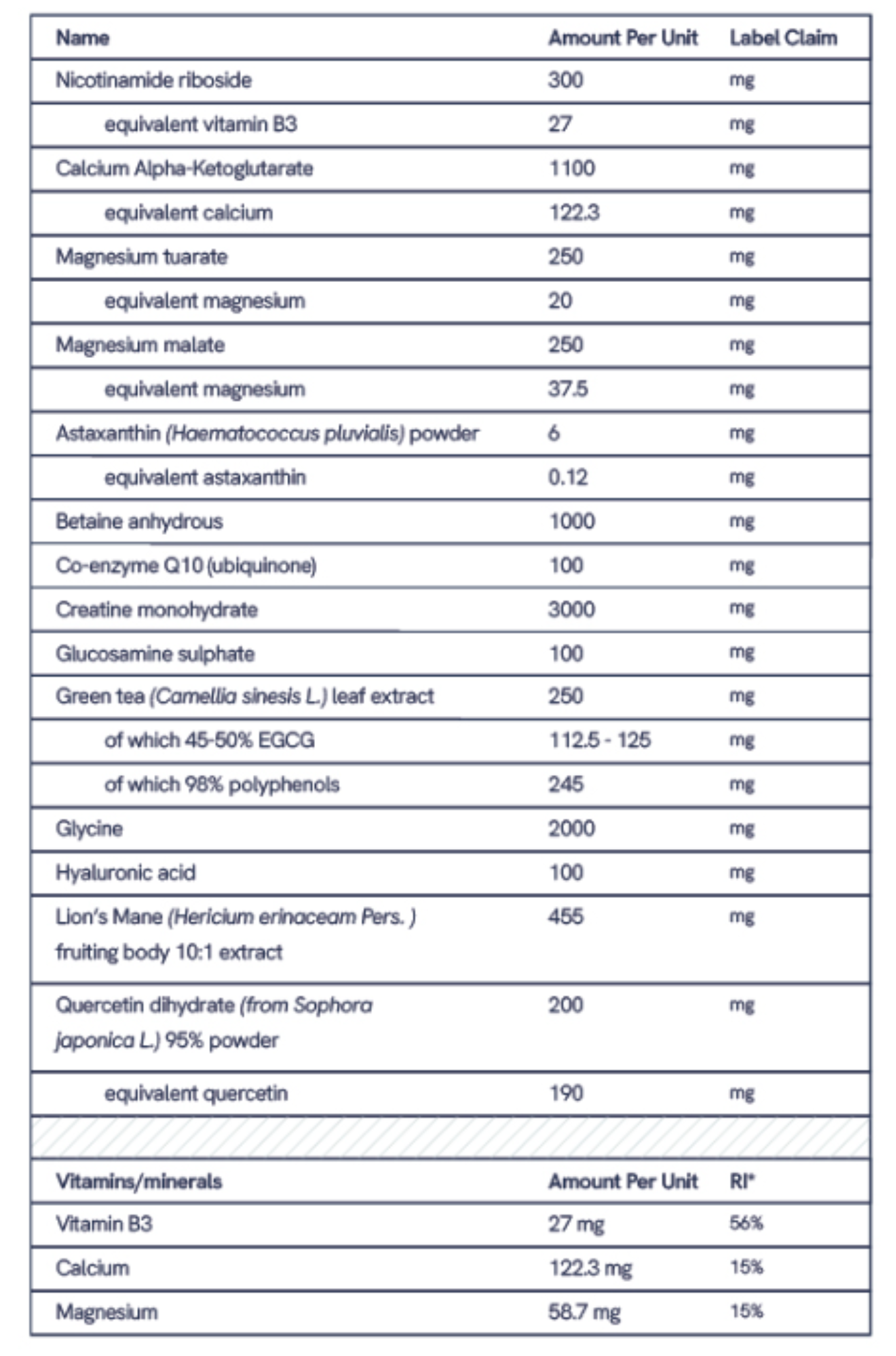
For transparency, Longevity One is a daily powder that provides, per scoop, magnesium (150 mg, as malate), vitamin C (100 mg), vitamin B6 (1.4 mg), vitamin B12 (2.5 mcg), folate (300 mcg) and niacin from nicotinamide riboside, each at 15% or more of the nutrient reference value. It contains no caffeine source and no iron, and it is independently tested by Eurofins and NZVT certified. It is one small part of a plan, not a first step.
Q&A: Tiredness vs Fatigue
What is the difference between tiredness and fatigue?
Tiredness is the everyday word and often covers both sleepiness and fatigue.1 Fatigue is a lack of physical or mental energy that is not necessarily sleepy, and it can only be measured by self-report.2 Sleepiness is a pull towards sleep. Knowing which one you mean helps you choose what to change.
Is fatigue worse than tiredness?
Not necessarily worse, but different. Researchers regard sleepiness and fatigue as distinct states, and fatigue has no agreed gold-standard measure.1 In practice, notice whether sleep is what makes you feel better. Fatigue that lasts for weeks deserves a GP check.
What is the difference between sleepiness and fatigue?
Sleepiness is a tendency to fall asleep, linked to the arousal system, while fatigue is weariness or low energy.1 Questionnaires measure them differently: sleepiness scales ask how likely you are to doze off in everyday situations.9 Fatigue scales ask about energy and effort instead. A sleepy person wants to sleep; a fatigued person may not.
What does exhaustion mean in research?
In exercise science, exhaustion is the point at which you can no longer continue a task at the required intensity. In one study, mental fatigue shortened time to exhaustion on a bike from 754 to 640 seconds on average.5 The difference came from perceived effort, not from the heart or muscles.
Can you be fatigued without being sleepy?
Yes. Researchers regard the two as distinct states, even though they often occur together.1 Many people feel drained but cannot nap, which points towards fatigue rather than sleepiness.
How common is fatigue in adults?
Common. In a US workforce survey, 37.9% reported fatigue in the previous two weeks.4 In a Swiss population study, 21.9% of adults aged 45 to 86 had fatigue in the previous week.11 Figures vary with the definition used.
Is fatigue physical or mental?
It can be either, or both. A fatigue scale developed in general practice found separate physical and mental factors.3 Mental fatigue can also reduce physical performance by making effort feel harder.5 The two are closely linked.
Does lack of sleep cause fatigue or sleepiness?
Both. A meta-analysis found that sleep loss affects mood even more than thinking or movement, so short nights can feel like fatigue and low mood.6 People also tend to underestimate how much short sleep affects them.10 Protecting sleep helps with both.
Can exercise help with fatigue?
Often, yes. In a randomised trial, six weeks of low-intensity exercise reduced fatigue in inactive young adults who felt persistently tired.12 Start gently and see how you respond.
When is fatigue a reason to see a doctor?
When it is persistent, severe, new or comes with other symptoms. A serious physical cause is uncommon, but your GP can check, starting with questions and an examination.7 Bring a short diary of how you feel.
Frequently Asked Questions
Can medication cause fatigue, and can I take supplements with it?
The label advises consulting your doctor if you use medication. Ask your GP or pharmacist and bring the label. If you think a medicine affects your energy, raise it with them, and do not stop a prescribed medicine on your own.
How long does fatigue normally last?
In primary care research, tiredness is described as often self-limiting.7 Fatigue that lasts more than a few weeks, despite changes, is a reason to see your GP.
Can a questionnaire tell me whether I am sleepy or fatigued?
It can give you a useful pointer. The Epworth Sleepiness Scale asks about dozing in eight everyday situations,9 while fatigue scales ask about physical and mental energy.3 Neither replaces a conversation with your GP.
What does Longevity One taste like?
It has a mango and pineapple flavour. Mix one level scoop in 250 to 500 ml of water, or into a smoothie or yogurt.
References
- Shen J, Barbera J, Shapiro CM. Distinguishing sleepiness and fatigue: focus on definition and measurement. Sleep Med Rev. 2006;10(1):63-76. View on PubMed ↗
- Enoka RM, Duchateau J. Translating fatigue to human performance. Med Sci Sports Exerc. 2016;48(11):2228-2238. View on PubMed ↗
- Chalder T, Berelowitz G, Pawlikowska T, Watts L, Wessely S, Wright D, et al. Development of a fatigue scale. J Psychosom Res. 1993;37(2):147-153. View on PubMed ↗
- Ricci JA, Chee E, Lorandeau AL, Berger J. Fatigue in the U.S. workforce: prevalence and implications for lost productive work time. J Occup Environ Med. 2007;49(1):1-10. View on PubMed ↗
- Marcora SM, Staiano W, Manning V. Mental fatigue impairs physical performance in humans. J Appl Physiol (1985). 2009;106(3):857-864. View on PubMed ↗
- Pilcher JJ, Huffcutt AI. Effects of sleep deprivation on performance: a meta-analysis. Sleep. 1996;19(4):318-326. View on PubMed ↗
- Stadje R, Dornieden K, Baum E, Becker A, Biroga T, Bösner S, et al. The differential diagnosis of tiredness: a systematic review. BMC Fam Pract. 2016;17(1):147. View on PubMed ↗
- Aaronson LS, Teel CS, Cassmeyer V, Neuberger GB, Pallikkathayil L, Pierce J, et al. Defining and measuring fatigue. Image J Nurs Sch. 1999;31(1):45-50. View on PubMed ↗
- Johns MW. A new method for measuring daytime sleepiness: the Epworth sleepiness scale. Sleep. 1991;14(6):540-545. View on PubMed ↗
- Van Dongen HP, Maislin G, Mullington JM, Dinges DF. The cumulative cost of additional wakefulness: dose-response effects on neurobehavioral functions and sleep physiology from chronic sleep restriction and total sleep deprivation. Sleep. 2003;26(2):117-126. View on PubMed ↗
- Galland-Decker C, Marques-Vidal P, Vollenweider P. Prevalence and factors associated with fatigue in the Lausanne middle-aged population: a population-based, cross-sectional survey. BMJ Open. 2019;9(8):e027070. View on PubMed ↗
- Puetz TW, Flowers SS, O'Connor PJ. A randomized controlled trial of the effect of aerobic exercise training on feelings of energy and fatigue in sedentary young adults with persistent fatigue. Psychother Psychosom. 2008;77(3):167-174. View on PubMed ↗
Disclaimer: Educational content only. Not medical advice. Supplements are not intended to diagnose, treat, cure, or prevent any disease. Consult a qualified healthcare professional if you have a medical condition or take medication.