A multivitamin rarely causes tiredness through its vitamins, and in trials people taking one reported less fatigue than with placebo. When someone feels worse, the usual culprits are iron upsetting the stomach, taking it without food, hidden caffeine in "energy" formulas, or stacking products past upper limits. If tiredness persists, the cause is probably something else, so see your GP.
Key Takeaways
- On average, multivitamin and mineral supplements reduced fatigue ratings compared with placebo in a meta-analysis of eight trials.1
- In trials of iron supplements, ferrous sulfate more than doubled the odds of gut side effects compared with placebo, which can leave you feeling unwell.2
- Very high zinc intakes can cause nausea, lethargy and fatigue, far above the amounts in a standard multivitamin.3
- Hidden or high caffeine in "energy" formulas can disturb sleep even when taken six hours before bed.4
- Long-term excess vitamin D can cause apathy and confusion; EFSA set the adult upper limit at 100 micrograms a day.5,6
- If tiredness is persistent, severe or new, see your GP, whatever supplements you take.
You started a multivitamin to feel less tired, and a week later you feel worse. Or you have noticed you seem sleepier on the days you take it. It is a fair question, and this article gives an honest answer, including the evidence that cuts against the idea. In short: the vitamins themselves rarely cause tiredness, but some ingredients, some habits and some products can leave you feeling worse, and it is worth knowing which.
Can a multivitamin make you tired?
Rarely, and not in the way most people think. The trial evidence points the other way on average. A meta-analysis of eight randomised, placebo-controlled trials in the general population, each lasting at least 28 days, found that multivitamin and mineral supplements reduced fatigue ratings, as well as perceived stress and confusion, compared with placebo.1 If multivitamins commonly caused tiredness, that pattern would be hard to explain.
So when someone feels more tired on a multivitamin, there are three broad possibilities. The product contains something that disagrees with them, such as iron or a high dose of a mineral. The product contains something they did not expect, such as caffeine. Or the tiredness has another cause that happens to coincide with starting the supplement. The checks below work through these in order.
Check 1: Does it contain iron?
Iron is one ingredient that can leave people feeling unwell. In a meta-analysis of 43 trials of iron supplements with 6,831 adults, ferrous sulfate more than doubled the odds of gut side effects compared with placebo (odds ratio 2.32).2 Nausea, stomach discomfort and constipation are not tiredness, but feeling queasy for a few hours after breakfast can easily feel like low energy. These trials tested iron supplements given on their own, not iron in multivitamins, and the meta-analysis did not find a clear link with dose.2 Two of its authors hold a patent on a new iron material for supplements.
If your multivitamin contains iron and you did not have a reason to take it, ask your GP whether you need it. Iron is a test-first nutrient: it helps when stores are low, and adds side-effect risk when they are not. Never stop iron that a doctor prescribed without talking to them first.
Check 2: Are you taking it on an empty stomach?
With zinc, overt symptoms including nausea, vomiting, stomach pain, lethargy and fatigue are described at extremely high intakes, while amounts of 100 to 300 mg a day, far above the 10 mg NRV set in Regulation (EU) No 1169/2011, have been linked with interference with copper status.3 A standard multivitamin contains much less than that. If a supplement upsets your stomach, taking it with a meal is the simplest change to try. Our article on when and how to take supplements has more on timing.
Check 3: Is there hidden caffeine?
Check whether your product lists caffeine, or a plant ingredient that supplies it, such as guarana or green tea extract. If it does, that changes the picture completely.
Caffeine can make you more tired in two ways. First, sleep: in a controlled study, 400 mg of caffeine taken six hours before bed still disturbed sleep significantly compared with placebo.4 A caffeinated multivitamin taken at lunch, on top of your usual coffee, can cost sleep you do not notice losing. Our article on deep sleep and REM explains why that matters. Second, withdrawal: fatigue, decreased energy, drowsiness and decreased alertness are validated withdrawal symptoms, typically starting 12 to 24 hours after the last dose, and stopping intakes as low as 100 mg a day can produce them.7 If you take an energy formula on weekdays and not at weekends, a Saturday slump may be withdrawal.
Check 4: Are you over an upper limit?
This is less common, but it is the one most worth catching, because it builds up quietly. Most people take more than one product: a multivitamin, a separate vitamin D, perhaps a B complex or an energy drink with added vitamins. Doses add up, and manufacturers often put in more than the label states to cover shelf-life losses. In a chemical analysis of a national sample of US multivitamins, measured content exceeded the label for every ingredient except thiamine, by about 25% for selenium and iodine and by 1.5% to 13% for most others.8
Vitamin D
Long-term excess vitamin D raises calcium levels, and the symptoms most often noted include confusion, apathy, recurrent vomiting, stomach pain, thirst and passing more urine.5 Apathy and confusion can feel a lot like tiredness. Excess of this kind is rare and usually involves very high doses taken over time, but a review notes that public interest in vitamin D may increase the risk from self-dosing above upper limits.5 EFSA set the adult upper limit at 100 micrograms a day, from all sources combined, and noted that the people most likely to exceed it are regular users of high-dose supplements.6
Vitamin A
Preformed vitamin A (retinol) is the other fat-soluble vitamin worth checking. A review of vitamin A toxicity found that intakes of 25,000 to 50,000 IU a day for several months or more can produce multiple adverse effects.9 EFSA's upper limit for preformed vitamin A is 3,000 micrograms a day for adults, and noted that European adults are unlikely to exceed it if they eat liver and liver products no more than about once a month.10 For comparison, the EU NRV for vitamin A, set in Regulation (EU) No 1169/2011, is 800 micrograms a day. The risk comes from stacking a multivitamin with separate high-dose vitamin A, fish liver oil or frequent liver meals. If you are pregnant or planning a pregnancy, this matters more, so ask your GP or midwife.
Vitamin B6
Vitamin B6 does not cause tiredness at normal doses, but it is the clearest case of "more is not better". EFSA set an upper limit of 12 mg a day for adults because excess intake can harm the peripheral nerves, and found that regular users of high-dose B6 supplements are the group most likely to exceed it.11 If you take a high-potency B complex alongside a multivitamin, add up the B6.

Check 5: Could something else explain it?
Often, yes. People usually start a multivitamin because they already feel tired, so whatever caused the tiredness is still there. Short or broken sleep, a heavy workload, low daylight in winter, not eating enough, alcohol, a recent infection and stress all cause tiredness and often overlap. Expectation plays a part too: if you are watching for a change, you notice every slump. The trials that found less fatigue measured it over at least four weeks,1 so a single tired day after starting tells you little.
A two-week log helps. Write down each day when you took the multivitamin, whether with food, your caffeine and alcohol, your sleep and your energy in the afternoon. Then stop the multivitamin for a week and keep logging. If nothing changes, look for another cause, with your GP if the tiredness persists.
Which cause fits what you notice?
The timing and the type of tiredness often point to the likely cause. Use this table as a starting point, not a diagnosis.
| What you notice | Most likely cause | What to try first |
|---|---|---|
| Queasy, heavy or bloated within a few hours of taking it | Iron or another mineral, especially without food2,3 | Take it with a meal; ask your GP whether you need the iron |
| Wired in the evening, flat the next morning | Caffeine in an "energy" formula disturbing sleep4 | Check for caffeine and plant sources; move it to the morning or switch |
| A slump or headache on days you skip it | Caffeine withdrawal7 | Check the label; cut down gradually rather than stopping suddenly |
| Slowly increasing apathy, thirst or nausea over weeks | Combined doses of vitamin D above the upper limit5,6 | Add up every product; stop extra vitamin D and see your GP |
| No pattern with the supplement at all | Another cause of tiredness that started earlier | Keep a two-week log; see your GP if it persists |
Most people who feel tired on a multivitamin will find their answer in the first three rows, or in the last one. The middle row is rare, but it is the one where carrying on and adding more products can make things worse, which is why the combined totals matter.
When should you see your GP?
See your GP if your tiredness is extreme, has lasted more than a few weeks, came on without an obvious reason, or comes with other changes such as unplanned weight loss, breathlessness, very heavy periods, low mood, changes in your sleep, thirst, or tingling or numbness. Take your supplement labels with you. A GP can look at the whole picture and arrange tests if needed. Feeling more tired on a supplement is useful information, but it rarely points at the supplement.
What should you do if you feel worse on a multivitamin?
- Take it with a meal rather than on an empty stomach.
- Check the label for iron and, if you did not need it, ask your GP about a product without it.2
- Check the label for caffeine, guarana, green tea extract or other caffeine sources, and take caffeine early in the day.4
- Add up vitamin D, vitamin A and vitamin B6 across every product you take, and compare them with the EFSA upper limits.6,10,11
- Keep a two-week log before and after stopping, so you can see whether the multivitamin makes any difference.
- Bring the labels to your GP or pharmacist, especially if you take medication.
Our guide on how to read a supplement label explains how to find each of these on a label.
How does Longevity One fit?
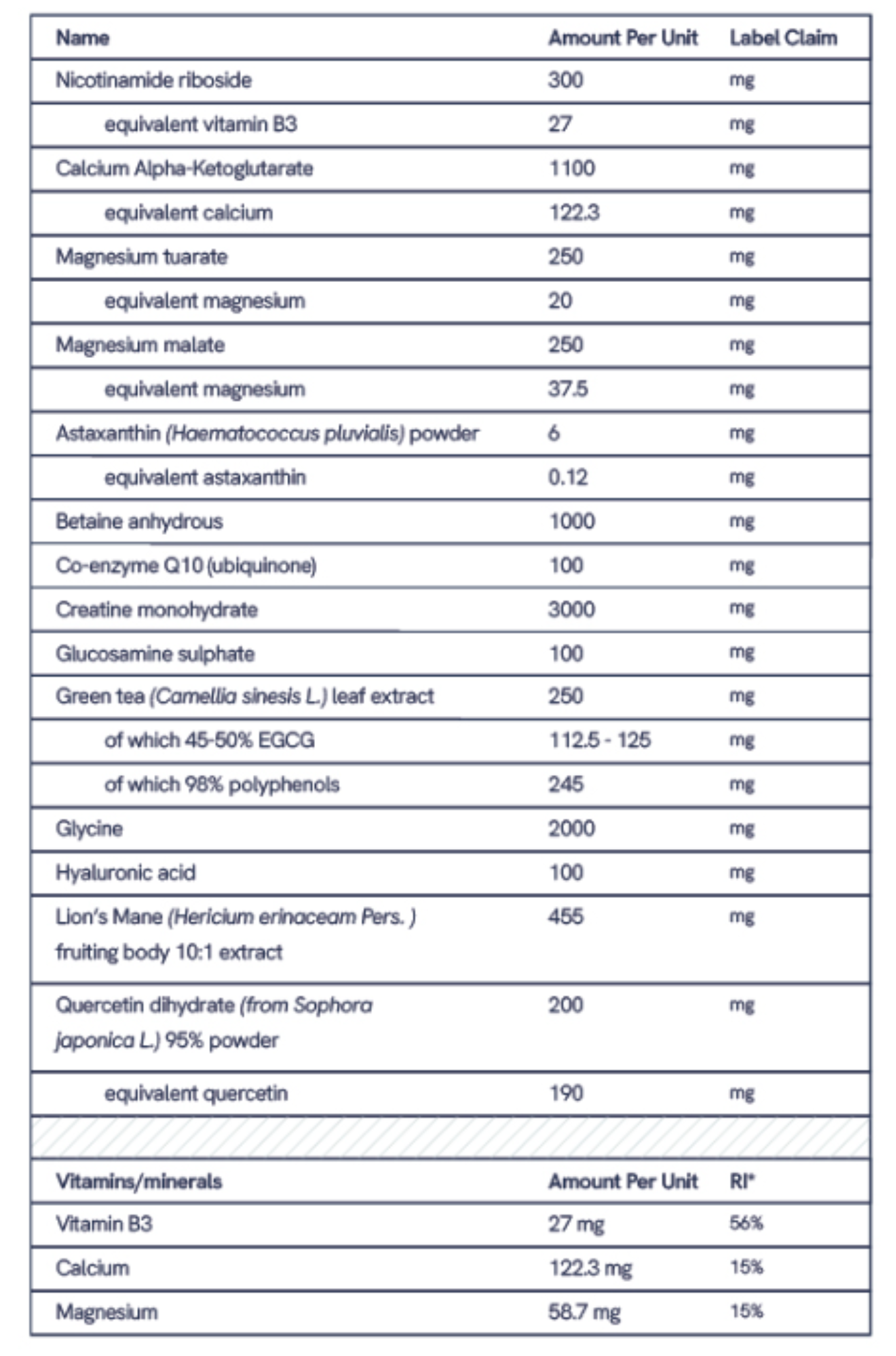
For transparency, here is how our own formula relates to the checks above, using only what is on its label. Longevity One contains no iron and no caffeine source (checks 1 and 3). Its doses sit near the NRV rather than at megadose levels: vitamin B6 is 1.4 mg, well under the 12 mg upper limit,11 vitamin D3 is 10 micrograms, a tenth of the 100 microgram upper limit,6 and zinc is 8 mg (check 4). The label suggests taking it once a day, preferably in the morning or with a meal that includes some fat (check 2). It provides magnesium, vitamins B6 and B12, folate, niacin and vitamin C at claim levels, so, for example, vitamin B6 contributes to the reduction of tiredness and fatigue. It is independently tested by Eurofins and NZVT certified. If you take other supplements as well, add up the doses before you combine them.
Q&A: Multivitamins and Tiredness
Why does my multivitamin make me tired?
Usually it is not the vitamins. Common reasons are iron upsetting your stomach, taking it without food, or hidden caffeine disturbing your sleep.2,4 On average, trials found less fatigue with multivitamins than with placebo.1
Can iron in a multivitamin make me feel tired?
It can make you feel unwell. In trials of iron supplements, ferrous sulfate more than doubled the odds of gut side effects compared with placebo.2 If you did not need iron, ask your GP whether to switch.
Can vitamin A cause fatigue?
Excess preformed vitamin A over months can cause multiple adverse effects, described at intakes of 25,000 to 50,000 IU a day.9 EFSA set the adult upper limit at 3,000 micrograms a day.10 A product that provides vitamin A at about the NRV of 800 micrograms is far below these amounts.
Can too much vitamin D make you tired?
Long-term excess can cause apathy and confusion, along with thirst and vomiting.5 EFSA set the adult upper limit at 100 micrograms a day.6 It is rare and usually follows very high doses over time.
Can zinc make me feel sick or tired?
At very high intakes, zinc can cause nausea, vomiting, lethargy and fatigue.3 A standard multivitamin contains far less. Taking it with food helps if it upsets your stomach.
Should I take my multivitamin in the morning or at night?
With a meal is more important than the time. If your product contains caffeine, take it early, because caffeine six hours before bed still disturbed sleep in a controlled study.4 Otherwise, choose the time you will remember.
Could my energy multivitamin be causing a caffeine crash?
Yes, if it contains caffeine. Fatigue and drowsiness are validated withdrawal symptoms, usually starting 12 to 24 hours after the last dose.7 Check the label for caffeine and plant sources such as guarana.
Do multivitamins usually reduce tiredness?
On average, yes, modestly. A meta-analysis of eight placebo-controlled trials found lower fatigue ratings with multivitamin and mineral supplements.1 The authors suggested that products with high doses of B vitamins may be more effective for mood.1
Can taking several supplements make me tired?
It can, if the totals push a nutrient such as vitamin D past its upper limit, or if one contains caffeine.6,4 Measured content can also exceed the label.8 Add up each nutrient across products.
Should I stop my multivitamin if I feel tired?
You can pause it for a week and keep a simple log, to see if anything changes. If tiredness continues after the pause, look for another cause. In trials, multivitamins on average lowered fatigue ratings rather than raising them.1 See your GP if tiredness is persistent or severe.
Frequently Asked Questions
Can a multivitamin interact with my medication?
Ask your GP or pharmacist before you start and bring the label. The Longevity One label advises consulting your doctor if you use medication. If you take several products, add up the doses, because measured content in multivitamins often exceeds the label.8
Is it safe to take a multivitamin with a separate vitamin D?
Usually, as long as the combined dose stays under the adult upper limit of 100 micrograms a day.6 Add both labels together.
How long should I try a multivitamin before deciding it does not suit me?
Trials measured changes after at least four weeks.1 Gut side effects usually show up sooner; if they do, try taking it with food before giving up.
What does Longevity One taste like?
It has a mango and pineapple flavour. Mix one level scoop in 250 to 500 ml of water, or into a smoothie or yogurt.
Can I take a multivitamin during pregnancy?
Ask your GP or midwife which product suits you, because needs and upper limits differ, especially for vitamin A. Longevity One is not suitable during pregnancy and breastfeeding.
References
- Long SJ, Benton D. Effects of vitamin and mineral supplementation on stress, mild psychiatric symptoms, and mood in nonclinical samples: a meta-analysis. Psychosom Med. 2013;75(2):144-153. View on PubMed ↗
- Tolkien Z, Stecher L, Mander AP, Pereira DI, Powell JJ. Ferrous sulfate supplementation causes significant gastrointestinal side-effects in adults: a systematic review and meta-analysis. PLoS One. 2015;10(2):e0117383. View on PubMed ↗
- Fosmire GJ. Zinc toxicity. Am J Clin Nutr. 1990;51(2):225-227. View on PubMed ↗
- Drake C, Roehrs T, Shambroom J, Roth T. Caffeine effects on sleep taken 0, 3, or 6 hours before going to bed. J Clin Sleep Med. 2013;9(11):1195-1200. View on PubMed ↗
- Marcinowska-Suchowierska E, Kupisz-Urbanska M, Lukaszkiewicz J, Pludowski P, Jones G. Vitamin D toxicity: a clinical perspective. Front Endocrinol (Lausanne). 2018;9:550. View on PubMed ↗
- EFSA Panel on Nutrition, Novel Foods and Food Allergens (NDA), Turck D, Bohn T, Castenmiller J, de Henauw S, Hirsch-Ernst KI, et al. Scientific opinion on the tolerable upper intake level for vitamin D, including the derivation of a conversion factor for calcidiol monohydrate. EFSA J. 2023;21(8):e08145. View on PubMed ↗
- Juliano LM, Griffiths RR. A critical review of caffeine withdrawal: empirical validation of symptoms and signs, incidence, severity, and associated features. Psychopharmacology (Berl). 2004;176(1):1-29. View on PubMed ↗
- Andrews KW, Roseland JM, Gusev PA, Palachuvattil J, Dang PT, Savarala S, et al. Analytical ingredient content and variability of adult multivitamin/mineral products: national estimates for the Dietary Supplement Ingredient Database. Am J Clin Nutr. 2017;105(2):526-539. View on PubMed ↗
- Hathcock JN, Hattan DG, Jenkins MY, McDonald JT, Sundaresan PR, Wilkening VL. Evaluation of vitamin A toxicity. Am J Clin Nutr. 1990;52(2):183-202. View on PubMed ↗
- EFSA Panel on Nutrition, Novel Foods and Food Allergens (NDA), Turck D, Bohn T, Castenmiller J, de Henauw S, Hirsch-Ernst KI, et al. Scientific opinion on the tolerable upper intake level for preformed vitamin A and beta-carotene. EFSA J. 2024;22(6):e8814. View on PubMed ↗
- EFSA Panel on Nutrition, Novel Foods and Food Allergens (NDA), Turck D, Bohn T, Castenmiller J, de Henauw S, Hirsch-Ernst KI, et al. Scientific opinion on the tolerable upper intake level for vitamin B6. EFSA J. 2023;21(5):e08006. View on PubMed ↗
Disclaimer: Educational content only. Not medical advice. Supplements are not intended to diagnose, treat, cure, or prevent any disease. Consult a qualified healthcare professional if you have a medical condition or take medication.