Most runners who eat enough, and eat a varied diet, will not run better on a multivitamin: a 90-day controlled trial in active men found no performance gain.1 A multivitamin can still be a sensible safety net where your intake falls short, such as vitamin D in the darker months. Iron is the exception: test first, with your GP, rather than guess.
Key Takeaways
- In a 90-day placebo-controlled trial, a high-potency multivitamin did not change aerobic capacity, a 90-minute run or muscle strength in 22 well-nourished active men.1
- A review of 130 experiments found little evidence that mineral supplements improve performance markers, with possible exceptions for iron and magnesium in particular situations.2
- Across 2,313 athletes, 56% had vitamin D inadequacy, and the risk rose in winter and spring.3
- Low iron is reported in about 15 to 35% of female and 5 to 11% of male athlete groups, so a blood test comes before any iron supplement.4
- High doses of vitamin C (1,000 mg) and vitamin E (235 mg) blunted markers of muscle adaptation to 11 weeks of running-based training.5
- In an international analysis, 14.8% of supplements contained anabolic steroids not declared on the label, which matters if you race under anti-doping rules.6
You run four or five times a week, the long run is creeping past 90 minutes, and someone at the club swears by a multivitamin. Lists of running endurance supplements usually include one. The honest answer to "do I need it?" depends less on how far you run and more on what you eat, where you live and what a blood test says. This article walks through the trials, the nutrients worth checking and what a sensible label looks like.
Why do so many runners take a multivitamin?
Supplement use is common in sport. A systematic review of 159 studies found that athletes used supplements more than the general US population, and that elite athletes used them far more than non-elite athletes.7 The same review noted that the methods of most surveys were weak, so exact percentages vary widely between sports and countries.7
The reasons are easy to understand. Running uses a lot of energy, so it feels logical that it must also use up vitamins and minerals. A multivitamin is cheap, simple and sold as insurance. Sports nutrition bodies take a more careful view: their shared position stand puts well-chosen food, fluids and timing first, and sees supplements as a narrow, case-by-case addition to that base.8
So the useful question is not "is a multivitamin good?" but "is anything in my diet actually short, and would a multivitamin cover it?" The answers are different for different runners.
What did trials of multivitamins in active people find?
The best evidence comes from placebo-controlled trials in people who train. There are not many, and most are old, but they point in the same direction.
The 90-day trial in active men
In a double-blind, placebo-controlled trial, 22 healthy, physically active men took either a high-potency multivitamin and mineral supplement or a placebo for 90 days.1 The researchers measured maximal aerobic capacity, a 90-minute endurance run on a treadmill and muscle strength. Nothing changed: maximal oxygen uptake, treadmill time, heart rate and blood markers during the long run were the same in both groups, and strength was unaffected.1 The authors concluded that supplementation did not affect performance in well-nourished men who kept up their training.1
The 7 to 8 month trial in athletes
A longer study followed 82 athletes from basketball, gymnastics, rowing and swimming through 7 to 8 months of training and competition, with matched groups given a vitamin and mineral supplement or a placebo.9 The athletes were monitored to make sure their diet alone met the recommended daily intakes. Across strength, aerobic and anaerobic tests the study found little evidence of any benefit; the only significant changes were in one subgroup of female basketball players, whose body weight, skinfolds and jumping ability increased.9
What a newer systematic review adds
A 2019 systematic review of minerals and trace elements screened more than 17,000 articles and included 130 experiments from 128 studies.2 It concluded that there is little evidence that mineral supplements improve physiological markers of athletic performance, with the possible exception of iron (in particular situations) and magnesium, the two minerals with the strongest quality of evidence.2 The review also noted that about half of athletes report taking some form of micronutrient supplement.2
The limits are clear. The two trials were small, are more than 30 years old and did not study recreational runners specifically. Both enrolled people whose diets were already adequate. They tell us that topping up a full tank does not make you faster; they do not tell us what happens when a runner is genuinely short of something.
Does running raise your need for vitamins and minerals?
Running raises your energy needs, and B vitamins are part of how food becomes usable energy. For example, thiamine, niacin, vitamin B6 and vitamin B12 contribute to normal energy-yielding metabolism. If you eat more food to fuel more training, you usually take in more of these nutrients as well, which is one reason the trials above found no gain.8 Our article on B vitamins and energy metabolism explains the biochemistry in more detail.
The picture changes when intake does not rise with training. Runners who restrict food to stay light, follow a narrow diet, or simply train far more than they eat are the ones most likely to fall short. In that case the first step is more food, not more pills, because a multivitamin supplies no energy at all.8
Which nutrients are worth checking if you run?
Instead of a blanket multivitamin, it is often more useful to look at the few nutrients where runners are known to fall short. The table summarises them.
| Nutrient | Why runners ask about it | What the evidence says | Practical step |
|---|---|---|---|
| Vitamin D | Little sun in winter, especially in northern Europe | 56% of 2,313 athletes had inadequate levels, more so in winter and spring3 | A daily supplement in the darker months; a blood test if unsure |
| Iron | Common in female and endurance athletes | About 15 to 35% of female and 5 to 11% of male athlete groups have low iron4 | Test first, with your GP; never take iron blind |
| Magnesium | Often marketed to runners for muscle function | One of two minerals with the strongest quality of evidence in sport2 | Food first (nuts, seeds, whole grains, greens); a modest daily dose is reasonable |
| Vitamin C and E in high doses | Sold as recovery or antioxidant support | 1,000 mg C plus 235 mg E blunted markers of training adaptation5 | Avoid megadoses around training; food amounts are fine |
| Everything else | A multivitamin covers it "just in case" | No performance gain in well-nourished active adults1,9 | Worth it only if your diet is narrow or restricted |
Vitamin D in the darker months
The skin makes vitamin D from sunlight, so levels tend to fall in the darker months and at higher latitudes. A meta-analysis of 23 studies with 2,313 athletes found that 56% had vitamin D inadequacy (below 32 ng/ml), and the risk was 1.85 times higher in winter and spring, higher for indoor sports and higher at more northern latitudes.3 In a UK study carried out in winter, 62% of 61 professional athletes had levels below 50 nmol/l, and 8 weeks of 5,000 IU of vitamin D3 a day raised levels from 29 to 103 nmol/l.10 That study was small and the athletes were not runners, so its performance findings (sprint and jump times improved) need caution.10 Vitamin D contributes to the maintenance of normal muscle function and to the maintenance of normal bones, both of which matter to anyone who runs.
Iron: test first, with your GP
Iron is central to oxygen transport and energy metabolism, which is why runners worry about it.4 A narrative review estimated that about 15 to 35% of female and 5 to 11% of male athlete groups have low iron.4 Part of the reason is a hormone called hepcidin, the main regulator of iron in the body, which rises after exercise.4 In 54 athletes, hepcidin rose about 3 hours after running in those with normal or high iron stores, while low stores kept it suppressed.11 If you have been prescribed iron, ask your GP or a sports dietitian how to time it around training.
If a blood test shows low iron stores, your GP can advise on what to do. Iron is not harmless if you do not need it, and a general multivitamin is not a plan for correcting low stores. So the order is always the same: blood test, then a plan with your GP.
Magnesium
In the 2019 review it was one of only two minerals with evidence of strong quality, although the overall case for improved performance was still limited.2 Magnesium contributes to a reduction of tiredness and fatigue. Magnesium contributes to normal muscle function. Magnesium contributes to electrolyte balance. Our article on magnesium covers food sources and forms.
Can a multivitamin get in the way of training?
This is the part of the story most runners have not heard. Training works partly because hard sessions create a short-lived stress signal in muscle, which the body answers by building more mitochondria and other adaptations. High doses of antioxidant vitamins may dampen that signal.
In a double-blind randomised trial, 54 young men and women took either 1,000 mg of vitamin C and 235 mg of vitamin E a day or a placebo for 11 weeks while following a training plan of three to four sessions a week, mostly running.5 Both groups improved their maximal oxygen uptake by about 8%, and shuttle-run performance by 10 and 14%.5 But in muscle biopsies, markers of new mitochondria (COX4 and PGC-1 alpha) rose by 59% and 19% in the placebo group and did not rise in the vitamin group.5 The performance tests did not show a difference, so the practical effect is uncertain; the authors advised caution with antioxidant supplements during endurance training.5
The doses matter here. 1,000 mg of vitamin C is more than twelve times the EU nutrient reference value of 80 mg set in Regulation (EU) No 1169/2011. A multivitamin with amounts close to 100% of the nutrient reference value (NRV) is a different thing from a high-dose antioxidant tablet, and food sources of vitamin C were not the issue in this trial.5

What should a runner look for on a multivitamin label?
If you decide a multivitamin or daily formula makes sense for you, the label tells you most of what you need. Our guide on how to read a supplement label goes further; for runners, these are the points that matter most.
- Doses near 100% of the NRV for most vitamins and minerals, rather than megadoses of a few.5
- Vitamin D in a meaningful amount if you train through a northern winter.3
- Iron only if a blood test shows you need it, and then usually as a separate product your GP advises on.4
- Magnesium in a stated form and amount, not hidden in a "blend".2
- Every dose printed, with no proprietary blends.
- No caffeine or stimulants hidden in a daily product, so you can control caffeine separately.
- Batch testing for banned substances if you race under anti-doping rules.6
Why does batch testing matter if you race?
Even runners who never think about doping can be caught out. In an international study, 634 non-hormonal supplements were bought in 13 countries between October 2000 and November 2001; 94 of them (14.8%) contained anabolic steroids that were not on the label.6 In relation to the number of products bought per country, the Netherlands had the highest share of positive samples, at 25.8%.6 These products were bought more than 20 years ago, when steroid precursors were widely sold, so the figures show that the risk exists rather than how common it is today. Under anti-doping rules, you are responsible for what is in your body, whatever the label said. If you race at club level or above, choose products screened batch by batch. Our article on third-party testing explains what that involves.
How does our own formula fit?
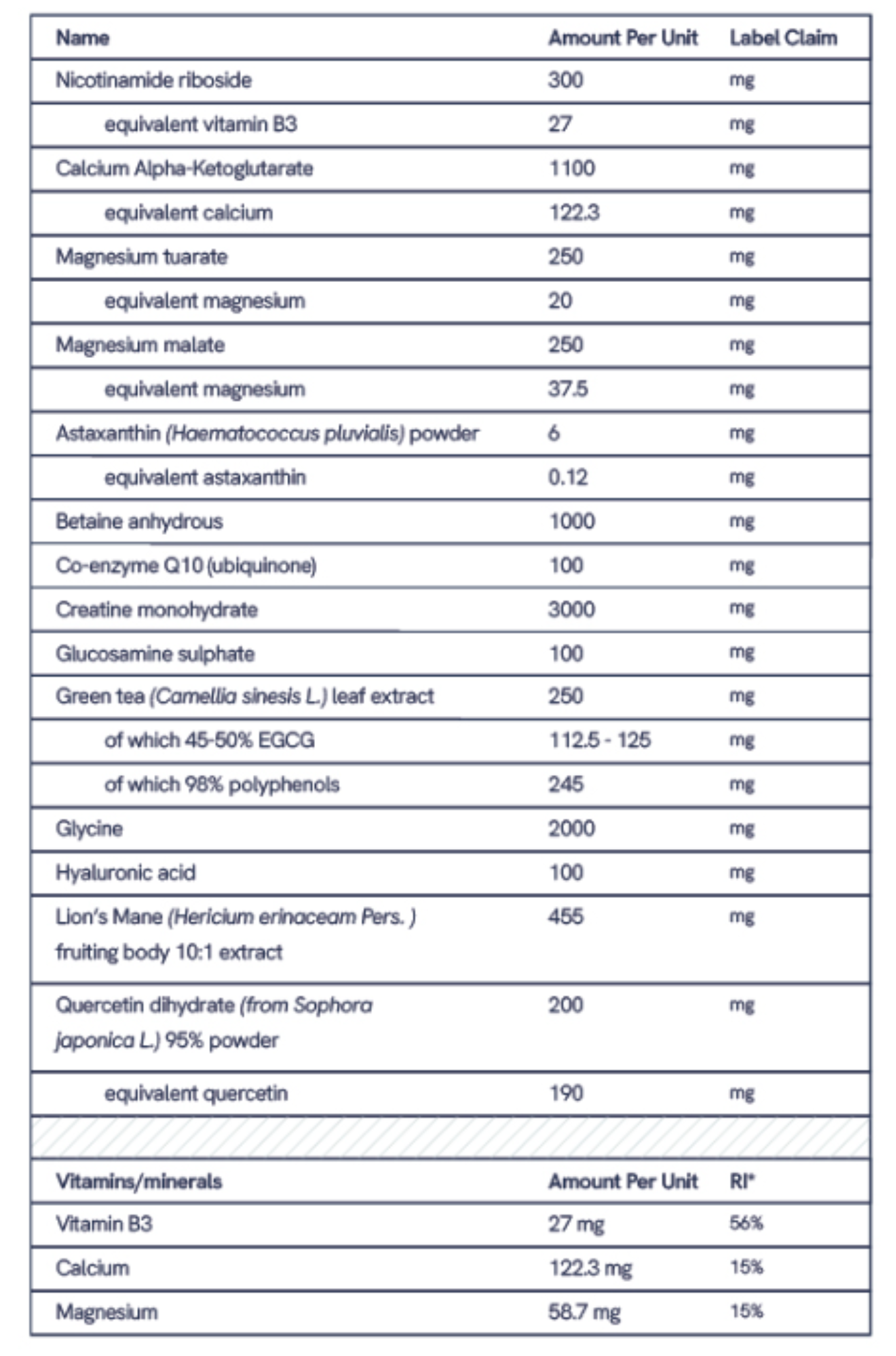
For transparency, Longevity One is a daily powder rather than a classic multivitamin. One scoop contains 24 ingredients, among them magnesium (as malate, 150 mg), vitamin D3 (10 mcg, 200% NRV), vitamin C (100 mg), vitamin B6, vitamin B12, folate, niacin from nicotinamide riboside, zinc (8 mg), selenium and 3,000 mg of creatine monohydrate. It contains no iron, no caffeine source, and no vitamin B2, vitamin B5 or iodine, so it does not cover every nutrient a full multivitamin does.
The claims that apply are the authorised ones for the nutrients it contains at 15% NRV or more. Vitamin B6, vitamin B12, folate, niacin and vitamin C contribute to the reduction of tiredness and fatigue. Magnesium contributes to a reduction of tiredness and fatigue. Magnesium contributes to normal muscle function. Calcium contributes to normal muscle function. Vitamin D contributes to the maintenance of normal muscle function. Creatine increases physical performance in successive bursts of short-term, high intensity exercise. Steady running is not covered by this claim. No claim is made for endurance or running performance. It is independently tested by Eurofins and NZVT certified, with every batch screened for banned substances.
When is a multivitamin worth it for a runner?
Putting the evidence together, a multivitamin or daily formula is most likely to be useful if one or more of these apply to you:
- You eat a narrow or restricted diet, or you are often under-eating for the training you do.8
- You live and train in northern Europe and rarely get sun on your skin in winter.3,10
- You prefer one simple daily routine to several separate products.
It is unlikely to help if you already eat a varied diet with enough energy, and hope it will make you faster.1,9 For most runners, the bigger gains still come from consistent training, enough sleep and enough food. Our article on running for longevity covers how running fits into long-term health.
When should a runner see a GP about tiredness?
Normal training tiredness eases with a lighter week. Tiredness that is persistent, severe or new, or comes with breathlessness, a racing heart, pale skin or a sudden drop in pace at easy efforts, is a reason to see your GP rather than to change supplements. Low iron is one of several possible causes, and only a blood test can tell.4
Q&A: Multivitamins for Runners
Do runners need a multivitamin?
Most runners who eat enough and eat a varied diet do not need one to perform well. In a 90-day trial in active men, a high-potency multivitamin changed neither aerobic capacity nor a 90-minute run.1 It can still be a reasonable safety net if your diet is narrow.
What is the best multivitamin for running?
There is no single best product, but a good one has doses close to 100% of the NRV, meaningful vitamin D and every dose printed. Avoid megadoses of antioxidant vitamins, which blunted markers of training adaptation in one trial.5 If you race, choose a batch-tested product.
Will a multivitamin make me run faster?
Probably not if your diet is already adequate. A trial in 82 athletes over 7 to 8 months found little evidence of any performance effect.9
Should runners take vitamin D?
Many athletes have low vitamin D, especially in winter and spring: 56% of 2,313 athletes in one meta-analysis.3 A daily supplement in the darker months is a common, sensible approach. A blood test tells you where you stand.
Should I take iron if I run a lot?
Only after a blood test. Low iron is common in female and endurance athletes, but iron is not harmless if you do not need it.4 Ask your GP to check your iron stores and advise on the form and dose.
Why does running affect iron absorption?
Exercise raises hepcidin, the main hormone that regulates iron in the body.4 In 54 athletes, hepcidin rose about 3 hours after running in those with normal or high iron stores.11 If you have been prescribed iron, ask your GP how to time it around training.
Do antioxidant vitamins interfere with training?
High doses may. In an 11-week trial, 1,000 mg of vitamin C and 235 mg of vitamin E a day stopped the rise in markers of new mitochondria seen with placebo.5 Performance gains were similar, so the practical effect is still uncertain.
Is magnesium worth taking for runners?
Magnesium had some of the strongest-quality evidence among minerals in sport, though the case for better performance was still limited.2 Magnesium contributes to a reduction of tiredness and fatigue. Magnesium contributes to normal muscle function. Food sources come first.
Can a multivitamin replace eating enough?
No. A multivitamin provides almost no energy, and the position stand on sports nutrition puts adequate food first.8 Runners who under-eat need more food, not more tablets.
Do supplements risk a failed doping test?
They can. In one international analysis, 14.8% of supplements contained anabolic steroids that were not on the label.6 If you race under anti-doping rules, use batch-tested products only.
Frequently Asked Questions
Can I take a multivitamin with my medication?
The label advises consulting your doctor if you use medication. Ask your GP or pharmacist and bring the label.
When should I take a daily formula on run days?
Timing matters less than consistency. Longevity One is meant to be taken once a day, preferably in the morning or with a meal that includes some fat. If you take prescribed iron, ask your GP how to time it, as hepcidin rises after running.11
What does Longevity One taste like?
It has a mango and pineapple flavour. Mix one scoop in 250 to 500 ml of water, or blend it into a smoothie or stir it into yogurt.
Does a multivitamin replace an iron test?
No. Longevity One contains no iron, and a general multivitamin is not designed to correct low stores. Low iron is common enough in runners that a blood test is the only reliable way to know.4
Is a multivitamin enough if I get very tired?
No. Tiredness that is persistent, severe or new is a reason to see your GP, who can check iron and other possible causes.4
References
- Singh A, Moses FM, Deuster PA. Chronic multivitamin-mineral supplementation does not enhance physical performance. Med Sci Sports Exerc. 1992;24(6):726-732. View on PubMed ↗
- Heffernan SM, Horner K, De Vito G, Conway GE. The role of mineral and trace element supplementation in exercise and athletic performance: a systematic review. Nutrients. 2019;11(3):696. View on PubMed ↗
- Farrokhyar F, Tabasinejad R, Dao D, Peterson D, Ayeni OR, Hadioonzadeh R, et al. Prevalence of vitamin D inadequacy in athletes: a systematic-review and meta-analysis. Sports Med. 2015;45(3):365-378. View on PubMed ↗
- Sim M, Garvican-Lewis LA, Cox GR, Govus A, McKay AKA, Stellingwerff T, et al. Iron considerations for the athlete: a narrative review. Eur J Appl Physiol. 2019;119(7):1463-1478. View on PubMed ↗
- Paulsen G, Cumming KT, Holden G, Hallén J, Rønnestad BR, Sveen O, et al. Vitamin C and E supplementation hampers cellular adaptation to endurance training in humans: a double-blind, randomised, controlled trial. J Physiol. 2014;592(8):1887-1901. View on PubMed ↗
- Geyer H, Parr MK, Mareck U, et al. Analysis of non-hormonal nutritional supplements for anabolic-androgenic steroids: results of an international study. Int J Sports Med. 2004;25(2):124-129. View on PubMed ↗
- Knapik JJ, Steelman RA, Hoedebecke SS, Austin KG, Farina EK, Lieberman HR. Prevalence of dietary supplement use by athletes: systematic review and meta-analysis. Sports Med. 2016;46(1):103-123. View on PubMed ↗
- Thomas DT, Erdman KA, Burke LM. Position of the Academy of Nutrition and Dietetics, Dietitians of Canada, and the American College of Sports Medicine: nutrition and athletic performance. J Acad Nutr Diet. 2016;116(3):501-528. View on PubMed ↗
- Telford RD, Catchpole EA, Deakin V, Hahn AG, Plank AW. The effect of 7 to 8 months of vitamin/mineral supplementation on athletic performance. Int J Sport Nutr. 1992;2(2):135-153. View on PubMed ↗
- Close GL, Russell J, Cobley JN, Owens DJ, Wilson G, Gregson W, et al. Assessment of vitamin D concentration in non-supplemented professional athletes and healthy adults during the winter months in the UK: implications for skeletal muscle function. J Sports Sci. 2013;31(4):344-353. View on PubMed ↗
- Peeling P, Sim M, Badenhorst CE, Dawson B, Govus AD, Abbiss CR, et al. Iron status and the acute post-exercise hepcidin response in athletes. PLoS One. 2014;9(3):e93002. View on PubMed ↗
Disclaimer: Educational content only. Not medical advice. Food supplements should not be used as a substitute for a varied, balanced diet and a healthy lifestyle. If you use medication, consult your doctor.