Electrolyte tablets do not build stamina. They replace some of the sodium you lose in sweat, which matters mainly in long, hot sessions of two hours or more and for heavy, salty sweaters. For most runs under an hour, water and normal meals are enough. Drinking far more than you sweat is a bigger risk than too little salt.
Key Takeaways
- Sweat rates and sweat sodium vary widely between people, so fluid and electrolyte plans should be personal.1,2
- Weighing yourself before and after a run is the simplest way to estimate your sweat loss.2
- In a randomised trial during a half-Ironman, salt capsules kept blood sodium higher and the salt group finished faster on average.3
- In a crossover study, 1,800 mg of sodium during two hours of exercise did not change sweat rate, heat strain or a time-to-exhaustion test.4
- Cramping in 210 Ironman triathletes was linked to faster racing and past cramps, not to blood sodium or weight loss.5
Search for running stamina tablets or running stamina pills and you will find tubes of fizzy electrolyte tablets, salt capsules and caffeine products, often next to each other. The promise is that one of them will help you keep going. The evidence tells a narrower story. Electrolyte tablets have a real job, and stamina sits outside it. This article explains what they do, when they make sense and when they do not.
What is in an electrolyte tablet?
Electrolytes are minerals that carry an electrical charge when dissolved in body water: mainly sodium, chloride, potassium, magnesium and calcium. Effervescent electrolyte tablets dissolve in a bottle of water, and the label lists how much of each mineral a tablet provides. Many contain little or no carbohydrate, so check that too. Salt capsules provide sodium and chloride with no fizz.
Sweat carries away water and electrolytes, and sodium is the electrolyte that sweat testing mainly measures.2 The amount lost varies a great deal: both sweat rate and sweat sodium concentration differ considerably between individuals and within the same person on different days.2 The author of that review works for a sports drink company research institute.
Do electrolyte tablets improve stamina?
Not directly. No electrolyte tablet makes your heart, lungs or muscles fitter. A systematic review of mineral and trace element supplements in sport, which included 15 experiments on sodium, found little evidence that mineral supplementation improves physiological markers of performance, with possible exceptions for iron and magnesium in particular situations.6
What electrolytes can do is help you avoid one specific problem during long exercise: losing so much fluid and sodium that you slow down or feel unwell. In exercise lasting more than about 30 minutes, the most likely contributors to fatigue are fluid loss and running low on carbohydrate.7 Electrolyte tablets address part of the first. They do nothing for the second, which is why carbohydrate, not salt, has the strongest evidence for long sessions: in 61 controlled studies, 82% found a performance benefit from carbohydrate compared with water.8
What the trials show
Two studies show how mixed the picture is. In a randomised controlled trial, 26 experienced triathletes took salt capsules (113 mmol of sodium in total) or a placebo before and during a real half-Ironman.3 The salt group finished faster on average and had higher blood sodium and chloride after the race; their body mass tended to fall less, while sweat loss and sweat sodium did not differ.3 Strength and jump height fell by similar amounts in both groups.3
In a double-blind crossover study, 11 trained athletes exercised for two hours at moderate intensity, once with 1,800 mg of sodium and once with a placebo, followed by a time-to-exhaustion test.4 Both trials ended with a body mass loss of about 2%, sweat rate was about 1 litre an hour in both, and time to exhaustion was the same (6.88 against 6.96 minutes).4 The authors found no effect on heat strain or performance, and suggested athletes interpret high sodium recommendations with caution.4
Both studies were small. Taken together, they suggest that sodium may help in long races, with real sweat losses over many hours, but has little effect in a two-hour session.
When do electrolytes actually matter?
The American College of Sports Medicine position stand advises keeping fluid losses during exercise below about 2% of body weight, and notes that drinks containing electrolytes and carbohydrate can provide benefits over water alone in some situations.1 A position statement on exercise in hot environments adds that fluid plans should be based on your own fluid balance, gut tolerance and thirst, and should avoid both drinking too little and drinking too much.9
| Situation | Electrolytes needed? | Why |
|---|---|---|
| Easy or moderate run under 60 minutes | Usually no | Losses are small and normal meals replace them1 |
| Run of 60 to 120 minutes in mild weather | Optional | Depends on your sweat rate; weigh yourself to find out2 |
| Long run or race over 2 hours | Often useful | Sodium losses add up over many hours3 |
| Any long session in heat or humidity | Often useful | Sweat rates rise; plan fluid and sodium in advance9 |
| Heavy or salty sweater | More likely useful | Sweat sodium varies widely between people2 |
| Day-to-day life, desk work | No | No large sweat losses to replace |
How to estimate your own sweat loss
The simplest and most accurate field method is to weigh yourself before and after a run, in minimal clothing and after towelling dry.2 The change in body mass, plus any fluid you drank during the run and allowing for toilet stops, gives an estimate of your sweat loss.2,1 Repeat in different weather. If you regularly lose more than 2% of your body weight on long runs, drink a little more, and consider sodium in that drink.1 If you gain weight during a run, you are drinking too much.
How much sodium is sensible?
Guidance is usually given as a concentration in drinks rather than a number of tablets. A review of nutrition for long triathlons suggested that drinks during exercise should contain about 30 to 50 mmol of sodium per litre, which is roughly 700 to 1,150 mg of sodium per litre.10 After long exercise, the same review suggested drinks with a higher sodium content, in a volume of about 150% of the body mass lost, to replace fluid.10 In practice, check the sodium per tablet on the label, work out how many tablets give that range per litre, and adjust for how much and how salty you sweat.2
Tablet, capsule, powder or food: does the form matter?
Less than the amount. Effervescent tablets are convenient because they dissolve into a measured drink. Salt capsules let you take sodium separately from your fluid, which some long-distance athletes prefer, but they need water alongside them. Powders often combine electrolytes with carbohydrate, which is useful in long sessions where you need both. Salty food, such as crackers, pretzels or a salted potato at an aid station, also works on long, slower efforts. In the heat, cold drinks have an extra use, because cold or icy drinks before and during exercise can lower body temperature.9 Whatever the form, avoid very concentrated drinks, which are linked to gut problems in long events.7
Is drinking too much a bigger risk than too little salt?
For many recreational runners, yes. Drinking far more than you sweat dilutes the sodium in your blood, which can make you seriously unwell. In long events, this has been reported mainly in slower competitors who drink very large amounts of water or other low-sodium drinks.7
Salt tablets do not make overdrinking safe.

Do electrolyte tablets stop cramps?
Cramps are the most common reason runners buy salt or magnesium. The evidence for both is weaker than the marketing suggests.
In a prospective study of 210 Ironman triathletes, the 43 who cramped did not differ from the 166 who did not in blood electrolytes before or after the race, or in body weight change.5 The only independent risk factors were a faster race time and a history of cramping in recent races.5 This points to muscle fatigue from racing hard, relative to your training, as the bigger factor. Better pacing and specific training for the event are more likely to help than extra tablets.
What about magnesium?
Magnesium contributes to electrolyte balance. Magnesium contributes to normal muscle function. Magnesium contributes to a reduction of tiredness and fatigue. Most people get it from food: nuts, seeds, whole grains, pulses and leafy greens. Our article on magnesium covers food sources and the different forms.
What should you look for on an electrolyte tablet label?
If your sessions are long or hot enough to need electrolytes, read the label as you would any supplement. Our guide on how to read a supplement label explains the basics; for electrolyte tablets, check these points.
- Sodium per tablet, in mg. This is the main ingredient that matters in sweat replacement.2
- How much water it is meant for. The concentration of the finished drink affects your stomach, and very concentrated drinks are linked to gut problems.7
- Caffeine. Some tablets and many products sold as stamina pills contain caffeine. Count it with your coffee, and avoid it late in the day.
- Carbohydrate. Most electrolyte tablets contain little or none, so they are not a fuel for long runs.8
- Batch testing, if you race under anti-doping rules.
- Your own health. If you have been advised to limit salt, ask your GP before using sodium tablets.
What actually builds stamina for running?
Stamina, the ability to keep going at a given pace, comes from training: regular easy running, gradually longer long runs, some faster work and enough recovery. Nutrition supports it by fuelling long sessions with carbohydrate8 and by managing fluid sensibly.1 Our article on running for longevity covers training for the long term. No tablet replaces that work, and none is needed for most runs under an hour.
How does our own formula fit?
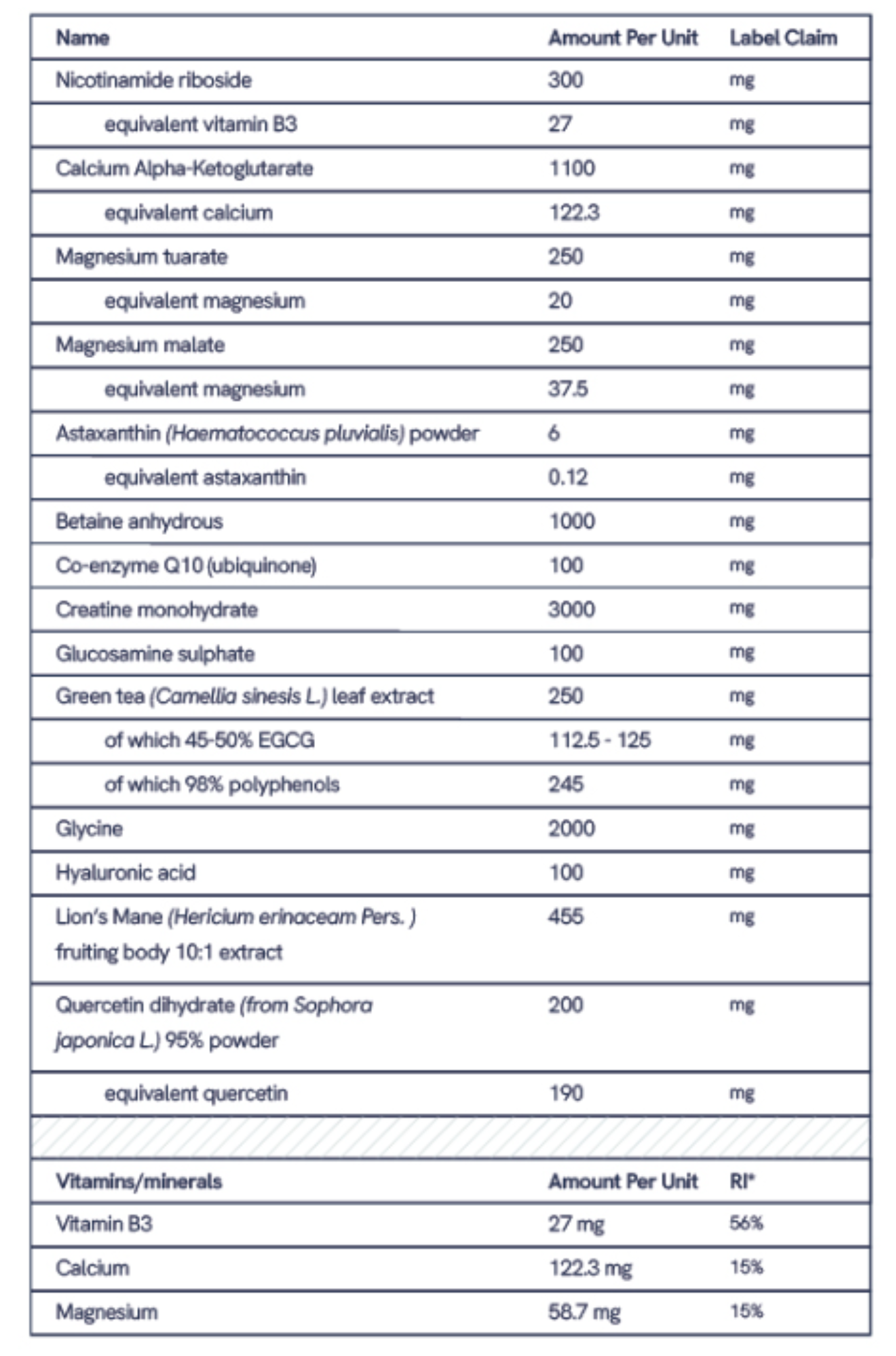
For transparency, Longevity One is a daily powder, not an electrolyte tablet or a sports drink. It contains magnesium (as malate, 150 mg, 40% of the NRV) and calcium (130 mg), but no sodium or potassium, so it does not replace what you lose in sweat. Magnesium contributes to electrolyte balance. Magnesium contributes to normal muscle function. Magnesium contributes to a reduction of tiredness and fatigue. Vitamin B6, vitamin B12, folate, niacin and vitamin C contribute to the reduction of tiredness and fatigue. No stamina, endurance or performance claim is made for it. It is independently tested by Eurofins and NZVT certified, with every batch screened for banned substances.
A simple electrolyte plan for runners
- For runs under an hour, drink to thirst and skip the tablets.
- Weigh yourself before and after a few long runs in different weather.2
- If you lose more than about 2% of body weight, drink a little more on long runs.1
- Add sodium for long or hot sessions, and for races beyond about two hours.3,9
- Never drink so much that you gain weight during a run.
- For long runs, take carbohydrate as well; electrolytes are not fuel.8
- For cramps, look at pacing and event-specific training before tablets.5
If you feel dizzy, confused, very unwell or unusually tired during or after a long run, stop and seek medical help. Tiredness that is persistent, severe or new is a reason to see your GP rather than to add electrolytes.
Q&A: Electrolyte Tablets and Stamina
Do electrolyte tablets increase stamina?
No. They replace some of the sodium lost in sweat, which can matter in long, hot sessions, but a review of mineral supplements in sport found little evidence of performance gains.6 Stamina comes from training.
What are running stamina tablets?
The term covers electrolyte tablets, salt capsules and caffeine products. Electrolytes replace sweat losses, while carbohydrate is what fuels long runs.8 Check the label to see which you are buying.
Do I need electrolytes for a 10 km run?
Usually not. For runs under about an hour, losses are small and normal meals replace them.1 Drink to thirst.
How do I know if I am a salty sweater?
Some runners notice white, salty marks on their kit after long runs, but that is an informal sign, not a measurement. Sweat sodium varies widely between people and can be measured in a sweat test, but such tests need careful methods to be accurate.2
Do salt tablets help in a long race?
They may. In a half-Ironman trial, salt capsules kept blood sodium higher and the salt group finished faster on average.3 The trial was small, with 26 athletes.
Can I take too much sodium?
More is not better. One study found no benefit from 1,800 mg of sodium during a two-hour session.4 Use the amount your sweat losses justify, and if you have been advised to limit salt, ask your GP first.
Are electrolyte tablets safe if I drink a lot?
They do not make overdrinking safe.
Do electrolytes stop muscle cramps?
Probably not on their own. In 210 Ironman triathletes, those who cramped had similar blood electrolytes, and cramping was linked to faster racing and a history of cramps.5
Should I use electrolytes in hot weather?
For long sessions in heat, yes, as part of a plan based on your own fluid losses.9 Acclimatise to the heat gradually, and avoid both drinking too little and drinking too much.
Frequently Asked Questions
Can I take electrolyte tablets with my medication?
The Longevity One label advises consulting your doctor if you use medication. Ask your GP or pharmacist and bring the label of any electrolyte product too, since sodium needs during exercise vary widely between people.2
Does Longevity One replace electrolyte tablets?
No. It contains magnesium and calcium but no sodium or potassium, so it does not replace sweat losses on long runs.2 It is a daily formula, separate from what you drink during exercise.
What does Longevity One taste like?
It has a mango and pineapple flavour. Mix one scoop into 250 to 500 ml of water, or into a smoothie or yogurt.
Can I take electrolytes every day?
On rest days there are no large sweat losses to replace. They make sense around long or hot sessions where you lose a lot of sweat.1
Are electrolyte tablets suitable during pregnancy?
Ask your midwife or GP before using any supplement during pregnancy. Longevity One is not suitable during pregnancy and breastfeeding.
References
- American College of Sports Medicine, Sawka MN, Burke LM, Eichner ER, Maughan RJ, Montain SJ, et al. American College of Sports Medicine position stand. Exercise and fluid replacement. Med Sci Sports Exerc. 2007;39(2):377-390. View on PubMed ↗
- Baker LB. Sweating rate and sweat sodium concentration in athletes: a review of methodology and intra/interindividual variability. Sports Med. 2017;47(Suppl 1):111-128. View on PubMed ↗
- Del Coso J, González-Millán C, Salinero JJ, Abián-Vicén J, Areces F, Lledó M, et al. Effects of oral salt supplementation on physical performance during a half-ironman: a randomized controlled trial. Scand J Med Sci Sports. 2016;26(2):156-164. View on PubMed ↗
- Earhart EL, Weiss EP, Rahman R, Kelly PV. Effects of oral sodium supplementation on indices of thermoregulation in trained, endurance athletes. J Sports Sci Med. 2015;14(1):172-178. View on PubMed ↗
- Schwellnus MP, Drew N, Collins M. Increased running speed and previous cramps rather than dehydration or serum sodium changes predict exercise-associated muscle cramping: a prospective cohort study in 210 Ironman triathletes. Br J Sports Med. 2011;45(8):650-656. View on PubMed ↗
- Heffernan SM, Horner K, De Vito G, Conway GE. The role of mineral and trace element supplementation in exercise and athletic performance: a systematic review. Nutrients. 2019;11(3):696. View on PubMed ↗
- Jeukendrup AE. Nutrition for endurance sports: marathon, triathlon, and road cycling. J Sports Sci. 2011;29(Suppl 1):S91-S99. View on PubMed ↗
- Stellingwerff T, Cox GR. Systematic review: carbohydrate supplementation on exercise performance or capacity of varying durations. Appl Physiol Nutr Metab. 2014;39(9):998-1011. View on PubMed ↗
- McCubbin AJ, Allanson BA, Caldwell Odgers JN, Cort MM, Costa RJS, Cox GR, et al. Sports Dietitians Australia position statement: nutrition for exercise in hot environments. Int J Sport Nutr Exerc Metab. 2020;30(1):83-98. View on PubMed ↗
- Jeukendrup AE, Jentjens RL, Moseley L. Nutritional considerations in triathlon. Sports Med. 2005;35(2):163-181. View on PubMed ↗
Disclaimer: Educational content only. Not medical advice. Food supplements should not be used as a substitute for a varied, balanced diet and a healthy lifestyle. If you use medication, consult your doctor.