Longevity Academy

Longevity Academy | The Longevity Store

Longevity Academy

We believe that healthy aging does not start with supplements, but with a conscious lifestyle. That is why we share our knowledge about sleep, nutrition, exercise and mental health - from extensive courses to practical tips.

Man working on laptop with water bottle

Longevity: The Basics

Our 11-chapter course, developed with longevity experts, gives you the knowledge and practical tools to make informed choices, practical for your daily routine.

  • In-depth Longevity Course from A to Z
  • Based on Published Research
  • Written By Experts
LONGEVITY 101 COURSE
Our advisory board

Our Advisory Board

For our Academy we work with experts in longevity. Clear explanations based on published research, translated into practical steps.

Dr. Robert Lufkin
Dr. Robert Lufkin
Head of TLS Advisory Board · Former Medical School Professor
Elizabeth Parrish MBA
Biotech & Longevity Advisor
Dr. Denys Tsveiuk
Dr. Denys Tsveiuk
Founder of Non Nocere Clinic · MD, Integrative Medicine
Dr. Robert Lufkin
Dr. Robert Lufkin
Head of TLS Advisory Board · Former Medical School Professor
Elizabeth Parrish MBA
Biotech & Longevity Advisor
Dr. Denys Tsveiuk
Dr. Denys Tsveiuk
Founder of Non Nocere Clinic · MD, Integrative Medicine

Longevity Insights for You

All
All
Nutrition
Nutrition
Exercise
Exercise
Recovery
Recovery
Cognitive Health
Cognitive Health
Ethics & Society
Ethics & Society
Future of Longevity
Future of Longevity
Other
Other
Showing all articles

Vitamins and Minerals for Muscle Fatigue After Training

Muscle fatigue after training mostly reflects the session itself, and recovers with food, protein, fluids and sleep. A few nutrients carry authorised claims about muscle function and tiredness in ...

Read More

Do Runners Need a Multivitamin? What the Evidence Shows

Most runners who eat enough, and eat a varied diet, will not run better on a multivitamin: a 90-day controlled trial in active men found no performance gain.1 A multivitamin can still be a sensibl...

Read More

How to Choose an Energy Supplement: A Buying Guide

The best dietary supplement for energy is one whose label you can check. Look for six things: where any lift comes from (caffeine or nutrients), doses of at least 15% of the NRV, claims in authori...

Read More

'Supports Normal Energy Release': What Energy Claims on Labels Mean

'Contributes to normal energy-yielding metabolism' is an authorised EU claim meaning a nutrient plays a role in turning food into energy in your body. It does not mean the product gives you extra ...

Read More

Rest Isn't Only Sleep: Types of Rest That Restore Energy

Rest is more than sleep. Sleep is the foundation, but energy also comes back through short naps, brief breaks during work, mentally switching off, time in nature, gentle movement, enjoyable leisur...

Read More

Can Magnesium Make You Tired?

For most people, no. Magnesium is not a sedative, and in sleep trials it has, if anything, been linked to better mornings rather than daytime drowsiness. Tiredness after starting magnesium is more...

Read More

Supplements for Triathletes: Fuelling Three Sports in One Race

For a triathlon, the supplements with the best evidence are carbohydrate, taken mainly on the bike leg, and caffeine before the start. Sodium in your drinks helps on long, hot races. Because train...

Read More

Why You Feel Tired the Day After Exercise

Feeling tired the day after exercise is common. Muscle soreness builds over a day or two, measurable muscle fatigue can last 48 to 72 hours after hard sessions, and the feeling of fatigue can outl...

Read More

How to Find the Energy to Exercise When You're Tired

When you are tired, exercise feels harder mainly because mental fatigue raises perceived effort, not because your body cannot do it. Short, easy sessions often leave people feeling more energetic:...

Read More

Energy and Focus Without Stimulants: What to Look For in a Supplement

A stimulant-free energy and focus supplement relies on nutrients instead of caffeine. Nutrients with authorised EU claims include magnesium and B vitamins such as B6, B12 and niacin, which contrib...

Read More

Can Vitamin C Give You Energy?

Vitamin C does not give you energy the way caffeine or food does, but it is involved in energy metabolism, and vitamin C contributes to the reduction of tiredness and fatigue. People with low vita...

Read More

Diet and Low Energy: What to Eat When You're Always Tired

If you are always tired, start with your plate: regular meals, slow-digesting carbohydrate with protein and fibre, enough fluid, and foods that supply iron, vitamin B12, folate and magnesium. Suga...

Read More

Electrolyte Tablets for Stamina: Do They Help?

Electrolyte tablets do not build stamina. They replace some of the sodium you lose in sweat, which matters mainly in long, hot sessions of two hours or more and for heavy, salty sweaters. For most...

Read More

A 7-Day Meal Plan for Steady Energy

This 7-day meal plan builds every meal on protein, fibre and slow-digesting carbohydrate, with fruit or vegetables at each meal, planned snacks, and water throughout. It avoids long gaps and sugar...

Read More

Energy Supplements Without Caffeine: What to Look For

A caffeine-free energy supplement will not give you the jolt of a coffee, and a good one does not pretend to. Check the label for hidden caffeine sources such as guarana or green tea extract, then...

Read More

Alcohol and Tiredness: Why a Few Drinks Drain Your Energy

Alcohol makes you sleepy at first but leaves you more tired the next day. It helps you fall asleep, then fragments the second half of the night, cuts REM sleep from about two drinks, and keeps hea...

Read More

Is Powdered Caffeine Safe? Pure Powder, Drink Mixes and Dosing Errors

Pre-portioned caffeine drink mixes with the dose printed per serving are as safe as the same amount from coffee. Pure caffeine powder is different. A normal dose is a fifth of a gram, too small to...

Read More

Teas for Energy: Green Tea, Matcha and Caffeine-Free Options

For energy and focus, black and green tea give a gentler dose of caffeine than coffee, about 14 to 61 mg a cup, together with L-theanine. In studies, tea and its caffeine plus L-theanine improved ...

Read More

Creatine in Energy Drinks: Does It Do Anything?

Creatine carries an authorised EU claim only at 3 g a day: creatine increases physical performance in successive bursts of short-term, high intensity exercise. A drink with less than that per serv...

Read More

Energy Gummies: What Is in Them, and Do They Work?

Several vitamins and minerals promote normal energy metabolism, including B vitamins, vitamin C and magnesium, and several carry an authorised claim about tiredness and fatigue. Energy gummies can...

Read More

Multivitamin for Women's Energy: What to Check

A multivitamin for women's energy is worth checking for three things: the nutrients with authorised tiredness claims at meaningful doses, whether it contains iron and how much, and every dose prin...

Read More

Pre-Workout, Energy Drink or a Daily Formula: Which Do You Need?

For training, a pre-workout and an energy drink mostly do the same job, and caffeine is the active part of both. Energy drinks often add sugar, while pre-workouts usually carry more caffeine per s...

Read More

At What Age Do You Start Feeling Tired?

There is no age at which tiredness switches on. In large population studies, age on its own explains very little of how tired adults feel, and in some samples older adults reported less fatigue. S...

Read More

Should You Exercise When You're Tired? A Decision Guide

Usually yes, if you are mentally tired but well: mental fatigue makes exercise feel harder without changing what your body can do, and a short, easy session often leaves people feeling more energe...

Read More

What Makes an Energy Drink or Supplement 'Cleaner'?

'Clean' has no legal definition on an energy drink or supplement, so it only means something when the label backs it up. Check five facts: caffeine in mg per serving, every dose printed, the sugar...

Read More

Energy and Focus Drinks: What's in Them?

Most energy and focus drinks combine caffeine with some of L-theanine, sugar or a sweetener, taurine, B vitamins and herbal extracts such as guarana or ginseng. In human trials, caffeine explains ...

Read More

Natural vs Synthetic Vitamins for Energy: Does the Source Matter?

For most vitamins, the chemical form and the dose matter more than whether the source is natural. Vitamin C from fruit and from a tablet was absorbed equally well in a controlled trial. Where real...

Read More

Mental Energy: What It Is and How to Protect It

Mental energy is the feeling of being willing and able to do mental work. Researchers measure it through mood scales and through tests of sustained attention and reaction time. It is drained by lo...

Read More

The 2pm crash: why you get tired after lunch

The 2pm crash is real and common. Your body clock has a natural dip in alertness in the early afternoon, and it happens even if you skip lunch. A large or carbohydrate-heavy lunch, a short night, ...

Read More

Sports Energy Powders: Carbs, Caffeine or Nutrients?

The best energy powder for a workout depends on the workout. For sessions over about an hour, a carbohydrate mix supplies fuel. Before a hard session, a caffeine-based pre-workout can help some pe...

Read More

Energy Supplements for Men: What the Evidence Supports

For most men, low energy comes from sleep, workload, alcohol and diet before any missing nutrient. The vitamins and minerals with authorised tiredness claims, such as magnesium, vitamin B6 and vit...

Read More

How to Read an Energy Drink Label

Read an energy drink label from the back. Find the caffeine in mg per 100 ml and multiply by the can size, then do the same for sugars. Check the vitamins against their % NRV, list every sweetener...

Read More

Supplements for Running Stamina: What Runners Should Know

For most runners, stamina comes from consistent training, enough fuel and enough sleep, not from a supplement. Caffeine has good evidence for endurance performance, and carbohydrate matters on lon...

Read More

Signs your body is run down, and what actually helps

Feeling run down usually means your recovery has fallen behind your load. Common signs are tiredness that sleep does not clear, poor sleep, low mood or a short fuse, and exercise that feels harder...

Read More

Cellular Energy and ATP Supplements Explained

"Cellular energy" on a label almost always points to ATP, the molecule every cell uses to store and spend energy. Your body makes its own ATP from food, around the clock. Swallowing ATP does not s...

Read More

Supplements for Endurance Athletes: What the Evidence Supports

For endurance athletes, the biggest gains come from training and fuelling: enough carbohydrate before and during long sessions, fluids and sleep. A few supplements have good evidence for specific ...

Read More

Best Fruit for Energy: What Human Studies Say About Kiwifruit, Bananas and More

There is no single best fruit for energy, because all fruit supplies its energy as natural sugar. What differs is what comes with it. Kiwifruit, citrus and strawberries are rich in vitamin C, whic...

Read More

IV Vitamin Drips for Energy: Are They Worth It?

An IV drip puts fluid and vitamins straight into a vein, so blood levels rise faster and higher than any tablet or drink can manage. The evidence that this helps healthy people feel less tired is ...

Read More

Effervescent Energy Tablets: Do They Work?

Effervescent energy tablets are fizzy vitamin tablets, usually B vitamins and vitamin C, sometimes with magnesium, caffeine or guarana. Daily trials over four to five weeks found modest effects on...

Read More

Do Minerals Give You Energy? Magnesium, Iron and Zinc Explained

Minerals contain no calories, so they cannot give you energy the way food does. Several help your body make and use it: magnesium is needed for ATP, iron carries oxygen and works in the mitochondr...

Read More

How Your Body Turns Food into Energy (and Where Vitamins Fit)

Your body turns food into energy by breaking carbohydrate, fat and protein into smaller molecules and capturing the energy they release in a molecule called ATP. Most ATP is made inside mitochondr...

Read More

Caffeine Alternatives for Energy: What Actually Works?

The best-supported caffeine alternatives are not products. Ten minutes of brisk walking or stair climbing, bright daylight, a 10-minute nap, enough sleep and enough fluid each improve how awake pe...

Read More

Energy Foods for Older Adults: What to Eat for Energy After 60

After 60, energy depends less on any single food and more on eating enough of the right things. Appetite and thirst tend to fall, protein needs rise to about 1.0 to 1.2 g per kg a day, and the bod...

Read More

Are High-Potency 'Energy' Vitamins Better?

High-potency energy vitamins are not better for most people. Vitamins act as cofactors, so once your needs are met, extra amounts add little and are often poorly absorbed or excreted. Some nutrien...

Read More

Energy-Zapping Habits and What to Change

Most energy-zapping habits are ordinary: sleeping six hours, shifting bedtimes at the weekend, screens in bed, coffee after mid-afternoon, a few evening drinks, sitting for hours, skipping exercis...

Read More

CNS Fatigue Explained: What Central Fatigue Is and What the Evidence Shows

CNS fatigue, or central fatigue, is a drop in the nervous system's ability to drive the muscles fully. It is real and measurable, but research suggests it is usually short-lived: after brief hard ...

Read More

Energy Gels and Liquid Energy: Do You Need Them?

Energy gels and other liquid carbohydrate help mainly in exercise lasting longer than about an hour, where 30 to 60 g of carbohydrate an hour, and up to 90 g beyond two and a half hours, supports ...

Read More

Organic and 'Natural' Energy Drinks: What's Actually Different?

An EU organic logo on an energy drink means at least 95% of its farmed ingredients are certified organic, with limits on additives. It does not cap caffeine or sugar, and systematic reviews find l...

Read More

How Long Do Vitamins Take to Work? Realistic Timelines

Most vitamins and minerals are not felt within hours. In human trials, changes linked to B vitamins and minerals were measured after four to nine weeks, iron after twelve weeks, and creatine takes...

Read More

Stim-Free Pre-Workout: Does It Work?

A stim-free pre-workout can help a little, if its ingredients are at studied doses. Citrulline and nitrate show small effects in meta-analyses, and the "pump" evidence is thin. Beta-alanine and cr...

Read More

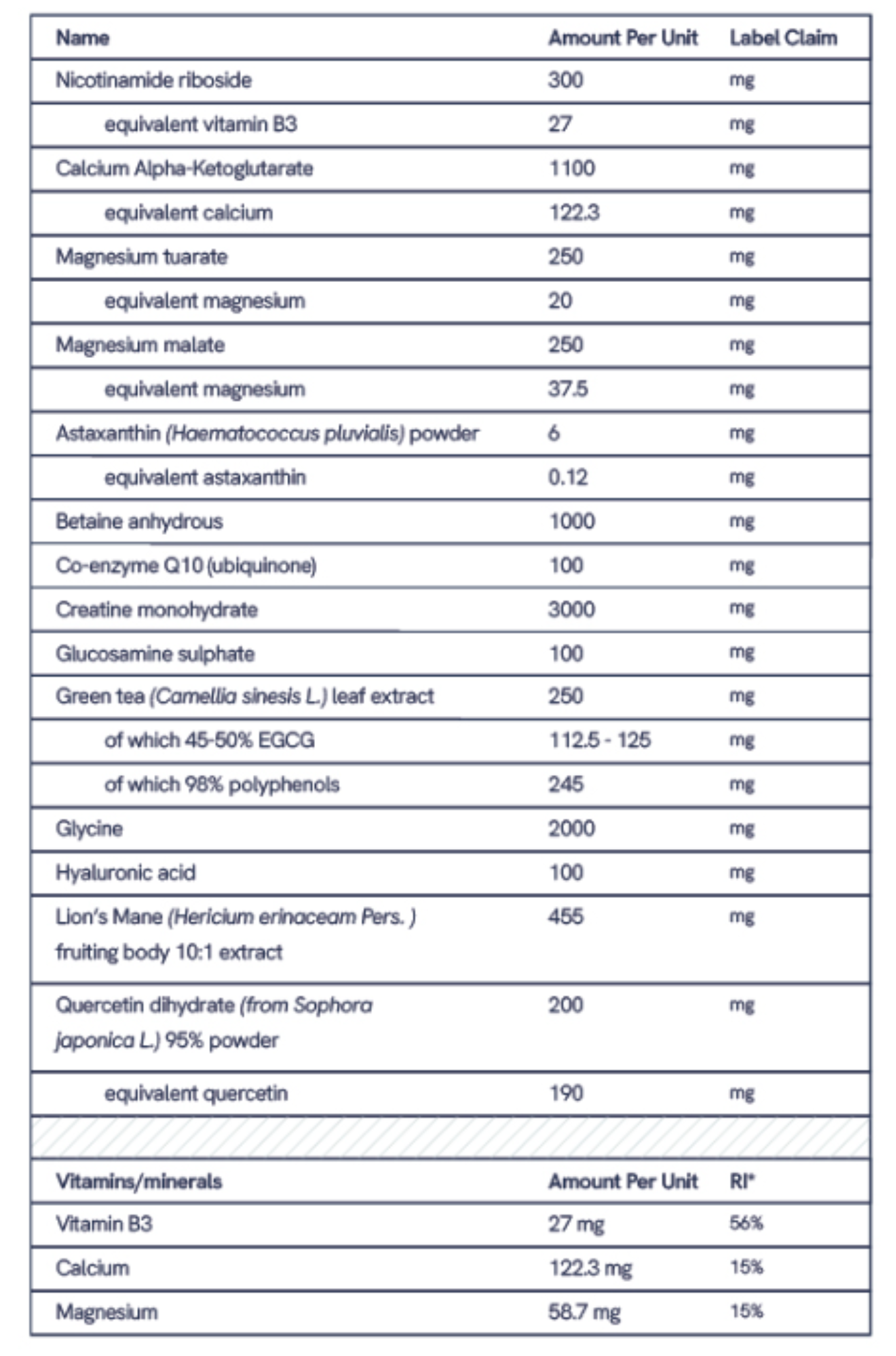
Longevity One

24 ingredients in one shake, including an NAD+ precursor (NR, 300 mg). Its vitamins and minerals support energy¹, cognitive function², and vitality.

SHOP NOW
  • Checkmark Based on Published Research
  • Checkmark Made in NL
  • Checkmark Expert Formulated
  • Checkmark Eurofins Lab Tested
  • Checkmark 24 Ingredients in 1
  • Checkmark 90-Day Money-Back Guarantee

Independent Testing & Quality Controls