After 60, energy depends less on any single food and more on eating enough of the right things. Appetite and thirst tend to fall, protein needs rise to about 1.0 to 1.2 g per kg a day, and the body absorbs less vitamin B12 from food. Regular meals with protein, foods rich in B12 and vitamin D, steady fluid, and strength training make the biggest difference.
Key Takeaways
- In a meta-analysis of 59 studies, healthy older adults ate 16% to 20% less than younger adults and reported 25% to 39% less hunger.1
- Expert groups advise healthy people over 65 to eat at least 1.0 to 1.2 g of protein per kg of body weight a day, and more if they are active.2,3
- About 6% of people over 60 in large surveys had low vitamin B12 and close to 20% had marginal levels, mainly because less B12 is released from food with age.4
- In standardised data from 55,844 Europeans, 13% had very low vitamin D levels across the year, rising to 17.7% in winter.
- When older adults are short of fluid, they feel less thirsty and drink less than younger adults, so a drinking routine is a sensible safeguard.5
- In adults over 55 doing resistance training, daily creatine can enhance the effect of the training on muscle strength.6
- Food comes first; a supplement is a bridge, not a replacement, and new or persistent tiredness needs a GP check.
Many people notice that their energy changes in their sixties and seventies. Some of that is normal, and some of it is not. The search for "energy food for seniors" usually comes from a practical question: what can I eat to feel more like myself? There is no single food that delivers energy beyond its calories, and no food carries an authorised claim for energy. But a few things about eating change with age in ways that affect how tired people feel, and each of them has a food answer. This guide covers appetite, protein, vitamin B12, vitamin D and fluid, then shows how to put them together.
What changes about food and energy as we age?
Three changes matter most. First, appetite tends to fall. Second, the body handles some nutrients differently: muscles respond less to the protein in a meal, and less vitamin B12 is released from food.2,4 Third, the sense of thirst becomes less reliable. None of these changes is dramatic on its own, but together they make it easier to eat and drink a little less than you need, for months or years, without noticing. Vitamins and minerals involved in energy-yielding metabolism, such as the B vitamins, iron and magnesium, are linked with fatigue when intake or status is low.7 Most of the authors of that review work for a consumer health company.
Why does appetite fall, and why does it matter?
A meta-analysis pooled 59 studies that compared healthy older adults (on average about 70) with younger adults (about 26). Energy intake was 16% to 20% lower in the older groups. Hunger was 25% to 39% lower, and fullness after an overnight fast was 37% higher. The authors concluded that ageing itself affects food intake, not only illness or medication.1
A smaller appetite is not a problem in itself. It becomes one when meals shrink without becoming richer in nutrients, so that protein, vitamins and minerals fall along with calories. That is why the rest of this guide focuses on nutrient-dense food: meals and snacks that bring more protein, vitamins and minerals per bite.
How do you eat well when your appetite is smaller?
- Eat more often: three smaller meals and two snacks can be easier than three large meals.
- Put protein first: start the meal with the fish, eggs, cheese, yogurt or beans, before you fill up on bread.
- Add without adding volume: a spoon of olive oil, a handful of nuts, grated cheese or a spoon of seeds raises nutrients without making the plate bigger.
- Make breakfast count: it is often the meal with the best appetite. Eggs, yogurt and oats are good bases.
- Eat with others when you can: many people find meals easier to enjoy in company. Staying socially and mentally active matters too, as our article on neuroplasticity after 50 explains.
How much protein do older adults need?
More than many people think. The PROT-AGE study group, convened with the European Union Geriatric Medicine Society, recommends that people over 65 eat at least 1.0 to 1.2 g of protein per kg of body weight a day, and 1.2 g per kg or more if they exercise or are otherwise active. It recommends both endurance and resistance exercise at levels that are safe for the individual.2 The ESPEN expert group reached the same range of 1.0 to 1.2 g per kg for healthy older people, and advised daily physical activity, including resistance and aerobic training, for as long as possible.3
For a 70 kg person, 1.0 to 1.2 g per kg is 70 to 84 g of protein a day, which is more than a light breakfast, a sandwich and a small dinner usually provide. Spreading it across the day, with a protein food at each meal, is the practical way to get there. If your GP has advised you to limit protein, follow that advice.
| Food | Typical portion | Protein | Vitamin B12 | Vitamin D |
|---|---|---|---|---|
| Salmon, farmed | 120 g raw | 24 g | 3.9 mcg (155% NRV) | 13 mcg (264% NRV) |
| Sardines, canned in oil | 90 g (one tin, drained) | 22 g | 8.0 mcg (322% NRV) | 4.3 mcg (86% NRV) |
| Eggs | 2 large (100 g) | 13 g | 0.9 mcg (36% NRV) | 2.0 mcg (40% NRV) |
| Greek yogurt, plain, fat-free | 150 g | 15 g | 1.1 mcg (45% NRV) | 0 |
| Cottage cheese, low fat | 150 g | 16 g | 0.7 mcg (28% NRV) | 0 |
| Whole milk | 250 ml | 8 g | 1.2 mcg (46% NRV) | Depends on fortification |
| Canned tuna in water, drained | 100 g | 19 g | 2.6 mcg (102% NRV) | 1.2 mcg (24% NRV) |
| Lentils, cooked | 150 g | 14 g | 0 | 0 |
Figures are from USDA FoodData Central (SR Legacy, each food links its entry), scaled to the portion shown, with % of the EU nutrient reference value (NRV) from Annex XIII of Regulation (EU) No 1169/2011. Vitamin D in salmon is for farmed fish; the USDA entries for wild salmon give no vitamin D value. Oily fish stands out because it brings protein, vitamin B12 and vitamin D in one portion.
Why does vitamin B12 matter more after 60?
Vitamin B12 contributes to the reduction of tiredness and fatigue. Vitamin B12 contributes to normal energy-yielding metabolism. It comes from animal foods such as fish, meat, eggs and dairy. A review of large surveys in the United States and the United Kingdom found that about 6% of people aged 60 or over had low B12 (below 148 pmol/L), and close to 20% had marginal levels, with the prevalence rising with age. In older people, the main cause is not low intake but reduced release of B12 from food in the stomach. The B12 in fortified foods and supplements is still absorbed well by most older people, because it is not bound to food proteins.4
This is a good example of where testing helps. Low B12 develops slowly and can be mistaken for "just getting older". If you are tired, ask your GP whether a B12 test makes sense, especially if you eat few animal foods or take regular medication. Our guide to B vitamins and energy metabolism explains the B vitamins in more detail.
What about vitamin D?
Vitamin D is made in the skin in sunlight. The NHS states that in the UK, between October and early March, the body does not make enough vitamin D from sunlight. A study that standardised blood data from 14 European population studies, covering 55,844 people, found that 13% had levels below 30 nmol/L on average across the year, rising to 17.7% in those sampled in the extended winter (October to March). Using a higher cut-off of 50 nmol/L, 40.4% were below it. People who spend more time indoors also get less sun.
Few foods are rich in vitamin D: oily fish such as salmon, mackerel and sardines, eggs, and foods with added vitamin D. Vitamin D contributes to the maintenance of normal muscle function. Vitamin D contributes to the maintenance of normal bones. It does not carry an authorised claim for tiredness, so it belongs in this guide for muscle and bone reasons rather than energy. In the Netherlands, the Netherlands Nutrition Centre (Voedingscentrum) advises a daily vitamin D supplement of 20 mcg for everyone aged 70 and over, and 10 mcg for women aged 50 to 69. The NHS advises everyone in the UK to consider a daily supplement in autumn and winter. Ask your GP or pharmacist what applies to you.

Why is thirst less reliable with age?
A review of age and fluid balance found that healthy older adults living independently usually drink enough day to day. When they are challenged by heat, exercise or a period without fluid, though, they feel less thirsty and drink less than younger adults, and their fluid balance recovers more slowly.5 In studies in healthy young adults, losing about 1.4% to 1.6% of body mass as fluid raised fatigue and, in women, difficulty concentrating.8,9 These studies were not in older people, but together they make a drinking routine a sensible safeguard rather than waiting for thirst.
- Have a drink with every meal and snack.
- Keep a glass or bottle where you can see it.
- Drink more in hot weather, during illness, and around exercise.
- Water, milk, tea and coffee all count; soup and fruit add fluid too.
- If you take medication that affects fluid balance, ask your GP how much to drink.
Does strength training change what you should eat?
It changes how much you get from what you eat. Muscles respond better to protein when they have been worked, and expert groups pair their protein advice with regular resistance and aerobic exercise for older people.2,3 A meta-analysis of randomised trials in 357 older adults (average age about 64) found that adding creatine to around 12 weeks of resistance training increased gains in chest and leg press strength more than training alone.6 The authors noted that the number of studies was limited.
Our longevity exercise programme explains how to build strength training into a week, and our article on creatine beyond the gym covers creatine in more depth.
What does a good day of eating look like after 60?
| Meal | Example | What it adds |
|---|---|---|
| Breakfast | Two eggs on whole-grain toast with tomatoes, or Greek yogurt with oats, berries and seeds | 13 to 20 g protein; B12; fibre2 |
| Mid-morning | A glass of milk and a piece of fruit | Fluid, protein, B12 |
| Lunch | Lentil soup with cheese on bread, or a tuna and bean salad | Protein, fibre, iron |
| Afternoon | A handful of nuts with a kiwifruit or orange | Magnesium, vitamin C |
| Dinner | Salmon or chicken with potatoes and vegetables | Protein, B12, vitamin D (salmon) |
| Evening | Cottage cheese or yogurt if hungry | Another protein dose |
This is a template, not a medical diet. If you follow a diet prescribed by your GP or dietitian, stick to it. Our 7-day meal plan for steady energy and our breakfast guide (both part of this series) give more examples.
Where does a supplement fit?
A supplement is a bridge, not a replacement. It is useful where food falls short for a known reason, and later life has a few: less B12 is absorbed from food, vitamin D levels drop in winter, and a smaller appetite can leave gaps.1 It cannot provide the protein, energy or fluid that meals do.
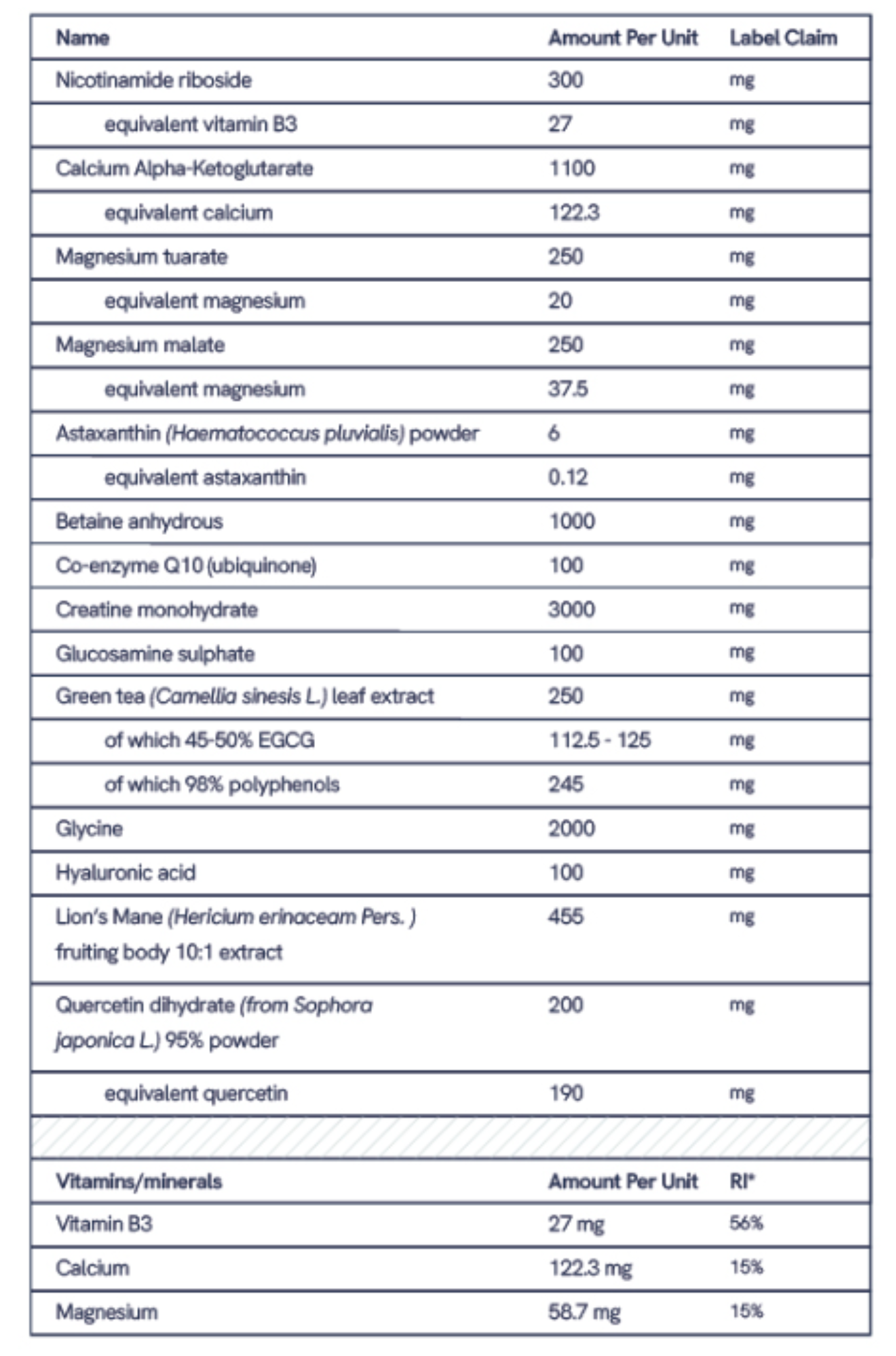
For transparency, our own daily formula, Longevity One, contains vitamin B12 (2.5 mcg, 100% NRV), vitamin D3 (10 mcg, 200% NRV), magnesium (as malate, 150 mg, 40% NRV), folate, vitamin B6 and 3,000 mg of creatine monohydrate. Magnesium contributes to a reduction of tiredness and fatigue. Vitamin B12, folate and vitamin B6 contribute to the reduction of tiredness and fatigue. Vitamin D contributes to the maintenance of normal muscle function. Daily creatine consumption can enhance the effect of resistance training on muscle strength in adults over the age of 55. The claim applies only to people who do resistance training. It contains no iron and no caffeine source, and it is independently tested by Eurofins and NZVT certified. Our article on magnesium and healthy ageing covers magnesium.
When should you see your GP about tiredness?
Tiredness in later life is common but not something to accept without a check. See your GP if it is new, severe or has lasted several weeks; if it comes with breathlessness, unexplained weight loss, a poor appetite that does not recover, low mood or confusion; or if it started after a change in medication. Blood tests for B12, folate, iron and vitamin D are simple, and testing first means you only supplement what you need.4
Q&A: Energy Foods for Older Adults
What are the best energy foods for older adults?
No food carries a claim for energy, but some foods do a lot of work. Oily fish, eggs, dairy, legumes, nuts and whole grains bring protein, vitamin B12, vitamin D and magnesium.2,4 Eat them across regular meals and snacks.
Why do older people get tired more easily?
Many reasons are not about food at all, such as sleep, medication and illness. On the food side, appetite and energy intake fall with age, and B12 absorption from food declines.1,4 A GP check helps separate the causes.
How much protein should a 70-year-old eat?
Expert groups recommend at least 1.0 to 1.2 g per kg of body weight a day for healthy older adults, and 1.2 g or more for active people.2,3 For a 70 kg person, that is roughly 70 to 85 g. Spread it across meals.
Should older adults take vitamin B12?
Not automatically. About 6% of people over 60 have low B12 and close to 20% have marginal levels.4 A blood test shows whether you need more, and fortified foods and supplements are absorbed well.
Does vitamin D give older adults more energy?
Vitamin D has no authorised claim for tiredness. Vitamin D contributes to the maintenance of normal muscle function, and low levels are common in European winters. Ask your GP or pharmacist about the advice for your age group.
How can I eat more when I am not hungry?
Smaller meals more often, protein first, and adding nuts, olive oil, cheese or seeds without making the plate larger all help. Hunger tends to be lower in older adults even when healthy.1 Eating with others often helps too.
How much should older adults drink?
Enough to stay comfortable. Thirst is less reliable when you are short of fluid, because older adults feel less thirsty than younger adults in that situation.5 Drinking with every meal and snack is a simple routine. Ask your GP if you have been told to limit fluid.
Is creatine useful after 60?
For adults over 55 doing resistance training, daily creatine can enhance the effect of the training on muscle strength. A meta-analysis in 357 older adults found greater gains in some strength measures with creatine plus training than with training alone.6 It is not a substitute for the training itself.
Are protein shakes needed after 60?
Usually not. Most people can reach their protein target from food spread across the day.2 A shake can help on days when appetite is poor.
Frequently Asked Questions
Can I take a daily supplement with my medication?
The label advises consulting your doctor if you use medication. Ask your GP or pharmacist and bring the label.
What does Longevity One taste like?
It has a mango and pineapple flavour. Mix one scoop in 250 to 500 ml of water, or stir it into a smoothie or yogurt if you prefer.
Is it normal to feel more tired after 60?
Some change is common, but persistent or new tiredness is worth a GP check. Low vitamin B12 is one of several causes that a simple blood test can find.4
Which foods have both protein and vitamin B12?
Fish, eggs, meat, milk, yogurt and cheese. One tin of sardines gives about 22 g of protein and over three times the daily reference value for B12, according to USDA FoodData Central. B12 from fortified foods is absorbed well in later life.4
Does a smaller appetite mean I need less protein?
No. Calorie needs may fall, but expert groups advise older adults to eat more protein per kg than younger adults.2,3 Choose foods that pack protein into a smaller portion.
References
- Giezenaar C, Chapman I, Luscombe-Marsh N, Feinle-Bisset C, Horowitz M, Soenen S. Ageing is associated with decreases in appetite and energy intake: a meta-analysis in healthy adults. Nutrients. 2016;8(1):28. View on PubMed ↗
- Bauer J, Biolo G, Cederholm T, Cesari M, Cruz-Jentoft AJ, Morley JE, et al. Evidence-based recommendations for optimal dietary protein intake in older people: a position paper from the PROT-AGE Study Group. J Am Med Dir Assoc. 2013;14(8):542-559. View on PubMed ↗
- Deutz NE, Bauer JM, Barazzoni R, Biolo G, Boirie Y, Bosy-Westphal A, et al. Protein intake and exercise for optimal muscle function with aging: recommendations from the ESPEN Expert Group. Clin Nutr. 2014;33(6):929-936. View on PubMed ↗
- Allen LH. How common is vitamin B-12 deficiency? Am J Clin Nutr. 2009;89(2):693S-696S. View on PubMed ↗
- Kenney WL, Chiu P. Influence of age on thirst and fluid intake. Med Sci Sports Exerc. 2001;33(9):1524-1532. View on PubMed ↗
- Devries MC, Phillips SM. Creatine supplementation during resistance training in older adults: a meta-analysis. Med Sci Sports Exerc. 2014;46(6):1194-1203. View on PubMed ↗
- Tardy AL, Pouteau E, Marquez D, Yilmaz C, Scholey A. Vitamins and minerals for energy, fatigue and cognition: a narrative review of the biochemical and clinical evidence. Nutrients. 2020;12(1):228. View on PubMed ↗
- Armstrong LE, Ganio MS, Casa DJ, Lee EC, McDermott BP, Klau JF, et al. Mild dehydration affects mood in healthy young women. J Nutr. 2012;142(2):382-388. View on PubMed ↗
- Ganio MS, Armstrong LE, Casa DJ, McDermott BP, Lee EC, Yamamoto LM, et al. Mild dehydration impairs cognitive performance and mood of men. Br J Nutr. 2011;106(10):1535-1543. View on PubMed ↗
Disclaimer: Educational content only. Not medical advice. Food supplements should not be used as a substitute for a varied, balanced diet and a healthy lifestyle. If you use medication, consult your doctor.