Vitamin C does not give you energy the way caffeine or food does, but it is involved in energy metabolism, and vitamin C contributes to the reduction of tiredness and fatigue. People with low vitamin C status report more fatigue, and correcting a shortfall can help. If your intake is already adequate, extra vitamin C is unlikely to make you feel more energetic.
Key Takeaways
- Vitamin C is a cofactor in making carnitine, which carries fatty acids into mitochondria to be used for energy.1
- Fatigue can occur when vitamin C status or supply is not adequate, alongside shortfalls in B vitamins, iron and magnesium.2
- In US survey data, 7.1% of people had deficient vitamin C levels, and smokers had levels about one-third lower than non-smokers.3
- Blood levels rise steeply between 30 and 100 mg a day; at single doses of 500 mg and higher, absorption declines and the extra is excreted.4
- Vitamin C from a tablet and from fruit was absorbed equally well in a controlled cross-over trial.5
- Under Regulation (EU) No 432/2012, vitamin C increases iron absorption.
Vitamin C has a reputation as an all-purpose pick-me-up, and many "energy" products include it at high doses. The science gives a more specific answer. Vitamin C is involved in turning food into energy and in several other processes linked to fatigue, so being low in it can leave you feeling tired. Being well supplied and then taking more does not add energy on top. Below we look at how vitamin C is involved and how common low status is. Then we get to how much you need and what high-dose products actually deliver.
Does vitamin C give you energy?
Not directly. Vitamin C has no calories, so it is not a fuel, and it is not a stimulant. What it does is help several enzymes work. That role is reflected in two authorised EU claims: vitamin C contributes to the reduction of tiredness and fatigue, and vitamin C contributes to normal energy-yielding metabolism. Both are listed in Regulation (EU) No 432/2012, and both apply when a daily serving provides at least 15% of the nutrient reference value (NRV) of 80 mg, which is 12 mg, as set in Annex XIII of Regulation (EU) No 1169/2011.
A 2020 review of the biochemical and clinical evidence placed vitamin C alongside B vitamins, iron, magnesium and zinc as micronutrients with recognised roles in energy metabolism and fatigue, and described the fatigue that may occur when status or supply of these nutrients is not adequate.2 That condition, status that is not adequate, is the important one for anyone deciding whether to take more. Most of the review's authors work for a pharmaceutical company that sells supplements.
How is vitamin C involved in energy metabolism?
The best-understood link runs through carnitine. Vitamin C is a cofactor in the biosynthesis of carnitine, a molecule required to move fatty acids into the mitochondria, where they are oxidised for energy.1 Vitamin C contributes to the protection of cells from oxidative stress. A review links these roles with the fatigue that may occur when vitamin C status is not adequate.2
What happens to fat use when vitamin C is low?
A small preliminary study tested this link directly. Researchers compared 15 young adults with marginal vitamin C status and 7 with adequate status during a 60-minute treadmill walk at moderate intensity. Those with marginal status oxidised 25% less fat per kilogram of body weight, and lower fat oxidation during exercise was associated with higher fatigue ratings (correlation coefficient -0.611).1 In a second part of the study, eight participants with marginal status entered an eight-week double-blind depletion-repletion trial; those repleted with 500 mg of vitamin C a day raised fat energy expenditure during exercise four-fold compared with depleted controls.1 The study was very small. Read it as support for the mechanism rather than proof that vitamin C reduces tiredness in everyone.
What does research show about vitamin C and fatigue?
The human evidence is small but points in one direction: effects appear in people whose vitamin C was low. In a trial in New Zealand, 35 young men ate either half a gold kiwifruit or two gold kiwifruit a day for six weeks. Overall mood changes did not reach statistical significance. In a subgroup of participants who started with more mood disturbance, two kiwifruit a day were followed by a 38% decrease in fatigue scores and a 31% increase in vigour.6 Their vitamin C intake and blood levels rose significantly, although kiwifruit also supply other nutrients, so not every change can be credited to vitamin C alone.6 The fruit was supplied by a kiwifruit company. There was no effect in participants who started with less mood disturbance.
What about high-dose intravenous vitamin C?
One randomised, double-blind trial gave 141 healthy office workers aged 20 to 49 either 10 g of vitamin C intravenously or a saline placebo. Fatigue scores were lower in the vitamin C group two hours later and remained lower after one day.7 When the researchers split participants by their starting vitamin C levels, the reduction in fatigue was seen in the group with lower baseline levels and not in the group with higher levels.7 Two points matter here. First, an infusion is a medical procedure and bypasses the gut entirely, so the result says nothing about tablets or powders. Second, even at that dose, the benefit tracked low starting status, the same pattern as the food study.
How common is low vitamin C?
Less common than it once was, but not rare. In the 2003 to 2004 US National Health and Nutrition Examination Survey, which measured serum vitamin C in 7,277 people aged six and over, the age-adjusted prevalence of deficiency was 7.1%.3 Adult smokers had mean levels about one-third lower than non-smokers, and lower income was linked with a higher risk of deficiency. Recent vitamin C supplement use or an adequate dietary intake lowered the risk.3
In Europe, a comparison of national diet surveys from eight countries, including the Netherlands, Belgium and Germany, concluded that, except for vitamin D, intakes of vitamins from food carried a low risk of being too low across age and sex groups.8 That finding covers vitamins in general rather than vitamin C specifically, but it suggests most people who eat fruit and vegetables daily are unlikely to be short. The groups more likely to be low are smokers, people who eat little fresh produce, and people on very restricted diets.
How much vitamin C do you need, and when is more pointless?
The clearest data come from a depletion-repletion study in which seven healthy volunteers lived in hospital for four to six months on a diet with less than 5 mg of vitamin C a day, and then took seven daily doses from 30 to 2,500 mg in turn. Blood levels followed an S-shaped curve: the steep part lay between 30 and 100 mg a day, and complete plasma saturation occurred at 1,000 mg a day.4 Absorption was complete for a single 200 mg dose, but at single doses of 500 mg and higher, absorption declined and the absorbed extra was excreted in urine.4
The authors concluded that doses above 400 mg a day had no evident value, that safe doses were below 1,000 mg a day, and noted that oxalate and urate excretion rose at 1,000 mg a day.4 The study was very small, but the dose curve has shaped vitamin C recommendations since.
| Daily vitamin C | What happens in the body | What it means for tiredness |
|---|---|---|
| Under about 30 mg | Low blood levels; the steep part of the curve has not been reached4 | The range where low status and fatigue are most likely2 |
| 80 mg (the NRV) | On the steep part of the curve, where each extra mg raises levels most4 | Enough for the authorised claims; covers most needs |
| 100 to 200 mg | Approaching the plateau; a single 200 mg dose is completely absorbed4 | Little further gain if your diet is already adequate |
| 500 mg and above | Absorption from single doses declines and the extra is excreted4 | No evident added value above about 400 mg a day4 |
| 1,000 mg and above | Plasma saturated; oxalate and urate excretion rise4 | Cost and side-effect risk without added benefit |

Why does vitamin C not feel like caffeine?
Because it does not act on the brain's alertness signals in the way caffeine does. A high-dose vitamin C drink tablet that makes you feel more awake within half an hour may contain caffeine or sugar as well, so check the label. Vitamin C works over days and weeks by keeping your tissues supplied. For more on the difference between nutrient drinks and caffeine drinks, see our article on how longevity drinks differ from coffee and energy drinks.
Is food or a supplement better?
For most people, food covers it.8 Gold kiwifruit, used in the trial above, is a high-vitamin C food,6 and fresh fruit and vegetables in general are the everyday sources. If you take a supplement, the form is less important than you might think: in a randomised cross-over study, nine young men took 200 mg of vitamin C either as a chewable tablet or from gold kiwifruit, and blood levels over eight hours were the same, with complete uptake from both.5 The study was co-funded by a kiwifruit company. The fruit brings fibre and other nutrients the tablet does not, which is a good reason to eat it, but the vitamin C itself is equivalent.
Does vitamin C help with iron?
Yes, and this is a useful link for energy. Vitamin C increases iron absorption, which is an authorised claim in Regulation (EU) No 432/2012. Eating a vitamin C-rich food with plant sources of iron, such as beans or lentils, is a simple habit. If you suspect low iron, ask your GP for a blood test before taking iron supplements.
Which other nutrients matter for tiredness?
Vitamin C is one of several nutrients with the authorised tiredness claim in Regulation (EU) No 432/2012. Among the nutrients in our formula, the others are vitamins B6 and B12, folate, niacin and magnesium. If you feel tired and your vitamin C intake is fine, one of these, or sleep, is more likely to be the missing piece. Our guide to B vitamins and energy metabolism covers the B group in detail.
When should you see your GP?
See your GP if your tiredness is extreme, has lasted more than a few weeks, came on without an obvious reason, or comes with other changes such as easy bruising, bleeding gums, cuts that are slow to close, unplanned weight loss or breathlessness. Very low vitamin C is uncommon in people who eat fruit and vegetables, so persistent tiredness usually has another explanation that a GP can look into. If you smoke, ask about your vitamin C intake as well, since smokers tend to have lower levels.3
How much vitamin C is in Longevity One?
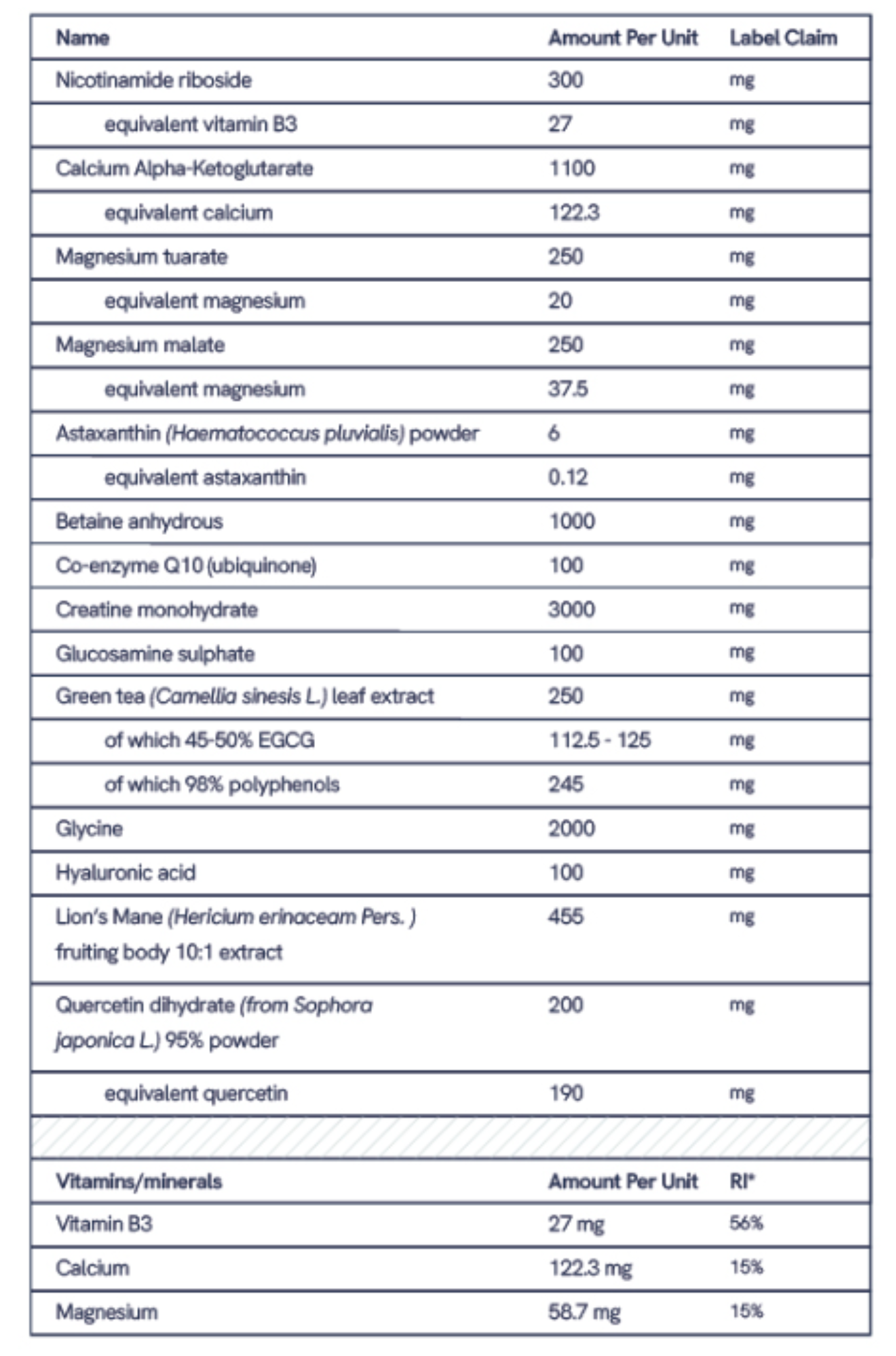
For transparency: Longevity One provides 100 mg of vitamin C (as ascorbic acid) per daily scoop, 125% of the NRV, on the steep, well-absorbed part of the dose curve rather than at megadose levels.4 At that level, vitamin C contributes to the reduction of tiredness and fatigue, and vitamin C contributes to normal energy-yielding metabolism. The formula also contains vitamins B6 and B12, folate and niacin, which carry the same tiredness claim. Magnesium contributes to a reduction of tiredness and fatigue. It contains no caffeine source. It is independently tested by Eurofins and NZVT certified.
Q&A: Vitamin C and Energy
Does vitamin C give you energy?
Not directly, because it is neither a fuel nor a stimulant. It is a cofactor in energy metabolism, for example in making carnitine, which carries fatty acids into mitochondria.1 Vitamin C contributes to the reduction of tiredness and fatigue, mainly when intake was low.
Can low vitamin C make you tired?
Yes. Fatigue is described among the effects of inadequate vitamin C status.2 In a small study, people with marginal vitamin C status burned less fat during exercise, and lower fat use was linked with more fatigue.1 Most people who eat fruit and vegetables are not low.
How much vitamin C should I take for tiredness?
The NRV of 80 mg covers most needs, and blood levels rise most steeply between 30 and 100 mg a day.4 Doses above about 400 mg a day showed no evident added value in the key dose study. Food alone often provides enough.
Is 1,000 mg of vitamin C a day better for energy?
No. At single doses of 500 mg and above, absorption declines and the extra is excreted.4 At 1,000 mg a day, oxalate and urate excretion also rose. Taking more than you need adds cost without adding energy.
How quickly does vitamin C work for fatigue?
In the kiwifruit study, changes in fatigue were measured after six weeks of eating two kiwifruit a day.6 Vitamin C works by restoring tissue levels, so expect weeks rather than hours. If a vitamin C drink gives an instant lift, check the label for caffeine or sugar.
Who is most likely to be low in vitamin C?
Smokers, people who eat little fresh fruit and vegetables, and people on restricted diets. In US survey data, smokers had vitamin C levels about one-third lower than non-smokers.3 Lower income was also linked with higher risk.
Is natural vitamin C better than synthetic?
For absorption, no. In a cross-over trial, 200 mg of vitamin C from a tablet or from gold kiwifruit gave the same blood levels.5 Fruit is still worth eating for its other nutrients.
Does vitamin C help you absorb iron?
Yes. Vitamin C increases iron absorption, which is an authorised claim. If you suspect low iron, ask your GP for a blood test before taking iron.
Does intravenous vitamin C reduce fatigue?
One trial in office workers found lower fatigue scores after a 10 g infusion, but only in those with lower starting levels.7 An infusion is a medical procedure, and the result does not apply to tablets or powders. Most people can meet their needs from food.
Is vitamin C an energy vitamin?
Vitamin C contributes to normal energy-yielding metabolism, an authorised claim it shares with several B vitamins. A review places it among the micronutrients with recognised roles in energy metabolism.2 Calling it an energy vitamin is fair only in that sense. It will not make you feel more energetic if you already get enough.
Frequently Asked Questions
Can I take vitamin C with my medication?
The label advises consulting your doctor if you use medication. Ask your GP or pharmacist and bring the label. High single doses of vitamin C are poorly absorbed in any case, so a modest dose is usually enough.4
Is it safe to take vitamin C every day?
At doses around the NRV, yes, for most people. In the main dose study, the authors considered safe doses to be below 1,000 mg a day and found no evident value above 400 mg.4 Avoid stacking several high-dose products.
Should I take vitamin C in the morning or evening?
Timing matters little, because vitamin C works by keeping tissue levels topped up, not by acting on the day you take it. Splitting larger amounts across meals suits the way absorption declines at higher single doses.4
What does Longevity One taste like?
It has a mango and pineapple flavour. Mix one level scoop in 250 to 500 ml of water, or stir it into a smoothie or yogurt.
Does vitamin C help if I smoke?
Smokers tend to have lower vitamin C levels, so making sure intake is adequate is reasonable.3 It does not offset the effects of smoking, and your GP can help if you want to stop.
References
- Johnston CS, Corte C, Swan PD. Marginal vitamin C status is associated with reduced fat oxidation during submaximal exercise in young adults. Nutr Metab (Lond). 2006;3:35. View on PubMed ↗
- Tardy AL, Pouteau E, Marquez D, Yilmaz C, Scholey A. Vitamins and minerals for energy, fatigue and cognition: a narrative review of the biochemical and clinical evidence. Nutrients. 2020;12(1):228. View on PubMed ↗
- Schleicher RL, Carroll MD, Ford ES, Lacher DA. Serum vitamin C and the prevalence of vitamin C deficiency in the United States: 2003-2004 National Health and Nutrition Examination Survey (NHANES). Am J Clin Nutr. 2009;90(5):1252-1263. View on PubMed ↗
- Levine M, Conry-Cantilena C, Wang Y, Welch RW, Washko PW, Dhariwal KR, et al. Vitamin C pharmacokinetics in healthy volunteers: evidence for a recommended dietary allowance. Proc Natl Acad Sci U S A. 1996;93(8):3704-3709. View on PubMed ↗
- Carr AC, Bozonet SM, Vissers MC. A randomised cross-over pharmacokinetic bioavailability study of synthetic versus kiwifruit-derived vitamin C. Nutrients. 2013;5(11):4451-4461. View on PubMed ↗
- Carr AC, Bozonet SM, Pullar JM, Vissers MC. Mood improvement in young adult males following supplementation with gold kiwifruit, a high-vitamin C food. J Nutr Sci. 2013;2:e24. View on PubMed ↗
- Suh SY, Bae WK, Ahn HY, Choi SE, Jung GC, Yeom CH. Intravenous vitamin C administration reduces fatigue in office workers: a double-blind randomized controlled trial. Nutr J. 2012;11:7. View on PubMed ↗
- Mensink GB, Fletcher R, Gurinovic M, Huybrechts I, Lafay L, Serra-Majem L, et al. Mapping low intake of micronutrients across Europe. Br J Nutr. 2013;110(4):755-773. View on PubMed ↗
Disclaimer: Educational content only. Not medical advice. Food supplements should not be used as a substitute for a varied, balanced diet and a healthy lifestyle. If you use medication, consult your doctor.