CNS fatigue, or central fatigue, is a drop in the nervous system's ability to drive the muscles fully. It is real and measurable, but research suggests it is usually short-lived: after brief hard efforts it largely returns within minutes, and after maximal lifting or sprints it was gone within 24 to 48 hours. In the studies below, the fatigue that lingered for days sat mainly in the muscles.
Key Takeaways
- Muscle fatigue has two parts: peripheral (in the muscle) and central (reduced drive from the brain and spinal cord).1
- In trained cyclists, short all-out time trials caused more muscle-level fatigue, and longer ones caused more central fatigue.2
- After brief high-intensity exercise, central fatigue typically recovered within about two minutes.3
- After heavy squats, jumps and sprints, reduced nervous system drive lasted 24 to 48 hours, and the fatigue was not primarily due to the nervous system.4
- After a marathon, strength loss in elite runners was linked to central rather than peripheral mechanisms.5
- Mental fatigue limits endurance mainly by making effort feel harder, which is different from measured central fatigue.6,7
- Self-reported well-being tracks training load more sensitively than many objective markers.8
"My CNS is fried." It is a common phrase in gyms and running clubs, used to explain flat sessions, heavy legs and low motivation after hard training. Central nervous system fatigue is a real phenomenon in exercise science. But the version described in many training forums, where a heavy deadlift session exhausts your nervous system for a week, goes further than the evidence. This article explains what central fatigue is, how researchers measure it, how long it lasts after different types of exercise, and where the evidence runs out.
What is CNS fatigue?
In exercise science, fatigue usually means an exercise-induced reduction in the maximal force a muscle can produce. A detailed review in Physiological Reviews explains that this can arise from changes in the muscle itself, called peripheral fatigue, or because the central nervous system fails to drive the motor nerves adequately, called central fatigue.1 "CNS fatigue" and "central fatigue" mean the same thing.
The same review makes a point that is often missed: even in rested people, voluntary activation is often slightly below maximal, so the force you can produce on purpose is commonly a little less than what the muscle could produce if fully stimulated.1 During fatiguing exercise this gap tends to widen. Central changes can happen in the brain (supraspinal fatigue) and in the spinal cord, where signals from fatigued muscles feed back and reduce the drive to them. The review ends with a simple summary: human muscle fatigue does not simply reside in the muscle.1
Central and peripheral fatigue work together
A 2016 review in Medicine and Science in Sports and Exercise describes how changes at all levels of the nervous system occur during exercise: the brain, spinal cord, motor output, sensory input from the muscles and the autonomic system.9 Small sensory nerves in the muscle increase their firing as fatigue develops, contribute to feelings of muscle discomfort and interact with the motor pathway. The review also notes that the mix of influences, and how much each contributes, varies with the type of exercise.9
How do researchers measure central fatigue?
Central fatigue cannot be felt directly or seen on a smartwatch. Laboratory studies use two main techniques, described in the Gandevia review.1
- Twitch interpolation: an electrical pulse is given to the nerve while a person pushes as hard as possible. If the pulse adds extra force, the muscle was not fully activated, which indicates a shortfall in central drive. The result is expressed as voluntary activation.
- Transcranial magnetic stimulation (TMS): a magnetic pulse over the motor cortex tests how the brain's output to the muscle changes with fatigue.
- Muscle twitch at rest: the force produced by an electrical pulse to a relaxed muscle shows how much fatigue sits in the muscle itself.
These methods are precise but demanding, so studies are small: the studies cited here had 8 to 16 participants, mostly trained young men.2,4,5,10 Keep that in mind before applying the results to everyone.
Does the type of exercise change the kind of fatigue?
Yes. A study at Northumbria University asked 13 well-trained male cyclists to complete 4 km, 20 km and 40 km time trials, lasting about 6, 32 and 66 minutes.2 Maximal strength fell by a similar amount after all three: 18%, 15% and 16%. But the source differed. The short, very intense trial produced more peripheral fatigue, with a 40% drop in the muscle twitch compared with 31% and 29% after the longer trials. The longer trials produced more central fatigue, with voluntary activation falling by 10 to 11% compared with 7% after the short one.2
| Type of exercise | Main source of fatigue | What studies found |
|---|---|---|
| Short, all-out effort (about 6 minutes) | More peripheral (muscle) | Larger drop in muscle twitch force; less central fatigue2 |
| Longer, steady effort (30 to 70 minutes) | More central | Voluntary activation fell 10 to 11% vs 7%2 |
| Prolonged running (30 km to marathon) | Central contributes; muscle damage adds to it | Strength loss tied to activation deficits after long runs11,5 |
| Heavy lifting, jumps, sprints | Mostly peripheral after the first day | Central drive returned within 24 to 48 hours; muscle fatigue lasted longer4 |
| Team sport match (90 minutes) | Both, short-lived centrally | Voluntary activation reduced at 24 hours, back by 48 hours10 |
Long runs and the marathon
A review of prolonged exercise found that central fatigue contributes to strength loss after long-distance running, and that it was smaller after cycling, which causes less muscle damage than running.11 After a 30 km run, the runners with the greatest loss of knee extensor strength showed a significant activation deficit.11
In eight elite marathon runners (average finish time 2 hours 34 minutes), knee extensor strength fell by 22% and calf strength by 17% after the race, and jump power stayed 18% lower two days later and 12% lower five days later.5 Because the electrically evoked properties of the muscle barely changed, the authors suggested that the strength loss was related to central rather than peripheral mechanisms.5 This is one of the clearer examples of long-lasting central fatigue, and it came after one of the most demanding events a runner can do.
How quickly does central fatigue wear off?
Faster than many people think. A 2017 review on recovery of neuromuscular fatigue found that after brief, high-intensity exercise, central fatigue typically recovered within about two minutes.3 Some peripheral aspects recovered within three to five minutes, while full muscle function could take some hours because of slower changes inside the muscle cells.3
After long, lower-intensity exercise, the pattern was different. Force showed a rapid partial recovery in the first minutes, mostly from the central component, but voluntary activation might not recover completely within 30 minutes.3 The authors noted that the factors behind this prolonged central fatigue after long locomotor exercise, such as running, still need to be identified.3
Does heavy lifting exhaust your nervous system?
This is the central claim behind "CNS exhaustion" in strength training, and one study tested it directly. Researchers noted that maximal strength, jump and sprint sessions are typically separated by at least 48 hours on the assumption that they cause marked fatigue of the central nervous system, an assumption that had not been well studied.4
Ten male athletes did three sessions: 10 sets of 5 back squats at 80% of their one-repetition maximum, 10 sets of 5 jump squats, and 15 maximal 30 m sprints. Nerve and muscle function were measured before, straight after and at 24, 48 and 72 hours.4 Overall fatigue resolved by 48 hours after jumps and by 72 hours after squats and sprints. Muscle function stayed lower for 48 hours after all three. Voluntary activation was reduced for 24 hours after jumps and sprints and for 48 hours after squats. No other changes in central nervous system function were found. The authors concluded that the fatigue required up to 72 hours to resolve but was not primarily underpinned by reduced central function.4
A similar study in 16 semi-professional football players found that voluntary activation fell by 8% straight after a match and was still 5% lower at 24 hours, before returning to normal by 48 hours.10 Players still reported feeling fatigued at 72 hours, after the measured changes had resolved.10

Is CNS fatigue the same as feeling mentally exhausted?
Not quite. A systematic review defines mental fatigue as a psychobiological state caused by prolonged periods of demanding cognitive activity.7 In a randomised crossover study, 16 people cycled to exhaustion after 90 minutes of a demanding mental task or neutral documentaries.6 Mental fatigue shortened time to exhaustion from 754 to 640 seconds, but heart rate, blood lactate and other physiological responses were largely unchanged. The difference was in perceived effort.6 A systematic review of 11 studies confirmed that mental fatigue impairs endurance performance mainly through higher perceived exertion, while maximal strength and power were not affected.7
Some scientists go further and argue that the brain regulates exercise to protect the body, and that the sensation of fatigue is part of that regulation. One influential perspective paper describes fatigue as largely a brain-derived emotion that helps ensure exercise ends before harm develops.12 This is a theoretical model, and the field still debates it. It does help explain why fatigue can feel stronger than any measured change in the muscles or nerves.
What does "CNS exhaustion" usually mean in practice?
When people say their CNS is fried, they usually describe a mix of things: heavy or weak muscles, low motivation, poor sleep, irritability and sessions that feel harder than they should. Some of these may involve short-lived central fatigue. Many are better explained by muscle fatigue that lasts 48 to 72 hours after hard sessions, by short sleep, or by a training load that has outgrown rest.4,8 The evidence does not support the idea that a single heavy session leaves the nervous system depleted for a week.
The limits of the evidence
- The studies cited here are small, with 8 to 16 participants, mostly trained young men.2,5,10
- Most measure the knee extensors or a single limb, which may not reflect the whole body.
- Lab tests capture the nervous system's ability to drive a muscle, not how tired you feel or how motivated you are.
- Long-term effects of repeated heavy weeks on central function are not well studied.
How should you plan training around central fatigue?
The practical message is less dramatic than gym folklore, and more useful. A systematic review of 56 studies found that self-reported well-being, such as mood, stress and perceived fatigue, tracked training load more sensitively than blood and heart rate markers, and that it improved when load came down.8 How you feel is a good guide.
- Leave 48 to 72 hours before repeating maximal efforts for the same muscles.4
- Keep easy days easy between hard sessions.
- After very long events such as a marathon, expect leg power to take several days to return.5
- Rate your well-being each morning; a run of low scores is a signal to reduce load.8
- Protect sleep; our article on deep sleep and REM explains how.
- Plan the week as a whole; our complete exercise programme shows how to combine strength, easy cardio and harder work.
When should you see a GP?
Training fatigue, central or peripheral, settles with lighter training and rest. See your GP if tiredness is persistent, severe or new, if it does not lift after a week or two of easy training, or if it comes with symptoms such as numbness, weakness on one side, dizziness, chest pain or unexplained weight loss. Those are not training issues.
How our own formula fits
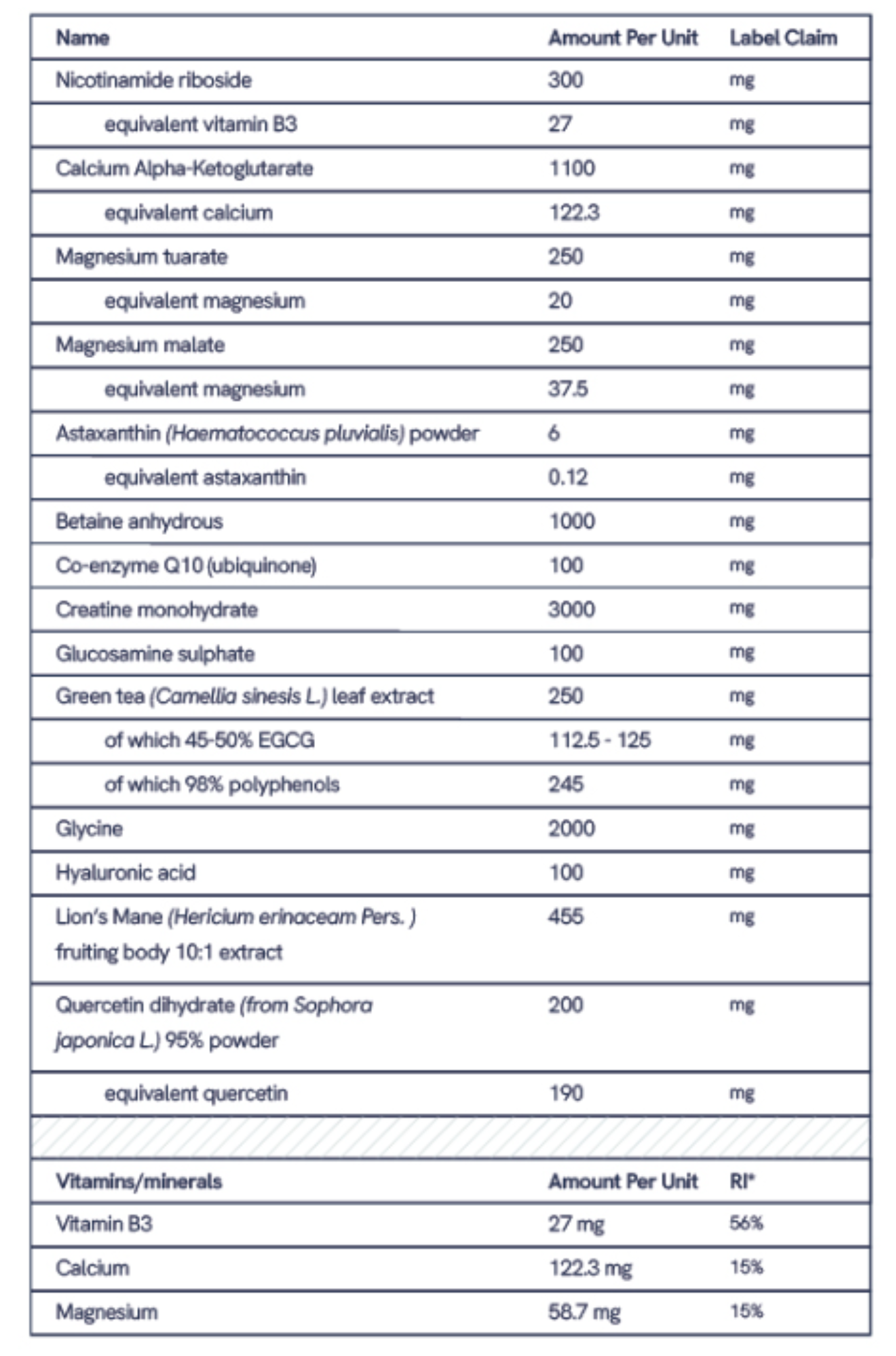
For transparency, Longevity One contains 3,000 mg of creatine monohydrate per daily scoop, alongside B vitamins, vitamin C and magnesium. Creatine increases physical performance in successive bursts of short-term, high intensity exercise. It carries no claim about central fatigue or recovery. Thiamine, niacin, vitamin B6, vitamin B12, biotin, vitamin C and magnesium contribute to the normal functioning of the nervous system, and vitamin B6, vitamin B12, folate, niacin and vitamin C contribute to the reduction of tiredness and fatigue. Magnesium contributes to a reduction of tiredness and fatigue. For more on creatine, see creatine beyond the gym. The product is tested by Eurofins and NZVT certified, with every batch screened for banned substances.
Q&A: CNS Fatigue
Is CNS fatigue real?
Yes. Central fatigue, a reduced drive from the nervous system to the muscles, is well documented in laboratory studies.1 What is less supported is the idea that it lasts for days after a normal gym session.
What is the difference between central and peripheral fatigue?
Peripheral fatigue sits in the muscle itself, while central fatigue is a shortfall in the nervous system's drive to the muscle.1 Both usually occur together. The mix depends on the type of exercise.9
How long does CNS fatigue last?
After brief, high-intensity efforts, central fatigue typically recovered within about two minutes.3 After heavy squats, jumps and sprints, reduced voluntary activation lasted 24 to 48 hours.4 Very long events such as a marathon are the main exception in the studies cited here: jump power was still 12% lower five days after the race.5
Does deadlifting or squatting fry your CNS?
The evidence does not support a long-lasting effect. After 10 sets of 5 squats at 80% of maximum, voluntary activation returned within 48 hours, and the fatigue was mainly in the muscle.4 Muscle fatigue lasted longer than the central change.
What are the symptoms of CNS fatigue?
In the lab, it shows up as a drop in voluntary activation during a maximal effort.1 In daily life, the feelings people call CNS fatigue, such as low motivation and heavy limbs, usually have several causes. Muscle fatigue, short sleep and training load are common ones.
Do endurance athletes get more central fatigue than sprinters?
It depends on the event. Longer efforts tend to produce more central fatigue and shorter, all-out efforts more muscle fatigue.2 After a marathon, strength loss was linked to central mechanisms.5 After sprint sessions, the fatigue that lasted longest was mainly in the muscle.4
Is mental fatigue the same as CNS fatigue?
No. Mental fatigue makes exercise feel harder and shortens endurance efforts without changing most physiological measures.6 Central fatigue is a measured change in the nervous system's drive to the muscle.
How do I know if my nervous system is tired?
You cannot measure it at home with any precision. Self-reported well-being tracks training load better than many objective markers, so a run of poor mornings is a useful sign.8 Reduce the load and see how you respond.
Does running cause more central fatigue than cycling?
Usually, yes. Long runs caused more central fatigue than cycling in a review, which the authors linked to the greater muscle damage from running.11 Cyclists still show central fatigue in longer time trials.2 Both groups benefit from easy days.
Can supplements help CNS fatigue?
No nutrient carries an authorised claim for central fatigue or recovery. Thiamine, niacin, vitamin B6, vitamin B12, biotin, vitamin C and magnesium contribute to the normal functioning of the nervous system, which is a general statement about normal function. Training load, sleep and food matter more.8
Frequently Asked Questions
Should I take a rest day for CNS fatigue?
If you feel worn out after several hard days, a lighter day is sensible. Research suggests central drive returns within 24 to 48 hours after maximal sessions, while muscle fatigue may take up to 72 hours.4
Can I take creatine or other supplements with my medication?
The label advises consulting your doctor if you use medication. Ask your GP or pharmacist and bring the label.
Why do I still feel tired after my strength has returned?
Perceived fatigue can outlast measured changes: football players still felt fatigued at 72 hours after their strength and nervous system drive had recovered.10 Sleep and stress also shape how tired you feel.
Is the central governor theory proven?
No. It is an influential model that sees fatigue as a brain-regulated sensation that protects the body.12 Many researchers accept that the brain plays a role, but the details are still debated.
What does Longevity One taste like?
It has a mango and pineapple flavour. Mix one level scoop in 250 to 500 ml of water, or into a smoothie or yogurt.
References
- Gandevia SC. Spinal and supraspinal factors in human muscle fatigue. Physiol Rev. 2001;81(4):1725-1789. View on PubMed ↗
- Thomas K, Goodall S, Stone M, Howatson G, St Clair Gibson A, Ansley L. Central and peripheral fatigue in male cyclists after 4-, 20-, and 40-km time trials. Med Sci Sports Exerc. 2015;47(3):537-546. View on PubMed ↗
- Carroll TJ, Taylor JL, Gandevia SC. Recovery of central and peripheral neuromuscular fatigue after exercise. J Appl Physiol. 2017;122(5):1068-1076. View on PubMed ↗
- Thomas K, Brownstein CG, Dent J, Parker P, Goodall S, Howatson G. Neuromuscular fatigue and recovery after heavy resistance, jump, and sprint training. Med Sci Sports Exerc. 2018;50(12):2526-2535. View on PubMed ↗
- Petersen K, Hansen CB, Aagaard P, Madsen K. Muscle mechanical characteristics in fatigue and recovery from a marathon race in highly trained runners. Eur J Appl Physiol. 2007;101(3):385-396. View on PubMed ↗
- Marcora SM, Staiano W, Manning V. Mental fatigue impairs physical performance in humans. J Appl Physiol. 2009;106(3):857-864. View on PubMed ↗
- Van Cutsem J, Marcora S, De Pauw K, Bailey S, Meeusen R, Roelands B. The effects of mental fatigue on physical performance: a systematic review. Sports Med. 2017;47(8):1569-1588. View on PubMed ↗
- Saw AE, Main LC, Gastin PB. Monitoring the athlete training response: subjective self-reported measures trump commonly used objective measures: a systematic review. Br J Sports Med. 2016;50(5):281-291. View on PubMed ↗
- Taylor JL, Amann M, Duchateau J, Meeusen R, Rice CL. Neural contributions to muscle fatigue: from the brain to the muscle and back again. Med Sci Sports Exerc. 2016;48(11):2294-2306. View on PubMed ↗
- Brownstein CG, Dent JP, Parker P, Hicks KM, Howatson G, Goodall S, et al. Etiology and recovery of neuromuscular fatigue following competitive soccer match-play. Front Physiol. 2017;8:831. View on PubMed ↗
- Millet GY, Lepers R. Alterations of neuromuscular function after prolonged running, cycling and skiing exercises. Sports Med. 2004;34(2):105-116. View on PubMed ↗
- Noakes TD. Fatigue is a brain-derived emotion that regulates the exercise behavior to ensure the protection of whole body homeostasis. Front Physiol. 2012;3:82. View on PubMed ↗
Disclaimer: Educational content only. Not medical advice. Food supplements should not be used as a substitute for a varied, balanced diet and a healthy lifestyle. If you use medication, consult your doctor.