Most energy and focus drinks combine caffeine with some of L-theanine, sugar or a sweetener, taurine, B vitamins and herbal extracts such as guarana or ginseng. In human trials, caffeine explains most of the short-term change in alertness and attention, and L-theanine with caffeine has some evidence of its own. B vitamins matter mainly where your diet falls short.
Key Takeaways
- In a trial that separated the ingredients, caffeine, not taurine or glucose, explained most of the changes in attention and reaction time.1
- Caffeine plus L-theanine improved alertness and attention-switching accuracy in the first two hours in a meta-analysis of 11 human studies.2
- Sugar drinks did not lift mood and were followed by more fatigue and less alertness within an hour in a meta-analysis of 31 studies.3
- Guarana extract contains caffeine; in one trial, lower doses gave more positive results on memory tasks than higher doses.4
- Five of 14 top-selling US energy drinks and shots in one analysis did not state their caffeine amount on the label.5
- Up to 400 mg of caffeine a day is not linked to adverse effects in healthy adults, according to a large systematic review.6
A drink that promises energy and focus sounds like the answer to a long afternoon of meetings. The can lists caffeine, L-theanine, B vitamins, taurine and a plant extract or two. Some of these have good human evidence for short-term alertness. Others are present in amounts too small to study, and "focus" itself is not an authorised health claim in the EU. This article goes through what is inside these drinks, one ingredient at a time, and what human studies found. For a broader comparison of energy drinks, coffee and nutrient drinks, see how longevity drinks differ from coffee and energy drinks.
What is usually inside an energy and focus drink?
The formulas vary, but the same ingredients appear again and again. The table summarises what each one is, the amount you will typically see listed, and how strong the human evidence is for a short-term effect on alertness or attention.
| Ingredient | What it is | What human trials found |
|---|---|---|
| Caffeine | Stimulant from coffee, tea, guarana or made synthetically | Explains most short-term changes in attention and reaction time1 |
| L-theanine | Amino acid found naturally in tea | With caffeine, better alertness and attention switching in the first two hours2 |
| Sugar or glucose | Carbohydrate; sugared versions list it per can | No mood benefit; more fatigue within an hour3 |
| Taurine | Amino acid; tested at 2,000 mg in one trial | Mixed effects on reaction time; did not explain the drink effect1 |
| B vitamins | Niacin, B6, B12 and others | Help where intake falls short; not a quick lift7 |
| Guarana | Plant extract that contains caffeine | Effects on memory and mood ratings in one dose study4 |
| Ginseng, ginkgo and others | Plant extracts, often at flavouring levels | Not studied alone at these amounts in drinks8 |
How much caffeine is in an energy and focus drink?
Caffeine is the active ingredient in most of these drinks, and the amount differs between products, so look for the number in mg per serving and per container. In a laboratory analysis of 9 top-selling US energy drinks and 5 energy shots, 5 of the 14 products did not give a caffeine amount on the label: 3 listed caffeine only as an ingredient and 2 hid it inside a proprietary blend.5 The 9 that did state an amount were within 15% of the label.5
For healthy adults, a large systematic review of studies published between 2001 and 2015 concluded that up to 400 mg of caffeine a day is not associated with adverse effects on the heart, behaviour, bones or reproduction.6 Its funders included food and beverage industry groups. The EFSA opinion on the safety of caffeine reached the same 400 mg figure for healthy adults, with 200 mg as a single dose. That total includes coffee, tea and chocolate as well as the drink. The International Society of Sports Nutrition notes that caffeine effects vary between people and that side effects become more likely at higher doses.9
Timing matters as much as amount. In a controlled sleep study, 400 mg of caffeine taken six hours before bed still reduced total sleep by more than an hour, measured at home with a sleep monitor.10 A focus drink at 4 pm can cost you part of the night, and poor sleep makes the next afternoon harder. Our article on deep sleep and REM explains why both stages matter.
Is the lift partly withdrawal relief?
For regular caffeine users, partly yes. In the ingredient trial described below, participants were habitual caffeine users who had gone 24 hours without it.1 Caffeine reduced their fatigue and raised their vigour ratings. A critical review of caffeine withdrawal found that headache, tiredness and low alertness are common after even a short break from regular intake, and that these symptoms ease once caffeine is taken again.11 Part of what a morning or afternoon drink does for a daily user is bring them back to their usual baseline.
Is it the caffeine or the other ingredients?
Researchers have tried to answer this by testing drinks whole and in parts. In a randomised, double-blind trial at Tufts University, 48 habitual caffeine users who had gone 24 hours without caffeine received 200 mg caffeine, 2,000 mg taurine, both, or neither on four separate days, each with either a 50 g glucose drink or a placebo.1 Caffeine improved executive control and working memory, shortened reaction times and reduced fatigue. Taurine had mixed effects: it slowed one reaction time task and sped up others, and it offset some of the effects of caffeine on vigour. Glucose alone slowed choice reaction time. The authors concluded that caffeine, not taurine or glucose, is likely responsible for the changes in performance people report after energy drinks.1
An earlier trial in Newcastle tested a 250 ml drink with 37.5 g glucose, 75 mg caffeine and flavouring levels of ginseng and ginkgo, as a whole and in fractions, in 20 people who had fasted overnight and gone without caffeine.8 Only the whole drink improved two memory and attention scores compared with placebo; there were no other effects on cognition or mood. The authors suggested some interaction between glucose and caffeine but did not find effects for the herbal fraction on its own.8 Both trials were small, short and measured effects within an hour or so.
What does L-theanine add?
L-theanine is an amino acid found naturally in tea, and it is the second most common "focus" ingredient after caffeine. In a randomised, placebo-controlled, double-blind crossover trial, healthy adults received 250 mg L-theanine, 150 mg caffeine, both, or placebo.12 Caffeine alone improved some reaction time and accuracy measures and reduced the rise in self-rated mental fatigue. The combination did the same and also gave faster simple reaction time, faster working memory responses, better sentence verification accuracy, lower "tired" ratings and higher "alert" ratings. L-theanine on its own raised "headache" ratings and lowered accuracy on one arithmetic task.12
A systematic review and meta-analysis of 11 randomised placebo-controlled human studies found moderate effect sizes for combined caffeine and L-theanine on self-rated alertness and attention-switching accuracy in the first two hours.2 When the authors looked at doses, the size of the effect tracked caffeine dose more closely than L-theanine dose, especially in the first hour.2 In other words, L-theanine appears to shape the caffeine effect rather than work as a separate source of alertness.
What about sugar, taurine and sweeteners?
Sugared energy drinks list sugar on the label, and the sugars line gives the exact figure per serving. A meta-analysis of 31 studies with 1,259 participants found that carbohydrate had no positive effect on any aspect of mood at any time point.3 Within the first hour, people who had carbohydrate reported more fatigue and less alertness than those who had placebo. Sugar may make a drink taste better, but it does not appear to be the source of the lift.3
Taurine is an amino acid that the body also makes. In the Tufts trial, 2,000 mg of taurine did not explain the performance changes, and it partly offset some effects of caffeine.1 Sugar-free versions replace sugar with sweeteners such as sucralose, acesulfame K or steviol glycosides; these change the taste and the sugar content, not the caffeine effect.

What do B vitamins add to a focus drink?
Many energy and focus drinks list niacin, vitamin B6 and vitamin B12. These vitamins have real roles: niacin, vitamin B6 and vitamin B12 contribute to normal energy-yielding metabolism and to normal psychological function. A review of B vitamins and the brain explains that they work as cofactors in energy metabolism and in making signalling molecules, and that the case for extra intake is strongest where status is low.7 So in a well-fed adult, the added B vitamins are less likely to make a noticeable difference.7 For more on how these vitamins work, see our guide to B vitamins and energy metabolism.
What about guarana, ginseng and other plant extracts?
Guarana is a plant whose seeds contain caffeine, so a drink with guarana has caffeine even if the label leads with the plant name. In a double-blind, placebo-controlled trial, 26 adults took a standardised guarana extract at 37.5, 75, 150 or 300 mg.4 Guarana improved scores on a memory factor and raised "alert" and "content" mood ratings; the two lower doses gave more positive results than the higher ones. The authors suggested that the effects could not be explained by caffeine alone, but this was one small study.4
Other plant extracts you may see include ginseng, ginkgo, rhodiola, ashwagandha, lion's mane and green tea extract. In drinks, they are often present at flavouring levels, as in the Newcastle trial, where the herbal fraction was tested separately and did not show effects on its own.8 Some focus drinks also add L-tyrosine, citicoline or alpha-GPC. None of these plants or compounds has an authorised health claim in the EU register, Regulation (EU) No 432/2012, so under Regulation (EC) No 1924/2006 a label cannot state that they improve focus or concentration.
How do you read an energy and focus drink label?
- Find the caffeine in mg per serving and per container. If only "caffeine" or a blend is listed, you cannot tell how much you are drinking.5
- Add up your caffeine for the day, including coffee and tea. Up to 400 mg a day is the level not linked to adverse effects in healthy adults.6
- Check whether a plant name hides caffeine. Guarana and tea extracts, for example, contain it.4,2
- Check the sugars line. More sugar does not mean more alertness.3
- Look for the L-theanine amount if that is why you chose the drink. One of the main trials used 250 mg with 150 mg of caffeine.12
- Read the word "focus" on the can as marketing. In the EU, no ingredient may claim to improve focus; the authorised wording is narrower.
- Note the time. Caffeine within six hours of bed shortened sleep in a controlled study.10
What can a label honestly say about focus?
In the EU, health claims must come from the authorised list in Regulation (EU) No 432/2012, under the rules of Regulation (EC) No 1924/2006, and "improves focus" is not on it. Some nutrients carry related claims in set wording. Zinc contributes to normal cognitive function. Thiamine, niacin, vitamin B6, vitamin B12, folate, biotin, vitamin C and magnesium contribute to normal psychological function. These claims apply only when the product provides at least 15% of the reference intake per serving, the significant amount set in Annex XIII of Regulation (EU) No 1169/2011, and they describe a normal function, not an extra effect on top of it. Plant extracts have none. When a focus drink names a vague "focus blend" without amounts, there is nothing to check.
How our own formula fits
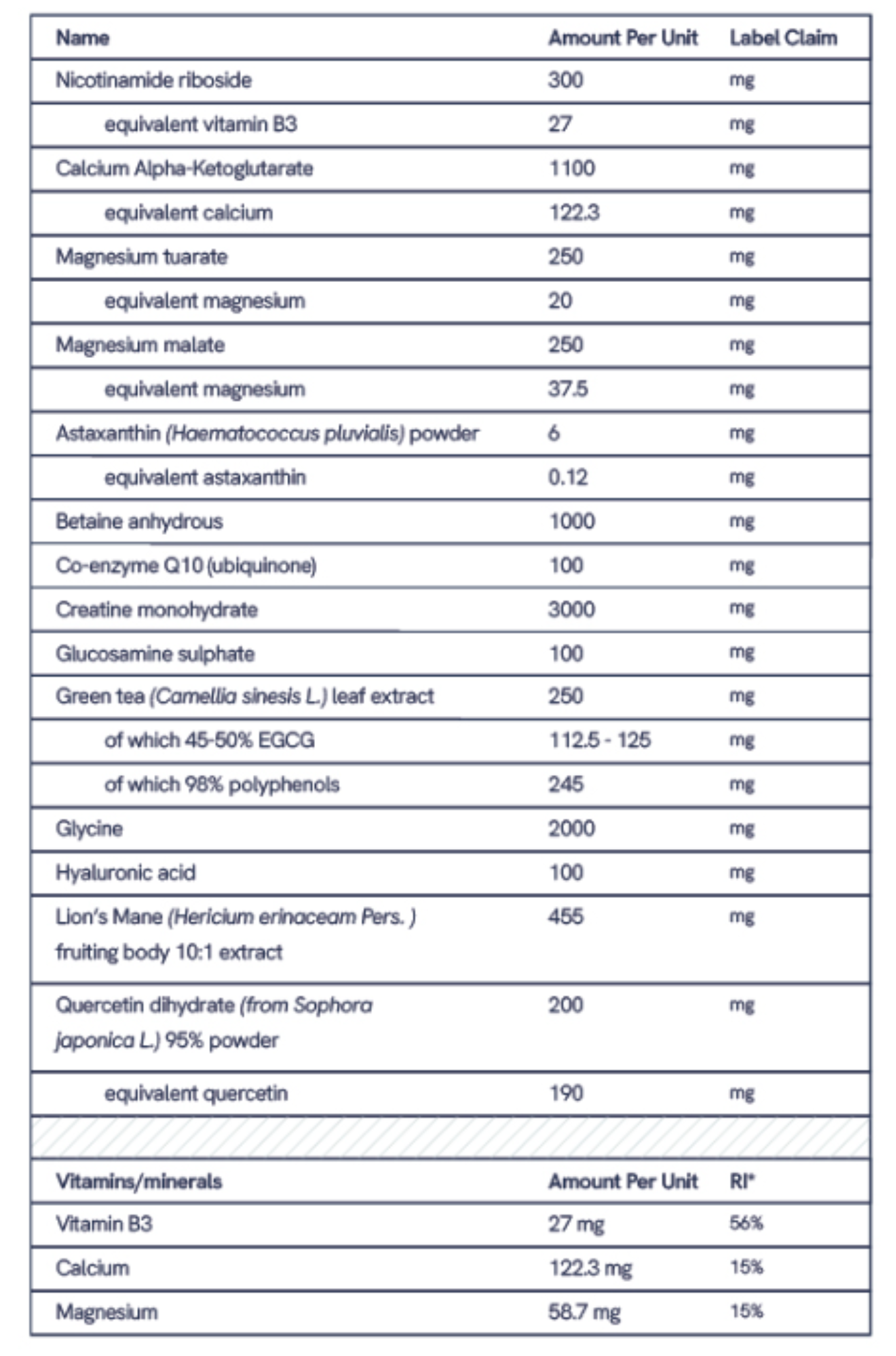
For transparency, Longevity One is not an energy or focus drink. It is a daily drink powder with no caffeine and no caffeine source, mixed once a day, every dose printed on the label. It contains 8 mg of zinc per serving (80% of the reference intake), and zinc contributes to normal cognitive function. It also contains thiamine, niacin, vitamin B6, vitamin B12, folate, biotin, vitamin C and magnesium, which contribute to normal psychological function. Niacin, vitamin B6, folate, vitamin B12 and vitamin C contribute to the reduction of tiredness and fatigue. Magnesium contributes to a reduction of tiredness and fatigue. These nutrients matter most where your intake falls short.7 It is independently tested by Eurofins and NZVT certified, with every batch screened.
If you rely on an energy drink every afternoon to get through the day, or your tiredness is new, severe or has lasted for weeks, talk to your GP. A drink cannot tell you why you are tired.
Q&A: Energy and Focus Drinks
What is in an energy and focus drink?
Most list caffeine, and many add L-theanine, B vitamins, taurine, sugar or a sweetener, and plant extracts. In a trial that separated the ingredients, caffeine explained most of the changes in attention and reaction time.1 Check the label for caffeine in mg per serving.
Do focus drinks actually help you concentrate?
In short trials, caffeine improved attention and reaction time, especially in regular users who had gone without it.1 Caffeine with L-theanine improved alertness and attention-switching accuracy for up to two hours.2 "Focus" is not an authorised health claim. The label cannot promise it.
Is L-theanine with caffeine better than caffeine alone?
In one crossover trial, the combination improved more measures than caffeine alone, including alertness and tiredness ratings.12 A meta-analysis found the effect tracked caffeine dose more than L-theanine dose.2 L-theanine alone did not help in that trial. It seems to shape the caffeine effect.
How much caffeine is too much from focus drinks?
A systematic review found that up to 400 mg a day is not linked to adverse effects in healthy adults.6 That total includes coffee and tea. The EFSA opinion on the safety of caffeine gives lower figures in pregnancy (200 mg a day) and for children and adolescents (3 mg per kg of body weight a day).
Does taurine give you energy?
Not on the evidence from drink trials. In one trial, 2,000 mg of taurine did not explain performance changes and partly offset some effects of caffeine.1 Caffeine was the active ingredient.
Does sugar in an energy drink help focus?
No. A meta-analysis of 31 studies found no mood benefit from carbohydrate.3 People reported more fatigue and less alertness within the first hour.
Is guarana the same as caffeine?
Guarana seeds contain caffeine, so a guarana drink is a caffeinated drink.4 One trial found effects on memory and mood ratings at low doses. The label should still state total caffeine.
Why do I feel worse after the drink wears off?
Part of it may be caffeine withdrawal, which brings headache, tiredness and low alertness.11 Sugared drinks may add to the dip.3 Steady sleep and meals are more reliable than another can. They do not wear off in the same way.
Do B vitamins in focus drinks make a difference?
They help most where your intake is low.7 In a well-fed adult, extra B vitamins are unlikely to change how alert you feel. Their authorised claims describe normal function only.
Can I drink a focus drink in the afternoon?
You can, but think about bedtime. Caffeine six hours before bed cut total sleep by more than an hour in a controlled study.10 An earlier cut-off protects the next day.
Frequently Asked Questions
Can I drink energy and focus drinks if I take medication?
Ask your GP or pharmacist first and bring the can or label. The label of Longevity One advises consulting your doctor if you use medication. If you are pregnant or breastfeeding, ask your midwife or GP.
Are focus drinks safe every day?
For healthy adults, total caffeine up to 400 mg a day from all sources is not linked to adverse effects.6 Check what else you drink and how your sleep responds.
Does Longevity One taste like an energy drink?
No. It has a mango and pineapple flavour and no fizz. Mix one scoop in 250 to 500 ml of water, or into a smoothie or yogurt. The vitamins inside work over time where intake falls short, not as a quick lift.7
Why does the label not say how much caffeine is in the blend?
Some products list caffeine only as part of a proprietary blend. In one analysis, 2 of 14 products did this.5 Choose products that state mg per serving.
When should I see a doctor about tiredness or poor concentration?
If it has lasted for weeks, is new or severe, or affects your work or driving, see your GP. A drink cannot explain or address the cause.
References
- Giles GE, Mahoney CR, Brunyé TT, Gardony AL, Taylor HA, Kanarek RB. Differential cognitive effects of energy drink ingredients: caffeine, taurine, and glucose. Pharmacol Biochem Behav. 2012;102(4):569-577. View on PubMed ↗
- Camfield DA, Stough C, Farrimond J, Scholey AB. Acute effects of tea constituents L-theanine, caffeine, and epigallocatechin gallate on cognitive function and mood: a systematic review and meta-analysis. Nutr Rev. 2014;72(8):507-522. View on PubMed ↗
- Mantantzis K, Schlaghecken F, Sünram-Lea SI, Maylor EA. Sugar rush or sugar crash? A meta-analysis of carbohydrate effects on mood. Neurosci Biobehav Rev. 2019;101:45-67. View on PubMed ↗
- Haskell CF, Kennedy DO, Wesnes KA, Milne AL, Scholey AB. A double-blind, placebo-controlled, multi-dose evaluation of the acute behavioural effects of guaraná in humans. J Psychopharmacol. 2007;21(1):65-70. View on PubMed ↗
- Attipoe S, Leggit J, Deuster PA. Caffeine content in popular energy drinks and energy shots. Mil Med. 2016;181(9):1016-1020. View on PubMed ↗
- Wikoff D, Welsh BT, Henderson R, Brorby GP, Britt J, Myers E, et al. Systematic review of the potential adverse effects of caffeine consumption in healthy adults, pregnant women, adolescents, and children. Food Chem Toxicol. 2017;109(Pt 1):585-648. View on PubMed ↗
- Kennedy DO. B vitamins and the brain: mechanisms, dose and efficacy. A review. Nutrients. 2016;8(2):68. View on PubMed ↗
- Scholey AB, Kennedy DO. Cognitive and physiological effects of an "energy drink": an evaluation of the whole drink and of glucose, caffeine and herbal flavouring fractions. Psychopharmacology (Berl). 2004;176(3-4):320-330. View on PubMed ↗
- Guest NS, VanDusseldorp TA, Nelson MT, Grgic J, Schoenfeld BJ, Jenkins NDM, et al. International society of sports nutrition position stand: caffeine and exercise performance. J Int Soc Sports Nutr. 2021;18(1):1. View on PubMed ↗
- Drake C, Roehrs T, Shambroom J, Roth T. Caffeine effects on sleep taken 0, 3, or 6 hours before going to bed. J Clin Sleep Med. 2013;9(11):1195-1200. View on PubMed ↗
- Juliano LM, Griffiths RR. A critical review of caffeine withdrawal: empirical validation of symptoms and signs, incidence, severity, and associated features. Psychopharmacology (Berl). 2004;176(1):1-29. View on PubMed ↗
- Haskell CF, Kennedy DO, Milne AL, Wesnes KA, Scholey AB. The effects of L-theanine, caffeine and their combination on cognition and mood. Biol Psychol. 2008;77(2):113-122. View on PubMed ↗
Disclaimer: Educational content only. Not medical advice. Food supplements should not be used as a substitute for a varied, balanced diet and a healthy lifestyle. If you use medication, consult your doctor.