The best dietary supplement for energy is one whose label you can check. Look for six things: where any lift comes from (caffeine or nutrients), doses of at least 15% of the NRV, claims in authorised wording, no dose above an upper limit, independent batch testing, and a fair cost per day for the doses you need. Iron belongs on the list only after a blood test.
Key Takeaways
- Vitamins and minerals support energy metabolism; they help most when status or supply is not adequate, and they are not stimulants.1
- Caffeine figures are often missing: in a US analysis of 53 supplements with caffeine-containing ingredients, only 28 stated an amount on the label.2
- EFSA upper limits for adults include 12 mg a day for vitamin B6, 100 micrograms for vitamin D and 1,000 micrograms for folic acid.3,4,5
- Measured content in multivitamins often runs above the label, so doses already near an upper limit leave little margin.6
- Independent testing matters: in one international study, 14.8% of supplements contained steroids not declared on the label.7
Search for the best supplement for energy and you will find rankings, influencer picks and products promising to change how your day feels. Most of those lists rank brands. This guide ranks nothing. Instead, it gives you six checks you can apply to any product on any shelf, so you can decide for yourself. It is written for people who read labels, and it works the same way for powders, tablets, capsules, shots and gummies.
What should an energy supplement actually do?
Start by being clear about what "energy" can mean on a label, because it covers two very different things. The first is stimulation. Caffeine, and sources of caffeine such as guarana, green tea extract and yerba mate, make you feel more alert for a few hours. The second is nutritional support. Several vitamins and minerals are cofactors in the reactions that turn food into usable energy, and a 2020 review linked fatigue with low status of B vitamins, vitamin C, iron, magnesium and zinc.1 Nutrients do not stimulate you. They help when you were short of them.
Neither kind is wrong, but they answer different questions. A stimulant answers "how do I feel more alert this afternoon?" A nutrient formula answers "is my diet giving my body what it needs for normal energy metabolism?" Knowing which question you are asking narrows the shelf considerably.
What can you realistically expect from a nutrient formula?
The realistic expectation is a gradual change over weeks, mainly if your diet has gaps, not a lift within the hour.
Check 1: Where does the energy come from?
Turn the product over and find every source of caffeine. It may be listed as caffeine, caffeine anhydrous, guarana, green tea extract, matcha, yerba mate, kola nut or green coffee extract. A good label states the total caffeine per serving in milligrams, not just the ingredient names. That matters, because the figure is often missing: in a US laboratory analysis of 53 supplements with caffeine-containing ingredients such as guarana, yerba mate, kola nut or green tea extract, only 28 stated a caffeine amount on the label, and daily caffeine at the highest labelled dose ranged from 1 to 829 mg.2 Without a stated total, you cannot tell where a product sits in that range.
Timing matters as much as the dose. In a controlled study, 400 mg of caffeine taken at bedtime, three hours before or six hours before bed each disturbed sleep significantly compared with placebo.9 An "energy" product taken in the afternoon can therefore cost you the sleep that would have done more for your energy the next day. For a fuller comparison of caffeine drinks and nutrient drinks, see our article on how longevity drinks differ from coffee and energy drinks.
- Pass: total caffeine stated in mg per serving, or no caffeine source at all.
- Fail: caffeine-containing plant extracts listed with no total caffeine figure.
Check 2: Are the doses meaningful?
In the EU, a vitamin or mineral counts as present in a significant amount when a daily serving provides at least 15% of its nutrient reference value (NRV), as set in Regulation (EU) No 1169/2011 (Annex XIII), and claims for it rest on that threshold under Regulation (EC) No 1924/2006. That gives you a simple test: find the %NRV column and check that the nutrients the product is sold on reach at least 15%. A product that lists ten vitamins at 5% each is a long ingredient list, not a meaningful dose.
The EU list of authorised claims, Regulation (EU) No 432/2012, gives the tiredness claim to several nutrients, including magnesium, vitamin C, vitamin B6, vitamin B12, folate and niacin. In the same list, thiamine, biotin and calcium contribute to normal energy-yielding metabolism but carry no tiredness claim. You do not need all of them, but you do need each stated dose. Our guide on how to read a supplement label explains the %NRV column and other label basics.
- Pass: every dose printed with %NRV, and the headline nutrients at 15% or more.
- Fail: proprietary blends that give one total weight for several ingredients.
Check 3: Does the claim wording match the register?
Authorised claims have set wording, and that wording is a quick honesty test. "Magnesium contributes to a reduction of tiredness and fatigue" and "Vitamin B12 contributes to normal energy-yielding metabolism" are examples of register wording. Each claim names the nutrient, not the product. A label that attaches a health claim to a herb, an amino acid or the product as a whole, without a named nutrient at a qualifying dose, is going beyond what EU rules allow.
Watch also for wording that promises more than any nutrient can deliver: instant energy, energy that lasts a set number of hours, or language that presents everyday tiredness as a medical problem the product deals with. These are marketing phrases, not authorised claims. Vitamins and minerals act as cofactors in energy metabolism, not as stimulants.1
- Pass: claims in register wording, each tied to a named nutrient at 15% NRV or more.
- Fail: claims for the product as a whole, for herbs or extracts, or promises about how quickly you will feel it.
Check 4: Does any dose go past an upper limit?
More is not better above your needs, and some nutrients have a tolerable upper intake level (UL): the highest daily intake from all sources that is unlikely to cause harm. EFSA has reviewed several of them since 2023. The table shows four that often appear in energy products.
| Nutrient | EFSA upper limit for adults | Why it was set | What to check on the label |
|---|---|---|---|
| Vitamin B6 | 12 mg a day3 | Harm to peripheral nerves with excess intake | "High-potency" B complexes can contain many times this |
| Vitamin D | 100 micrograms a day4 | Excess calcium in the urine at high intakes | Add up all products you take, including a separate vitamin D |
| Folic acid and methylfolate | 1,000 micrograms a day5 | Risk for people whose vitamin B12 status is low | Combined total from all supplements |
| Selenium | 255 micrograms a day10 | Hair loss as an early sign of excess | Combined total, plus Brazil nuts if you eat them often |
In each of these opinions, EFSA noted that European adults are unlikely to exceed the limit from food, and that the people most likely to go over are regular users of high-dose supplements.3,4,10 In US survey data, supplement use increased the share of people above an upper limit for seven nutrients, though for any single nutrient that share stayed at 4% or less.8
There is one more reason to leave headroom. Manufacturers often add more than the label states to cover losses over the shelf life.6 In a chemical analysis of a national sample of US multivitamins, the measured content of every ingredient except thiamine exceeded the label on average, by 1.5% to 13% for most nutrients and by about 25% for selenium and iodine.6 A label that already sits at an upper limit may be above it in the tub.
- Pass: doses close to the NRV, with every nutrient well under its upper limit.
- Fail: megadoses presented as a selling point, especially vitamin B6.

Check 5: Is it independently tested?
You cannot test a tub at home, so you rely on someone who can. Look for a named independent laboratory, a certificate of analysis you can request or download, and testing that covers every batch rather than a single product sample. If you compete in tested sport, look for an anti-doping screening scheme such as NZVT in the Netherlands. This is not a theoretical risk: in an international study of 634 supplements bought in 13 countries, 94 (14.8%) contained anabolic steroids that were not declared on the label.7 That study is from the early 2000s, but it is the reason batch screening exists. Our article on third-party testing explains what a certificate of analysis should show.
- Pass: a named laboratory, batch certificates available, and anti-doping screening if you need it.
- Fail: "lab tested" with no laboratory named and no certificate available.
Check 6: What does it cost per day?
Price per tub tells you little. Work out the cost per day instead: divide the price by the number of daily servings in the pack, not the number of capsules or scoops. If a serving is three capsules, a 90-capsule tub is 30 days, not 90. Then compare like with like. A product that costs 1 euro a day for nutrients at 100% of the NRV is better value than one that costs 70 cents a day for the same nutrients at 10%, because the cheaper one never reaches a meaningful dose.
Two further cost traps are worth avoiding. The first is stacking several products that overlap, which costs more and adds to your total intake. In US survey data, supplement use raised the share of people above an upper limit for seven nutrients; the authors reported consulting and advisory roles with supplement industry groups and companies.8 The second is paying for a long ingredient list. A long list of ingredients at token doses costs more to make and does less than a shorter list at real doses.
Does the format matter?
Less than the label does. As a rough guide, a scoop of powder has more room for bulky minerals than a single tablet, and small formats such as shots and gummies have less, so check how much of each nutrient a serving actually provides, and whether gummies add sugar. Choose the format you will take every day, then apply the six checks. Our comparison of shots, capsules and powders covers the trade-offs in more detail.
When should you skip the shelf and see your GP?
If your tiredness is extreme, has lasted more than a few weeks, came on without an obvious reason, or comes with other changes such as unplanned weight loss, breathlessness, very heavy periods or changes in your sleep, see your GP before buying anything. Iron is the best example of why testing comes first. Iron helps only people whose stores are low. A blood test tells you which group you are in. If you take medication, are pregnant, planning a pregnancy or breastfeeding, ask your GP, pharmacist or midwife first.
Your energy supplement scorecard
| Check | What a good label shows | Red flag |
|---|---|---|
| 1. Energy source | Total caffeine in mg, or none | Caffeine plant extracts with no total |
| 2. Doses | Every dose with %NRV; headline nutrients at 15% or more | Proprietary blends; token doses |
| 3. Claims | Register wording, tied to a named nutrient | Claims for the whole product or for herbs |
| 4. Upper limits | Doses near the NRV, all under the UL | Megadoses as a selling point |
| 5. Testing | Named laboratory, batch certificates | "Lab tested" with no detail |
| 6. Cost | Fair cost per daily serving at real doses | Low price per tub, low doses per day |
How does Longevity One measure up?
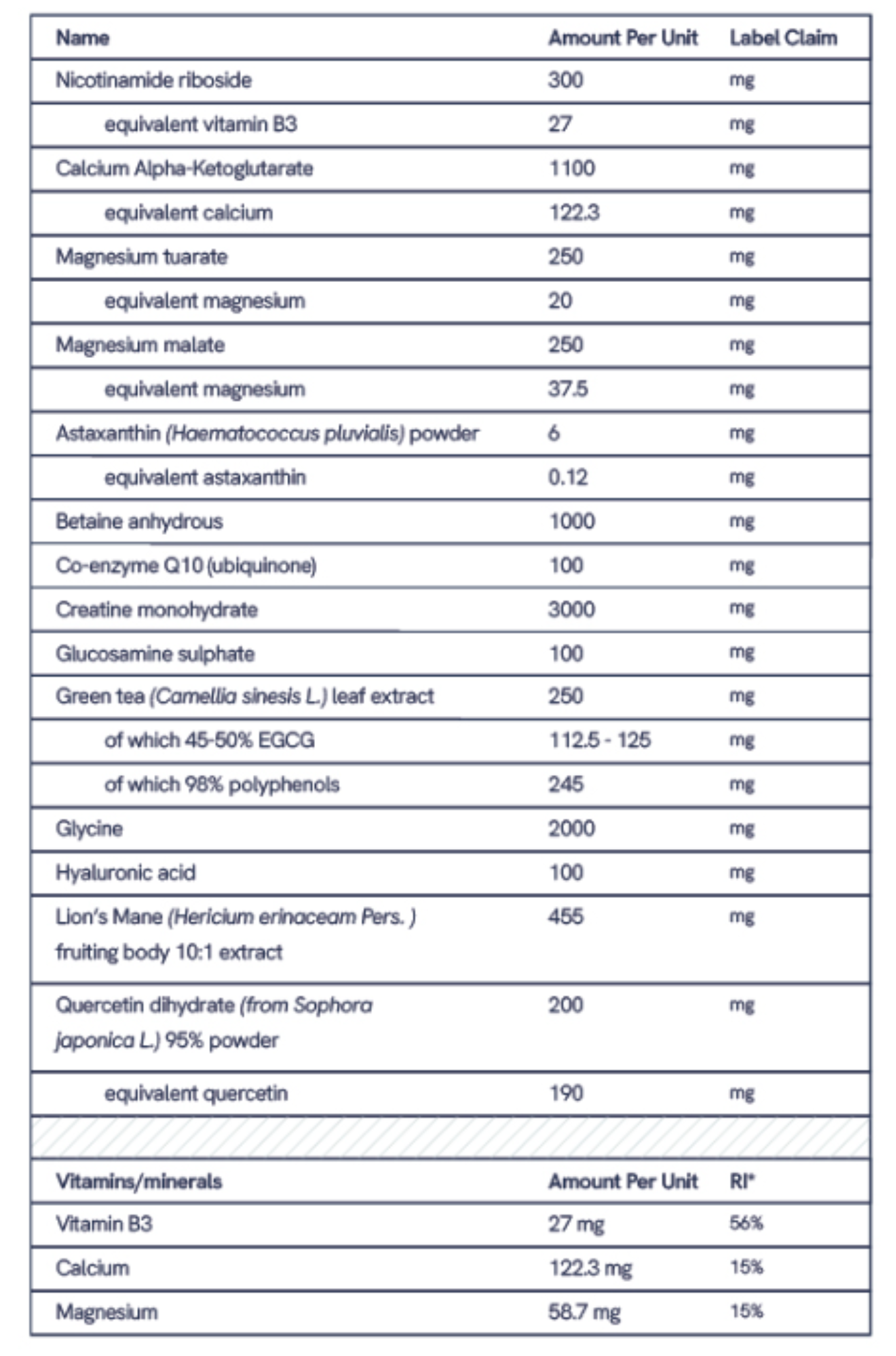
For transparency, here is how our own formula scores against these checks, using only what is on its label. Longevity One contains no caffeine or caffeine source (check 1). Every dose is printed: magnesium 150 mg (40% NRV), vitamin B6 1.4 mg (100%), vitamin B12 2.5 micrograms (100%), folate 300 micrograms (150%), niacin 131.4 mg from nicotinamide riboside, and vitamin C 100 mg (125%) (check 2). These reach the 15% threshold, so, for example, vitamin B6 contributes to the reduction of tiredness and fatigue (check 3). The doses sit near the NRV rather than at megadose levels (check 4). It is independently tested by Eurofins and NZVT certified, with every batch screened, and certificates of analysis are available (check 5).
It contains no iron, on purpose, for the test-first reason above, and it is one scoop a day in 250 to 500 ml of water. Apply the same six checks to it as to anything else you consider.
Q&A: Choosing an Energy Supplement
What is the best dietary supplement for energy?
There is no single best product for everyone. The best choice is a product whose caffeine, doses, claims, upper limits and testing you can check on the label, at a fair cost per day. Nutrient formulas help most when your diet has gaps.1
Do energy supplements actually work?
It depends what is in them. Caffeine works within the hour but can cost sleep, even when taken six hours before bed.9 Vitamins and minerals are cofactors, not stimulants, and help mainly when status is low.1 Check which kind you are buying.
How do I know if an energy supplement contains caffeine?
Look for caffeine, guarana, green tea extract, matcha, yerba mate, kola nut or green coffee extract in the ingredients. Then look for a total caffeine figure in mg. In one US analysis, only 28 of 53 supplements with caffeine-containing ingredients stated an amount.2
What dose of vitamins should an energy supplement contain?
At least 15% of the NRV for each nutrient it is sold on, which is the threshold for an authorised claim. Doses near 100% of the NRV are common and sensible. Doses far above that add little and can approach upper limits.3
Can you take too much of an energy supplement?
Yes. EFSA has set upper limits such as 12 mg a day for vitamin B6 and 100 micrograms a day for vitamin D.3,4 Stacking products, or taking more than the stated daily dose, is the usual way people go over.
Are high-dose B vitamin supplements better for energy?
Not reliably. Vitamin B6 in particular has an upper limit of 12 mg a day.3 A dose near the NRV is the sensible default.
Why does testing matter if the label lists the doses?
Because the label is a promise, not proof. Measured content often differs from labelled amounts,6 and in one international study 14.8% of supplements contained steroids not on the label.7 Batch testing by a named laboratory checks both.
How do I compare the cost of energy supplements?
Work out the cost per daily serving, not per tub or per capsule. Then check that the doses are meaningful, because a cheap product with token doses is poor value. Overlapping products also add cost and push intakes towards upper limits.8
Should an energy supplement contain iron?
Only if you need iron, which a blood test shows. Ask your GP to check your iron status before you add it.
How long should I try an energy supplement before deciding?
For a nutrient formula, at least four weeks of daily use. Note your energy and sleep before you start, so you can compare.
Frequently Asked Questions
Can I take an energy supplement with my medication?
The label advises consulting your doctor if you use medication. Ask your GP or pharmacist and bring the label. For any other product, check whether it states its total caffeine, because many do not.2
Are energy supplements safe to take every day?
A nutrient formula at doses near the NRV is generally suitable for daily use. Check each dose against its upper limit, and avoid doubling up across products.3,5 Caffeine products need more care with timing because of sleep.9
Is a powder, a tablet or a gummy best?
The one you will take every day, as long as it passes the six checks. Check the doses per serving whatever the format, and the sugar content of gummies. Measured content can also differ from the label in any format, which is why testing matters.6
What does Longevity One taste like?
It has a mango and pineapple flavour. Mix one level scoop in 250 to 500 ml of water, or into a smoothie or yogurt.
Is Longevity One suitable during pregnancy?
No. The label states it is not suitable during pregnancy and breastfeeding. Ask your GP or midwife about the supplements that are right for that stage.
References
- Tardy AL, Pouteau E, Marquez D, Yilmaz C, Scholey A. Vitamins and minerals for energy, fatigue and cognition: a narrative review of the biochemical and clinical evidence. Nutrients. 2020;12(1):228. View on PubMed ↗
- Andrews KW, Schweitzer A, Zhao C, Holden JM, Roseland JM, Brandt M, et al. The caffeine contents of dietary supplements commonly purchased in the US: analysis of 53 products with caffeine-containing ingredients. Anal Bioanal Chem. 2007;389(1):231-239. View on PubMed ↗
- EFSA Panel on Nutrition, Novel Foods and Food Allergens (NDA), Turck D, Bohn T, Castenmiller J, de Henauw S, Hirsch-Ernst KI, et al. Scientific opinion on the tolerable upper intake level for vitamin B6. EFSA J. 2023;21(5):e08006. View on PubMed ↗
- EFSA Panel on Nutrition, Novel Foods and Food Allergens (NDA), Turck D, Bohn T, Castenmiller J, de Henauw S, Hirsch-Ernst KI, et al. Scientific opinion on the tolerable upper intake level for vitamin D, including the derivation of a conversion factor for calcidiol monohydrate. EFSA J. 2023;21(8):e08145. View on PubMed ↗
- EFSA Panel on Nutrition, Novel Foods and Food Allergens (NDA), Turck D, Bohn T, Castenmiller J, de Henauw S, Hirsch-Ernst KI, et al. Scientific opinion on the tolerable upper intake level for folate. EFSA J. 2023;21(11):e08353. View on PubMed ↗
- Andrews KW, Roseland JM, Gusev PA, Palachuvattil J, Dang PT, Savarala S, et al. Analytical ingredient content and variability of adult multivitamin/mineral products: national estimates for the Dietary Supplement Ingredient Database. Am J Clin Nutr. 2017;105(2):526-539. View on PubMed ↗
- Geyer H, Parr MK, Mareck U, et al. Analysis of non-hormonal nutritional supplements for anabolic-androgenic steroids: results of an international study. Int J Sports Med. 2004;25(2):124-129. View on PubMed ↗
- Blumberg JB, Frei BB, Fulgoni VL, Weaver CM, Zeisel SH. Impact of frequency of multi-vitamin/multi-mineral supplement intake on nutritional adequacy and nutrient deficiencies in U.S. adults. Nutrients. 2017;9(8):849. View on PubMed ↗
- Drake C, Roehrs T, Shambroom J, Roth T. Caffeine effects on sleep taken 0, 3, or 6 hours before going to bed. J Clin Sleep Med. 2013;9(11):1195-1200. View on PubMed ↗
- EFSA Panel on Nutrition, Novel Foods and Food Allergens (NDA), Turck D, Bohn T, Castenmiller J, de Henauw S, Hirsch-Ernst KI, et al. Scientific opinion on the tolerable upper intake level for selenium. EFSA J. 2023;21(1):e07704. View on PubMed ↗
Disclaimer: Educational content only. Not medical advice. Food supplements should not be used as a substitute for a varied, balanced diet and a healthy lifestyle. If you use medication, consult your doctor.