Your body turns food into energy by breaking carbohydrate, fat and protein into smaller molecules and capturing the energy they release in a molecule called ATP. Most ATP is made inside mitochondria through glycolysis, the Krebs cycle and oxidative phosphorylation. Vitamins and minerals supply no calories, but several act as essential helpers at these steps.
Key Takeaways
- Daily energy use has three parts: resting metabolism, the energy cost of digesting food (about 5 to 15% of the total) and physical activity.1
- The brain is about 2% of body weight but accounts for about 20% of the oxygen, and so the calories, the body uses, according to a short commentary in PNAS.2
- ATP is the energy currency of every cell; muscle stores of ATP are small, so cells must remake it constantly from food fuels.3
- Carbohydrate and fat are the main fuels; the mix shifts with how hard you move, with more carbohydrate used at higher intensities.4
- B vitamins act as coenzymes in the pathways that release energy from food, and in cells most ATP is bound to magnesium.5,6
- Vitamins and minerals contain no usable energy. They help most when intake has been low, and large surveys show shortfalls are common for several of them.7,8
You eat a bowl of oats at breakfast and three hours later you climb the stairs without thinking about it. Between those two moments sits one of the most elegant processes in biology. This guide follows the energy in food from your plate into your cells, step by step, and shows exactly where vitamins and minerals fit in. It also explains what they do not do, because that part is often left out.
Why do we need energy at all?
Energy keeps you alive even when you are lying still. Your heart beats, your lungs move, your kidneys filter blood, your nerves send signals and every cell pumps ions across its membrane. Daily energy expenditure has three components: basal metabolic rate (the energy cost of staying alive at rest), diet-induced thermogenesis (the energy cost of digesting, absorbing and storing food) and physical activity.1 Diet-induced thermogenesis accounts for about 5 to 15% of daily energy expenditure on a mixed diet, and it is highest for protein and lowest for fat.1
Physical activity is the part that varies most between people. Researchers express it as the physical activity level: total energy expenditure divided by resting energy expenditure. For sustainable lifestyles this ranges from about 1.1 to 1.2 at the low end to 2.0 to 2.5 at the high end, and it averages 1.7 to 1.8 in adults of working age before declining to about 1.4 by age 90.9 In other words, for most adults, resting metabolism uses the larger share of the day's energy and movement uses the rest.
Some organs are especially demanding. A short commentary in PNAS, which has no abstract, states in its text that the brain makes up about 2% of body weight yet accounts for about 20% of the oxygen, and hence the calories, that the body consumes.2 That is one reason why thinking hard can feel tiring, and why a steady fuel supply matters for concentration as well as for muscles.
What are the sources of energy in the body?
All the energy you use comes from three macronutrients in food (carbohydrate, fat and protein), plus alcohol if you drink it. EU nutrition labels use set conversion values, listed in Annex XIV of Regulation (EU) No 1169/2011: about 17 kJ (4 kcal) per gram for carbohydrate and for protein, 37 kJ (9 kcal) per gram for fat, 29 kJ (7 kcal) per gram for alcohol and 8 kJ (2 kcal) per gram for fibre. Vitamins and minerals do not appear in that list, because they provide no usable energy.
Once absorbed, these fuels are either used straight away or stored. The body keeps a small reserve of carbohydrate as glycogen in muscle and liver, a much larger reserve as fat, and a very small, fast-acting reserve of phosphocreatine in muscle.3 Protein is mainly used for building and maintaining tissue; it contributes to energy, but it is not a dedicated store.
| Fuel | Energy value on EU labels | Main store in the body | When it matters most |
|---|---|---|---|
| Carbohydrate | 17 kJ (4 kcal) per gram | Glycogen in muscle and liver; glucose in blood | Higher-intensity effort; the main fuel for the brain3 |
| Fat | 37 kJ (9 kcal) per gram | Fat tissue and fat droplets inside muscle | Rest and low-intensity, longer activity4 |
| Protein | 17 kJ (4 kcal) per gram | No dedicated store; muscle and other tissue | Mainly building and maintaining tissue, a smaller share of energy |
| Phosphocreatine | Not a food energy source | Muscle | The first seconds of a sprint or a heavy lift3 |
| Vitamins and minerals | None (0 kJ) | Various | Helpers in the pathways, not fuels5 |
The balance between carbohydrate and fat shifts with effort. In a classic tracer study of trained adults cycling at 25%, 65% and 85% of their maximal oxygen uptake, the use of blood glucose and muscle glycogen rose with intensity, while the release of fat from fat tissue was highest at the lowest intensity.4 The study was small (five people), but its pattern has been confirmed many times: easy movement relies more on fat, hard effort relies more on carbohydrate.3
What is ATP and why is it called the energy currency?
Cells cannot use the energy in a glucose molecule or a fatty acid directly. They first transfer it into adenosine triphosphate, or ATP. When a cell needs energy to contract a muscle fibre, send a nerve signal or build a protein, it uses ATP, and the body then has to remake it.3
The key point is that the body keeps very little ATP in stock. Muscle stores of ATP are small, so metabolic pathways must constantly remake it at the rate it is used.3 During a sprint, the rate of demand can rise many times over within seconds, and the body switches on its different ATP-making systems to keep up.3 ATP also needs a partner: inside cells most ATP is bound to magnesium, and this magnesium-ATP complex is its biologically functional form.5 Most of the authors of that review work for a consumer health company. Our article on magnesium and energy covers that relationship in more depth.
How does the body turn food into ATP?
Think of energy metabolism as a production line with four stations. Each one passes its product to the next, and each relies on specific enzymes. Many of those enzymes only work with a helper molecule, a coenzyme, that the body makes from a vitamin.6 For a wider look at what happens inside cells, see our guide to supporting cellular health.
Station 1: digestion and absorption
Digestion breaks food into units small enough to absorb, which cells then use for energy or store. Digesting, absorbing and storing food has its own energy cost, which is the diet-induced thermogenesis mentioned above.1
Station 2: glycolysis
Glycolysis takes place in the fluid part of the cell, outside the mitochondria. It splits one glucose molecule into two smaller molecules called pyruvate and produces a small amount of ATP directly. Glycolysis does not need oxygen, which is why it can supply energy quickly during hard effort; this is part of what researchers call substrate-level, or "anaerobic", ATP production.3 Muscle glycogen feeds glycolysis directly, which makes it a fast fuel.3
Station 3: the Krebs cycle
Pyruvate then enters the mitochondria, the small structures inside cells where most ATP is made. There it is converted into a two-carbon unit called acetyl-CoA. This step relies on an enzyme complex that needs thiamine (vitamin B1) in its active coenzyme form, and it also uses coenzymes made from niacin, riboflavin and pantothenic acid.6,5 Fatty acids are broken down into the same acetyl-CoA units, which is why fat and carbohydrate end up in a shared pathway.3
Acetyl-CoA enters the Krebs cycle (also called the citric acid cycle), a loop of reactions that strips electrons from the carbon units and releases carbon dioxide, which you breathe out. The Krebs cycle itself produces little ATP. Its main product is a stream of high-energy electrons loaded onto carrier molecules, including one made from niacin.6
Station 4: oxidative phosphorylation
The final station sits in the mitochondria. The electron carriers made in the earlier steps hand their electrons to the electron transport chain, where they provide the energy used to make ATP; a review of vitamin biochemistry describes this step as needing riboflavin, niacin, pantothenic acid and iron.5 This is oxidative phosphorylation, the "aerobic" system, which uses the electrons released from carbohydrate and fat metabolism to make ATP.3 Iron is also what carries oxygen in the blood.5
What about protein?
Amino acids can be stripped of their nitrogen and fed into glycolysis or the Krebs cycle at several points. Vitamin B6, in its active form, is the coenzyme for many of these amino acid reactions, and it is also needed to release glucose from glycogen.6,5 In a well-fed person, protein supplies a modest share of daily energy; its main job is to build and maintain tissue.
Where do vitamins and minerals fit in?
Vitamins and minerals are the tools on the production line, not the raw material. The active forms and steps in the table below are as described in the open full texts of two reviews of vitamin biochemistry. B vitamins are water-soluble vitamins that act as coenzymes in a large number of energy-releasing and building reactions.6 A review of their biochemistry describes the B vitamins, vitamin C, iron, magnesium and zinc as having recognised roles in energy-yielding metabolism, oxygen transport and nerve function.5 Our longer guide to B vitamins and energy metabolism goes through each B vitamin in turn.
| Nutrient | Active form or role | Where it works |
|---|---|---|
| Thiamine (B1) | Thiamine pyrophosphate | Turning pyruvate into acetyl-CoA; a Krebs cycle step6,5 |
| Riboflavin (B2) | FAD and FMN | Electron carriers in the Krebs cycle and electron transport chain6,5 |
| Niacin (B3) | NAD and NADP | Electron carriers in glycolysis, the Krebs cycle and fat breakdown6,5 |
| Pantothenic acid (B5) | Part of coenzyme A | Forms acetyl-CoA, the entry point to the Krebs cycle6,5 |
| Vitamin B6 | Pyridoxal 5'-phosphate | Amino acid metabolism; releasing glucose from glycogen5 |
| Biotin | Coenzyme for carboxylase enzymes | Making glucose and fatty acids; amino acid breakdown6,5 |
| Vitamin B12 | Coenzyme forms | Breakdown of some fatty acids and amino acids in mitochondria6,5 |
| Vitamin C | Cofactor for enzymes | Making carnitine, which carries fatty acids into mitochondria5 |
| Magnesium | Binds ATP | Most cellular ATP is present as magnesium-ATP5 |
| Iron | Part of haemoglobin and electron transport proteins | Oxygen transport and the electron transport chain5 |
The EU recognises this role in authorised health claims. Thiamine, niacin, vitamin B6, vitamin B12, biotin, vitamin C, calcium and magnesium each contribute to normal energy-yielding metabolism. The word "normal" matters. These nutrients let the process run as it should; they do not make it run faster than normal in someone whose intake is already adequate.

Do vitamins give you energy directly?
No. A vitamin tablet or powder contains essentially no calories from its vitamins, so it cannot supply energy in the way food does. What vitamins and minerals can do is make sure the pathways that release energy from food are not held back by a missing helper. A review aimed at doctors who see patients with low energy concluded that, once other causes are ruled out, low intake of vitamins and minerals can be one contributor, and that supplementation can correct a shortfall if taken for long enough.7 Our companion article on whether vitamins give you energy looks at the trial evidence in people who are not deficient.
How common are vitamin and mineral shortfalls?
More common than many people assume. In a nationally representative US survey of 16,444 Americans aged 4 and over, large shares had total usual intakes, from food and supplements combined, below the estimated average requirement: 46% for magnesium, 39% for calcium and 31% for vitamin C.8 The same analysis found that intakes above the tolerable upper level were rare.8 The first author worked for a supplement industry trade association. European survey methods and figures differ, so these numbers are a guide rather than a direct measure of intake in the Netherlands or Belgium.
A review noted that older adults are a well-recognised risk group for low intake, and identified another: young adults, often women, with demanding lifestyles who are physically active and whose eating is marked by poor choices or regular dieting.7 Some shortfalls also have specific causes. For vitamin B12, low intake of animal foods is the main reason for low levels in younger adults, while reduced absorption becomes more important with age: in large US and UK surveys about 6% of adults aged 60 and over were deficient and close to 20% had marginal status.10
What does this mean for your daily energy?
The production line view gives a practical order of priorities. Fuel comes first, then the helpers, then everything that affects how you use the energy you make.
- Eat enough, regularly. Carbohydrate, fat and protein are the only sources of energy. Long gaps or very low intake leave the production line short of raw material.1
- Match fuel to effort. Harder activity draws more on carbohydrate; easier, longer activity draws more on fat.4
- Cover the helpers through food. Wholegrains, legumes, nuts, seeds, eggs, dairy, fish, meat, fruit and vegetables supply B vitamins, vitamin C and magnesium together.5
- Know your risk groups. Regular dieting, a plant-based diet without B12, older age and a heavy training load all raise the chance of a shortfall.7,10
- Do not expect extra from extra. More of a vitamin than you need is unlikely to speed up a pathway that is already running normally; supplements help most where intake has been low.7
- Look at sleep and activity too. How much energy you feel you have depends on far more than metabolism. If you are often tired, look at sleep, workload and movement as well.
How our own formula fits
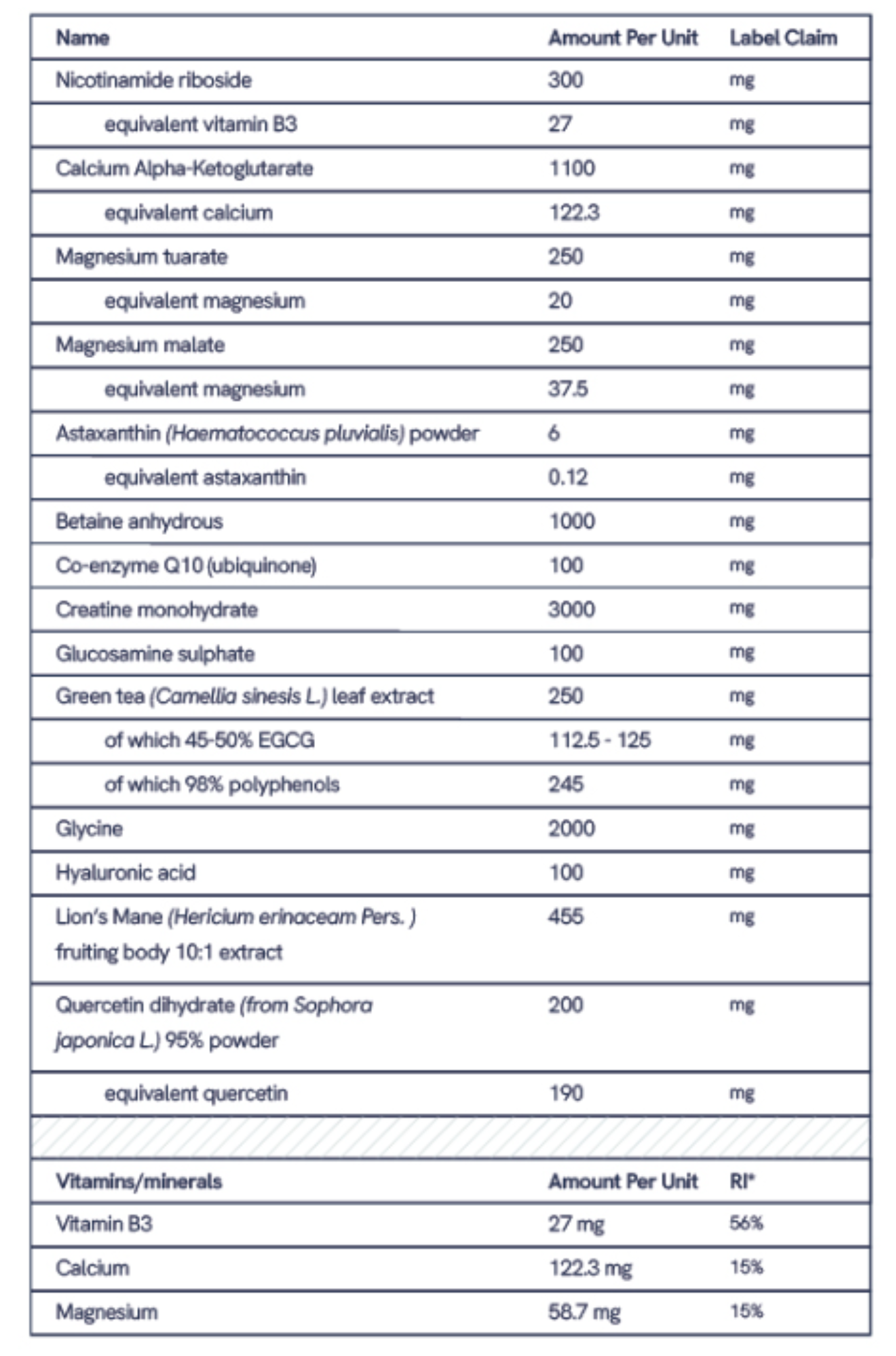
For transparency, here is how this applies to our own product. Longevity One is a daily powder that contains several of the nutrients on the production line, each at a printed dose: thiamine 1.1 mg, niacin (vitamin B3) 131.4 mg, vitamin B6 1.4 mg, vitamin B12 2.5 mcg, biotin 50 mcg, vitamin C 100 mg, calcium 130 mg and magnesium 150 mg (as malate). Each of these is present at 15% or more of the reference intake, which is the level at which the energy-yielding metabolism claim applies. The formula does not contain riboflavin, pantothenic acid or iron, so it does not cover every step in the table above, and it contains no caffeine source. It is independently tested by Eurofins and NZVT certified. Like any supplement, it adds to a balanced diet; it does not replace food as your source of energy.
When should you speak to your GP?
Ordinary tiredness after a short night or a busy week is normal. Tiredness that is persistent, severe or new, that does not lift with rest, or that comes with other symptoms such as breathlessness, weight change or low mood, deserves a conversation with your GP. They can check for causes that diet or supplements will not address, including low iron or vitamin B12, which should be tested before you supplement.10
Q&A: How the Body Makes Energy
What are the main sources of energy in the body?
The body gets its energy from carbohydrate, fat and protein in food, plus alcohol if you drink it. It stores carbohydrate as glycogen, keeps a large reserve of fat and a small, fast reserve of phosphocreatine in muscle.3 Vitamins and minerals are helpers in these pathways, not energy sources.5 Food is the only real fuel.
Why do we need energy when we are resting?
Even at rest, your heart, lungs, brain, kidneys and every cell need energy to function. Resting metabolism is one of three parts of daily energy expenditure, alongside digesting food and physical activity.1 The brain alone accounts for about 20% of the oxygen and calories the body uses.2 For most adults, resting metabolism is the largest share of the day.
What is ATP in simple terms?
ATP is a small molecule that stores energy in a form every cell can use. Cells split it to power work and then recharge it from food fuels.3 Because stores are small, ATP has to be remade all the time. That is why a steady supply of fuel matters.
What is the difference between aerobic and anaerobic energy?
Anaerobic pathways, such as glycolysis and phosphocreatine breakdown, make ATP quickly without oxygen but in limited amounts. Aerobic metabolism uses oxygen in the mitochondria to make far more ATP from carbohydrate and fat.3 Most daily activity relies mainly on aerobic metabolism.
Does the body burn fat or carbohydrate first?
It uses both at the same time, and the mix depends on effort. In a tracer study, low-intensity exercise drew more on fat, while higher intensities drew more on blood glucose and muscle glycogen.4 Diet, training and how long you exercise shift the balance as well.3 There is no single switch from one fuel to the other.
Which vitamins are involved in energy metabolism?
The B vitamins act as coenzymes throughout energy metabolism, and vitamin C, iron and magnesium have roles too.6,5 Under EU rules, thiamine, niacin, vitamin B6, vitamin B12, biotin, vitamin C, calcium and magnesium each contribute to normal energy-yielding metabolism. Riboflavin and pantothenic acid are involved as well.
Why does magnesium matter for ATP?
Inside cells, ATP is bound to magnesium, and this complex is the form enzymes use.5 Magnesium contributes to normal energy-yielding metabolism. In a US survey of people aged 4 and over, 46% had total magnesium intakes below the estimated average requirement.8 Nuts, seeds, legumes and wholegrains are good food sources.
Can taking more vitamins speed up my metabolism?
Not in a meaningful way if your intake is already adequate. The authorised claims describe a contribution to normal energy-yielding metabolism, which means letting the process run as it should. Supplements help most where intake has been low.7,5
Does protein give you energy?
Yes. Protein provides about 17 kJ (4 kcal) per gram, and amino acids can feed into glycolysis and the Krebs cycle, with vitamin B6 needed for many of those steps.5 In a well-fed person, protein is used mainly to build and maintain tissue. Digesting it also costs more energy than digesting fat or carbohydrate.1
Who is most likely to fall short of the vitamins involved in energy metabolism?
Some groups are more likely to fall short than others. A review named older adults as a well-recognised risk group, and young active adults, often women, with poor food choices or regular dieting as another.7 Vitamin B12 deserves attention for people who eat few animal foods and for adults over 60.10 Your GP can test levels if you are unsure.
Frequently Asked Questions
Do vitamins contain calories?
No, not in any meaningful amount. Vitamins and minerals help release energy from carbohydrate, fat and protein, but they are not fuels themselves.5 A supplement may contain a small amount of energy from other ingredients, which is shown on the label.
Is it better to get these nutrients from food or from a supplement?
Food comes first, because it provides the fuel and the helpers together. A supplement can help fill gaps, and surveys show gaps are common for some nutrients, such as magnesium and vitamin C.8
Can I take a vitamin and mineral supplement with my medication?
The label advises consulting your doctor if you use medication. Ask your GP or pharmacist and bring the label.
How long does it take for a supplement to make a difference?
If your intake was low, it can take weeks for levels to recover, and supplements need to be taken for an adequate period.7 If your intake was already adequate, you may not notice any change, and that is expected.
What does Longevity One taste like?
It has a mango and pineapple flavour. Mix one scoop in 250 to 500 ml of water, or stir it into a smoothie or yogurt if you prefer.
References
- Westerterp KR. Diet induced thermogenesis. Nutr Metab (Lond). 2004;1(1):5. View on PubMed ↗
- Raichle ME, Gusnard DA. Appraising the brain's energy budget. Proc Natl Acad Sci U S A. 2002;99(16):10237-10239. View on PubMed ↗
- Hargreaves M, Spriet LL. Skeletal muscle energy metabolism during exercise. Nat Metab. 2020;2(9):817-828. View on PubMed ↗
- Romijn JA, Coyle EF, Sidossis LS, Gastaldelli A, Horowitz JF, Endert E, et al. Regulation of endogenous fat and carbohydrate metabolism in relation to exercise intensity and duration. Am J Physiol. 1993;265(3 Pt 1):E380-E391. View on PubMed ↗
- Tardy AL, Pouteau E, Marquez D, Yilmaz C, Scholey A. Vitamins and minerals for energy, fatigue and cognition: a narrative review of the biochemical and clinical evidence. Nutrients. 2020;12(1):228. View on PubMed ↗
- Kennedy DO. B vitamins and the brain: mechanisms, dose and efficacy. A review. Nutrients. 2016;8(2):68. View on PubMed ↗
- Huskisson E, Maggini S, Ruf M. The role of vitamins and minerals in energy metabolism and well-being. J Int Med Res. 2007;35(3):277-289. View on PubMed ↗
- Wallace TC, McBurney M, Fulgoni VL 3rd. Multivitamin/mineral supplement contribution to micronutrient intakes in the United States, 2007-2010. J Am Coll Nutr. 2014;33(2):94-102. View on PubMed ↗
- Westerterp KR. Physical activity and physical activity induced energy expenditure in humans: measurement, determinants, and effects. Front Physiol. 2013;4:90. View on PubMed ↗
- Allen LH. How common is vitamin B-12 deficiency? Am J Clin Nutr. 2009;89(2):693S-696S. View on PubMed ↗
Disclaimer: Educational content only. Not medical advice. Food supplements should not be used as a substitute for a varied, balanced diet and a healthy lifestyle. If you use medication, consult your doctor.