Pre-portioned caffeine drink mixes with the dose printed per serving are as safe as the same amount from coffee. Pure caffeine powder is different. A normal dose is a fifth of a gram, too small to measure with kitchen spoons or scales. For most people, pure bulk powder is not worth the risk.
Key Takeaways
- A systematic review supports up to 400 mg of caffeine a day from all sources as an intake not linked to adverse effects in healthy adults.1
- Training studies use 3 to 6 mg per kg of body weight, about 210 to 420 mg for a 70 kg adult.2
- Pure caffeine powder cannot be measured reliably with kitchen spoons or a scale that reads only whole grams.
- Laboratory tests of pre-workout powders found 59% to 176% of the labelled caffeine, so even portioned products vary.3
- People clear caffeine at very different rates, mainly because of the liver enzyme CYP1A2.4
Search for a powdered caffeine drink and you will find two very different things. One is a flavoured drink mix in sachets or tubs, with a set amount of caffeine per serving, often sold as an alternative to coffee or energy drinks. The other is pure caffeine powder, sold in bulk bags, sometimes for people who want to make their own pre-workout or drink mix. The first is a caffeine product like any other. The second is a concentrated ingredient that is easy to get dangerously wrong. This article explains why, and how to tell the two apart.
How much caffeine is a normal dose?
Start with the numbers. A systematic review of 381 studies published between 2001 and 2015 concluded that up to 400 mg of caffeine a day in healthy adults is not associated with overt adverse effects on the heart, behaviour, bone or reproduction.1 The review was funded through an industry-supported scientific body whose members include beverage and coffee trade groups. The same review supported 300 mg a day for healthy pregnant women and 2.5 mg per kg a day for children and adolescents.1 The EFSA scientific opinion on the safety of caffeine uses 400 mg a day for healthy adults outside pregnancy, and considers single doses up to 200 mg not to raise safety concerns.
Sports research gives a similar picture. The ISSN position stand reports consistent benefits for exercise at 3 to 6 mg per kg of body weight, and notes that very high doses of about 9 mg per kg bring a high rate of side effects without being needed.2 Several of the position stand's authors have advisory or consulting ties to supplement companies. In a double-blind trial in resistance-trained men, 9 mg per kg raised the frequency of side effects to between 15% and 62% depending on the symptom.5
| Amount | What it represents |
|---|---|
| About 107 mg | One 250 ml cup of coffee, as used in a sleep meta-analysis6 |
| 200 mg (0.2 g) | Single dose that EFSA considers raises no safety concern in healthy adults; about 3 mg per kg for 70 kg, within the training range2 |
| 400 mg (0.4 g) | Daily total from all sources supported for healthy adults1 |
| About 630 mg | 9 mg per kg for 70 kg, where side effects became frequent5 |
The key point is the unit. Every useful dose of caffeine is a fraction of a gram.
Why is pure caffeine powder risky?
The measuring problem
A 200 mg dose is 0.2 g. In pure powder form that is a pinch, a small mound that is hard to judge by eye. Household measuring spoons are not made for amounts this small, and a kitchen scale that reads in whole grams cannot show 0.2 g at all: its smallest step is five times the dose you want. A spoonful that looks small can hold many times the safe amount, and the difference between a normal dose and a dangerous one is a matter of a few grams, not kilograms.
Errors in this setting are easy: a heaped spoon instead of a level one, a scale that reads zero for anything below 1 g, a mix-up between a milligram figure and a gram figure on a recipe, or a second scoop because the first "did not work". Pure powder gives no margin for any of them.
Why individual differences matter
People clear caffeine at different speeds. One liver enzyme, CYP1A2, handles about 95% of caffeine, and its speed varies widely between people.4
Why do people buy pure caffeine powder?
The usual reasons are cost, control and do-it-yourself mixing. A bag of pure powder holds hundreds of doses for the price of a few tubs of pre-workout, and some people like to build their own training drink from separate ingredients. The appeal is understandable, but the need is small. In a nationally representative US survey of 24,808 adults, caffeine users took about 211 mg a day on average, mostly from coffee, tea and soft drinks.8 That is two cups of coffee, not a bulk supply.
The control argument also works the other way. Pure powder offers precise control only to someone with a laboratory balance that reads to the milligram, and the discipline to use it every time. Without that, a tablet removes the weighing step altogether: over-the-counter caffeine tablets typically contain 100 to 200 mg each. For a home-made pre-workout, a measured tablet taken with the rest of the drink does the same job without any weighing.
What are the warning signs of too much caffeine?
At high doses, caffeine can cause a fast or irregular heartbeat, vomiting, and in severe cases seizures.7 At more ordinary excess doses, the effects are less dramatic but still unpleasant, and in trials they become more frequent as the dose rises.5 If someone has swallowed a large amount of pure caffeine powder or tablets, or has a racing or irregular heartbeat, chest pain, repeated vomiting or a seizure after caffeine, call the emergency services straight away. Do not wait to see if it passes.

How do drink mixes differ from pure powder?
A caffeine drink mix sold in single sachets, or with a scoop that delivers a stated dose, removes most of the measuring problem. The dose is decided in the factory, not in your kitchen. The questions become the ones you would ask of any caffeine product: how many milligrams per serving, how many servings you will have, and what else is in the mix.
Labels are not always exact. In laboratory tests of 15 popular pre-workout powders, only 6 labels stated caffeine at all, and measured caffeine ranged from 59% to 176% of the amount claimed, with all but one product varying by 40 mg or more within or between batches.3 That was a small laboratory study of labels rather than health effects, but it shows why a stated dose per serving and independent testing matter. Our guides on how to read a supplement label and third-party testing explain what to look for.
A drink mix checklist
- Caffeine stated in mg per serving, not hidden in a blend.3
- Single sachets or a scoop with a stated dose, never "add to taste".
- A dose per serving of 200 mg or less, the single-dose figure in the EFSA scientific opinion on the safety of caffeine.
- Your daily total from all sources counted, and kept under 400 mg.1
- The last serving at least 9 to 13 hours before bed, depending on the dose.6
- A clear warning for children and during pregnancy on the pack.
- A named testing laboratory, or a Certificate of Analysis on request.
Who should avoid caffeine powders altogether?
Pure bulk powder is not a sensible product for anyone without laboratory equipment, and it should never be in a home with children. For children and adolescents, the safety review supported no more than 2.5 mg per kg a day from all sources1, and the ISSN does not recommend energy drinks or shots for children.9
Several other groups should be cautious with any concentrated caffeine product. The ISSN position stand on energy drinks advises against them during pregnancy, when trying to become pregnant and when breastfeeding, and for people sensitive to caffeine.9 If you are pregnant or breastfeeding, ask your midwife or GP about caffeine. Caffeine also interacts with many medications4, so speak to your GP or pharmacist if you take regular medication.
Does a powdered caffeine drink affect sleep differently?
No. Sleep responds to how much caffeine you take and when, not to the format. A 2023 meta-analysis of 24 studies found that caffeine cut total sleep by 45 minutes and reduced sleep efficiency by 7%.6 The authors calculated that a 107 mg coffee should be finished at least 8.8 hours before bed, and a 217.5 mg pre-workout serving at least 13.2 hours before.6 A drink mix with a similar dose needs the same gap.
What are safer ways to get caffeine?
If you want caffeine, the simplest options are the ones with a known, modest dose. A cup of coffee or tea is familiar and hard to overdo by accident. A tablet of 100 or 200 mg gives a set dose per unit. A pre-portioned drink mix with the caffeine printed per serving is reasonable if you count it with everything else. Bulk pure powder adds risk without adding anything you cannot get from these. Our comparison of longevity drinks, coffee and energy drinks sets out the differences between drink types.
If you find you need more and more caffeine to function, the answer is rarely a stronger product. Look at sleep and daily routine first, and see your GP if your tiredness is persistent, severe or new.
Where does a daily formula fit?
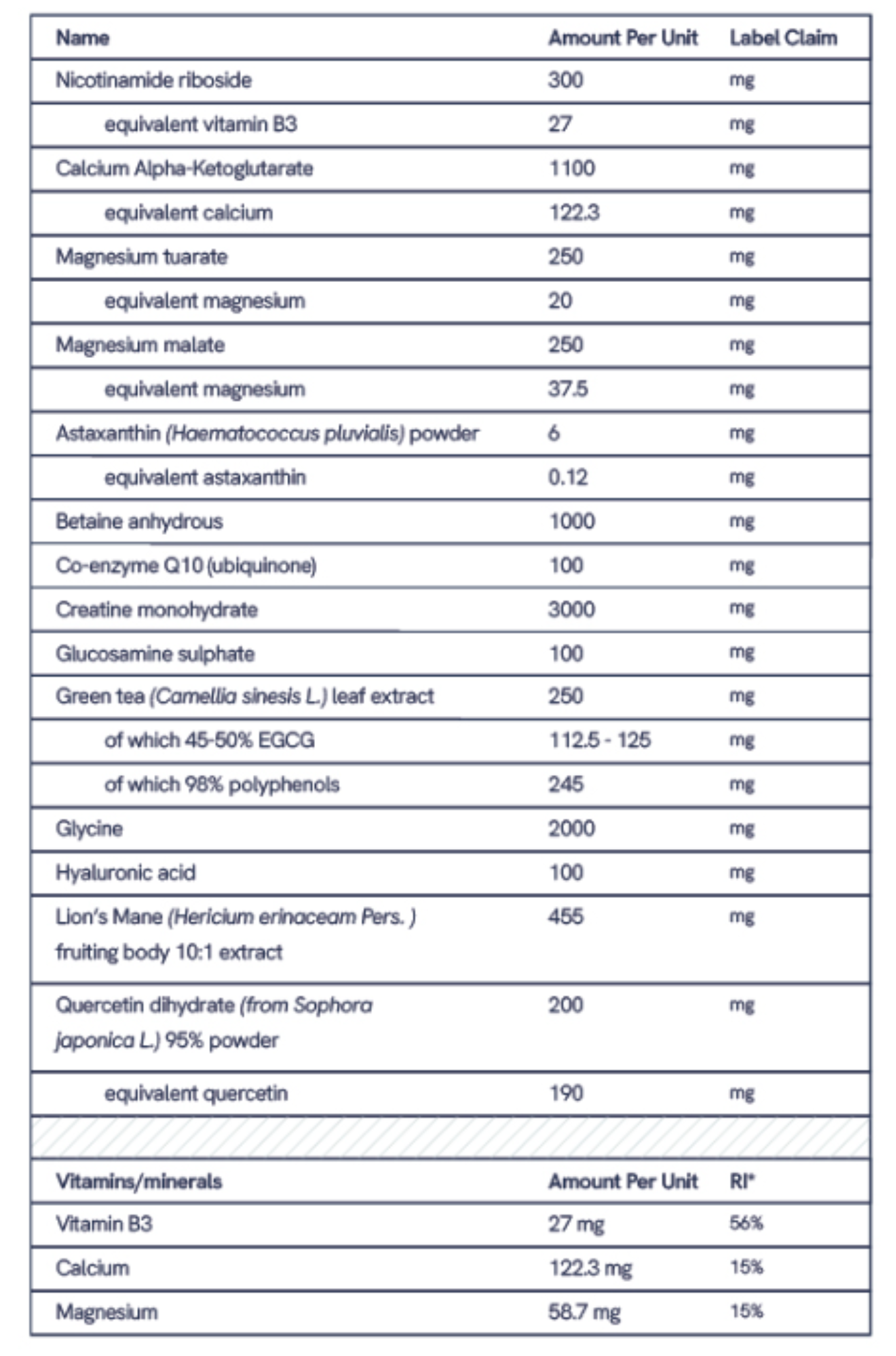
A daily nutrition powder is not a caffeine product. For transparency, Longevity One contains no caffeine and no caffeine source, and is taken as one level scoop a day. Magnesium contributes to a reduction of tiredness and fatigue. Vitamin B6, vitamin B12, folate, niacin and vitamin C contribute to the reduction of tiredness and fatigue. It is not designed to give a lift in the way caffeine does, and it can be taken alongside a modest coffee habit without adding to your caffeine total.
Q&A: Powdered Caffeine
Is pure caffeine powder legal to buy?
Rules differ by country and change over time, so check your national food safety authority. Legal availability does not tell you whether you can measure a bulk powder accurately at home.
How much caffeine powder is safe?
For healthy adults, up to 400 mg a day from all sources is the supported figure, and many people need far less.1 That is 0.4 g in total, which is too little to measure accurately with kitchen spoons or scales.
Why is caffeine powder more dangerous than coffee?
Because the dose is concentrated and hard to measure. A 200 mg amount is only 0.2 g, which a whole-gram kitchen scale cannot show. Choose a product with the amount printed per serving.
Are caffeine powder drink mixes safe?
Pre-portioned mixes with the caffeine printed per serving are comparable to other caffeine products at the same dose. Laboratory tests show labels can still be off, so prefer products with stated mg per serving and independent testing.3
How much caffeine is in a scoop of pre-workout powder?
Laboratory tests of 15 products found 91 to 387 mg per serving.3 Training studies use about 3 to 6 mg per kg of body weight.2
What does too much caffeine feel like?
Side effects become more frequent as the dose rises, and in one trial they rose sharply at 9 mg per kg.5 A fast or irregular heartbeat, vomiting or a seizure are signs of taking far too much and need emergency help.7
Should I count coffee when using a caffeine drink mix?
Yes. The 400 mg daily figure is from all sources together.1
Why do some people react strongly to small doses?
People clear caffeine at very different speeds, mainly because of variation in the liver enzyme CYP1A2.4 Some younger people have had severe reactions to doses not usually known to cause harm.7
Is caffeine powder safe for teenagers?
No. A systematic review supported a limit of 2.5 mg per kg a day for adolescents1, and the ISSN advises adolescents to be cautious with energy drinks and shots.9
Does a powdered caffeine drink keep you awake longer than coffee?
Only if it contains more caffeine. A meta-analysis advised at least 8.8 hours between a coffee and bedtime, and 13.2 hours for a 217.5 mg serving.6
Frequently Asked Questions
Can I use caffeine powder or drink mixes if I take medication?
Ask your GP or pharmacist first and bring the product label. Caffeine interacts with many medications.4 For Longevity One, the label advises consulting your doctor if you use medication.
Does Longevity One contain caffeine powder?
No. It contains no caffeine and no caffeine source. It is a daily nutrition powder, not a stimulant.
What does Longevity One taste like?
It has a mango and pineapple flavour. Mix one scoop into 250 to 500 ml of water, or into a smoothie or yogurt.
What should I do with pure caffeine powder I already have?
Do not use it without accurate laboratory scales, and keep it locked away from children. Ask your local pharmacy or municipality how to dispose of it.
Is caffeine powder safe during pregnancy?
Ask your midwife or GP. The ISSN advises against energy drinks and shots during pregnancy and breastfeeding.9
References
- Wikoff D, Welsh BT, Henderson R, Brorby GP, Britt J, Myers E, et al. Systematic review of the potential adverse effects of caffeine consumption in healthy adults, pregnant women, adolescents, and children. Food Chem Toxicol. 2017;109(Pt 1):585-648. View on PubMed ↗
- Guest NS, VanDusseldorp TA, Nelson MT, Grgic J, Schoenfeld BJ, Jenkins NDM, et al. International society of sports nutrition position stand: caffeine and exercise performance. J Int Soc Sports Nutr. 2021;18(1):1. View on PubMed ↗
- Desbrow B, Hall S, O'Connor H, Slater G, Barnes K, Grant G. Caffeine content of pre-workout supplements commonly used by Australian consumers. Drug Test Anal. 2019;11(3):523-529. View on PubMed ↗
- Nehlig A. Interindividual differences in caffeine metabolism and factors driving caffeine consumption. Pharmacol Rev. 2018;70(2):384-411. View on PubMed ↗
- Pallarés JG, Fernández-Elías VE, Ortega JF, Muñoz G, Muñoz-Guerra J, Mora-Rodríguez R. Neuromuscular responses to incremental caffeine doses: performance and side effects. Med Sci Sports Exerc. 2013;45(11):2184-2192. View on PubMed ↗
- Gardiner C, Weakley J, Burke LM, Roach GD, Sargent C, Maniar N, et al. The effect of caffeine on subsequent sleep: a systematic review and meta-analysis. Sleep Med Rev. 2023;69:101764. View on PubMed ↗
- Willson C. The clinical toxicology of caffeine: a review and case study. Toxicol Rep. 2018;5:1140-1152. View on PubMed ↗
- Fulgoni VL 3rd, Keast DR, Lieberman HR. Trends in intake and sources of caffeine in the diets of US adults: 2001-2010. Am J Clin Nutr. 2015;101(5):1081-1087. View on PubMed ↗
- Jagim AR, Harty PS, Tinsley GM, Kerksick CM, Gonzalez AM, Kreider RB, et al. International society of sports nutrition position stand: energy drinks and energy shots. J Int Soc Sports Nutr. 2023;20(1):2171314. View on PubMed ↗
Disclaimer: Educational content only. Not medical advice. Food supplements should not be used as a substitute for a varied, balanced diet and a healthy lifestyle. If you use medication, consult your doctor.