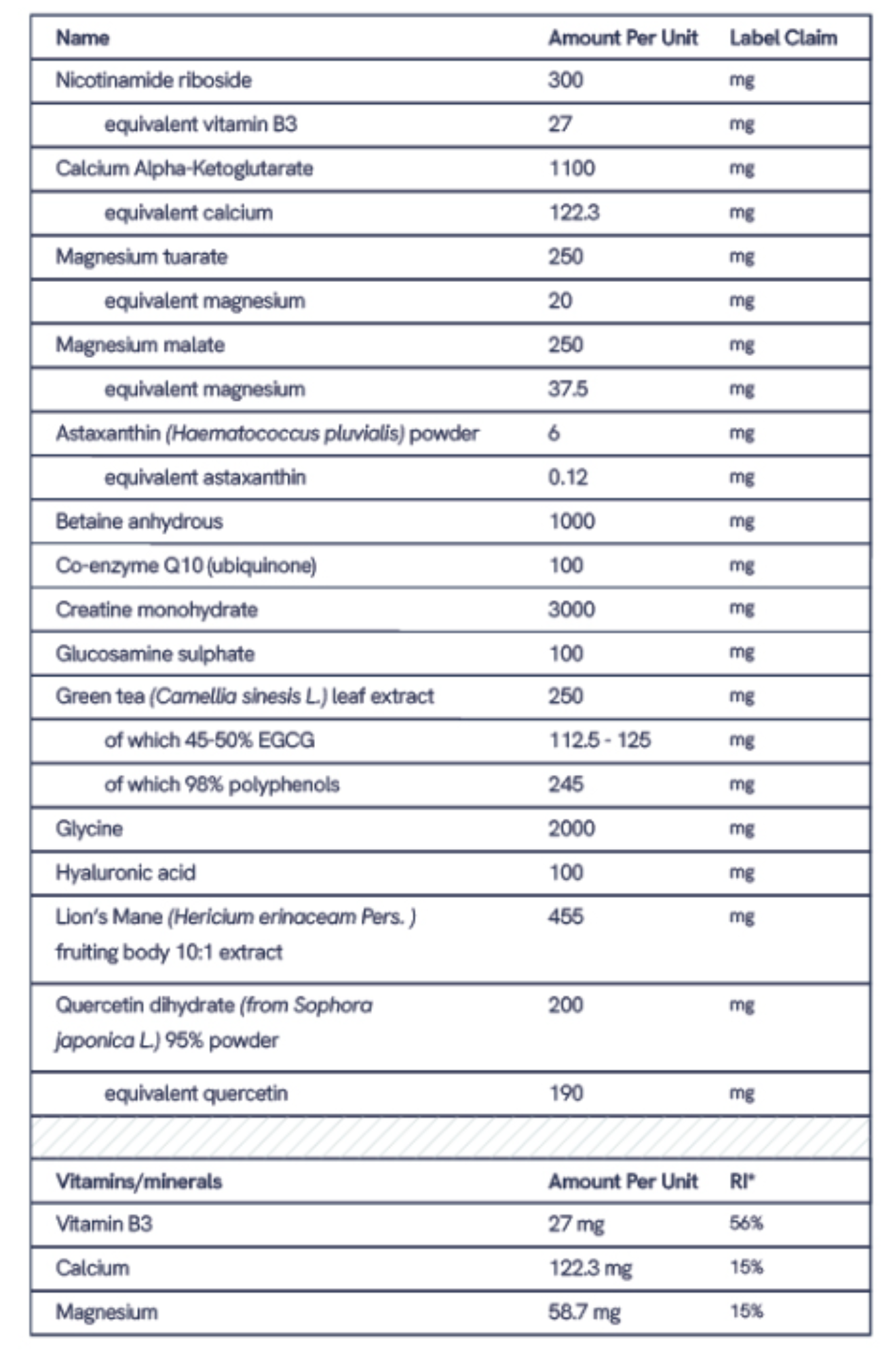
Longevity superfood blends combine concentrated plant-based ingredients -- such as greens, berries, adaptogens, and functional mushrooms -- into convenient powder or capsule formats. Quality varies significantly across products. The most important evaluation criteria are ingredient dose transparency, evidence quality for included compounds, third-party testing, and the absence of proprietary blend concealment. No superfood blend can replace a balanced diet, and no ingredient in these products is proven to extend human lifespan.
Key Takeaways
- Longevity superfood blends typically combine greens (spirulina, chlorella, wheatgrass), berry extracts (blueberry, acai, goji), functional mushrooms (lion's mane, reishi, cordyceps), and adaptogens into a single product.
- Spirulina is among the better-researched greens in humans; meta-analyses of controlled clinical trials suggest associations with inflammatory markers in certain populations, though study heterogeneity is high.1
- Wild blueberry polyphenols have been studied in human RCTs for their role in vascular function and cognitive support in healthy older adults, with evidence growing but still preliminary.2
- Lion's mane mushroom (Hericium erinaceus) has been the subject of several small human RCTs focused on cognitive function; results are promising but study sizes remain limited.3,4
- B vitamins contribute to normal energy-yielding metabolism and help reduce tiredness and fatigue (EFSA-approved claims); these are among the strongest evidence-based components in superfood blend formulas.
- Proprietary blends that conceal individual ingredient amounts make quality evaluation impossible; always prioritise products with fully disclosed formulas and independent Certificates of Analysis.
- Superfood blends are not dietary replacements; they are best considered alongside, not instead of, a nutrient-dense whole-food diet.
What Makes a Longevity Superfood Blend?
The term "superfood blend" is a marketing category, not a regulatory classification. In practice, these products are multi-ingredient formulations that combine concentrated whole-food-derived or extracted compounds, typically sold as powders to be mixed with water or as capsules. The "longevity" framing reflects consumer interest in healthy ageing, though it is important to note that no product of this kind has been demonstrated to extend human lifespan in a controlled study.
Most longevity superfood blends draw from several broad ingredient categories. Greens such as spirulina (Arthrospira platensis), chlorella, wheatgrass, and barley grass are concentrated plant sources of chlorophyll, proteins, and micronutrients. Berry extracts including blueberry, acai, goji (wolfberry), and pomegranate provide polyphenols -- plant compounds including anthocyanins, flavonols, and proanthocyanidins that have attracted research interest for their antioxidant and signalling properties. Functional mushrooms such as lion's mane (Hericium erinaceus), reishi (Ganoderma lucidum), and cordyceps (Cordyceps militaris) are included for their beta-glucan content and bioactive compounds studied in Asian traditional medicine. Adaptogens such as ashwagandha (Withania somnifera), rhodiola (Rhodiola rosea), and maca (Lepidium meyenii) complete the typical formulation.
The quality of human clinical evidence for each of these ingredient categories varies considerably. Understanding that variation is the starting point for any informed evaluation of a product.
Evaluating Ingredients: What Has Human Evidence?
Spirulina and Greens
Spirulina is among the most studied microalgae in human clinical trials. A 2022 systematic review of 18 human intervention studies found associations between spirulina supplementation and inflammatory and antioxidant biomarkers in multiple populations, including overweight individuals and those with certain metabolic profiles.1 A 2023 meta-analysis of 20 RCTs involving 1,076 participants found associations between spirulina supplementation and lipid biomarkers including LDL-C, total cholesterol, and triglycerides, with moderate to high heterogeneity across included studies.5
However, it is important to frame these findings carefully. Most spirulina trials have been conducted in individuals with pre-existing metabolic conditions, not in healthy populations seeking general longevity support. Effect sizes are moderate, heterogeneity between studies is substantial, and the doses studied (typically 1--8 g per day) are often higher than amounts present in multi-ingredient superfood blends. A meta-analysis on spirulina's antioxidant effects found marginal significance for total antioxidant capacity and superoxide dismutase activity across nine controlled clinical trials totalling 415 participants.6
Chlorella, wheatgrass, and barley grass have considerably less published human clinical trial data. They contribute micronutrients including magnesium, vitamin C, and B vitamins, where EFSA-approved claims are applicable. Vitamin C contributes to the protection of cells from oxidative stress, and magnesium contributes to normal energy-yielding metabolism -- these approved functional roles are more robustly supported than any specific therapeutic claim for the greens themselves.
Berry Extracts and Polyphenols
Among berry-derived ingredients, blueberry polyphenols have the strongest body of human RCT evidence in the context of longevity-relevant endpoints. A 2023 double-blind, randomised, placebo-controlled trial enrolled 61 healthy older adults and assessed the effects of daily wild blueberry supplementation over 12 weeks. The blueberry group showed significant improvements in vascular function (flow-mediated dilation) and cognitive performance relative to placebo, with associated changes in cerebral blood flow.2 An earlier RCT found that blueberry concentrate supplementation for 12 weeks was associated with improved brain perfusion and task-related brain activation in healthy older adults assessed by fMRI.7
A 2019 systematic review of 12 blueberry RCTs found that eight of the included studies reported improvements in at least one measure of cognitive performance, particularly memory outcomes.8 Results were most consistent in older adults and those with mild cognitive concerns. Evidence is less consistent in younger, healthy populations.
For acai, goji berry, and pomegranate, human evidence is substantially more limited. Most studies are short-term, with small sample sizes and biomarker outcomes rather than functional endpoints. These ingredients contribute polyphenols with antioxidant properties, but specific health outcome claims are not supportable at this time.
Functional Mushrooms
Lion's mane mushroom (Hericium erinaceus) has the best-documented human clinical trial record among functional mushrooms commonly included in superfood blends. A double-blind, placebo-controlled RCT conducted in 30 Japanese adults aged 50 to 80 with mild cognitive impairment found that those who consumed lion's mane powder for 16 weeks showed significantly higher scores on a cognitive function scale compared to the placebo group, with effects declining after supplementation was stopped.3 A 2023 double-blind, randomised, placebo-controlled parallel-groups pilot study in 41 healthy adults aged 18 to 45 found that a single dose of lion's mane produced quicker performance on a Stroop cognitive task, with a trend toward reduced stress after 28 days of supplementation, though the authors noted the limitations of a small pilot study and called for larger confirmatory trials.4
Reishi (Ganoderma lucidum) and cordyceps have a much smaller body of human clinical evidence than lion's mane, and most well-designed RCTs in humans are limited in size and duration. They are commonly included for their beta-glucan content, which is a class of polysaccharides with a general association with immune-related biomarkers in human studies, though specific health claims cannot be made.
Adaptogens
Ashwagandha (Withania somnifera) has the strongest human evidence among adaptogens commonly found in superfood blends. Multiple RCTs in humans have examined its effects on self-reported stress, cortisol levels, and physical performance, with several showing statistically significant effects, though most trials are small and of short duration. Rhodiola and maca have smaller human evidence bases; the existing RCTs are generally positive for fatigue-related outcomes, but effect sizes are modest and study methodologies vary considerably.
No EFSA-approved health claims exist for any of these adaptogenic plants in the European regulatory context. They should be presented as ingredients "studied for" their potential roles, not as ingredients with established health benefits.
Energy and Vitality: What a Superfood Blend Can Realistically Contribute
Energy and vitality are among the most common reasons consumers choose longevity superfood blends. It is important to distinguish between the nutrient contributions of these products and the marketed claims.
Where blends contain meaningful doses of B vitamins -- particularly B1 (thiamine), B3 (niacin/niacinamide), B6, and B12 -- they can legitimately carry EFSA-approved claims, since these nutrients contribute to normal energy-yielding metabolism. Vitamin B6 and B12, together with magnesium, help reduce tiredness and fatigue. If a product provides a meaningful portion of these nutrients at a dose equivalent to their reference intake, the energy claims are grounded in approved regulatory science.
However, many superfood blends rely on proprietary blends or include trace amounts of these nutrients below any physiologically meaningful threshold. Marketing language about "boosting energy" through spirulina, cordyceps, or maca extracts goes beyond what the current human evidence supports for general healthy populations. Consumers seeking genuine energy support should evaluate whether B vitamin content is declared, meaningful, and sourced from forms with known bioavailability.
Separately, improvements in general wellbeing -- such as those sometimes reported with adaptogen use in stressed individuals -- are not equivalent to biochemically defined "energy." These are different endpoints, and honest formulation philosophy should distinguish between them.
How to Choose a Quality Longevity Superfood Blend
Given the wide variation in product quality within this category, a clear evaluation framework is more useful than brand comparisons. The following criteria apply regardless of which product is under consideration.
Full Ingredient Disclosure
A quality superfood blend lists every ingredient separately with its exact dose per serving. Any product that uses the phrase "proprietary blend" and gives only a combined weight for multiple ingredients does not allow you to evaluate whether any individual ingredient is present in a dose that has been used in human research. This is a critical transparency failure.
Third-Party Testing and Certificate of Analysis
Independent laboratory testing confirms that a product contains what its label states, at the declared dose, and is free from heavy metals, microbial contamination, and residual solvents. A Certificate of Analysis (COA) from an accredited laboratory -- such as testing by Eurofins or equivalent third-party facilities -- provides objective verification that marketing claims align with actual content. Products that do not publish or make available COAs offer no independent quality assurance.
Meaningful Doses Relative to Research
Even fully disclosed formulas may include an ingredient at a dose far below that used in any human study. Spirulina at 200 mg in a blend was not the dose used in RCTs showing effects on lipid biomarkers -- those trials used 1,000 to 8,000 mg per day. Blueberry extract at 50 mg cannot be compared to trials using 600 mg of freeze-dried blueberry daily. Consumers should compare label doses against study doses before assuming equivalence.
Minimal Additives and Sweeteners
Many superfood blends include substantial amounts of natural flavours, sweeteners (erythritol, stevia), and flow agents. These are not inherently harmful, but they contribute to overall serving volume in a way that may displace active ingredient content. A blend with 10 g per serving, of which 4 g is flavouring and base carriers, delivers less active ingredient per serving than one with the same serving size but minimal additives.
Vegan and Allergen Considerations
Most plant-based superfood blends are naturally vegan, but consumers should verify capsule material (plant cellulose vs gelatine) and check for hidden animal-derived processing aids. Common cross-contamination concerns include shared manufacturing with dairy, gluten, and soy. Products certified vegan and tested for allergen absence provide greater assurance for those with specific dietary requirements.
Transparency About What the Product Is Not
Reputable brands distinguish between what their product contributes nutritionally and what it cannot replace. A superfood blend is not a substitute for a varied diet, not a replacement for prescribed medication, and not a treatment for any condition. Brands that make clear the supplementary and educational nature of their products reflect stronger credibility than those relying on vague longevity claims unsupported by the evidence.
Q&A: Longevity Superfood Blends
What are the top longevity superfood blends designed to do?
Longevity superfood blends aim to provide a broad array of plant-derived compounds in a convenient format: concentrated greens, berry polyphenols, functional mushroom extracts, and adaptogenic herbs. Their intended role is nutritional support and complementing a healthy diet, not treating or preventing disease. The ingredients with the best human evidence are those with documented RCTs, such as spirulina for certain biomarker outcomes,1 blueberry polyphenols for vascular and cognitive support in older adults,2 and lion's mane for cognitive function in certain populations.3
How should I choose a longevity superfood blend for overall health?
Prioritise products with full dose transparency (no proprietary blends), third-party testing with a published Certificate of Analysis, and ingredients with human clinical evidence at meaningful doses. Compare each ingredient's label dose against the doses used in published RCTs. Avoid products making disease or reversal claims, as these are not supported by regulatory science and may indicate poor formulation philosophy.
Can a longevity superfood blend support daily vitality and energy?
Where a blend contains meaningful doses of B vitamins, these contribute to normal energy-yielding metabolism and help reduce tiredness and fatigue (EFSA-approved claims). The contribution of greens or adaptogenic herbs to subjective energy levels in healthy individuals is less clearly supported by human data. Realistic expectations involve nutritional contribution from micronutrients and plant compounds, not a biochemical energy enhancement equivalent to stimulants.
Are longevity superfood blends vegan friendly?
Most superfood blends are formulated with plant-based ingredients and are suitable for vegans. However, capsule materials can vary: gelatine capsules are animal-derived, while vegetable cellulose capsules (HPMC) are vegan. Always verify the capsule specification on the product label or contact the manufacturer directly. Some products also carry certified vegan logos from independent certification bodies.
What makes a longevity superfood blend high quality?
High quality is defined by ingredient transparency, dose accuracy, and third-party verified purity. A high-quality product discloses every ingredient with its individual dose, uses forms of ingredients with established bioavailability, is tested by an accredited independent laboratory, and provides a Certificate of Analysis on request or publicly. Quality is not determined by the length of an ingredient list or the presence of trending ingredients.
Do superfood blends with functional mushrooms have human evidence?
Lion's mane (Hericium erinaceus) has the best-documented human RCT record among mushrooms typically found in these blends. A double-blind placebo-controlled trial in adults with mild cognitive impairment showed significant cognitive function improvements over 16 weeks.3 Reishi and cordyceps have fewer and smaller human trials. All existing evidence is preliminary, and large-scale confirmatory trials are still needed.
What does spirulina actually contribute in a superfood blend?
Spirulina provides protein, B vitamins, and the blue pigment phycocyanin. It is also a source of iron, which contributes to the reduction of tiredness and fatigue, and of vitamin B12 in some forms (though bioavailability from algal B12 varies). Human trials have studied spirulina primarily for lipid biomarkers and inflammatory markers, mostly in individuals with pre-existing metabolic conditions.5 The doses in those trials are typically far higher than what is present in multi-ingredient blends.
Should I take a superfood blend or focus on whole foods?
Whole foods provide dietary fibre, co-factors, and synergistic phytonutrients in forms and combinations that concentrated extracts cannot fully replicate. A superfood blend is a supplement to, not a substitute for, a nutritionally diverse diet. The scientific consensus on healthy ageing consistently places diet quality as a primary determinant of long-term health outcomes. A blend may add nutritional breadth in convenient form, but it should build upon an adequate dietary foundation, not replace one.
What should I avoid when reading a superfood blend label?
Avoid products using proprietary blends that do not disclose individual ingredient doses. Be cautious of claims that a product "reverses ageing," "detoxifies," or offers guaranteed outcomes, as no supplement can make these claims legitimately. Look critically at ingredient lists where dozens of compounds are combined: the more ingredients, the lower the dose of each, and the less likely any individual ingredient reaches a dose studied in human trials.
How does Longevity Complete relate to superfood blends?
Longevity Complete is a comprehensive multivitamin and mineral formula that differs from typical superfood blends by focusing on micronutrient provision at meaningful doses with EFSA-compliant claims. It includes B vitamins (contributing to normal energy-yielding metabolism and reduction of tiredness and fatigue), vitamin C and zinc (contributing to protection of cells from oxidative stress), and vitamin D (contributing to normal immune function and maintenance of normal bones). It is independently tested, with a Certificate of Analysis available, and does not rely on proprietary blend concealment. It is not positioned as a superfood blend, but shares the same quality principles of dose transparency and third-party verification.
Frequently Asked Questions
What is a longevity superfood blend?
A longevity superfood blend is a multi-ingredient supplement, typically in powder or capsule form, combining concentrated plant sources such as greens, berry extracts, functional mushrooms, and adaptogens. The term "longevity" is a marketing category, not a regulatory definition. Quality varies widely. The most reliable products are those with full dose transparency, third-party testing, and no proprietary blend concealment.
Which longevity superfood blend ingredient has the most human evidence?
Among commonly included ingredients, spirulina has the largest number of human RCTs for biomarker outcomes,1,5 blueberry polyphenols have meaningful RCT evidence for vascular and cognitive outcomes in older adults,2 and lion's mane mushroom has the best-documented record for cognitive function among functional mushrooms.3 B vitamins carry EFSA-approved claims for energy and fatigue reduction.
Are longevity superfood blends vegan friendly?
Most are, but it depends on the capsule material used. Gelatine capsules are animal-derived; vegetable cellulose (HPMC) capsules are vegan. Always check the product specification or contact the manufacturer to confirm. Some products carry certified vegan logos, which provide independent verification. The plant-based ingredients themselves -- greens, berries, mushrooms -- are inherently vegan.
How do I know if the doses in a superfood blend are meaningful?
Compare the dose listed on the label for each ingredient against the doses used in published human RCTs. If the dose on the label is substantially lower than what has been studied -- which is common in blends with many ingredients -- the ingredient may be present for label appeal rather than meaningful nutritional contribution. Products with proprietary blends that conceal individual doses cannot be evaluated at all and should be avoided.
Can a superfood blend replace a multivitamin?
Not reliably. Most superfood blends prioritise concentrated plant extracts over precise micronutrient provision. Unless a product clearly states the percentage of the nutrient reference value (NRV%) for each vitamin and mineral, it is difficult to know what micronutrient gaps it addresses. A dedicated multivitamin and mineral supplement with transparent nutrient levels and EFSA-compliant claims provides more reliable micronutrient support than most superfood blends.
What does "top longevity superfood blend for 2024 or 2025" actually mean?
This phrasing is marketing language. There is no regulatory body that certifies a product as the "top" longevity blend for any year. The meaningful evaluation criteria remain constant: dose transparency, third-party testing, quality of human evidence for included ingredients, and absence of disease claims. The best approach is to assess any product against these objective criteria rather than rely on rankings or awards.
References
- Calella P, Di Dio M, Cerullo G, Di Onofrio V, Galle F, Liguori G. Antioxidant, immunomodulatory, and anti-inflammatory effects of Spirulina in disease conditions: a systematic review. Int J Food Sci Nutr. 2022;73(8):1047-1056. View on PubMed ↗
- Wood E, Hein S, Mesnage R, Fernandes F, Abhayaratne N, Xu Y, Zhang Z, Bell L, Williams C, Rodriguez-Mateos A. Wild blueberry (poly)phenols can improve vascular function and cognitive performance in healthy older individuals: a double-blind randomized controlled trial. Am J Clin Nutr. 2023;117(6):1306-1319. View on PubMed ↗
- Mori K, Inatomi S, Ouchi K, Azumi Y, Tuchida T. Improving effects of the mushroom Yamabushitake (Hericium erinaceus) on mild cognitive impairment: a double-blind placebo-controlled clinical trial. Phytother Res. 2009;23(3):367-372. View on PubMed ↗
- Docherty S, Doughty FL, Smith EF. The Acute and Chronic Effects of Lion's Mane Mushroom Supplementation on Cognitive Function, Stress and Mood in Young Adults: A Double-Blind, Parallel Groups, Pilot Study. Nutrients. 2023;15(22):4842. View on PubMed ↗
- Rahnama I, Arabi SM, Chambari M, Bahrami LS, Hadi V, Mirghazanfari SM, Rizzo M, Hadi S, Sahebkar A. The effect of Spirulina supplementation on lipid profile: GRADE-assessed systematic review and dose-response meta-analysis of data from randomized controlled trials. Pharmacol Res. 2023;193:106802. View on PubMed ↗
- Naeini F, Zarezadeh M, Mohiti S, Tutunchi H, Ebrahimi Mamaghani M, Ostadrahimi A. Spirulina supplementation as an adjuvant therapy in enhancement of antioxidant capacity: a systematic review and meta-analysis of controlled clinical trials. Int J Clin Pract. 2021;75(10):e14618. View on PubMed ↗
- Bowtell JL, Aboo-Bakkar Z, Conway ME, Adlam AR, Fulford J. Enhanced task-related brain activation and resting perfusion in healthy older adults after chronic blueberry supplementation. Appl Physiol Nutr Metab. 2017;42(7):773-779. View on PubMed ↗
- Travica N, D'Cunha NM, Naumovski N, Kent K, Mellor DD, Roodenrys S, Sarris J, Scholey A. The effect of blueberry interventions on cognitive performance and mood: A systematic review of randomized controlled trials. Brain Behav Immun. 2020;85:96-105. View on PubMed ↗