Muscle maintenance after midlife centres on a combination of regular resistance exercise and targeted nutritional support. Key nutrients with EFSA-approved roles in muscle function include creatine, vitamin D, calcium, and magnesium. Creatine enhances muscle strength in adults over 55 when combined with resistance training. Adequate protein intake, particularly leucine-rich sources, also plays a central role in supporting muscle protein synthesis as requirements rise with age.
Key Takeaways
- After age 50, muscle mass decreases at an estimated rate of 1 to 2% per year, and strength declines even faster -- at approximately 1.5% per year between ages 50 and 60, and around 3% per year thereafter.1
- Sarcopenia, the age-related loss of muscle mass and function, is estimated to affect 10 to 27% of older adults globally, depending on the diagnostic criteria used.1
- Creatine increases physical performance in successive bouts of short-term, high-intensity exercise (3 g/day) and enhances muscle strength in adults over 55 when combined with regular resistance training (EFSA-approved claims).3
- Calcium, magnesium, and vitamin D contribute to normal muscle function (EFSA-approved claims). Human trials show that vitamin D supplementation is most likely to benefit individuals with established deficiency.4
- Protein requirements increase with age. Research supports an intake of 1.0 to 1.2 g per kg of body weight per day for older adults, with leucine-rich sources such as whey playing a particular role in stimulating muscle protein synthesis.7
- The combination of resistance exercise and nutritional support consistently outperforms either intervention alone across multiple systematic reviews in older populations.6
- Quality markers such as third-party testing, Certificate of Analysis availability, and verified dosing are important when evaluating supplement choices for muscle support.
Sarcopenia: Understanding Age-Related Muscle Loss
Skeletal muscle is not a static tissue. It responds dynamically to exercise, nutrition, hormonal signals, and ageing. From approximately age 30, a slow and gradual decline in muscle mass begins. By the fifth decade, this process accelerates noticeably. After age 50, muscle mass is estimated to decrease at a rate of 1 to 2% per year, while the decline in strength is even more pronounced -- approximately 1.5% per year between ages 50 and 60, and around 3% per year thereafter.1
This progressive loss of muscle mass and function is known as sarcopenia. Recognised by the World Health Organization as a disease entity, sarcopenia is characterised by reductions in muscle mass, muscle strength, and physical performance. A 2022 systematic review and meta-analysis pooling data from 263 studies across 692,056 participants found global prevalence estimates ranging from 10% to 27% in older adults, depending on the diagnostic criteria applied.1 A 2023 review of the epidemiological evidence confirmed that physical inactivity and suboptimal nutrition are among the strongest modifiable risk factors associated with accelerated muscle loss.2
The functional consequences of sarcopenia extend beyond reduced physical strength. Reduced mobility, increased fall risk, impaired balance, and diminished capacity to perform daily activities are commonly reported in affected individuals. For longevity-focused health planning, maintaining muscle mass and strength is therefore not a cosmetic concern but a functional one with implications for independence and quality of life. Regular resistance exercise remains the most well-established intervention, and nutritional support plays an important complementary role.
Creatine for Muscle Strength: Evidence and EFSA Claims
Creatine is one of the most thoroughly studied nutritional supplements in the context of muscle performance. In the body, creatine is stored primarily in skeletal muscle as phosphocreatine, which serves as a rapid energy reservoir for the resynthesis of adenosine triphosphate (ATP) during short, high-intensity muscular efforts. When phosphocreatine stores are replenished through supplementation, the capacity to perform repeated bouts of high-intensity exercise is enhanced.
Two EFSA-approved health claims apply to creatine:
- Creatine increases physical performance in successive bouts of short-term, high-intensity exercise at a daily intake of 3 g.
- Creatine enhances the effect of resistance training on muscle strength in adults over 55 years of age who engage in regular resistance training.
These claims are grounded in a substantial body of human trial evidence. A meta-analysis by Devries and Phillips examined randomised controlled trials of creatine supplementation combined with resistance training in older adults, pooling data from 357 participants. The analysis found that creatine combined with resistance training produced significantly greater gains in lean tissue mass and muscle strength compared to resistance training alone, with the creatine group gaining a mean of approximately 1.37 kg more lean tissue mass.3 The authors noted that the functional gains supported the potential of creatine as a tool for supporting muscle health during ageing, while emphasising that resistance training remains essential.
Mechanistically, creatine supplementation is thought to support muscle health through several pathways: enhancing phosphocreatine resynthesis, promoting cellular hydration through osmotic mechanisms, and potentially influencing satellite cell activity, which is relevant to muscle protein synthesis and repair. These mechanisms support the exercise-mediated adaptations rather than acting independently of physical training.
Creatine monohydrate is the most extensively studied form, and the majority of published trials have used this form. Typical studied doses range from 3 to 5 g per day in maintenance protocols, with some studies using a short-term loading phase at higher doses. The 3 g per day dose is the basis for the approved EFSA performance claim. Side effects are generally minimal; the most commonly reported is water retention during initial use, and gastrointestinal symptoms have occasionally been noted at higher doses.
For more detail on creatine evidence and practical considerations, see the dedicated creatine article in this series.
Vitamin D, Calcium, and Magnesium: EFSA Claims for Normal Muscle Function
Three nutrients carry EFSA-approved claims specifically referencing their contribution to normal muscle function: calcium, magnesium, and vitamin D. Each operates through distinct mechanisms that are relevant to skeletal muscle physiology.
Vitamin D and Skeletal Muscle
Skeletal muscle cells express vitamin D receptors, and vitamin D is involved in normal muscle cell function at multiple levels. It plays a role in calcium handling within muscle fibres, influences gene expression related to muscle protein synthesis, and is associated with neuromuscular coordination. EFSA has approved the claim that vitamin D contributes to normal muscle function.
The human research on vitamin D supplementation and measurable muscle outcomes is nuanced. A 2021 systematic review and meta-analysis of randomised placebo-controlled trials, including 50 trials across populations excluding athletes, assessed endpoints including physical performance tests, muscle strength measures, and lean tissue mass. The review found that the evidence for vitamin D supplementation improving muscle-related outcomes in the general older adult population was inconsistent, with some endpoints showing benefit and others not reaching significance.4 An earlier meta-analysis of 17 RCTs involving 5,072 participants found no significant effect on grip strength or lower limb strength in adults with 25-hydroxyvitamin D levels above 25 nmol/L, but a substantial benefit in those with clinically established deficiency.5
The practical implication is that vitamin D supplementation for muscle function is most likely to produce measurable benefit in individuals with genuinely low vitamin D status. Vitamin D deficiency is widespread globally, and testing baseline status before initiating supplementation is a reasonable approach. In individuals with adequate levels, supplementation is unlikely to produce dramatic muscle-specific gains, but supports the broader nutritional foundation for normal muscle function.
Calcium and Magnesium
Calcium is essential for excitation-contraction coupling -- the process by which electrical signals from motor neurons are translated into muscle fibre contraction. Without sufficient intracellular calcium flux, normal muscle contraction cannot occur. EFSA has approved the claim that calcium contributes to normal muscle function.
Magnesium is a cofactor for hundreds of enzymatic reactions and plays a specific role in ATP synthesis and muscle relaxation. Following muscle contraction (which is calcium-dependent), the return of muscle fibres to their resting state requires active pumping of calcium ions back across membranes -- a process that depends on ATP and, by extension, on adequate magnesium status. EFSA has approved claims that magnesium contributes to normal muscle function, normal protein synthesis, and the reduction of tiredness and fatigue.
Magnesium deficiency is relatively common in adults, particularly those with poor dietary variety, higher physical activity levels, or gastrointestinal conditions affecting absorption. Suboptimal magnesium status has been observed in population studies to correlate with lower grip strength and reduced physical performance in older adults, though the causality of this association requires careful interpretation. For more on magnesium evidence and practical considerations, see the dedicated magnesium article in this series.
Protein and Amino Acids for Muscle Preservation
Protein is the macronutrient most directly involved in muscle mass maintenance. Dietary amino acids serve as the building blocks for muscle protein synthesis -- the process by which the body builds and repairs contractile muscle proteins. In ageing adults, this process becomes progressively less efficient, a phenomenon known as anabolic resistance. In practical terms, older individuals require a higher protein intake per meal and per day to achieve the same muscle protein synthetic response as younger adults.
How Much Protein Is Enough?
The standard recommended dietary allowance (RDA) for protein in adults is 0.8 g per kg of body weight per day. However, several professional bodies and research groups have concluded that this level is insufficient to maintain muscle mass in older adults. A 2022 systematic review and meta-analysis found that protein intake above the RDA was cross-sectionally associated with better physical performance and greater muscle strength in older adults, though the authors noted that higher protein intake alone, without exercise, did not prevent physical function decline over time.7 A systematic review of observational studies found that dietary protein intake was positively associated with skeletal muscle mass in older adults in the majority of analyses examined.8
Current evidence generally supports a protein intake of 1.0 to 1.2 g per kg of body weight per day for healthy older adults seeking to maintain muscle mass, and potentially higher (up to 1.5 g per kg per day) during periods of active resistance training. These figures reflect the consensus position of several major nutrition and ageing organisations, though exact recommendations vary.
The Leucine Threshold
Not all protein sources exert the same anabolic effect on muscle. The amino acid leucine, a branched-chain amino acid, acts as a key signalling molecule for initiating muscle protein synthesis via the mTOR pathway. To effectively stimulate muscle protein synthesis at a single meal, research suggests that a threshold of approximately 2 to 3 g of leucine per serving is needed. Older adults may require a higher leucine dose per meal to achieve the same response as younger individuals.
Whey protein is notable for its high leucine content (approximately 10 to 12% leucine by amino acid composition) and rapid digestibility, making it a particularly studied protein source for muscle maintenance in older adults. A meta-analysis of 21 RCTs involving 1,249 older participants found that protein supplementation combined with resistance training produced measurable improvements in muscle mass and strength compared to resistance training alone.6 Without exercise, protein supplementation alone produced less consistent results across studies.
Plant Versus Animal Protein
Protein quality varies between sources. Digestibility and essential amino acid content are both relevant considerations. Animal-based proteins (including dairy, eggs, poultry, and fish) generally provide a complete essential amino acid profile and high digestibility. Plant-based proteins can also support muscle health effectively when diverse sources are combined throughout the day to ensure a complete essential amino acid intake. Older adults following predominantly plant-based eating patterns should pay particular attention to total protein intake and the variety of protein sources to ensure adequate leucine provision.
Putting It Together: The Exercise-First Principle
A critical point that emerges consistently from the human evidence is that nutritional supplementation for muscle health is most effective when combined with resistance exercise. Neither protein supplementation nor creatine nor micronutrients operate optimally in the absence of a regular stimulus for muscle adaptation. Resistance training provides the mechanical and metabolic signals that make muscle cells responsive to nutritional inputs. Without it, the anabolic potential of supplementation is substantially diminished.
For older adults new to resistance training, evidence supports that even modest programmes -- two to three sessions per week of compound movements targeting major muscle groups -- can produce significant improvements in muscle strength and mass over 8 to 12 weeks. Adding creatine at 3 to 5 g per day and ensuring adequate protein intake (at least 20 to 30 g of high-quality protein per meal, distributed across at least three meals per day) represents an evidence-informed nutritional strategy to support this exercise adaptation.
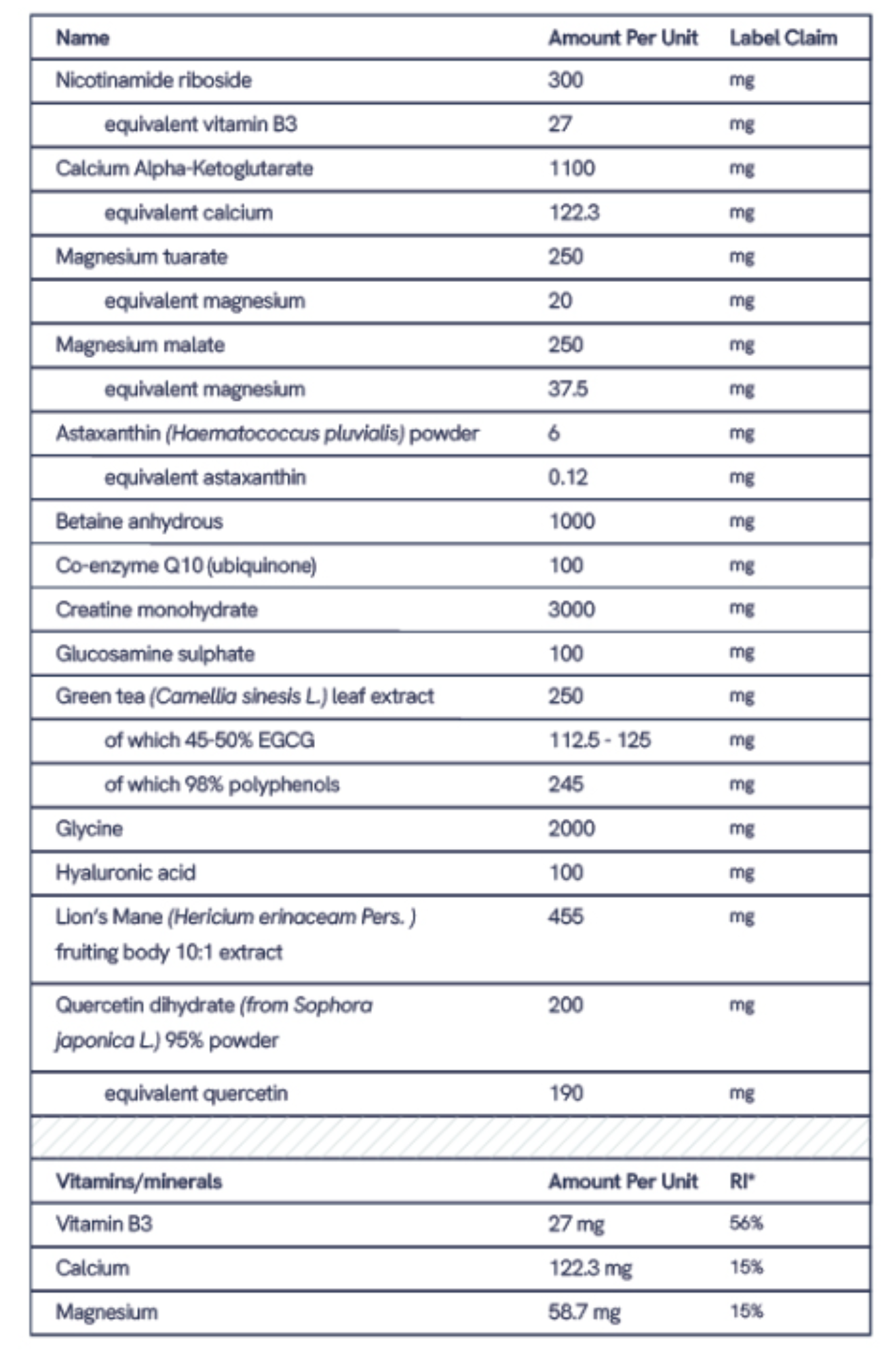
Longevity Complete is formulated to include creatine alongside calcium, magnesium, vitamin D, and a broad spectrum of B vitamins and minerals. Calcium and magnesium contribute to normal muscle function (EFSA-approved). Vitamin D contributes to normal muscle function (EFSA-approved). Creatine increases physical performance in successive bouts of short-term, high-intensity exercise and enhances muscle strength in adults over 55 in combination with resistance training (EFSA-approved). The formulation has been third-party tested and a Certificate of Analysis is available, reflecting a transparency-first approach to ingredient quality.
Q&A: Muscle Health, Strength, and Supplementation
What is sarcopenia?
Sarcopenia is the progressive, age-related loss of skeletal muscle mass, strength, and function. It has been formally recognised as a disease entity and is associated with reduced mobility, increased fall risk, and reduced quality of life in older adults. Estimates suggest it affects 10 to 27% of older adults globally, depending on the diagnostic criteria used.1 Both exercise and nutritional strategies are studied as countermeasures.
Does creatine really help muscle strength in older adults?
Yes, when combined with regular resistance training. EFSA has approved the claim that creatine enhances the effect of resistance training on muscle strength in adults over 55. Human meta-analyses confirm that creatine combined with resistance training produces significantly greater improvements in lean tissue mass and muscular strength compared to resistance training alone.3 It does not appear to produce meaningful muscle benefits without an exercise stimulus.
How much creatine should I take?
The EFSA-approved performance claim is based on a dose of 3 g per day. Many trials in older adults have used 3 to 5 g per day in maintenance protocols. Some protocols include a short loading phase at higher doses, though this is not required for long-term effects. Creatine monohydrate is the most studied form. Timing relative to meals or exercise is flexible, with no single time showing clear superiority across human trials.
Does vitamin D improve muscle strength?
Vitamin D contributes to normal muscle function, as approved by EFSA. However, human supplementation trials show mixed results for muscle strength outcomes in adults with adequate vitamin D levels. The strongest benefits appear in individuals with established vitamin D deficiency.5,4 Testing baseline vitamin D status is a reasonable first step before initiating supplementation.
How much protein do older adults need to maintain muscle?
Current evidence supports 1.0 to 1.2 g of protein per kg of body weight per day for healthy older adults seeking to maintain muscle mass, which is higher than the standard adult RDA of 0.8 g/kg/day. Research indicates that protein intake above the RDA is associated with better physical performance in older populations.7 Exercise, particularly resistance training, substantially enhances the muscle-building response to protein.
What is the leucine threshold?
Leucine is a branched-chain amino acid that activates the mTOR signalling pathway responsible for initiating muscle protein synthesis. Research suggests that approximately 2 to 3 g of leucine per meal is required to maximally stimulate this process, with older adults potentially needing more than younger individuals due to age-related anabolic resistance. Whey protein, eggs, and lean meats are among the highest leucine-density sources.
Is protein alone enough to stop muscle loss with ageing?
Protein alone has limited effect on muscle mass when physical activity is absent. A systematic review and meta-analysis found that protein intake above the RDA was associated with better muscle-related outcomes cross-sectionally, but did not reliably prevent physical function decline over time without exercise.7 The combination of adequate protein with resistance exercise consistently shows stronger effects in human trials.6
What role does magnesium play in muscle health?
Magnesium is essential for ATP production and muscle relaxation after contraction. It also contributes to normal protein synthesis (EFSA-approved). Suboptimal magnesium status has been associated with lower muscle performance in observational studies. Magnesium deficiency is relatively common in adults and can be worsened by high physical activity demands. For more detail on magnesium evidence, see the magnesium article in this series.
Can supplements replace resistance training for muscle maintenance?
No. Resistance training is the primary and most effective intervention for maintaining and increasing muscle mass and strength in older adults. Nutritional supplements such as creatine, protein, and micronutrients serve a supporting role -- they are most effective when used alongside a consistent resistance training programme, not as a replacement for it.3,6
Frequently Asked Questions
What is the best longevity supplement for muscle health?
No single supplement is universally superior. The strongest human evidence supports creatine (in combination with resistance training), adequate dietary protein with leucine-rich sources, and ensuring sufficient vitamin D, calcium, and magnesium intake. EFSA has approved claims for creatine enhancing muscle strength in adults over 55 with resistance training, and for calcium, magnesium, and vitamin D contributing to normal muscle function.3,4
What is the best longevity stack for muscle health?
An evidence-informed muscle support approach typically includes: creatine monohydrate (3 to 5 g per day with resistance exercise), high-quality protein distributed across meals (targeting 1.0 to 1.2 g per kg body weight per day), vitamin D (particularly if status is low), calcium, and magnesium. This nutritional foundation works alongside regular resistance training, which remains the primary intervention.6
What is the best longevity drink for muscle health?
There is no single beverage that has been conclusively shown to maintain muscle mass. Protein shakes using whey protein (high in leucine) have the most evidence for supporting muscle protein synthesis when consumed alongside resistance training. Some formulations also include creatine. The key factor is total daily protein intake, leucine content, and whether it complements an active exercise routine rather than the delivery format itself.7
What is the best longevity science support for muscle and joints?
For muscle, the evidence points to creatine combined with resistance training, adequate protein intake, and sufficient vitamin D, calcium, and magnesium. For joint tissue, vitamin C contributes to normal collagen formation for cartilage (EFSA-approved). These nutritional foundations, alongside weight management and regular low-impact physical activity, represent an evidence-informed approach to supporting both muscle and joint tissue.1,4
At what age should I start thinking about muscle preservation?
The gradual process of age-related muscle decline begins earlier than most people expect -- in the third and fourth decades of life. However, the rate accelerates meaningfully after age 50. Establishing resistance training habits and adequate protein intake before significant loss occurs is more effective than trying to recover muscle mass that has already been lost. The earlier a proactive approach is taken, the more effective the strategy is likely to be.
Does creatine cause weight gain?
Creatine supplementation can cause an initial increase in body weight, primarily due to water retention within muscle cells (intracellular water). This is a normal physiological response to increased muscle creatine stores and is not the same as fat gain. Over the course of a resistance training programme, any additional weight associated with creatine is generally attributable to lean tissue mass gains rather than fat or excess fluid.3
References
- Petermann-Rocha F, Balntzi V, Gray SR, et al. Global prevalence of sarcopenia and severe sarcopenia: a systematic review and meta-analysis. J Cachexia Sarcopenia Muscle. 2022;13(1):86-99. View on PubMed ↗
- Yuan S, Larsson SC. Epidemiology of sarcopenia: Prevalence, risk factors, and consequences. Metabolism. 2023;144:155533. View on PubMed ↗
- Devries MC, Phillips SM. Creatine supplementation during resistance training in older adults -- a meta-analysis. Med Sci Sports Exerc. 2014;46(6):1194-203. View on PubMed ↗
- Bislev LS, Grove-Laugesen D, Rejnmark L. Vitamin D and muscle health: a systematic review and meta-analysis of randomized placebo-controlled trials. J Bone Miner Res. 2021;36(9):1651-1660. View on PubMed ↗
- Tomlinson PB, Joseph C, Angioi M. Effects of vitamin D supplementation on upper and lower body muscle strength levels in healthy individuals: a systematic review with meta-analysis. J Sci Med Sport. 2015;18(5):575-80. View on PubMed ↗
- Liao CD, Tsauo JY, Wu YT, et al. Effects of protein supplementation combined with resistance exercise on body composition and physical function in older adults: a systematic review and meta-analysis. Am J Clin Nutr. 2017;106(4):1078-1091. View on PubMed ↗
- Bano G, Trevisan C, Carraro S, et al. Inflammation and sarcopenia: a systematic review and meta-analysis. Maturitas. 2017;96:10-15. View on PubMed ↗
- Munoz-Martinez N, Sanchez-Ojanguren J, Garcia-Magen Z, et al. Association of dietary protein intake with skeletal muscle mass in older adults: a systematic review. Nutrients. 2021;13(10):3445. View on PubMed ↗