'Clean' has no legal definition on an energy drink or supplement, so it only means something when the label backs it up. Check five facts: caffeine in mg per serving, every dose printed, the sugar and sweeteners used, independent batch testing, and claims in authorised wording. A product that passes all five is cleaner in a way you can verify.
Key Takeaways
- "Clean" is a marketing word with no legal definition in the EU or UK.
- Caffeine labels are often wrong: only 9 of 20 caffeinated supplements in one analysis stated their caffeine correctly.1
- Caffeine taken six hours before bed still cut total sleep by more than an hour in a controlled study.2
- In daily users, much of the lift from caffeine is recovery from overnight withdrawal.3,4
- In an international analysis, 14.8% of supplements contained anabolic steroids not listed on the label. That is why batch testing matters.5
- Nutrients with authorised tiredness claims matter most where your intake falls short.6

The fridge is full of cans that say "clean energy" in big letters. Some have 200 mg of caffeine, some have none, and some do not say. The word on the front cannot tell you which is which. The back of the can can.
Why is "clean" so hard to pin down?
Nobody regulates it. There is no legal definition of "clean" for foods or supplements in the EU or UK, so two products can both use the word and mean completely different things. For us, a cleaner product is one that lets you check what is in it, and the five tests below show you how.
Test 1: Is the caffeine stated in mg?
A cleaner product states total caffeine per serving and names every source, including guarana, green tea extract, matcha and yerba mate. Labels get this wrong more often than you would think: in one analysis of caffeinated supplements, only 9 of 20 stated their caffeine content accurately.1 In the EU, drinks above 150 mg of caffeine per litre must also carry a "High caffeine content" warning.
The amount and timing matter too. Caffeine taken six hours before bed still cut measured sleep by more than an hour,2 and in daily users much of the morning lift is recovery from overnight withdrawal rather than a real gain.3,4
Test 2: Is every dose printed?
A cleaner label lists each ingredient with its own dose. A "proprietary blend", "energy matrix" or "complex" with one total weight tells you what is inside but not how much. You then have no way to compare it with the research or with other products.
Test 3: What sugar and sweeteners does it use?
Look at grams of sugar per serving, and at which sweeteners are named. Sweeteners used in the EU are authorised additives, so the choice comes down to your preference and how much you consume in a day. A cleaner product names them plainly on the label.
Test 4: Is it independently tested, batch by batch?
Labels cannot fake this one. In an international study, 14.8% of supplements bought on the open market contained anabolic steroids that were not on the label.5 A cleaner product names the laboratories that test it and the standard it meets. Our article on third-party testing explains what to look for.
Test 5: Are the claims in authorised wording?
In the EU and UK, a supplement may only make health claims in approved wording, such as "magnesium contributes to a reduction of tiredness and fatigue". Promises of instant or all-day energy are not authorised claims. The nutrients behind the real claims matter most where your intake falls short.6
How our own formula fits
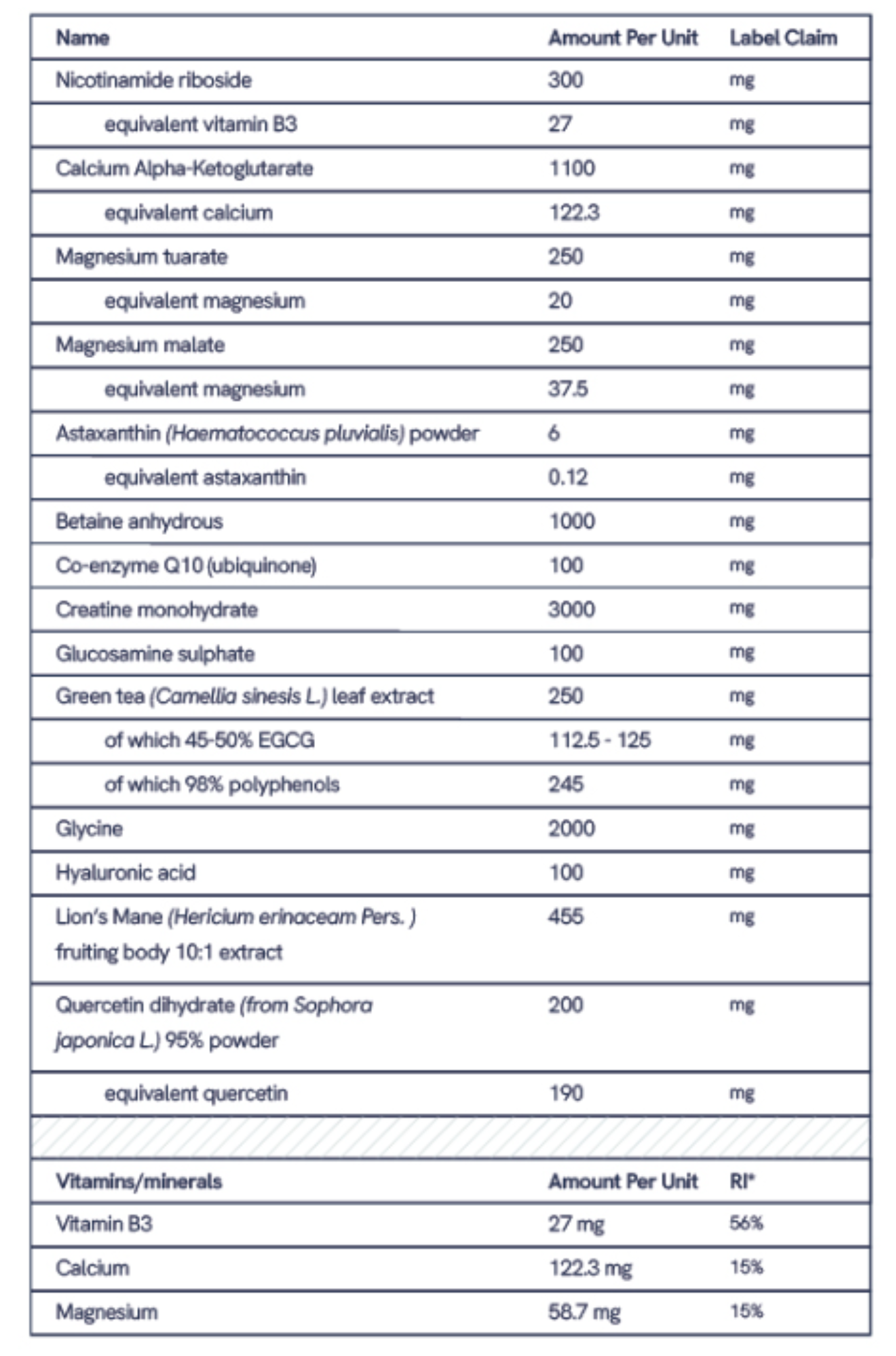
Here is how Longevity One scores on these tests. It contains no caffeine source, prints every dose with no proprietary blend, and is tested by Eurofins and NZVT certified. Hold any product, ours included, to the same five tests. For how nutrient drinks compare with coffee, see our guide to shots, capsules and powders.
The five-test summary
| Test | What a cleaner label shows |
|---|---|
| Caffeine | Total mg per serving and every source named |
| Doses | Each ingredient with its own dose; no blends |
| Sugar and sweeteners | Grams of sugar and named sweeteners |
| Testing | Named independent laboratories, batch by batch |
| Claims | Authorised wording only |
Q&A: Cleaner Energy Drinks and Supplements
What is a clean energy drink?
There is no legal definition. A practical one is a product whose caffeine, doses, sugar, testing and claims you can all check on the label. Caffeine labels in particular are often inaccurate.1
Is natural caffeine cleaner?
No. Caffeine is the same molecule whatever its source. The amount and timing matter far more, because late caffeine costs sleep.2
Are zero-sugar energy drinks cleaner?
They avoid sugar, but they may still carry a high caffeine dose. Check the mg per can.
Does "clean label" mean tested?
Not necessarily. Testing is a separate fact, and a big one: 14.8% of supplements in one study contained steroids not on the label.5
How much caffeine is too much in an energy drink?
EFSA considers up to 400 mg a day from all sources not to raise safety concerns for healthy adults outside pregnancy. Count every source, and keep the last one at least six hours before bed.2
Can an energy supplement work without caffeine?
A nutrient formula can carry authorised tiredness claims, which matter most where your intake falls short. Expect something different from the jolt of a coffee.6
Frequently Asked Questions
Can I drink energy drinks with my medication?
Ask your GP or pharmacist. Caffeine interacts with several common medicines.
Are energy drinks safe in pregnancy?
Ask your midwife or GP how much caffeine is right for you during pregnancy.
How do I cut back on energy drinks?
Reduce gradually over a week or two. Withdrawal symptoms usually begin 12 to 24 hours after the last dose.4
Does a caffeine-free daily powder taste good?
A powder with real doses of minerals and B vitamins tastes of them, and flavouring only covers so much. Most people find it helps to mix it very cold.
References
- Cohen PA, Attipoe S, Travis J, Stevens M, Deuster P. Caffeine content of dietary supplements consumed on military bases. JAMA Intern Med. 2013;173(7):592-594. View on PubMed
- Drake C, Roehrs T, Shambroom J, Roth T. Caffeine effects on sleep taken 0, 3, or 6 hours before going to bed. J Clin Sleep Med. 2013;9(11):1195-1200. View on PubMed
- James JE, Rogers PJ. Effects of caffeine on performance and mood: withdrawal reversal is the most plausible explanation. Psychopharmacology (Berl). 2005;182(1):1-8. View on PubMed
- Juliano LM, Griffiths RR. A critical review of caffeine withdrawal: empirical validation of symptoms and signs, incidence, severity, and associated features. Psychopharmacology (Berl). 2004;176(1):1-29. View on PubMed
- Geyer H, Parr MK, Mareck U, et al. Analysis of non-hormonal nutritional supplements for anabolic-androgenic steroids: results of an international study. Int J Sports Med. 2004;25(2):124-129. View on PubMed
- Tardy AL, Pouteau E, Marquez D, Yilmaz C, Scholey A. Vitamins and minerals for energy, fatigue and cognition: a narrative review of the biochemical and clinical evidence. Nutrients. 2020;12(1):228. View on PubMed
Disclaimer: Educational content only. Not medical advice. Food supplements should not be used as a substitute for a varied, balanced diet and a healthy lifestyle. If you use medication, consult your doctor.