There is no age at which tiredness switches on. In large population studies, age on its own explains very little of how tired adults feel, and in some samples older adults reported less fatigue. Sleep, muscle and fitness do change after 50, and those changes respond to habits. Tiredness that is persistent, severe or new deserves a GP visit at any age.
Key Takeaways
- In a Swiss study of 2,848 adults aged 45 to 86, about one in five reported fatigue, and older age was linked with less fatigue, not more, once other factors were accounted for.1
- In Norway and Denmark, fatigue scores rose only weakly with age, and in healthy Danish adults general fatigue fell with age.2
- After 70, fatigue becomes more common, but it tracked health, activity and loneliness rather than birthdays.
- Sleep becomes lighter and more broken with age, while the recommended amount for older adults stays at 7 to 8 hours.3,4
- Muscle mass falls noticeably from around 50, yet resistance training raised strength by roughly a quarter to a third in adults over 50.5,6
- Low vitamin B12 status becomes more common after 60, so testing beats guessing.7
Many people in their fifties and sixties say the same thing: "I just don't have the energy I used to." It is easy to blame the calendar. The research tells a more useful story. Age changes some of the systems that shape how energetic you feel, but age alone is a weak predictor of tiredness, and most of what does change can be influenced. This article is a calm myth check: what the population data shows, what really shifts after 50, and which signs are worth a conversation with your GP.
Is there an age when tiredness starts?
No single age marks the start of tiredness. The best evidence comes from population surveys that ask thousands of ordinary adults, not patients, how tired they feel. These studies are useful because they show the background level of fatigue in everyday life and how it varies with age, sex and health.
What the large population studies found
In a cross-sectional survey in Lausanne, Switzerland, researchers assessed 2,848 adults aged 45 to 86 with the Fatigue Severity Scale. Fatigue in the previous week was present in 21.9% of participants. Those with fatigue were, on average, younger. In the adjusted analysis, older age was associated with less fatigue, while poor sleep, low mood, higher body weight and low self-rated health were associated with more. The authors concluded that sleep complaints and fatigue in older people are not explained by ageing itself and should prompt a search for the cause.1
A Norwegian survey of a random sample of 3,500 adults aged 19 to 80 found the same pattern from a different angle. Total fatigue scores and age were only weakly correlated (r = 0.17 in men and 0.09 in women), and 11.4% of respondents reported substantial fatigue lasting six months or longer.2 In Denmark, a survey of 1,608 adults aged 20 to 77 found that general and physical fatigue actually decreased with age among people who were healthy. Fatigue rose with age only among those living with a long-term health problem.
These studies have limits. They are snapshots, so they cannot show cause and effect, and people who feel very unwell may be less likely to reply. Even so, across three countries and thousands of adults, the message is consistent: growing older does not, by itself, make most people tired. If you are curious about the gap between years lived and how your body is ageing, our guide to biological age vs chronological age explains the idea.
Why do so many people feel more tired after 50?
Age may not be the cause, yet the feeling is common in midlife and beyond. Several slow changes add up, and each one interacts with habits. None of them is permanent, and most can be measured.
Sleep changes shape, not only length
A meta-analysis of 65 studies covering 3,577 healthy people aged 5 to 102 described how sleep changes across the lifespan. In adults, total sleep time, sleep efficiency and the share of deep (slow-wave) and REM sleep all fell with age, while the time taken to fall asleep and the time awake during the night rose. Most of these changes levelled off in later adulthood: after 60, only sleep efficiency continued to fall.3 In plain terms, sleep in your sixties tends to be lighter and more broken than in your thirties, which can leave you feeling less refreshed even after a full night in bed.
What does not change much is the need. An expert panel convened by the National Sleep Foundation recommended 7 to 9 hours for adults and 7 to 8 hours for adults aged 65 and over.4 The idea that older people simply need less sleep is a myth; what changes is how easily that sleep comes. Our article on deep sleep and REM covers the habits that support both stages.
Muscle and fitness change slowly
Muscle is the engine for nearly everything you do in a day, from climbing stairs to carrying shopping. In a whole-body MRI study of 468 men and women aged 18 to 88, muscle mass relative to body weight began to fall from the third decade, but a noticeable drop in absolute muscle mass appeared only towards the end of the fifth decade, mainly in the legs.5 Aerobic fitness follows a similar curve. In 810 healthy adults followed for a median of 7.9 years, peak oxygen uptake declined by 3% to 6% per decade in the twenties and thirties, but by more than 20% per decade in the seventies.8
When the same task takes a larger share of your capacity, it feels harder, and you feel more tired afterwards. That is one reason everyday activities can feel more draining with age, even when nothing is wrong. Capacity can be built at any age, and the section below shows how.
Life load changes too
Midlife often brings a heavy mix of work, caring for children or parents, and less time for movement and rest. Later, retirement can remove structure and daily contact with other people. These are not biological effects of age, but they arrive at certain ages and are easy to mistake for ageing itself. When you ask "am I tired because I am older?", it is worth also asking "what has changed in how I sleep, move and spend my days?"
What happens to energy after 70?
Fatigue does become more common in later life. The Jerusalem Longitudinal Study followed a representative group of community-dwelling adults born in 1920 and 1921, assessing them at ages 70, 78, 85, 90, 95 and 100. The share reporting fatigue was 29.4% at 70, 52.3% at 78 and 67.9% at 85.
The detail matters. Fatigue was linked with measures of health and function, and with later declines in physical activity, self-rated health, independence in daily tasks and loneliness. The researchers saw no consistent pattern linking fatigue with the common medical diagnoses they recorded. In other words, even in very late life, tiredness says something about how a person is living and functioning. The authors call it an important marker worth noticing, which is the opposite of the common shrug that it is "just age".
Which changes are normal, and which are worth a GP visit?
Some shifts in energy with age are expected. Others are a reason to book an appointment. The table below is a general guide, not a diagnosis; the right-hand column follows the NHS advice on tiredness on when to see a GP.
| Often part of getting older | Worth discussing with your GP |
|---|---|
| Lighter sleep and waking once or twice in the night3 | Tiredness that has lasted a few weeks and you are not sure why |
| Taking a little longer to fall asleep than when you were younger3 | Tiredness that affects your daily life |
| Lower peak fitness than in earlier decades8 | Tiredness with other symptoms, such as weight loss or changes in mood |
| Slightly less power for heavy tasks, mainly in the legs5 | Gasping, snorting or choking noises in your sleep that someone else notices |
| Less muscle relative to body weight than in your thirties5 | Tiredness that is severe or new for you |
Your GP can look at the whole picture, including sleep, mood, medicines and simple blood tests where they are warranted. A short conversation often turns a vague feeling into something specific and manageable.

What helps energy at any age?
The levers are the same at 35 and at 75. What changes with age is how much each one matters, because there is less spare capacity to hide a poor habit.
Regular movement
A meta-analysis of randomised trials found that regular exercise increased feelings of energy and reduced feelings of fatigue compared with control conditions, with an average effect size of 0.37.9 That is a small to moderate effect. The authors were candid about one limit: in the trials that used a placebo control and tested exercise alone, no effect was found, so expectation probably explains part of the benefit. It is still one of the most reliable ways to feel more energetic.
Strength work
Strength matters more with each decade, because it sets how hard daily tasks feel. A meta-analysis of 47 studies with 1,079 adults aged 50 and over found that resistance training increased strength by about 24% to 33%, depending on the exercise, with greater gains at higher training intensity.6 The NHS activity guidelines for older adults suggest strength, balance and flexibility work on at least 2 days a week for adults aged 65 and over, built up gradually. Our longevity exercise programme shows how to combine strength and steady cardio.
Protecting sleep
Because sleep becomes lighter with age, the conditions around it matter more: a regular wake time, daylight in the morning, a cool, dark bedroom, and caffeine kept to earlier in the day. The target of 7 to 8 hours for older adults is a useful benchmark for time asleep, not just time in bed.4
Do nutrient needs change after 60?
Some do, and this is where testing earns its place. Vitamin B12 is the clearest example. In large surveys in the United States and the United Kingdom, about 6% of adults aged 60 and over had low vitamin B12 levels, and close to 20% had marginal status, with the share rising with age. In older adults, the main reason is reduced absorption of the B12 bound to food, rather than eating too little of it.7
Vitamin D is the other nutrient to know about in northern Europe. In standardised data from 55,844 Europeans of all ages, children included, 13.0% had blood levels below 30 nmol/L across the year, rising to 17.7% in the winter months, and 40.4% were below 50 nmol/L. These figures cover all ages, not only older adults. Both nutrients are easy to check with a blood test, and the result tells you whether a change in diet or a supplement makes sense. Iron is a separate case: do not take it unless a test shows you need it, and always decide with your GP. For the role of B vitamins in energy metabolism, see our guide to B vitamins and energy.
Where does a supplement fit?
Last, and only after sleep, movement, food and any needed tests. A supplement cannot stand in for those, and it should never delay a GP visit for tiredness that is persistent, severe or new. Where intake or status falls short, some nutrients have authorised roles. Vitamin B12, folate, vitamin B6, niacin and vitamin C contribute to the reduction of tiredness and fatigue. Magnesium contributes to a reduction of tiredness and fatigue. Vitamin D contributes to the maintenance of normal muscle function.
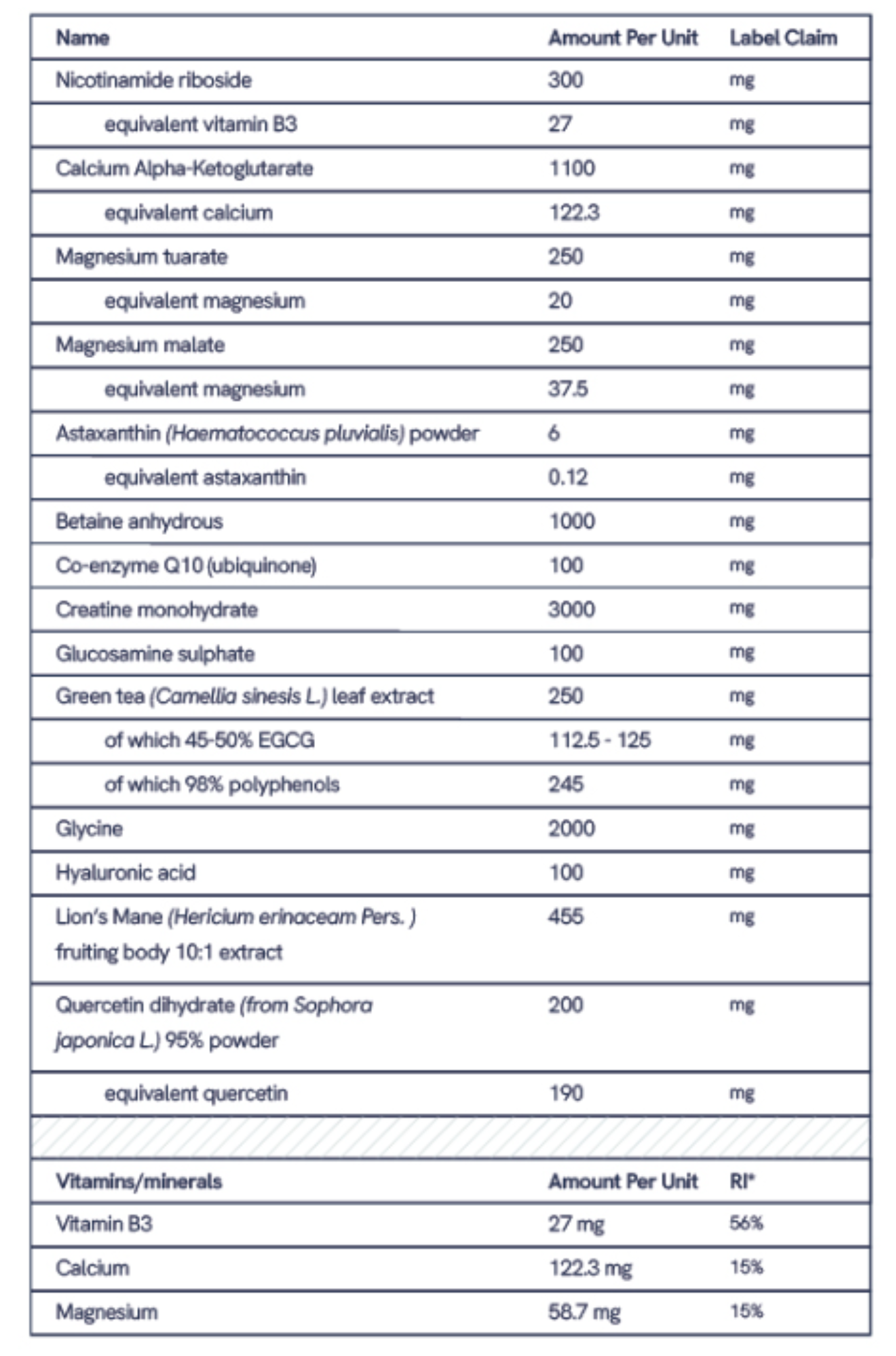
For transparency, our own formula, Longevity One, is a daily powder with 24 ingredients. Per scoop it provides 2.5 mcg of vitamin B12 (100% of the reference intake), 10 mcg of vitamin D3 (200%), 150 mg of magnesium as malate (40%) and 100 mg of vitamin C (125%), with every dose printed on the label. It contains no iron and no caffeine. It is independently tested by Eurofins and is NZVT certified, with every batch screened. It is not a reason to skip a blood test, and it does not change how age affects sleep or muscle.
A calm checklist for feeling less tired with age
- Notice what changed in your sleep, movement and routine before you blame your age.
- Aim for 7 to 8 hours of sleep if you are over 65, with a regular wake time.4
- Move every day and add strength work on at least 2 days a week, as the NHS activity guidelines for older adults suggest for adults over 65.
- Ask your GP whether checking vitamin B12 and vitamin D makes sense for you.7
- Keep people in your week: contact, purpose and routine all shape how energetic you feel.
- See your GP if tiredness is persistent, severe or new, or comes with any of the signs in the table above.
Healthy ageing, as we use the term, is about keeping the systems that make you feel capable in good working order. Tiredness is information. Read it, check it where needed, and act on the parts you can change.
Q&A: Age and Tiredness
At what age do people start feeling tired?
There is no set age. In a Swiss study of adults aged 45 to 86, older age was linked with less fatigue after adjustment for other factors.1 What changes with age is sleep depth, muscle and fitness, and each of these can be influenced. Look at those before blaming the calendar.
Is it normal to feel tired all the time in your 60s?
Feeling tired all the time is common but not something to accept as normal. In population surveys, fatigue was only weakly related to age.2 Constant tiredness deserves a look at sleep, activity and mood. If it is persistent, severe or new, see your GP.
Does old age cause tiredness?
Age alone appears to play a small part. In a Danish survey, general fatigue decreased with age among healthy adults and rose only in people with long-term health problems. So it is usually something that comes with age, not age itself.
Do older people need less sleep?
Not really. The National Sleep Foundation panel recommends 7 to 8 hours for adults aged 65 and over, close to the 7 to 9 hours for younger adults.4 Sleep becomes lighter, which is why it can feel like you need less. Protecting the conditions for sleep matters more with age.
Why is my sleep lighter than it used to be?
Deep sleep and REM sleep make up a smaller share of the night as adults age. Time awake during the night tends to rise.3 These changes are expected, and a regular routine and a bedroom set up for sleep may still help.
When does muscle loss start?
In an MRI study of 468 adults, muscle relative to body weight began to fall in the third decade, with a noticeable drop in absolute muscle mass from around 50, mainly in the legs.5 Strength training at any age helps hold on to it. It is never too late to start.
Can exercise make me feel less tired at 60?
Yes, for most people. Resistance training raised strength by about a quarter to a third in adults over 50.6 Regular exercise also increased feelings of energy in trials, although part of that effect may be expectation.9 Start gently and build up.
How common is tiredness after 70?
It becomes more common. In the Jerusalem Longitudinal Study, 29.4% reported fatigue at 70, rising to 67.9% at 85. It was linked with function, activity and loneliness, so it is worth acting on. A GP review is a good first step.
Should I check my B12 after 60?
It is a reasonable question for your GP. About 6% of adults over 60 had low B12 and nearly 20% had marginal status in large surveys.7 Absorption from food falls with age, so a blood test gives a clear answer.
Is low vitamin D common in Europe?
Fairly common, especially in winter. In data from 55,844 Europeans of all ages, 17.7% had levels below 30 nmol/L in the winter months. A blood test tells you whether you need to act.
Frequently Asked Questions
Can I take supplements with my medication?
The label advises consulting your doctor if you use medication. Ask your GP or pharmacist and bring the label, especially if you take several medicines.
Is feeling tired a sign of getting old?
Not on its own. Population studies show only a weak link between age and fatigue in healthy adults.2 Tiredness is more often a sign of how you are sleeping, moving and feeling.
How much sleep do I need after 65?
The National Sleep Foundation panel suggests 7 to 8 hours.4 If you regularly sleep far less or far more and feel unrefreshed, mention it to your GP.
What does Longevity One taste like?
It has a mango and pineapple flavour. Mix one scoop in 250 to 500 ml of water, or into a smoothie or yogurt.
When should I see a doctor about tiredness?
See your GP if tiredness is persistent, severe or new, or comes with unexplained weight loss, breathlessness, low mood or other changes you cannot explain. Treat fatigue in later life as a useful signal.1
References
- Galland-Decker C, Marques-Vidal P, Vollenweider P. Prevalence and factors associated with fatigue in the Lausanne middle-aged population: a population-based, cross-sectional survey. BMJ Open. 2019;9(8):e027070. View on PubMed ↗
- Loge JH, Ekeberg O, Kaasa S. Fatigue in the general Norwegian population: normative data and associations. J Psychosom Res. 1998;45(1):53-65. View on PubMed ↗
- Ohayon MM, Carskadon MA, Guilleminault C, Vitiello MV. Meta-analysis of quantitative sleep parameters from childhood to old age in healthy individuals: developing normative sleep values across the human lifespan. Sleep. 2004;27(7):1255-1273. View on PubMed ↗
- Hirshkowitz M, Whiton K, Albert SM, Alessi C, Bruni O, DonCarlos L, et al. National Sleep Foundation's sleep time duration recommendations: methodology and results summary. Sleep Health. 2015;1(1):40-43. View on PubMed ↗
- Janssen I, Heymsfield SB, Wang ZM, Ross R. Skeletal muscle mass and distribution in 468 men and women aged 18-88 yr. J Appl Physiol (1985). 2000;89(1):81-88. View on PubMed ↗
- Peterson MD, Rhea MR, Sen A, Gordon PM. Resistance exercise for muscular strength in older adults: a meta-analysis. Ageing Res Rev. 2010;9(3):226-237. View on PubMed ↗
- Allen LH. How common is vitamin B-12 deficiency? Am J Clin Nutr. 2009;89(2):693S-696S. View on PubMed ↗
- Fleg JL, Morrell CH, Bos AG, Brant LJ, Talbot LA, Wright JG, et al. Accelerated longitudinal decline of aerobic capacity in healthy older adults. Circulation. 2005;112(5):674-682. View on PubMed ↗
- Puetz TW, O'Connor PJ, Dishman RK. Effects of chronic exercise on feelings of energy and fatigue: a quantitative synthesis. Psychol Bull. 2006;132(6):866-876. View on PubMed ↗
Disclaimer: Educational content only. Not medical advice. Food supplements should not be used as a substitute for a varied, balanced diet and a healthy lifestyle. If you use medication, consult your doctor.