Key Takeaways
- Vitamins B1, B3, B6, B12, and biotin contribute to normal energy-yielding metabolism (EFSA-approved claims).
- Vitamins B6 and B12 help reduce tiredness and fatigue (EFSA-approved claims).
- Vitamins B6, B12, and folate contribute to normal homocysteine metabolism (EFSA-approved claim). Elevated homocysteine is associated with ageing-related concerns in observational research.
- Vitamin B12 deficiency is estimated to affect up to 10-15% of adults over 60, largely due to declining absorption capacity with age.1
- A 2021 systematic review and meta-analysis (16 RCTs, 6,276 participants) found no evidence that B12 supplementation improves cognitive function or depressive symptoms in people without overt deficiency or advanced neurological conditions.2
- A meta-analysis of B vitamin supplementation (12 RCTs, 2,015 participants) found a significant benefit for perceived stress (SMD = 0.23, p = 0.03), though effects on other mood facets were inconsistent.3
- B vitamins are water-soluble and generally have a wide safety margin at typical supplement doses. A food-first approach is recommended, with supplementation considered when dietary intake or absorption is insufficient.
The B Vitamin Family: Roles in Energy Production
The B vitamin complex comprises eight distinct vitamins, each serving as a cofactor in metabolic pathways that convert macronutrients (carbohydrates, fats, and proteins) into adenosine triphosphate (ATP), the body's primary energy currency. These pathways include glycolysis, the citric acid cycle (Krebs cycle), and the electron transport chain within mitochondria.
Vitamin B1 (Thiamine) contributes to normal energy-yielding metabolism (EFSA-approved claim). Thiamine is a cofactor for pyruvate dehydrogenase and alpha-ketoglutarate dehydrogenase, both critical enzymes in carbohydrate metabolism. Vitamin B1 also contributes to normal heart function (EFSA-approved claim). Dietary sources include whole grains, pork, legumes, and seeds.
Vitamin B2 (Riboflavin) is a precursor to the coenzymes FAD and FMN, which participate in numerous oxidation-reduction reactions within the electron transport chain. Sources include dairy products, eggs, lean meats, and green vegetables.
Vitamin B3 (Niacin) contributes to normal energy-yielding metabolism (EFSA-approved claim). As a precursor to NAD+ and NADP+, niacin is essential for over 400 enzymatic reactions, including those in energy metabolism and DNA repair. Sources include poultry, fish, whole grains, and legumes.
Vitamin B5 (Pantothenic acid) is a component of coenzyme A (CoA), which is central to fatty acid metabolism and the citric acid cycle. It is widely distributed in foods, making isolated deficiency rare.
Vitamin B6 (Pyridoxine) contributes to normal energy-yielding metabolism and helps reduce tiredness and fatigue (EFSA-approved claims). B6 is involved in over 100 enzyme reactions, primarily in amino acid metabolism. It also contributes to normal homocysteine metabolism (EFSA-approved claim). Sources include poultry, fish, potatoes, bananas, and chickpeas.
Vitamin B7 (Biotin) contributes to normal energy-yielding metabolism (EFSA-approved claim). Biotin is a cofactor for carboxylase enzymes involved in fatty acid synthesis, gluconeogenesis, and amino acid metabolism. It also contributes to maintenance of normal skin and hair (EFSA-approved claim). Sources include eggs, nuts, seeds, and liver.
Vitamin B9 (Folate) is essential for one-carbon metabolism, DNA synthesis, and cell division. It also contributes to normal homocysteine metabolism (EFSA-approved claim). Folate is found in leafy green vegetables, legumes, and fortified foods.
Vitamin B12 (Cobalamin) contributes to normal energy-yielding metabolism and helps reduce tiredness and fatigue (EFSA-approved claims). B12 is required for two enzymatic reactions: the conversion of methylmalonyl-CoA to succinyl-CoA (mitochondrial energy metabolism) and the conversion of homocysteine to methionine (methylation cycle). It also contributes to normal homocysteine metabolism (EFSA-approved claim). Dietary sources are almost exclusively animal-derived: meat, fish, dairy, and eggs.
B Vitamins and Fatigue Reduction
Vitamins B6 and B12 help reduce tiredness and fatigue (EFSA-approved claims). This approved claim is based on the established biochemical roles of these vitamins in energy metabolism. When B vitamin status is inadequate, the metabolic pathways that produce ATP function less efficiently, which can contribute to feelings of tiredness.
A narrative review of the biochemical and clinical evidence concluded that the roles of B vitamins in energy metabolism are well established at the biochemical level, and that inadequate status of these vitamins is associated with fatigue symptoms. However, the review also noted that supplementation above adequate levels does not appear to provide additional energy benefits in well-nourished individuals.4
A 2023 randomised, double-blind trial in 32 healthy adults (aged 20-30) found that 8 weeks of B-complex supplementation was associated with improvements in exercise performance parameters and reduced markers of fatigue compared to placebo.5 However, this was a small study in young, healthy participants, and the results should be interpreted with caution.
A systematic review and meta-analysis of B vitamin supplementation and mood (12 RCTs, 2,015 participants) found a significant benefit for perceived stress (SMD = 0.23, 95% CI: 0.02-0.45, p = 0.03). Effects on other mood facets, including fatigue specifically, were inconsistent across studies.3
The key principle is that B vitamin supplementation is most likely to benefit individuals whose status is inadequate. For those with sufficient intake and normal absorption, additional supplementation is unlikely to provide a noticeable boost in energy levels.
B12 and Folate: Special Considerations for Ageing
Vitamin B12 deserves particular attention in the context of ageing. The absorption of B12 from food requires adequate stomach acid production and intrinsic factor, a protein secreted by the stomach lining. Both decline with age. Atrophic gastritis, which affects an estimated 10-30% of older adults, reduces stomach acid production and impairs B12 absorption from food sources.1
B12 deficiency is estimated to affect 5-15% of adults over 60 in developed countries. Certain groups are at higher risk: vegans and vegetarians (due to limited dietary sources), older adults with reduced gastric acid production, individuals taking proton pump inhibitors or metformin long-term, and those with gastrointestinal conditions that affect absorption.
A 2021 systematic review and meta-analysis of 16 RCTs (6,276 participants) assessed the effects of B12 supplementation on cognitive function, depressive symptoms, and fatigue. The analysis found no evidence that B12 supplementation improves cognitive function or depressive symptoms in individuals without overt B12 deficiency or advanced neurological disorders.2 This finding underscores the importance of testing before assuming benefit from supplementation.
Vitamins B6, B12, and folate contribute to normal homocysteine metabolism (EFSA-approved claim). Homocysteine is an amino acid intermediate in the methylation cycle. Elevated levels (hyperhomocysteinaemia) have been associated with various age-related concerns in observational research. A meta-analysis of 95 studies (46,175 participants) found that B vitamin supplementation was associated with modest slowing of cognitive decline as measured by standardised tests, particularly with interventions lasting longer than 12 months.6 The certainty of this evidence is moderate, and the clinical significance of the observed effects remains debated.
Regarding the forms of B12, methylcobalamin and cyanocobalamin are both effective at raising B12 levels. Methylcobalamin is the naturally occurring coenzyme form, while cyanocobalamin is a synthetic form that is widely used in supplements due to its stability and lower cost. Both are well-absorbed when taken orally. The debate over methylated versus non-methylated forms is ongoing, and current evidence does not clearly demonstrate the superiority of one form over the other for general supplementation.
B Vitamins in Longevity Complete
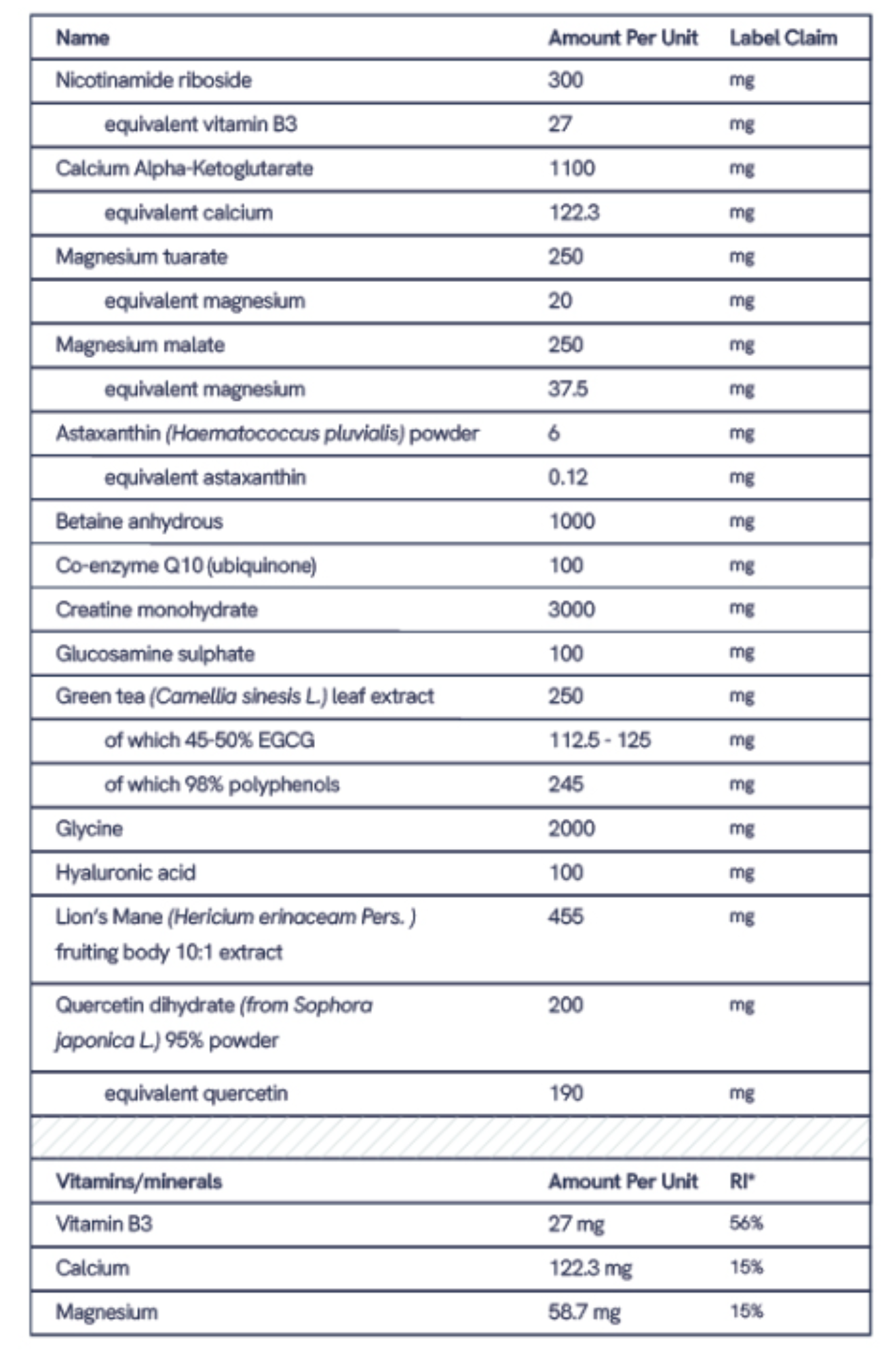
Longevity Complete includes a comprehensive B vitamin complex as part of its multi-nutrient formulation. The following EFSA-approved claims apply to the B vitamins within this product:
- Vitamins B1, B3, B6, B12, and biotin contribute to normal energy-yielding metabolism.
- Vitamins B6 and B12 help reduce tiredness and fatigue.
- Magnesium, vitamins B1, B3, B6, B12, biotin, and vitamin C contribute to normal psychological and nervous system function.
- Vitamin B1 contributes to normal heart function.
- Vitamins B6, B12, and folate contribute to normal homocysteine metabolism.
The inclusion of B vitamins alongside magnesium (which also contributes to normal energy-yielding metabolism and helps reduce tiredness and fatigue) reflects a formulation approach that addresses multiple aspects of cellular energy production. Longevity Complete undergoes third-party testing with a Certificate of Analysis (COA) available, and independent verification is conducted by Eurofins laboratory.
Food Sources, Supplementation, and Dosing
A balanced, varied diet provides adequate B vitamins for most people. Key dietary sources include:
Whole grains (B1, B3, B5, B6), leafy green vegetables (folate, B2), legumes and pulses (B1, folate, B6), eggs (B2, B7, B12), dairy products (B2, B12), poultry and fish (B3, B6, B12), red meat and liver (B12, B2, B3, folate), nuts and seeds (B1, B6, B7), and fortified foods such as cereals and plant-based milks (B12, folate).
Supplementation may be appropriate in the following circumstances: vegetarian or vegan diets (particularly for B12), age over 50 (due to declining B12 absorption), use of medications that affect B vitamin absorption (proton pump inhibitors, metformin), restricted diets or malabsorption conditions, and increased physiological demand (such as pregnancy).
B-complex supplements provide all eight B vitamins in a single formulation, which can be more practical than supplementing individual vitamins. When individual B vitamins are warranted, B12 and folate are the most commonly supplemented in ageing populations.
B vitamins are water-soluble, meaning excess amounts are generally excreted in urine rather than stored. This gives them a wide safety margin at typical supplement doses. However, very high doses of certain B vitamins (notably B6 above 100 mg/day over extended periods) have been associated with peripheral neuropathy. Taking B vitamins in the morning is generally recommended, as they support energy metabolism and may affect sleep if taken late in the day.
Questions and Answers
Do B vitamins give you energy?
B vitamins do not contain calories and do not provide energy directly. They function as cofactors in the metabolic pathways that convert food into ATP, the body's energy currency. Vitamins B1, B3, B6, B12, and biotin contribute to normal energy-yielding metabolism, and vitamins B6 and B12 help reduce tiredness and fatigue (EFSA-approved claims). Supplementation is most likely to benefit those with inadequate B vitamin status.
Which B vitamin is most important for energy?
All eight B vitamins work together in energy metabolism. No single B vitamin is more important than the others, as they participate in different steps of the same metabolic pathways. Deficiency in any one can impair the overall process. B12 receives particular attention in ageing populations due to its declining absorption with age.1
Can B vitamins help with tiredness?
Vitamins B6 and B12 help reduce tiredness and fatigue (EFSA-approved claims). A narrative review confirmed that inadequate B vitamin status is associated with fatigue symptoms.4 However, supplementation above adequate levels does not appear to provide additional energy benefits in well-nourished individuals.
How common is B12 deficiency in older adults?
B12 deficiency is estimated to affect 5-15% of adults over 60 in developed countries, largely due to declining stomach acid production and intrinsic factor secretion. Those taking proton pump inhibitors or metformin, and those following vegan or vegetarian diets, are at higher risk.1
Should I take methylcobalamin or cyanocobalamin?
Both forms are effective at raising B12 levels. Methylcobalamin is the naturally occurring coenzyme form; cyanocobalamin is a synthetic form with greater stability. Current evidence does not clearly demonstrate superiority of one form over the other for general supplementation. Both are well-absorbed when taken orally.
What is homocysteine and why does it matter?
Homocysteine is an amino acid intermediate in the methylation cycle. Vitamins B6, B12, and folate contribute to normal homocysteine metabolism (EFSA-approved claim). Elevated homocysteine has been associated with ageing-related concerns in observational research, though the clinical significance of lowering homocysteine through supplementation remains an area of ongoing investigation.6
Can vegans get enough B vitamins from diet alone?
Vegans can obtain most B vitamins from plant foods, with the notable exception of B12, which is found almost exclusively in animal-derived sources. B12 supplementation or consumption of B12-fortified foods is considered essential for those following a vegan diet. B2 and B3 intakes may also be lower in some vegan diets.
Are there risks to taking B vitamin supplements?
B vitamins have a wide safety margin at typical supplement doses due to their water-soluble nature. Very high doses of B6 (above 100 mg/day over prolonged periods) have been associated with peripheral neuropathy. High-dose niacin (B3) can cause flushing. Otherwise, B vitamin supplements are generally well-tolerated. Those taking medications should consult a healthcare professional, as some B vitamins may interact with certain drugs.
When should I take B vitamins?
Morning is generally recommended, as B vitamins support energy metabolism and may affect sleep if taken late in the day. They can be taken with or without food, though absorption of some forms may be improved with a meal.
Do B vitamins improve cognitive function?
A meta-analysis of 95 studies (46,175 participants) found that B vitamin supplementation was associated with modest slowing of cognitive decline, particularly with interventions lasting longer than 12 months.6 However, a separate meta-analysis found no benefit in people without overt deficiency.2 The evidence suggests B vitamin status should be adequate, but supplementation above normal levels may not provide additional cognitive benefits.
Frequently Asked Questions
What is the difference between B-complex and individual B vitamins?
A B-complex supplement contains all eight B vitamins in a single formulation. Individual B vitamin supplements provide only one specific vitamin (such as B12 or folate). B-complex is practical for general support, while individual supplementation may be appropriate when a specific deficiency has been identified through testing.
Can B vitamins help with morning energy?
Vitamins B1, B3, B6, B12, and biotin contribute to normal energy-yielding metabolism, and vitamins B6 and B12 help reduce tiredness and fatigue (EFSA-approved claims). Taking B vitamins in the morning supports these metabolic pathways throughout the day. However, they are not stimulants and do not provide an immediate energy boost like caffeine.
How do I know if I am B12 deficient?
B12 deficiency can be assessed through a blood test measuring serum B12 levels, and more sensitively through methylmalonic acid (MMA) and homocysteine levels. Symptoms of deficiency may include fatigue, weakness, and neurological changes. Individuals over 50, vegans, and those on certain medications should consider periodic testing.
Do B vitamins interact with medications?
Some B vitamins may interact with certain medications. Proton pump inhibitors and metformin can reduce B12 absorption. High-dose B6 may interact with levodopa. Folate supplementation may mask B12 deficiency if taken alone. Anyone taking regular medication should consult a healthcare professional before starting B vitamin supplementation.
Is it possible to take too many B vitamins?
B vitamins are water-soluble and excess amounts are generally excreted in urine. At typical supplement doses, they are considered safe. However, very high doses of B6 (above 100 mg/day long-term) have been associated with nerve damage, and high-dose niacin can cause flushing. Following recommended dosages is advised.
Why does my urine turn yellow after taking B vitamins?
The bright yellow colour is caused by riboflavin (vitamin B2) being excreted in urine. This is a normal, harmless effect and simply indicates that excess water-soluble B2 is being eliminated by the body. It does not indicate that the supplement is not working.
References
- Green R, Allen LH, Bjorke-Monsen AL, et al. Vitamin B12 deficiency. Nat Rev Dis Primers. 2017;3:17040. View on PubMed ↗
- Markun S, Gravestock I, Jager L, et al. Effects of Vitamin B12 Supplementation on Cognitive Function, Depressive Symptoms, and Fatigue: A Systematic Review, Meta-Analysis, and Meta-Regression. Nutrients. 2021;13(3):923. View on PubMed ↗
- Young LM, Pipingas A, White DJ, et al. A Systematic Review and Meta-Analysis of B Vitamin Supplementation on Depressive Symptoms, Anxiety, and Stress: Effects on Healthy and 'At-Risk' Individuals. Nutrients. 2019;11(9):2232. View on PubMed ↗
- Tardy AL, Pouteau E, Marquez D, et al. Vitamins and Minerals for Energy, Fatigue and Cognition: A Narrative Review of the Biochemical and Clinical Evidence. Nutrients. 2020;12(1):228. View on PubMed ↗
- Lee MC, Hsu YJ, Shen SY, et al. A functional evaluation of anti-fatigue and exercise performance improvement following vitamin B complex supplementation in healthy humans, a randomized double-blind trial. Int J Med Sci. 2023;20(10):1272-1281. View on PubMed ↗
- Wang Z, Zhu W, Xing Y, et al. B vitamins and prevention of cognitive decline and incident dementia: a systematic review and meta-analysis. Nutr Rev. 2022;80(4):931-949. View on PubMed ↗
- Liu K, Yang Z, Lu X, et al. The origin of vitamin B12 levels and risk of all-cause, cardiovascular and cancer specific mortality: A systematic review and dose-response meta-analysis. Arch Gerontol Geriatr. 2024;117:105230. View on PubMed ↗
- Wolffenbuttel BHR, Wouters HJCM, Heiner-Fokkema MR, van der Klauw MM. The Many Faces of Cobalamin (Vitamin B12) Deficiency. Mayo Clin Proc Innov Qual Outcomes. 2019;3(2):200-214. View on PubMed ↗
Disclaimer: Educational content only. Not medical advice. Supplements are not intended to diagnose, treat, cure, or prevent any disease. Consult a qualified healthcare professional if you have a medical condition or take medication.