The best-supported caffeine alternatives are not products. Ten minutes of brisk walking or stair climbing, bright daylight, a 10-minute nap, enough sleep and enough fluid each improve how awake people feel in human studies. None matches the sharp lift of caffeine, but they do not build tolerance or cost you sleep. If you cut down on coffee, do it gradually rather than all at once.
Key Takeaways
- Ten minutes of stair walking increased feelings of energy more than 50 mg of caffeine in sleep-restricted young women.1
- Six weeks of low or moderate exercise, three times a week, improved feelings of energy in sedentary adults with persistent tiredness.2
- Brighter white light increased self-rated alertness in most of 68 studies in a systematic review.3
- After short sleep, a 10-minute afternoon nap improved sleepiness, fatigue and performance for up to 155 minutes.4
- Two weeks of 6 hours or less in bed a night impaired attention as much as up to two nights without sleep.5
- Carbohydrate did not lift mood and was linked to more fatigue in the first hour, so sugar is not a caffeine substitute.6
- Withdrawal from caffeine usually starts 12 to 24 hours after the last dose and lasts 2 to 9 days; because symptoms rise with the daily dose, a gradual reduction may be gentler.7
Perhaps coffee has stopped working the way it used to. Perhaps it keeps you up at night, or you have noticed that you need it just to feel normal. Searching for caffeine alternatives usually turns up a list of drinks and powders. The research points somewhere less exciting and more useful. Most of the reliable alternatives are habits: a walk, daylight, a short nap, a proper night's sleep. This article ranks them by the human evidence. Our article on how longevity drinks differ from coffee and energy drinks covers the drinks side.
Two notes on scope. Teas are covered in a separate article in this series. Herbal extracts with stimulant effects are outside this article, because they are stimulants in their own right rather than alternatives to one.
Why look for an alternative to caffeine?
For many daily coffee drinkers, the lift has quietly become a return to baseline. In a double-blind study, 16 regular users were kept on 400 mg of caffeine a day for at least two weeks and on placebo for at least two weeks.8 Once tolerance had formed, daily caffeine showed almost no net benefit on the measures taken, while one day without it raised ratings of tired, fatigued, sluggish and weary and lowered ratings of energetic and lively.8 In other words, at least at that high daily dose, part of the morning coffee effect is the end of an overnight dip that the habit itself creates.
That dip is caffeine withdrawal. A review of 57 experimental and 9 survey studies validated symptoms including headache, fatigue, decreased energy, decreased alertness, drowsiness and difficulty concentrating.7 They usually begin 12 to 24 hours after the last dose, peak at 20 to 51 hours and last 2 to 9 days, and they appeared after stopping intakes as low as 100 mg a day.7 Any alternative has to be judged against this: in the first days without coffee, almost anything will feel weaker than caffeine.
Which caffeine alternatives have the best evidence?
| Alternative | Best evidence | What was found | How quickly |
|---|---|---|---|
| Short bout of movement | Crossover trial, 18 young women1 | 10 minutes of stair walking beat 50 mg caffeine for feelings of energy | Minutes; short-lived |
| Regular exercise | RCT, 36 sedentary adults2 | 6 weeks of low or moderate exercise improved feelings of energy | Weeks |
| Bright light | Systematic review, 68 studies3 | Brighter white light raised self-rated alertness in most studies | Minutes |
| 10-minute nap | Repeated-measures study, 24 adults4 | Better sleepiness, fatigue and performance for up to 155 minutes | Immediate |
| Enough sleep | Controlled lab study, 48 adults5 | Short sleep built up deficits people did not notice | Nights to weeks |
| Enough fluid | Controlled study, 25 women9 | Mild fluid loss lowered vigour and concentration | Hours |
| Music during exercise | Meta-analysis, 139 studies10 | Better mood, performance and perceived effort | During the session |
| Sugar | Meta-analysis, 31 studies6 | No lift in mood; more fatigue in the first hour | Not an alternative |
Does a short walk work as well as coffee?
For feeling energised, it can work better than a small dose. In a repeated-measures crossover experiment, 18 physically active female students who were caffeine users and slept less than 45 hours a week completed three conditions: 10 minutes of low-to-moderate intensity stair walking, a 50 mg caffeine capsule, or a placebo capsule.1 Stair walking increased self-rated vigour compared with both caffeine and placebo.1 The effect was transient, the caffeine dose was low, and the study was small and limited to young women. Memory and attention scores did not differ significantly between conditions.1
In practice, a brisk walk around the building, a few flights of stairs or a short walk outside is the simplest substitute for a mid-morning or mid-afternoon coffee. It costs nothing and carries no sleep penalty. It also pairs well with daylight, the next item on the list.
Does exercise give you more energy over time?
Regular exercise changes how energetic people feel across weeks. In a randomised controlled trial, 36 healthy but sedentary young adults who reported persistent fatigue were assigned to low-intensity exercise, moderate-intensity exercise or no exercise, three sessions a week for six weeks.2 Both exercise groups reported similar improvements in feelings of energy, and the low-intensity group showed the larger reduction in fatigue.2 The changes were unrelated to gains in fitness, which suggests that you do not need hard training to feel the benefit.2 Our guide to Zone 2 cardio explains how to train at a comfortable, sustainable intensity.
Can light replace your morning coffee?
Light can make people feel more alert in the short term. A systematic review identified 68 studies that varied light intensity, colour or both and measured alertness.3 Increasing the intensity of white light raised people's own ratings of alertness in a majority of studies, although a substantial proportion found no significant effect, possibly because samples were small or baseline lighting was already bright.3 Effects on reaction-time tasks were rarely significant, and the evidence for blue-enriched light specifically was inconsistent.3
The practical version is simple. Get outside, or sit near a window, soon after waking and again in the early afternoon. Light will not feel like a coffee, but it supports alertness without any effect on your caffeine tolerance.
Is a nap better than a coffee in the afternoon?
For many people it is the most effective option, if it is short. In a study of 24 healthy young adults whose night-time sleep was restricted to about 5 hours, participants were tested after no nap or after naps of 5, 10, 20 or 30 minutes at 15:00.4 The 5-minute nap gave few benefits.4 The 10-minute nap produced immediate improvements in sleepiness, fatigue, vigour and cognitive performance, some lasting up to 155 minutes.4 The 20-minute nap helped too, but its benefits took about 35 minutes to appear, and the 30-minute nap caused a period of grogginess before any improvement.4 The authors concluded that 10 minutes was the most effective length overall.4
If you can lie down or recline for a few minutes after lunch, set an alarm for 10 to 15 minutes, including the time to fall asleep. Avoid long or late naps if you have trouble sleeping at night.

Is better sleep the real alternative?
For most caffeine-dependent people, yes. Caffeine often fills a sleep gap. In a controlled laboratory study, 48 healthy adults were randomised to 4, 6 or 8 hours in bed a night for 14 nights.5 Those on 6 hours or less built up deficits in attention and working memory equal to as much as two nights without any sleep.5 Their own sleepiness ratings rose only slightly after the first few days, so they were largely unaware of how impaired they had become.5 This is why a daily coffee can feel essential: it masks a deficit you no longer notice.
The most effective caffeine alternative may therefore be more sleep: in that study, it was the 4-hour and 6-hour groups, not the 8-hour group, that built up the deficits.5 Our articles on deep sleep and REM and the ideal sleep environment cover how to get there.
Do water and food make a difference?
Fluids
Mild fluid loss affects how you feel. In a placebo-controlled study, 25 healthy young women lost on average 1.36% of their body mass in fluid during exercise sessions.9 Compared with days when they were well supplied with fluid, they reported lower vigour, more fatigue and inertia, poorer concentration, more perceived task difficulty and more headaches, although most measures of cognitive performance were unaffected.9 Drinking water regularly through the day is an easy, low-cost habit, and a glass of cold water can stand in for the ritual of a mid-morning coffee. Cold water on the face or a cool shower feels refreshing too, but we found no good controlled trials of it as an alertness tool.
Food
Sugar is the alternative most people reach for, and the one with the weakest case. A meta-analysis of 31 studies with 1,259 participants found that carbohydrate did not improve any aspect of mood at any time point, and was associated with more fatigue and less alertness than placebo within the first hour.6 A sweet snack may satisfy hunger, but it is not a substitute for caffeine. Regular meals, with protein, fibre and whole foods, help you avoid the long gaps that leave you flat, even if they do not produce a lift of their own.
What about music, decaf and other small tricks?
Music is one of the best studied mood aids during activity. A meta-analysis of 139 studies with 3,599 participants found that listening to music during exercise improved affective valence, how good people felt (effect size 0.48), physical performance (0.31) and perceived exertion (0.22), with faster tempos giving larger performance effects.10 For a walk or a workout instead of a coffee, music makes the activity more appealing.
Decaffeinated coffee keeps the ritual and the taste, and expectation itself can help. In a double-blind trial, 88 people received caffeinated or decaffeinated coffee and were told either that it was caffeinated or that it was not.11 Both caffeine and the belief that they had had caffeine improved attention and psychomotor speed, and the expectation alone raised self-rated vigour.11 Be aware that decaf is not caffeine-free: in a laboratory analysis of decaffeinated coffees, servings contained up to 13.9 mg per 16-ounce cup and up to 15.8 mg per espresso shot.12 That is far less than regular coffee, but it is not zero.
How do you cut down on caffeine without feeling terrible?
Stopping abruptly is the hardest way. Withdrawal symptoms increase with the usual daily dose, so a gradual reduction may be gentler.7 A simple plan:
- Count your current daily caffeine, including tea, cola and energy drinks.
- Cut down in steps you can manage, for example by replacing one coffee with decaf, which still contains a little caffeine.12
- Move your remaining caffeine earlier, so the last one is by early afternoon.
- Put a 10-minute walk, ideally outdoors, where the removed coffee used to be.1,3
- Keep a glass of water with you through the day.9
- Protect your sleep, and use a 10-minute nap on short nights.4,5
- Expect 2 to 9 days of duller mornings after each larger step, and keep going.7
If you remain tired most days after a few weeks of better sleep and less caffeine, or if your tiredness is severe or new, see your GP. Persistent tiredness has many possible causes and deserves a proper check.
Where does a daily formula fit?
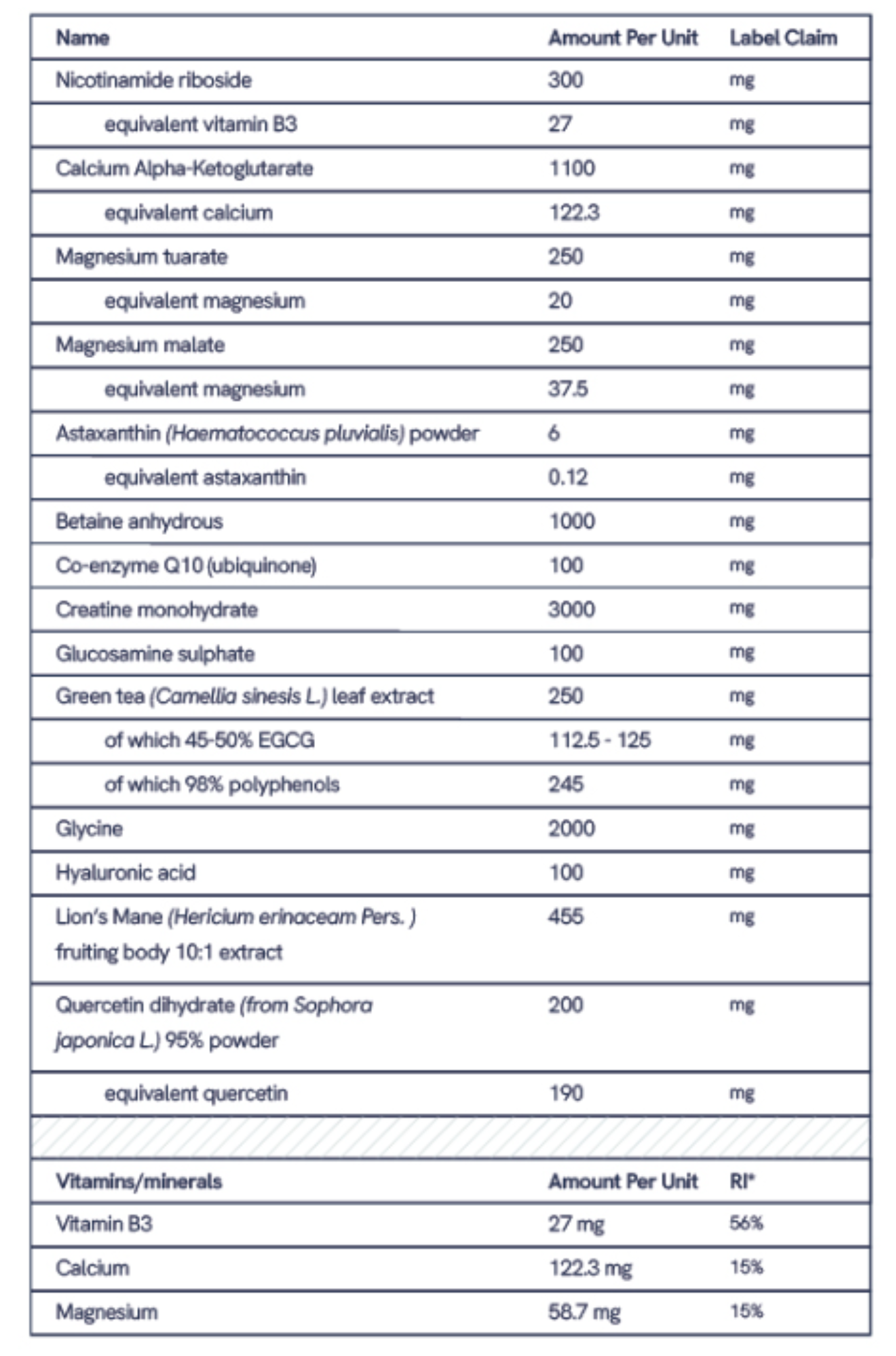
A daily nutrition formula is not a caffeine replacement, and it will not produce a lift. For transparency, Longevity One contains no caffeine and no caffeine source. Magnesium contributes to a reduction of tiredness and fatigue. Vitamin B6, vitamin B12, folate, niacin and vitamin C contribute to the reduction of tiredness and fatigue. Thiamine, niacin, vitamin B6, vitamin B12 and biotin contribute to normal energy-yielding metabolism. These nutrients matter most where your diet falls short. Read more in our guide to B vitamins and energy metabolism.
Q&A: Caffeine Alternatives
What is the best natural alternative to caffeine for energy?
A short bout of movement is one of the best supported. Ten minutes of stair walking increased feelings of energy more than 50 mg of caffeine in one study.1
What can I drink instead of coffee for energy?
Water is a good start, because mild fluid loss lowers vigour and concentration.9 Decaf keeps the ritual, and expectation alone improved attention in one trial.11
Is decaf coffee caffeine-free?
No. A laboratory analysis found up to 13.9 mg of caffeine per 16-ounce cup of decaf and up to 15.8 mg per decaf espresso.12 That is much less than regular coffee.
How long does caffeine withdrawal last?
Symptoms usually start 12 to 24 hours after the last dose, peak at 20 to 51 hours and last 2 to 9 days.7 Because symptoms rise with the daily dose, reducing gradually may make them milder.7
Is a nap a good replacement for afternoon coffee?
A short one is. After restricted sleep, a 10-minute nap improved sleepiness, fatigue and performance for up to 155 minutes, while a 30-minute nap caused grogginess first.4
Does daylight really make you more alert?
Brighter white light raised self-rated alertness in most studies in a systematic review, although many were small.3 Getting outside, or sitting near a window, is the simplest way to use this.
Is sugar a good alternative to caffeine?
No. In a meta-analysis, carbohydrate did not improve mood and was linked to more fatigue and less alertness in the first hour.6
Will exercise give me more energy if I am always tired?
In a six-week trial in sedentary adults with persistent tiredness, both low and moderate exercise improved feelings of energy.2 Low-intensity exercise reduced fatigue the most.
Why do I feel worse when I first stop coffee?
Because daily caffeine creates tolerance, and a day without it raises tiredness and sluggishness.8 This settles as your body adjusts.
Does music help with energy?
During exercise, music improved mood, performance and perceived effort in a meta-analysis of 139 studies.10 It can make a walk or workout in place of a coffee more appealing.
Frequently Asked Questions
Can I cut down on caffeine if I take medication?
Ask your GP or pharmacist and bring the label of anything you take. The Longevity One label advises consulting your doctor if you use medication.
Does Longevity One contain caffeine, and what does it taste like?
It contains no caffeine and no caffeine source, so it does not add to your caffeine total during a taper. It has a mango and pineapple flavour. Mix one scoop into 250 to 500 ml of water, or into a smoothie or yogurt.
Which caffeine alternatives work at a desk job?
A short walk or a few flights of stairs, ideally with daylight, is the simplest option.1,3 Keep water on your desk, because mild fluid loss lowers vigour and concentration.9
How much sleep do I need to stop relying on caffeine?
There is no single number for everyone. In a lab study, adults limited to 6 hours or less in bed for two weeks built up deficits they did not notice themselves.5
I am tired all the time, even with coffee. Should I worry?
If tiredness is persistent, severe or new, see your GP. Short sleep is a common cause, and caffeine hides it without fixing it.5
References
- Randolph DD, O'Connor PJ. Stair walking is more energizing than low dose caffeine in sleep deprived young women. Physiol Behav. 2017;174:128-135. View on PubMed ↗
- Puetz TW, Flowers SS, O'Connor PJ. A randomized controlled trial of the effect of aerobic exercise training on feelings of energy and fatigue in sedentary young adults with persistent fatigue. Psychother Psychosom. 2008;77(3):167-174. View on PubMed ↗
- Souman JL, Tinga AM, Te Pas SF, van Ee R, Vlaskamp BNS. Acute alerting effects of light: a systematic literature review. Behav Brain Res. 2018;337:228-239. View on PubMed ↗
- Brooks A, Lack L. A brief afternoon nap following nocturnal sleep restriction: which nap duration is most recuperative? Sleep. 2006;29(6):831-840. View on PubMed ↗
- Van Dongen HP, Maislin G, Mullington JM, Dinges DF. The cumulative cost of additional wakefulness: dose-response effects on neurobehavioral functions and sleep physiology from chronic sleep restriction and total sleep deprivation. Sleep. 2003;26(2):117-126. View on PubMed ↗
- Mantantzis K, Schlaghecken F, Sünram-Lea SI, Maylor EA. Sugar rush or sugar crash? A meta-analysis of carbohydrate effects on mood. Neurosci Biobehav Rev. 2019;101:45-67. View on PubMed ↗
- Juliano LM, Griffiths RR. A critical review of caffeine withdrawal: empirical validation of symptoms and signs, incidence, severity, and associated features. Psychopharmacology (Berl). 2004;176(1):1-29. View on PubMed ↗
- Sigmon SC, Herning RI, Better W, Cadet JL, Griffiths RR. Caffeine withdrawal, acute effects, tolerance, and absence of net beneficial effects of chronic administration: cerebral blood flow velocity, quantitative EEG, and subjective effects. Psychopharmacology (Berl). 2009;204(4):573-585. View on PubMed ↗
- Armstrong LE, Ganio MS, Casa DJ, Lee EC, McDermott BP, Klau JF, et al. Mild dehydration affects mood in healthy young women. J Nutr. 2012;142(2):382-388. View on PubMed ↗
- Terry PC, Karageorghis CI, Curran ML, Martin OV, Parsons-Smith RL. Effects of music in exercise and sport: a meta-analytic review. Psychol Bull. 2020;146(2):91-117. View on PubMed ↗
- Dawkins L, Shahzad FZ, Ahmed SS, Edmonds CJ. Expectation of having consumed caffeine can improve performance and mood. Appetite. 2011;57(3):597-600. View on PubMed ↗
- McCusker RR, Fuehrlein B, Goldberger BA, Gold MS, Cone EJ. Caffeine content of decaffeinated coffee. J Anal Toxicol. 2006;30(8):611-613. View on PubMed ↗
Disclaimer: Educational content only. Not medical advice. Food supplements should not be used as a substitute for a varied, balanced diet and a healthy lifestyle. If you use medication, consult your doctor.