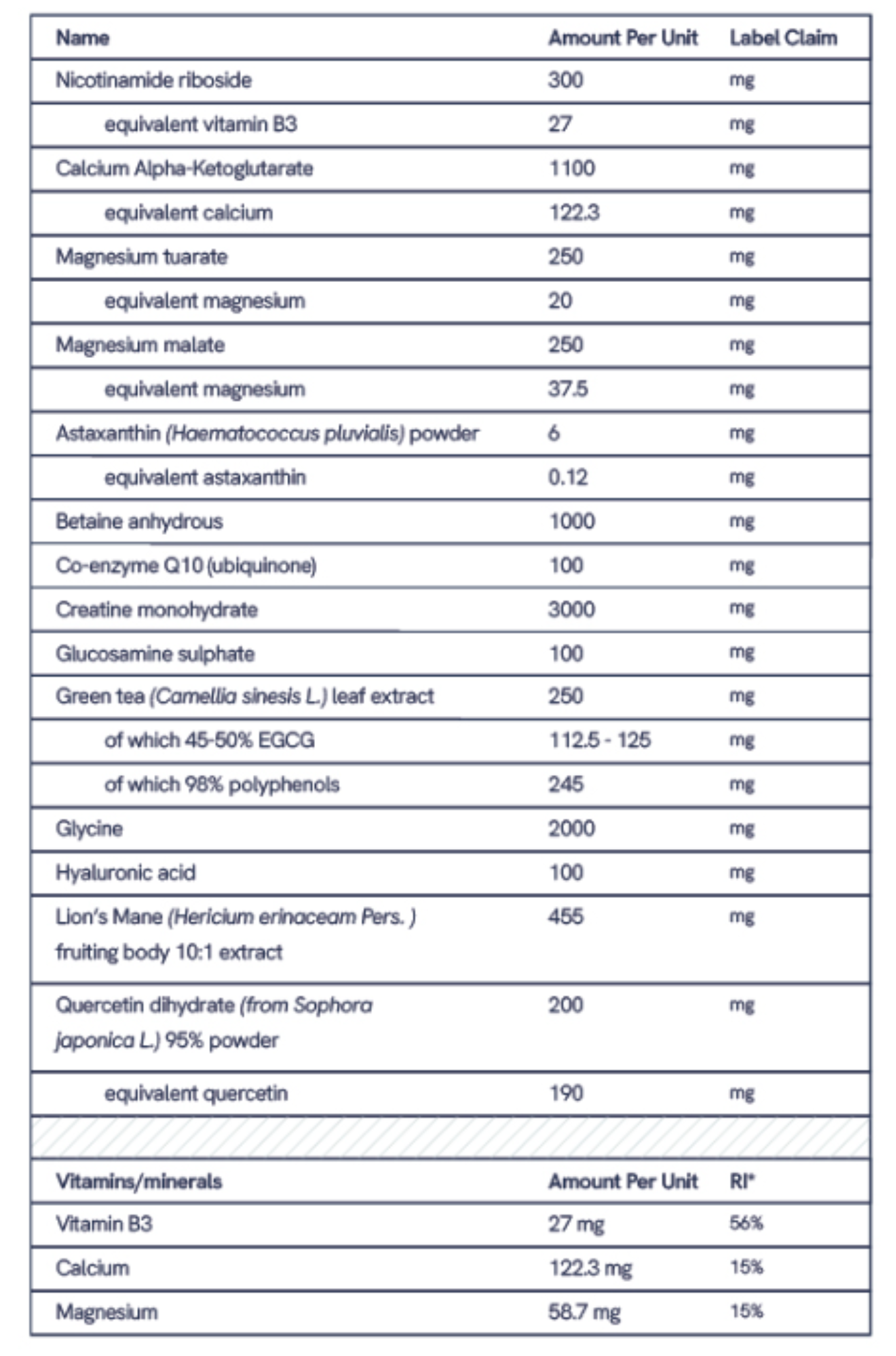
"Cellular energy" on a label almost always points to ATP, the molecule every cell uses to store and spend energy. Your body makes its own ATP from food, around the clock. Swallowing ATP does not seem to raise it in the blood: in a controlled trial, a 5,000 mg dose left blood ATP unchanged. The ingredients with authorised EU claims here are vitamins and minerals that contribute to normal energy-yielding metabolism.
Key Takeaways
- ATP is made inside your cells from the carbohydrate, fat and protein you eat, and it is used up within moments, so your body keeps only a small stock.
- In a crossover trial of eight healthy adults, a single 5,000 mg dose of oral ATP did not raise ATP in the blood.1
- ATP, CoQ10, D-ribose and NAD+ precursors carry no authorised EU health claim, whatever the front of the tub says.
- Thiamin, riboflavin, niacin, B6, B12, vitamin C, magnesium and iron are among the nutrients with the authorised claim that they contribute to normal energy-yielding metabolism.2
- That claim only counts when one serving gives at least 15% of the nutrient reference value (NRV), so the numbers on the panel matter more than the name on the front.
- The best-known human trial of nicotinamide riboside (NR) measured NAD+ levels and tolerability over six weeks. It did not set out to measure energy.4
Search for a cell energy supplement and you will find tubs promising to "recharge your mitochondria" or "fuel you at the cellular level". The language sounds precise. Most of the time it is loose shorthand for one molecule, ATP, plus a handful of vitamins and minerals your cells need to make it.
This guide explains what cellular energy means, what happens to ATP when you swallow it, and how to read the label of anything sold for cell energy.
What does "cellular energy" actually mean?
Every cell runs on adenosine triphosphate, or ATP. When a muscle contracts or a nerve fires, ATP gives up one of its phosphate groups and releases energy. The cell then rebuilds it, mostly inside the mitochondria, using fuel from the food you eat. Cells spend and remake ATP constantly, so the stock at any moment is small and the supply depends on a steady flow of fuel.
Turning food into ATP takes a long chain of enzymes, and many of them need a vitamin or mineral to work. B vitamins act as helpers at several steps, and magnesium binds to ATP inside the cell.2,3 That is the biology behind the EU's authorised claim for these nutrients: each one contributes to normal energy-yielding metabolism. The B vitamins also work as a linked group, which is why one review argues that people whose diet falls short are better served by the whole group than by one or two in isolation.3
Can you take ATP as a supplement?
You can buy it, but the evidence suggests very little survives the trip. Researchers in Maastricht gave eight healthy volunteers a single 5,000 mg dose of ATP or a placebo. To protect it from stomach acid, they delivered it in coated pellets that open in the small intestine, or through a tube placed straight into the intestine. Over the next four and a half to seven hours, ATP in the blood did not rise with any method.1
Uric acid, the end product when the body breaks ATP down, rose by about 50% with two of the methods. The authors read this as a sign that the gut breaks ATP apart and absorbs the pieces. The trial tested single doses, so it cannot say what months of daily use would do.1

What about CoQ10, D-ribose and NAD+?
These three appear on many cellular energy labels. Your body makes all of them itself. Coenzyme Q10 sits in the mitochondrial membrane and passes electrons along the chain that makes ATP. D-ribose is a sugar that forms part of the ATP molecule. NAD+ is a coenzyme that carries electrons from food towards that same chain, and niacin is one of the vitamins the body uses to make it.2
None of them carries an authorised EU health claim. A label in the EU cannot lawfully say they support your energy, and you should read any wording that hints at it with that in mind.
NAD+ precursors such as nicotinamide riboside get the most attention. In a six-week placebo-controlled crossover trial in healthy middle-aged and older adults, NR was well tolerated.4 The trial was set up to test tolerability, so it gives no answer on whether anyone felt more energetic.
Which nutrients carry energy-yielding metabolism claims?
In the UK and the EU, a supplement may only make health claims that regulators have authorised, in approved wording. A claim applies only when one serving provides at least 15% of the NRV. The right-hand column shows that minimum, so you can hold it against any label.
| Nutrient | Authorised claim (EU and GB wording) | Minimum per serving for the claim |
|---|---|---|
| Thiamin (vitamin B1) | Thiamin contributes to normal energy-yielding metabolism. | 0.165 mg |
| Riboflavin (vitamin B2) | Riboflavin contributes to normal energy-yielding metabolism. | 0.21 mg |
| Niacin (vitamin B3) | Niacin contributes to normal energy-yielding metabolism. | 2.4 mg |
| Pantothenic acid (vitamin B5) | Pantothenic acid contributes to normal energy-yielding metabolism. | 0.9 mg |
| Vitamin B6 | Vitamin B6 contributes to normal energy-yielding metabolism. | 0.21 mg |
| Vitamin B12 | Vitamin B12 contributes to normal energy-yielding metabolism. | 0.38 micrograms |
| Biotin | Biotin contributes to normal energy-yielding metabolism. | 7.5 micrograms |
| Vitamin C | Vitamin C contributes to normal energy-yielding metabolism. | 12 mg |
| Magnesium | Magnesium contributes to normal energy-yielding metabolism. | 56.25 mg |
| Iron | Iron contributes to normal energy-yielding metabolism. | 2.1 mg |
| ATP, CoQ10, D-ribose, NAD+ precursors | No authorised EU health claim. | Not applicable |
Extra amounts above what your diet already provides tend to do little. A 2020 review of the biochemical and clinical evidence found the clearest effects in people whose intake was falling short.2
How do you read a cellular energy label?
- Look past the front of the tub to the supplement facts panel, and find the vitamins and minerals in the table above.
- Check each one reaches at least 15% of the NRV per serving. The panel usually prints the percentage next to the dose.
- Treat ATP, CoQ10, D-ribose and NAD+ precursors as ingredients without an authorised claim, and judge them on the evidence.
- Make sure every ingredient has its own dose. An "energy matrix" with one total weight hides how much of each is inside.
- Check for caffeine sources such as guarana or green tea extract. A cellular energy product that also contains caffeine will feel like caffeine.
- Look for named testing laboratories and a certificate of analysis for your batch.
Our guide to third-party testing in supplements explains what a certificate of analysis should show. For transparency, here is how our own daily drink measures up against the checklist. Longevity One prints every dose of its 24 ingredients on the panel, including 150 mg of magnesium as malate, and uses no proprietary blend. It is tested by Eurofins, and as part of its NZVT certification every batch is screened for banned substances. Hold any product, ours included, to the list above.
Q&A: Cellular Energy Supplements
Do ATP supplements work?
The best human evidence says a single oral dose does not raise ATP in the blood. In a placebo-controlled trial, 5,000 mg of ATP given in three different ways left blood ATP unchanged, while uric acid, a breakdown product, went up.1 Your cells make their own ATP from food.
What is the best cell energy supplement?
Start with the nutrients that carry the authorised claim for normal energy-yielding metabolism: the B vitamins, vitamin C, magnesium and iron. Check they reach 15% of the NRV per serving and that every dose is printed.2 Iron is one to test for with your GP before you supplement.
Is CoQ10 the same as ATP?
No. CoQ10 is a coenzyme that helps pass electrons along the chain your mitochondria use to make ATP. ATP is the end product. Your body makes both, and neither carries an authorised EU health claim.
Is NAD+ the same as cellular energy?
NAD+ is one of the coenzymes your cells use to turn food into ATP. The main human NR trial tested tolerability and did not measure energy.4
Do I need a cellular energy supplement if I eat well?
Probably less than the marketing suggests. Shortfalls in B vitamins, vitamin C, magnesium and iron matter, while extra amounts do little when intake is already adequate.2
Frequently Asked Questions
Can I take a cellular energy supplement with my medication?
Ask your GP or pharmacist before you start, and bring the label with you. Some vitamins, minerals and other ingredients can interact with common medicines.
Do cellular energy powders taste good?
Honestly, a powder with real doses of B vitamins and minerals tastes of them, and flavouring can only cover so much. B vitamins can be slightly bitter and magnesium a little chalky. Most people find it easiest mixed very cold in a shaker.
Will I still need my other supplements?
Lay the labels side by side. If two products both contain magnesium or B vitamins, you pay twice and the doses add up. Keep anything your GP has recommended, and ask before dropping it.
References
- Arts IC, Coolen EJ, Bours MJ, Huyghebaert N, Stuart MA, Bast A, Dagnelie PC. Adenosine 5'-triphosphate (ATP) supplements are not orally bioavailable: a randomized, placebo-controlled cross-over trial in healthy humans. J Int Soc Sports Nutr. 2012;9(1):16. View on PubMed
- Tardy AL, Pouteau E, Marquez D, Yilmaz C, Scholey A. Vitamins and minerals for energy, fatigue and cognition: a narrative review of the biochemical and clinical evidence. Nutrients. 2020;12(1):228. View on PubMed
- Kennedy DO. B vitamins and the brain: mechanisms, dose and efficacy. A review. Nutrients. 2016;8(2):68. View on PubMed
- Martens CR, Denman BA, Mazzo MR, Armstrong ML, Reisdorph N, McQueen MB, Chonchol M, Seals DR. Chronic nicotinamide riboside supplementation is well-tolerated and elevates NAD+ in healthy middle-aged and older adults. Nat Commun. 2018;9(1):1286. View on PubMed
Disclaimer: Educational content only. Not medical advice. Food supplements should not be used as a substitute for a varied, balanced diet and a healthy lifestyle. If you use medication, consult your doctor.