Effervescent energy tablets are fizzy vitamin tablets, usually B vitamins and vitamin C, sometimes with magnesium, caffeine or guarana. Daily trials over four to five weeks found modest effects on mental tiredness, mainly where intake may be low. The fizz does not improve absorption, and one tablet can contain several hundred milligrams of sodium that the label may not show.
Key Takeaways
- In a randomised trial in 215 working men, a daily effervescent B complex with vitamin C and minerals for 33 days improved ratings of vigour and mental tiredness.1
- A follow-up in 198 men found higher ratings of concentration and alertness after a working day at some time points over 28 days.2
- B vitamins and vitamin C work as cofactors in energy metabolism, and the benefit of extra intake is strongest where status is low.3
- Effervescent vitamin C at 500 mg was absorbed far less efficiently than at 60 mg in healthy volunteers.4
- Effervescent supplement tablets measured in Germany contained on average 284 mg of sodium each, and vitamin tablets 378 mg.5
- Caffeine-containing tablets work through caffeine, the ingredient that explains most short-term changes in attention.6
Drop a tablet into a glass of water, wait for the fizz to settle, and drink. Effervescent energy tablets are sold as an easy way to "energise" a tired morning, and the tube usually lists B vitamins, vitamin C and sometimes magnesium, zinc, caffeine or guarana. Below we look at what is in these tablets and what human trials have found. We also check whether the fizz makes any difference, and one detail that rarely appears on the front of the tube: sodium.
What is in an effervescent energy tablet?
The fizz is carbon dioxide, released when an acid and a carbonate in the tablet react in water. The carbonate is often a sodium salt, which is why these tablets can carry a lot of sodium: effervescent supplements measured in Germany averaged 283.9 mg of sodium per tablet.5
The active ingredients vary by product, so the ingredient list is the guide. Many "energy" tablets combine several B vitamins with vitamin C; some add magnesium, zinc or calcium, and some add caffeine, guarana or ginseng. The rest of the tablet is typically flavouring, sweeteners and colour.
| Type of tablet | Typical active ingredients | What to expect |
|---|---|---|
| B complex with vitamin C | B vitamins, vitamin C, sometimes zinc and magnesium | Helps where intake is low; studied as daily use over weeks1,3 |
| Vitamin C only | Often 500 mg or 1,000 mg vitamin C | High single doses are absorbed less efficiently4 |
| Magnesium | Magnesium, sometimes with B vitamins | Magnesium contributes to a reduction of tiredness and fatigue |
| With caffeine or guarana | Caffeine plus vitamins | A short-term caffeine effect6 |
Do effervescent energy tablets work?
It depends on what you expect. The best evidence comes from trials of a daily effervescent B vitamin complex with vitamin C and minerals. In a randomised, placebo-controlled, double-blind trial, 215 men aged 30 to 55 in full-time employment took one effervescent tablet or an identical placebo tablet every day for 33 days.1 The supplement group reported improvements in perceived stress and vigour, rated themselves as less mentally tired before and after a demanding hour of tests, and performed better on one arithmetic task.1
The same research group then followed 198 men from that cohort with tests on mobile phones before and after a working day, over 28 days.2 The supplement group rated their concentration higher after a working day, though not before work, and reported greater alertness after work on day 14 and both before and after work on day 28.2 A separate trial in 216 women aged 25 to 50 taking a daily multivitamin and mineral for nine weeks found less decline in mood and fatigue ratings during long multitasking sessions.7
Three points matter when you read these results. The effects were modest and measured on rating scales and lab tasks. They appeared after weeks of daily use. And the participants were not selected for low vitamin status, so it is not clear how much of the benefit came from people whose diets were falling short. A review of vitamins and minerals for energy and fatigue makes the point directly: these nutrients matter most when status or supply is not adequate.3
What do the vitamins in the tablet do?
B vitamins work as cofactors: enzymes need them to turn food into usable energy. A review of B vitamins and the brain describes their roles in energy metabolism in mitochondria and in making signalling molecules.8 Several carry authorised EU claims. For example, under Regulation (EU) No 432/2012, niacin, vitamin B6, vitamin B12, folate and vitamin C contribute to the reduction of tiredness and fatigue, and thiamine, niacin, vitamin B6, vitamin B12 and biotin contribute to normal energy-yielding metabolism. These claims describe normal functions. They do not mean a tablet will make you less tired than you are now if your intake is already enough. Our guide to B vitamins and energy metabolism explains each vitamin.
What about magnesium tablets?
Effervescent magnesium tablets are often sold alongside energy tablets, sometimes combined with B vitamins. Magnesium contributes to a reduction of tiredness and fatigue. Magnesium contributes to normal energy-yielding metabolism. The review of vitamins and minerals for fatigue describes magnesium's role in energy-yielding metabolism and links low magnesium status with tiredness.3 Four of its five authors worked for a pharmaceutical company at the time. As with the vitamins, the people most likely to notice a difference are those whose intake is low. Magnesium tablets measured in the German study contained less sodium than vitamin tablets, on average 232.7 mg per tablet, but that is still a meaningful amount if you take more than one.5 The EFSA report on tolerable upper intake levels sets an upper level of 250 mg a day for magnesium from readily dissolved salts in supplements, because mild diarrhoea is the most sensitive side effect of those forms.
What about tablets with caffeine?
If the tablet contains caffeine or guarana, you will feel that within the hour, as you would from coffee. In a trial that tested energy drink ingredients separately, caffeine explained most of the changes in attention, working memory and reaction time.6 Check the caffeine in mg per tablet and count it towards your day; up to 400 mg a day from all sources is not linked to adverse effects in healthy adults.9 That review was funded through an industry-supported scientific body, and EFSA reached the same 400 mg figure in its scientific opinion on the safety of caffeine.
Does the fizz help you absorb more?
There is no good evidence that it does. An effervescent tablet dissolves before you drink it, which some people find easier than swallowing a large tablet, and the drink counts towards your daily fluids. But once the vitamins are in solution, absorption depends on the dose and on your body. The bubbles play no part.
Vitamin C is the clearest example. In a pharmacokinetic study in nine healthy volunteers, effervescent vitamin C tablets of 60 mg and 500 mg were compared. With the 500 mg tablet, less than 30% of the dose was absorbed compared with the 60 mg tablet, because absorption in the gut is saturable and lasts only a few hours.4 A detailed depletion and repletion study found the same pattern for vitamin C in general: absorption was complete at 200 mg as a single dose, fell at 500 mg and above, and the absorbed excess was excreted.10
Water-soluble B vitamins behave similarly. In a small controlled feeding study in six young Japanese women, urinary levels of most B vitamins and vitamin C rose in step with intake when doses were raised to three and six times the reference amounts.11 So a tablet with several hundred percent of the reference intake raises the amount you excrete.

How much sodium is in an effervescent tablet?
More than most people expect. Researchers in Germany measured the sodium content of 39 effervescent dietary supplement tablets bought in 2022 and compared them with label data for 51 effervescent supplements sold in the US.5 The German tablets contained on average 283.9 mg of sodium each, equal to about 14% of the maximum recommended daily sodium intake used in the study. Vitamin tablets had the most, at 378.3 mg on average, about 19% of that maximum, more than magnesium, calcium or mineral tablets.5 The measured sodium in the German products was also higher than the sodium declared on the US labels, and the authors concluded that sodium in effervescent tablets often is not disclosed.5
In practice, one tablet a day adds a modest amount of sodium to a typical diet. Two or three a day, or an effervescent vitamin tablet on top of other effervescent products, can add up to a meaningful share of the daily limit. The WHO guideline on sodium intake advises adults to keep sodium below 2 g a day, which is 5 g of salt. If your GP has advised you to limit salt, an effervescent tablet is worth discussing, and a non-effervescent form may suit you better.
Why is sodium not always on the label?
In the EU, food supplements are covered by Directive 2002/46/EC and are exempt from the mandatory nutrition declaration under Article 29 of Regulation (EU) No 1169/2011, so sodium or salt may not be listed at all. If it is shown, it may appear as "salt", which Annex I of the same regulation defines as sodium multiplied by 2.5. When the tube does not say, the ingredient list is the only clue: sodium bicarbonate, sodium carbonate or sodium citrate near the top means a meaningful amount.5
Is a fizzy tablet better than a capsule, powder or shot?
Each format has trade-offs. Effervescent tablets are convenient and pleasant to drink, but usually carry sodium and sweeteners, and a single tablet has room for only a limited amount of each ingredient. Capsules and film-coated tablets carry no sodium from a fizz reaction. Powders can hold larger amounts of minerals and other ingredients in one serving. Shots deliver a concentrated dose, usually with caffeine. Our article on shots, capsules and powders compares the formats in more depth. Whatever the format, the dose of each nutrient and your own needs matter more than how it is delivered.3
How do you choose an effervescent tablet, or decide to skip one?
- Read the full ingredient list and each dose with its % NRV. Very high percentages add little if your intake is already enough.11
- Look for sodium or salt per tablet. If it is not stated, check for sodium bicarbonate, carbonate or citrate.5
- Count tablets. Two or three a day multiply both the sodium and the vitamins.
- Check for caffeine or guarana and add it to your daily total.9
- For vitamin C, remember that very high single doses are absorbed less efficiently.10
- Expect effects, if any, over weeks of daily use, not within the hour.1
- If you are tired most days for weeks, see your GP before relying on any tablet.
For a general guide to doses and red flags, see our article on how to read a supplement label.
How our own formula fits
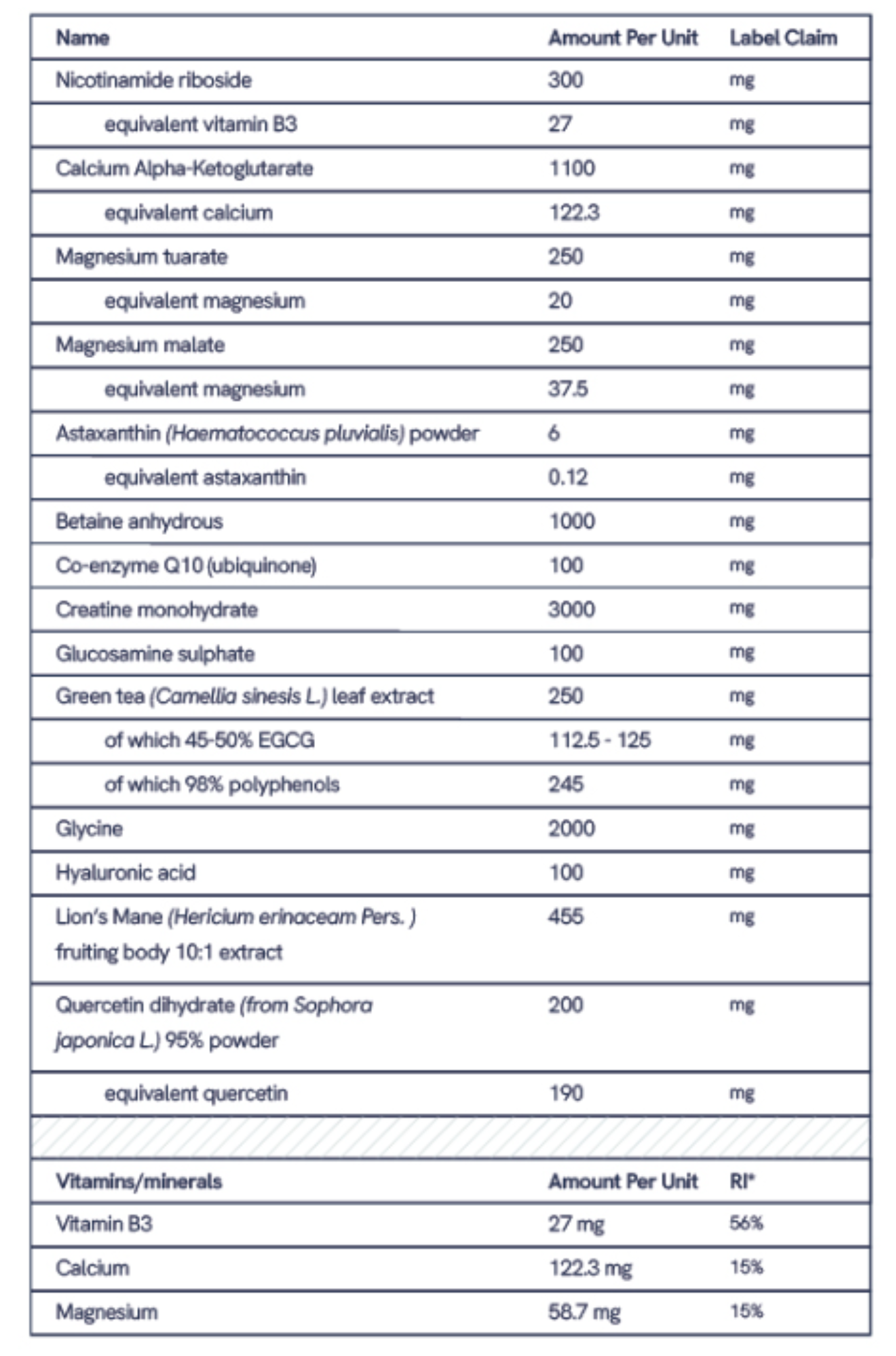
For transparency, Longevity One is not an effervescent tablet. It is a daily drink powder, one level scoop in 250 to 500 ml of water, with no caffeine and no caffeine source; sodium is not among its ingredients, and every dose is printed on the label. Niacin, vitamin B6, folate, vitamin B12 and vitamin C contribute to the reduction of tiredness and fatigue. Magnesium contributes to a reduction of tiredness and fatigue. These nutrients matter most where your intake falls short.3 It is independently tested by Eurofins and NZVT certified, with every batch screened.
If your tiredness is persistent, severe or new, talk to your GP. A tablet, fizzy or not, cannot tell you why you are tired.
Q&A: Effervescent Energy Tablets
Do effervescent energy tablets give you energy?
Trials of a daily effervescent B complex with vitamin C found modest improvements in vigour and mental tiredness after 33 days.1 The effect builds slowly, over weeks. Tablets with caffeine give a short-term caffeine effect.6
How quickly do effervescent vitamin tablets work?
Not immediately. The positive trials measured effects after 28 to 33 days of daily use.1,2 If you feel a lift within the hour, check the tube for caffeine.
Is effervescent vitamin C absorbed better?
There is no good evidence that the fizz helps. In healthy volunteers, less than 30% of a 500 mg effervescent dose was absorbed compared with a 60 mg dose.4 Smaller doses spread through the day are absorbed more efficiently.
How much sodium is in an effervescent tablet?
Effervescent supplement tablets measured in Germany averaged 284 mg of sodium each, and vitamin tablets 378 mg.5 That is about 14% and 19% of the maximum daily sodium intake used in the study. The label may not say.
Can I take two effervescent tablets a day?
Check the label for the maximum. Two tablets double the sodium, which can approach a fifth or more of the daily limit.5 They also double vitamin doses that may already be well above your needs.11
Are effervescent tablets better than capsules?
They are easier for people who dislike swallowing tablets, and the drink adds to your fluids. They usually contain sodium and sweeteners that capsules do not.5 The dose and your needs matter more than the format.
Who might benefit from an effervescent vitamin tablet?
People whose diets are low in B vitamins or vitamin C are the most likely to notice a difference.3 In a small feeding study, urinary vitamin levels rose in step with intake.11 If you suspect a low level, test first, with your GP.
Do effervescent energy tablets contain caffeine?
Some do, often from caffeine or guarana. Caffeine explains most short-term effects on attention.6 Keep your total from all sources within 400 mg a day.9
Why does my urine turn bright yellow after a vitamin tablet?
A common explanation is riboflavin (vitamin B2), a yellow vitamin, though we found no study that measured urine colour. What has been measured is that urinary vitamin levels, including riboflavin, rise in step with intake.11 It shows the extra passing through.
Frequently Asked Questions
Can I take effervescent energy tablets with medication?
Ask your GP or pharmacist first and bring the tube, especially if you have been advised to limit sodium. If you are pregnant, ask your midwife or GP.
What do effervescent tablets taste like, and what about Longevity One?
Effervescent tablets vary in flavour, and they often contain sodium from the fizz reaction.5 Longevity One is a powder with a mango and pineapple flavour; mix one level scoop in 250 to 500 ml of water, or into a smoothie or yogurt.
Do effervescent magnesium tablets help with tiredness?
Magnesium contributes to a reduction of tiredness and fatigue. A review of fatigue and micronutrients links low magnesium status with tiredness.3 As with B vitamins, the benefit is clearest where intake is low. Check the sodium per tablet too.5
Should I take an effervescent tablet in the morning?
Most people take it in the morning, and with breakfast it is easy to remember. The timing matters less than daily consistency, as in the trials that found effects.1
When should I see a doctor instead of taking energy tablets?
If you feel tired most days for several weeks, or the tiredness is new or severe, see your GP. A blood test can check for low iron or B12 before you supplement.
References
- Kennedy DO, Veasey R, Watson A, Dodd F, Jones E, Maggini S, Haskell CF. Effects of high-dose B vitamin complex with vitamin C and minerals on subjective mood and performance in healthy males. Psychopharmacology (Berl). 2010;211(1):55-68. View on PubMed ↗
- Kennedy DO, Veasey RC, Watson AW, Dodd FL, Jones EK, Tiplady B, et al. Vitamins and psychological functioning: a mobile phone assessment of the effects of a B vitamin complex, vitamin C and minerals on cognitive performance and subjective mood and energy. Hum Psychopharmacol. 2011;26(4-5):338-347. View on PubMed ↗
- Tardy AL, Pouteau E, Marquez D, Yilmaz C, Scholey A. Vitamins and minerals for energy, fatigue and cognition: a narrative review of the biochemical and clinical evidence. Nutrients. 2020;12(1):228. View on PubMed ↗
- Piotrovskij VK, Kállay Z, Gajdos M, Geryková M, Trnovec T. The use of a nonlinear absorption model in the study of ascorbic acid bioavailability in man. Biopharm Drug Dispos. 1993;14(5):429-442. View on PubMed ↗
- Kunz M, Götzinger F, Jacobs CM, Lauder L, Ukena C, Meyer MR, et al. Hidden sodium in effervescent-tablet dietary supplements and over-the-counter drugs: a comparative cross-sectional study. BMJ Open. 2023;13(11):e076302. View on PubMed ↗
- Giles GE, Mahoney CR, Brunyé TT, Gardony AL, Taylor HA, Kanarek RB. Differential cognitive effects of energy drink ingredients: caffeine, taurine, and glucose. Pharmacol Biochem Behav. 2012;102(4):569-577. View on PubMed ↗
- Haskell CF, Robertson B, Jones E, Forster J, Jones R, Wilde A, Maggini S, Kennedy DO. Effects of a multi-vitamin/mineral supplement on cognitive function and fatigue during extended multi-tasking. Hum Psychopharmacol. 2010;25(6):448-461. View on PubMed ↗
- Kennedy DO. B vitamins and the brain: mechanisms, dose and efficacy. A review. Nutrients. 2016;8(2):68. View on PubMed ↗
- Wikoff D, Welsh BT, Henderson R, Brorby GP, Britt J, Myers E, et al. Systematic review of the potential adverse effects of caffeine consumption in healthy adults, pregnant women, adolescents, and children. Food Chem Toxicol. 2017;109(Pt 1):585-648. View on PubMed ↗
- Levine M, Conry-Cantilena C, Wang Y, Welch RW, Washko PW, Dhariwal KR, et al. Vitamin C pharmacokinetics in healthy volunteers: evidence for a recommended dietary allowance. Proc Natl Acad Sci U S A. 1996;93(8):3704-3709. View on PubMed ↗
- Fukuwatari T, Shibata K. Urinary water-soluble vitamins and their metabolite contents as nutritional markers for evaluating vitamin intakes in young Japanese women. J Nutr Sci Vitaminol (Tokyo). 2008;54(3):223-229. View on PubMed ↗
Disclaimer: Educational content only. Not medical advice. Food supplements should not be used as a substitute for a varied, balanced diet and a healthy lifestyle. If you use medication, consult your doctor.