Energy gels and other liquid carbohydrate help mainly in exercise lasting longer than about an hour, where 30 to 60 g of carbohydrate an hour, and up to 90 g beyond two and a half hours, supports performance. Gels, drinks and bars are used about equally well. For shorter sessions, easy training or everyday tiredness at a desk, you do not need them.
Key Takeaways
- Carbohydrate needs during exercise scale with duration: little or none for about an hour, 30 to 60 g an hour for longer sessions and up to 90 g an hour beyond 2.5 hours.1
- In 61 controlled studies, 82% found a performance benefit from carbohydrate, and the benefit grew with exercise duration.2
- Simply rinsing a carbohydrate drink in the mouth improved a one-hour cycling time trial, without swallowing it.3
- A glucose and fructose gel taken with water was used by the body as well as the same carbohydrate in a drink.4
- Gut complaints affect roughly 30 to 50% of athletes, and the gut can be trained to tolerate carbohydrate during exercise.5,6
- Caffeinated gels and chews are alternative caffeine sources; studied doses are 3 to 6 mg per kg of body weight.7
- Vitamins and minerals take part in energy metabolism but supply no fuel; they are a daily question, separate from gels.8
"Liquid energy" means two very different things on a shop shelf. One is exercise fuel: gels, sports drinks and chews that deliver carbohydrate while you move. The other is everyday energy: small bottles and shots that rely on caffeine, sugar or added vitamins to help you through an afternoon. Both are sold as liquid energy supplements. They answer different questions. This article deals mainly with the first, and explains at the end why the second is a separate decision.
What is actually in an energy gel?
An energy gel is a concentrated, semi-solid carbohydrate, usually from glucose, maltodextrin (short chains of glucose) and sometimes fructose, in a small sachet. The grams of carbohydrate per gel vary between products, so check the label. Some add sodium, and some add caffeine. Sports drinks deliver carbohydrate diluted in water, often with electrolytes; chews and bars deliver it as a solid. All of them have the same job: to give working muscles and the brain carbohydrate when your own stores are being used up. Carbohydrate can be taken as a liquid, a semi-solid or a solid, and all three can work.9
When do you actually need a gel?
The answer depends mainly on how long you exercise, and to a lesser extent how hard. Sports nutrition guidance scales carbohydrate intake to the characteristics of the session.1 The table summarises it.
| Session | Carbohydrate during exercise | Do you need a gel? |
|---|---|---|
| Under about 45 minutes | Not covered by the intake targets, which start at sessions of about 1 hour1 | No, if you have eaten in the previous hours |
| About 1 hour, hard effort | Small amounts, or a mouth rinse, may help1 | Optional; a few sips of sports drink can be enough |
| 1 to 2.5 hours | 30 to 60 g an hour1 | Helpful; gels, drink or chews all work |
| Over 2.5 hours | Up to 90 g an hour, from mixed sugars1,9 | Usually yes, combined with drink and food |
| Easy, low-intensity session | Lower than the targets above9 | Rarely |
What the controlled studies show
A systematic review gathered 61 randomised performance studies, with 679 participants, that compared carbohydrate with water alone.2 In 82% of them, carbohydrate gave a significant performance benefit, and the benefit increased with the length of exercise.2 The authors described two different mechanisms. In efforts of about an hour, the benefit appears to come from carbohydrate touching receptors in the mouth, which signal to reward areas of the brain, so the type and amount of carbohydrate matter very little.2 In efforts longer than about two hours, where muscle glycogen runs low, the benefit comes from delivering carbohydrate at high rates for the muscles to use.2
The mouth-rinse finding
The clearest example of the first mechanism is a small study in nine trained cyclists (seven men and two women).3 During a one-hour time trial they rinsed either a 6.4% maltodextrin drink or water around the mouth for 5 seconds at regular intervals, then spat it out. With carbohydrate, they finished in 59.6 minutes against 61.4 minutes with water, at a higher average power, without any difference in heart rate or perceived effort.3 In other words, for a hard hour, you may not need to swallow a gel at all. For a three-hour ride or run, you do need to swallow fuel.
How much per hour for long sessions?
For efforts of two to three hours, a single sugar source such as glucose can be used at up to about 60 g an hour.9 Above that, the body needs mixed sugars, typically glucose and fructose, which are absorbed by different routes, to use around 90 g an hour.9 Intake advice does not depend on body weight or training status, but it can be lower when the pace is easy.9 The author of that review was then based at a sports drink company research institute. If a gel provides 25 g, then 60 g an hour means a little more than two gels an hour, or one gel plus a carbohydrate drink.
Gel, drink or bar: does the format matter?
Most fuelling research has used drinks. Two laboratory studies from the same group tested whether gels and bars work as well.
In the first, eight well-trained cyclists rode for 180 minutes at a moderate effort three times: with a glucose and fructose gel taken with plain water, with the same carbohydrate in a drink, or with water only.4 Both carbohydrate options provided 108 g an hour, and fluid intake was matched at 867 ml an hour. Peak use of the ingested carbohydrate was almost identical (1.44 g a minute from the gel, 1.42 g a minute from the drink), as was the efficiency of its use (71% and 69%).4
In the second, eight well-trained athletes rode for 180 minutes with a glucose and fructose bar plus water, the same carbohydrate as a drink, or water.10 The bar was used about as well as the drink overall, although use was 15% lower at a few time points in the middle of the ride.10 The authors concluded that a bar can be a practical form of carbohydrate alongside other forms.10
These were small studies in trained people, cycling at steady effort, so they do not settle every question. But they suggest that the choice between gel, drink and bar can be made on practical grounds: what you can carry, what you can stomach at your pace, and how much fluid you also need.
Do gels need water?
In the gel study, the gel was taken with plain water, and fluid intake was matched to the drink trial.4 That is how gels are meant to be used. A gel is very concentrated, and a review lists nutritional choices among the three main causes of gut complaints during exercise.5 You still need fluid during long exercise, and sweat rates vary widely, so the amount is personal.11 Drinks containing carbohydrate and electrolytes can offer benefits over water alone in some situations11, which is one reason many athletes use a mix of drink and gels.
Why do gels upset some stomachs?
Gut complaints are common in exercise: studies suggest that 30 to 50% of athletes experience them, mostly mild.5 During hard exercise, blood flow to the gut falls, especially when athletes have lost a lot of fluid, which is thought to be one of the main contributors.5 Mechanical jolting, as in running, and nutritional choices add to it.5 In a study of 221 athletes in competitive events, higher carbohydrate intakes were linked with more nausea and wind, but also with faster Ironman finish times, and a history of gut problems was the strongest predictor of symptoms.12
The gut adapts. Practising carbohydrate intake during training improves how fast the stomach empties and how much the intestine can absorb, and probably reduces the chance of problems on race day.6 This is why experienced athletes use the same gels in training as in races, and why race day is never the moment to try a new one.
- Start with the lower end of the hourly range and build up over several weeks of long sessions.6
- Take each gel with a few mouthfuls of water.4
- Use mixed sugars when you go beyond about 60 g an hour.9
- Spread intake through the session rather than taking large amounts at once.
- Note what you used and how your stomach felt; your history is the best guide.12

What about caffeinated gels?
Many gels contain caffeine. The International Society of Sports Nutrition position stand concludes that 3 to 6 mg of caffeine per kg of body mass consistently improves exercise performance, that very high doses (around 9 mg per kg) mainly add side effects, and that alternative sources such as gels and chews have been studied.7 The most common timing in studies is 60 minutes before exercise, although the best timing likely depends on the source.7
Two practical points follow. Count your caffeine: coffee before the start plus several caffeinated gels can add up quickly. And remember that responses differ between individuals, including effects on sleep7, so caffeinated gels late in an evening session may cost you sleep that night.
When are gels not needed?
Gels are a tool for long or hard exercise. They are not needed for:
- Sessions under about 45 to 60 minutes, if you have eaten in the previous hours.1
- Easy runs, rides or swims at a conversational pace, where carbohydrate use is lower.9
- Gym sessions and most team training, unless they are long and intense.
- Everyday tiredness at a desk, where a gel delivers sugar your muscles are not using.
If you are trying to lose body fat, regular gels on short sessions add energy you may not need. Match intake to the session rather than cutting carbohydrate out.
Is liquid energy for everyday tiredness the same thing?
No, and this is where the term "liquid energy supplement" causes confusion. Everyday energy shots and drinks are a different kind of product: most are built around caffeine, often with sugar and sometimes with added vitamins, and are aimed at alertness rather than fuel. They can make you feel more alert for a while, but they do not address why you feel tired.
Vitamins and minerals play a different role. They are involved in the pathways that turn food into usable energy, and fatigue can appear when status or supplies are not adequate.8 That is why several carry authorised claims. Magnesium contributes to a reduction of tiredness and fatigue. Niacin, vitamin B6, vitamin B12, folate and vitamin C contribute to the reduction of tiredness and fatigue. Thiamine contributes to normal energy-yielding metabolism, and so do niacin, vitamin B6, vitamin B12, biotin, vitamin C, calcium and magnesium. But these nutrients supply no fuel themselves, and they are not a quick lift.8 Our article on B vitamins and energy metabolism explains the biochemistry; our comparison of longevity drinks, coffee and energy drinks covers the everyday products; and our guide to shots, capsules and powders compares formats.
So the two questions have different answers. "Do I need a gel?" depends on how long and how hard you exercise. "Do I need daily nutrients?" depends on your diet, and is answered by food first. Mixing the two leads to people drinking sugar for desk fatigue, or expecting vitamins to fuel a long run.
How does our own formula fit?
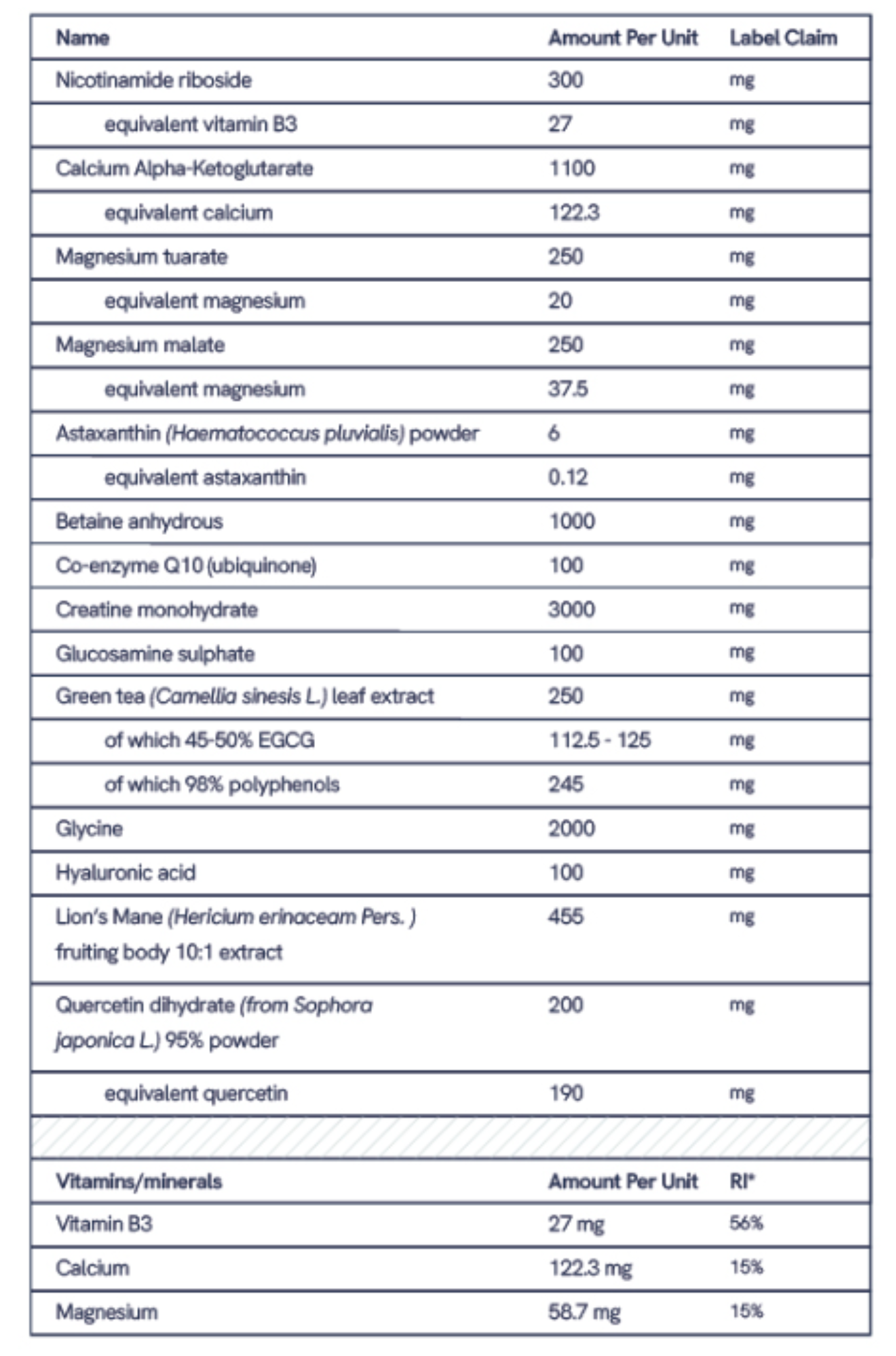
For transparency, Longevity One belongs to the second group. It is a daily powder with vitamins, minerals and creatine, taken once a day in water, and it is not an exercise fuel, an energy shot or a gel replacement. It contains no caffeine source. The claims that apply are those for its nutrients. Magnesium contributes to a reduction of tiredness and fatigue. Vitamin B6, vitamin B12, folate, niacin and vitamin C contribute to the reduction of tiredness and fatigue. No claim is made for endurance, stamina or performance. It is independently tested by Eurofins and NZVT certified, with every batch screened for banned substances.
A quick decision guide
- How long is the session? Under an hour: you probably do not need a gel.1
- Is it hard and about an hour? A few sips of sports drink, or a mouth rinse, may be enough.3
- Is it longer than an hour? Plan 30 to 60 g of carbohydrate an hour from gels, drink or food.1
- Is it longer than 2.5 hours? Work towards up to 90 g an hour from mixed sugars, practised in training.9,6
- Is caffeine involved? Count the total and stay within the range you have tested.7
- Is it everyday tiredness, not exercise? Look at sleep, meals and your diet, not gels.
If tiredness is persistent, severe or new, see your GP. No gel, shot or supplement should be used to push through fatigue that has an underlying cause.
Q&A: Energy Gels and Liquid Energy
Do I need energy gels for a 5 km or 10 km run?
Usually not. Efforts of about an hour or less need little or no carbohydrate during exercise, provided you have eaten beforehand.1 A few sips of sports drink are enough for most people.
How many gels per hour should I take?
Work from carbohydrate per hour: 30 to 60 g for sessions of one to two and a half hours, and up to 90 g beyond that.1 Divide by the grams of carbohydrate stated on the gel label. Build up to it in training.
Are gels better than sports drinks?
Not in how the carbohydrate is used. In a study of eight trained cyclists, a glucose and fructose gel taken with water was used almost exactly as well as the same carbohydrate in a drink.4 Choose on comfort and convenience.
Can I use energy bars instead of gels?
Yes, for longer and steadier sessions. A glucose and fructose bar was used about as well as a drink during a three-hour ride, though slightly less at some time points.10 Solid food is harder to manage at high intensity.
Do I have to drink water with a gel?
Yes, ideally. In the gel study, gels were taken with plain water.4 A review also lists nutritional choices among the main causes of gut complaints during exercise.5
Why do energy gels give me stomach problems?
Gut complaints affect about 30 to 50% of athletes, and causes include reduced blood flow to the gut during hard exercise and nutritional choices.5 Practising with gels in training helps the gut adapt.6
What is a carbohydrate mouth rinse?
It means swishing a carbohydrate drink around the mouth for a few seconds and spitting it out. In nine trained cyclists, this shortened a one-hour time trial from 61.4 to 59.6 minutes compared with water.3 It only applies to efforts of about an hour.
Are caffeinated gels a good idea?
They can be, if you know your caffeine tolerance. Studies support 3 to 6 mg per kg of body mass, and gels and chews are recognised alternative sources.7 Count all your caffeine for the day, including coffee.
Is a liquid energy shot the same as a gel?
No. A gel supplies carbohydrate fuel, and carbohydrate during exercise improved performance in 82% of controlled studies in one review.2 Most everyday energy shots are built around caffeine instead. Neither replaces sleep, food or an adequate diet.
Do vitamins give you energy like a gel?
No. Vitamins and minerals take part in energy-yielding metabolism, but they supply no fuel.8 Magnesium contributes to a reduction of tiredness and fatigue. Vitamin B12 contributes to the reduction of tiredness and fatigue.
Frequently Asked Questions
Can I take energy gels or supplements with my medication?
The Longevity One label advises consulting your doctor if you use medication. Ask your GP or pharmacist and bring the label, along with the labels of any caffeinated gels you use, since responses to caffeine differ between people.7
Can I mix Longevity One into my sports drink?
It is designed to be mixed in 250 to 500 ml of water once a day, or into a smoothie or yogurt, rather than in a bottle for exercise. Keep your carbohydrate drink for the session itself.1
What does Longevity One taste like?
It has a mango and pineapple flavour. Mix one scoop into 250 to 500 ml of water, or into a smoothie or yogurt.
Are gels safe for people who race under anti-doping rules?
Gels are a supplement like any other, so choose batch-tested products if you are tested. Longevity One is NZVT certified, with every batch screened for banned substances.
Can I make my own liquid energy drink?
Some athletes do. At high intakes, guidance favours a mix of sugars that are absorbed by different routes, such as glucose and fructose.9 Table sugar is made of glucose and fructose, but homemade drinks have not been tested in the studies cited here, so weigh the sugar, know the grams per bottle, and try it in training first.
References
- Burke LM, Hawley JA, Wong SH, Jeukendrup AE. Carbohydrates for training and competition. J Sports Sci. 2011;29(Suppl 1):S17-S27. View on PubMed ↗
- Stellingwerff T, Cox GR. Systematic review: carbohydrate supplementation on exercise performance or capacity of varying durations. Appl Physiol Nutr Metab. 2014;39(9):998-1011. View on PubMed ↗
- Carter JM, Jeukendrup AE, Jones DA. The effect of carbohydrate mouth rinse on 1-h cycle time trial performance. Med Sci Sports Exerc. 2004;36(12):2107-2111. View on PubMed ↗
- Pfeiffer B, Stellingwerff T, Zaltas E, Jeukendrup AE. CHO oxidation from a CHO gel compared with a drink during exercise. Med Sci Sports Exerc. 2010;42(11):2038-2045. View on PubMed ↗
- de Oliveira EP, Burini RC, Jeukendrup A. Gastrointestinal complaints during exercise: prevalence, etiology, and nutritional recommendations. Sports Med. 2014;44(Suppl 1):S79-S85. View on PubMed ↗
- Jeukendrup AE. Training the gut for athletes. Sports Med. 2017;47(Suppl 1):101-110. View on PubMed ↗
- Guest NS, VanDusseldorp TA, Nelson MT, Grgic J, Schoenfeld BJ, Jenkins NDM, et al. International society of sports nutrition position stand: caffeine and exercise performance. J Int Soc Sports Nutr. 2021;18(1):1. View on PubMed ↗
- Tardy AL, Pouteau E, Marquez D, Yilmaz C, Scholey A. Vitamins and minerals for energy, fatigue and cognition: a narrative review of the biochemical and clinical evidence. Nutrients. 2020;12(1):228. View on PubMed ↗
- Jeukendrup A. A step towards personalized sports nutrition: carbohydrate intake during exercise. Sports Med. 2014;44(Suppl 1):S25-S33. View on PubMed ↗
- Pfeiffer B, Stellingwerff T, Zaltas E, Jeukendrup AE. Oxidation of solid versus liquid CHO sources during exercise. Med Sci Sports Exerc. 2010;42(11):2030-2037. View on PubMed ↗
- American College of Sports Medicine, Sawka MN, Burke LM, Eichner ER, Maughan RJ, Montain SJ, et al. American College of Sports Medicine position stand. Exercise and fluid replacement. Med Sci Sports Exerc. 2007;39(2):377-390. View on PubMed ↗
- Pfeiffer B, Stellingwerff T, Hodgson AB, Randell R, Pöttgen K, Res P, et al. Nutritional intake and gastrointestinal problems during competitive endurance events. Med Sci Sports Exerc. 2012;44(2):344-351. View on PubMed ↗
Disclaimer: Educational content only. Not medical advice. Food supplements should not be used as a substitute for a varied, balanced diet and a healthy lifestyle. If you use medication, consult your doctor.