A multivitamin for women's energy is worth checking for three things: the nutrients with authorised tiredness claims at meaningful doses, whether it contains iron and how much, and every dose printed in full. Iron matters most for women who menstruate, but it is best taken after a blood test. No multivitamin can stand in for sleep.
Key Takeaways
- In a nine-week trial, women aged 25 to 50 taking a multivitamin and mineral supplement showed a smaller decline in mood and fatigue ratings during demanding multitasking than with placebo.1
- Shortfalls in B vitamins, vitamin C, iron and magnesium are linked with fatigue, and extra amounts help less when intake is already adequate.2
- Iron supplements often upset the stomach: ferrous sulfate roughly doubled the odds of gut side effects in a meta-analysis.3
- B12 comes almost entirely from animal foods, so women who eat few of them are more likely to run low.4
- The B vitamins work as a linked group, so a full set makes more sense than one or two alone.5
- Energy changes around perimenopause are a conversation for your GP or a menopause clinic, not a label claim.

Back-to-back weeks, a period that leaves you flattened, and a growing feeling that you used to have more in the tank. A multivitamin for women promises to help. Whether it can depends on what is actually in the tub, and on one nutrient in particular.
What makes a multivitamin an energy multivitamin?
Mostly the label. Any multivitamin can carry the authorised tiredness claims if it provides enough of the right nutrients, and none can carry more than that. In the UK and EU, these are the claims to look for, each valid only when a daily serving provides at least 15% of the nutrient reference value (NRV).
| Nutrient | Authorised claim (EU and GB wording) | Minimum per serving for the claim |
|---|---|---|
| Iron | Iron contributes to the reduction of tiredness and fatigue. | 2.1 mg |
| Magnesium | Magnesium contributes to a reduction of tiredness and fatigue. | 56.25 mg |
| Vitamin B6 | Vitamin B6 contributes to the reduction of tiredness and fatigue. | 0.21 mg |
| Vitamin B12 | Vitamin B12 contributes to the reduction of tiredness and fatigue. | 0.38 micrograms |
| Folate | Folate contributes to the reduction of tiredness and fatigue. | 30 micrograms |
| Vitamin C | Vitamin C contributes to the reduction of tiredness and fatigue. | 12 mg |
A 2020 review links fatigue with shortfalls in exactly these nutrients, and is clear that the effects appear when status or supply is not adequate.2 B vitamins also work in closely linked pathways, so a formula with the whole group makes more sense than one or two in isolation.5
What did a trial in working-age women find?
In a placebo-controlled trial, 216 women aged 25 to 50 took a multivitamin and mineral supplement or a placebo for nine weeks. During extended multitasking, the supplement group showed a smaller decline in mood and fatigue ratings and more accurate performance across the tasks.1 The effects were modest, and the product was a commercial one tested with a co-author from the manufacturer.
Should a women's multivitamin contain iron?
It depends on you, which is why a blood test comes first. Women who menstruate lose iron every month, and low iron stores are a common, testable reason for tiredness.
Iron also has a cost: in a meta-analysis of 43 trials, ferrous sulfate roughly doubled the odds of gut side effects such as constipation and nausea compared with placebo.3 So the order is test, then supplement, with your GP deciding the dose.
What about B12 and folate?
Vitamin B12 comes almost entirely from animal foods, and low status becomes more common with age, so women who eat a mostly plant-based diet or are over 60 should keep an eye on it.4 Folate carries its own tiredness claim and is easy to check on the label. If you are planning a pregnancy, ask your GP or midwife about folic acid, because the advice for that stage is different.
What about energy and perimenopause?
Many women notice their energy changing in their 40s, and perimenopause can be part of the picture. No multivitamin carries a hormone claim, and this guide makes none. If your sleep, cycle or energy has changed, a GP or menopause clinic can look at the whole picture.
How our own formula fits
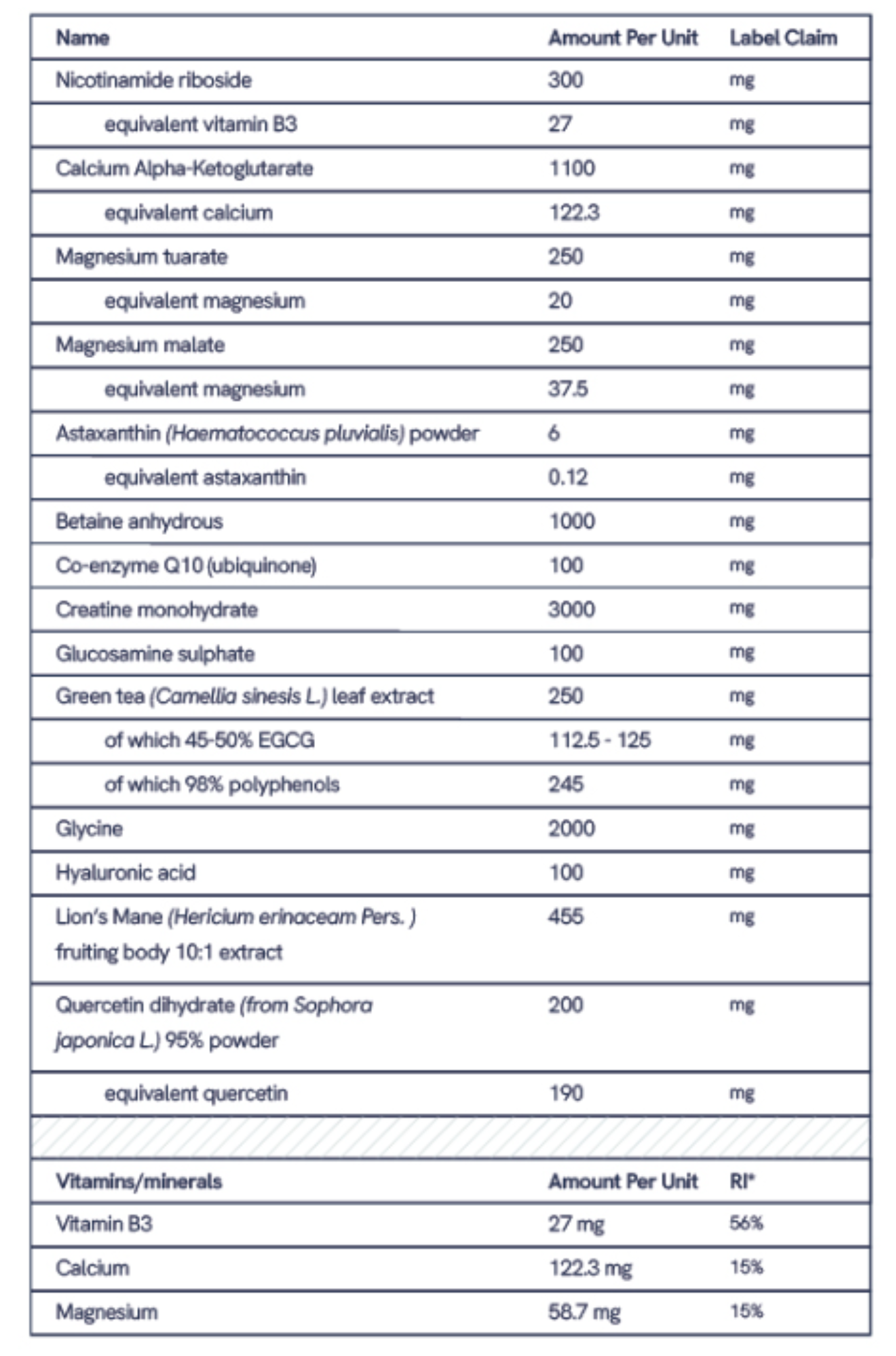
For transparency, Longevity One provides magnesium, vitamins B6, B12 and C, and folate at claim levels, with every dose printed. It contains no iron, on purpose, so if a blood test shows you need iron, your GP will advise a separate source. If you are pregnant or breastfeeding, ask your GP or midwife before taking it. Our guide to reading a supplement label covers what to check on any product, ours included.
Your checklist for a women's energy multivitamin
- Check that the tiredness nutrients reach at least 15% of the NRV per serving.
- Look for every dose printed, with no proprietary blends.
- Find out whether it contains iron, and how much, before you buy.
- Ask your GP for a blood test if you suspect low iron, B12 or vitamin D.
- Check for hidden caffeine, especially in products sold for energy.
- If you are pregnant, planning a pregnancy or breastfeeding, ask your GP or midwife first.
Q&A: Women's Energy Vitamins
What are the best vitamins for women's energy?
The ones with authorised tiredness claims: iron, magnesium, vitamins B6 and B12, folate and vitamin C. Which of them you need depends on your diet and, for iron, a blood test.2
Should I take iron if I feel tired?
Only after a blood test, with your GP deciding the dose.
Why do iron supplements upset my stomach?
Gut side effects are common with ferrous sulfate, roughly doubling the odds compared with placebo in a meta-analysis.3 Your GP or pharmacist can suggest how to take it.
Do vegetarian and vegan women need B12?
Usually yes, from fortified foods or a supplement, because B12 comes almost entirely from animal foods.4
Can a multivitamin help with perimenopause tiredness?
No multivitamin carries a hormone claim. If your energy has changed around perimenopause, talk to your GP or a menopause clinic.
How long does a multivitamin take to work?
The trial in working-age women measured changes after nine weeks, and the effects were modest.1
Frequently Asked Questions
Can I take a multivitamin with my medication?
Ask your GP or pharmacist first and bring the label. Some minerals, iron in particular, interact with common medicines.
Can I take a multivitamin and an iron supplement together?
Ask your pharmacist about timing. Some minerals affect how well others are absorbed, and the right schedule depends on the products.
Will I still need my other supplements?
Compare the labels so you are not doubling up, and keep anything your GP has recommended.
Does a daily powder taste good?
A powder with real doses of minerals and B vitamins tastes of them. Mixing it very cold, or into a smoothie, helps most people.
References
- Haskell CF, Robertson B, Jones E, Forster J, Jones R, Wilde A, Maggini S, Kennedy DO. Effects of a multi-vitamin/mineral supplement on cognitive function and fatigue during extended multi-tasking. Hum Psychopharmacol. 2010;25(6):448-461. View on PubMed
- Tardy AL, Pouteau E, Marquez D, Yilmaz C, Scholey A. Vitamins and minerals for energy, fatigue and cognition: a narrative review of the biochemical and clinical evidence. Nutrients. 2020;12(1):228. View on PubMed
- Tolkien Z, Stecher L, Mander AP, Pereira DI, Powell JJ. Ferrous sulfate supplementation causes significant gastrointestinal side-effects in adults: a systematic review and meta-analysis. PLoS One. 2015;10(2):e0117383. View on PubMed
- Allen LH. How common is vitamin B-12 deficiency? Am J Clin Nutr. 2009;89(2):693S-696S. View on PubMed
- Kennedy DO. B vitamins and the brain: mechanisms, dose and efficacy. A review. Nutrients. 2016;8(2):68. View on PubMed
Disclaimer: Educational content only. Not medical advice. Food supplements should not be used as a substitute for a varied, balanced diet and a healthy lifestyle. If you use medication, consult your doctor.