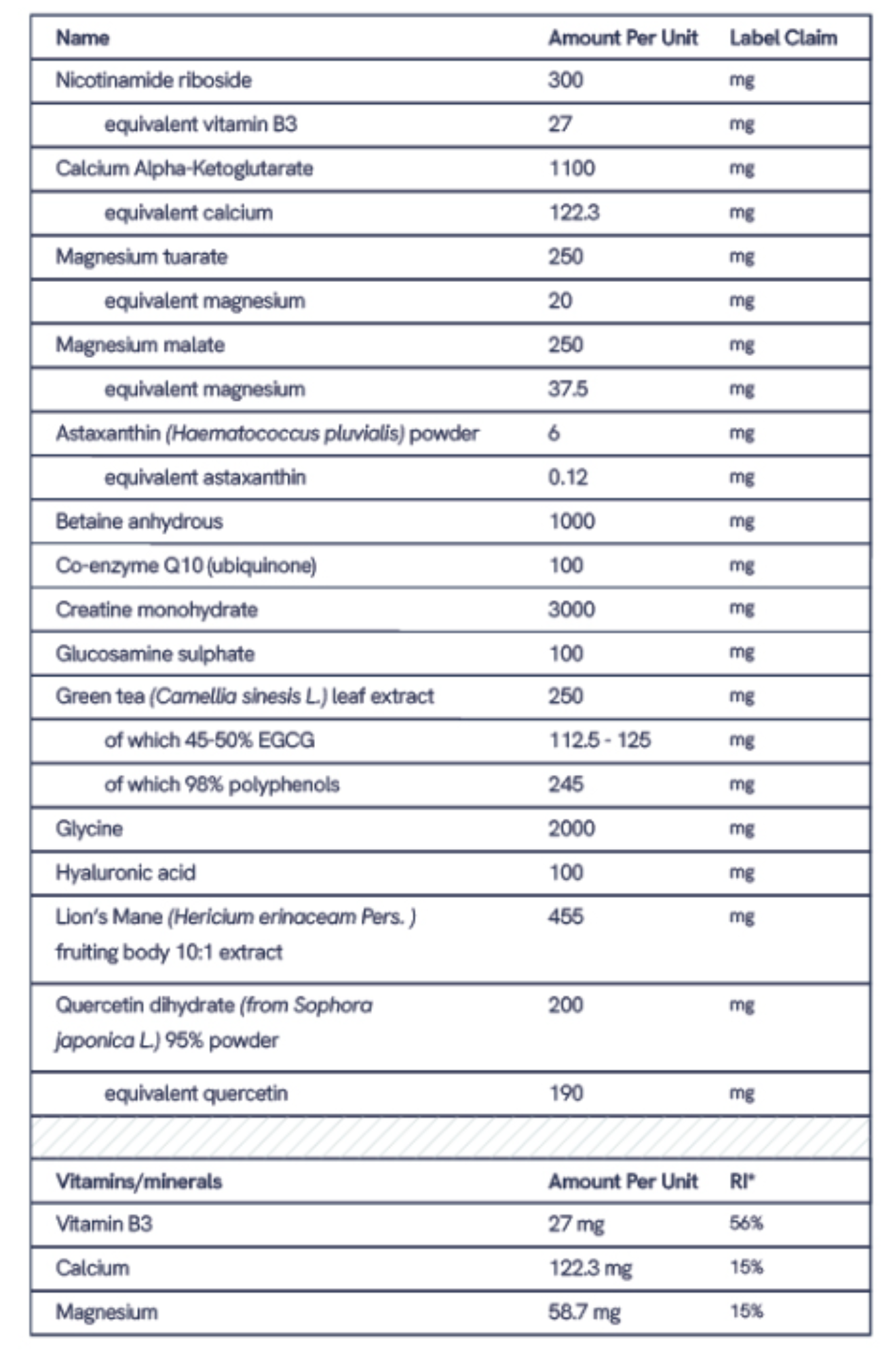
Third-party testing means an independent laboratory verifies a supplement's contents, purity, and safety — entirely separate from the manufacturer. It confirms that what is on the label is what is in the product, screens for contaminants including heavy metals and microbial organisms, and provides an objective quality assurance layer that brand self-testing alone cannot offer. For longevity supplements taken daily over extended periods, this level of transparency is a meaningful marker of quality and consumer respect.
Key Takeaways
- Third-party testing means an accredited laboratory independent of the manufacturer analyses a supplement for identity, potency, purity, and contaminant levels — providing objectivity that in-house quality control cannot replicate.
- Research shows that supplement label accuracy is a genuine industry-wide concern: one study analysing 272 herbal and dietary supplement products found that 51% were mislabelled, with actual chemical contents that did not match the label.1
- Heavy metals including lead, arsenic, cadmium, and mercury can be present in supplement ingredients, particularly botanical and plant-derived products, due to soil absorption during cultivation.2
- Microbial contamination is a documented quality concern in plant-derived dietary supplements, with some product categories showing contamination levels that exceed established safety limits.3
- A Certificate of Analysis (COA) from an accredited laboratory is the primary document consumers should request to verify a brand's quality claims.
- NZVT (Nederlands Zekerheidssysteem Voedingssupplementen Topsport) is a Dutch government-backed certification system that screens supplements for prohibited substances relevant to elite sport, providing confidence for athletes and sport-conscious consumers.
- No single certification covers all quality dimensions simultaneously; understanding what each programme verifies helps consumers make better-informed decisions.
What Third-Party Testing Actually Means
The term "third-party tested" is used widely in the supplement industry, but its meaning is not always made clear. Understanding precisely what independent laboratory testing involves is the first step to evaluating whether a brand's quality claims are substantiated.
Third-party testing refers to laboratory analysis conducted by an organisation that is independent of the supplement manufacturer and independent of the consumer. Because the testing laboratory has no commercial interest in a favourable result, its findings carry a degree of objectivity that in-house quality control cannot replicate. When a brand conducts its own testing, there is an inherent conflict of interest, even when the internal team is diligent. Independent verification removes that conflict.
In practice, third-party laboratory testing of a finished supplement batch typically covers four categories of analysis.
Identity testing confirms that the ingredients listed on the label are actually present in the product. This is particularly important for botanical and herbal ingredients, where species substitution and adulteration are documented concerns in the published literature.4
Potency testing measures whether each ingredient is present at the amount declared on the label. A product may state "500 mg of ingredient X per serving," but the actual quantity could be significantly lower or higher. A review of multi-ingredient pre-workout supplements found that caffeine content ranged from 59% to 176% of packaging claims, a variation that has real implications for users.4
Purity testing screens for unwanted substances including residual solvents from the manufacturing process, pesticide residues from agricultural sourcing, and adulterants — undeclared compounds that may be introduced deliberately or accidentally during production.
Contaminant testing specifically assesses levels of heavy metals (primarily lead, arsenic, cadmium, and mercury) and microbial organisms (bacteria, yeasts, and moulds). These contaminants can be present in raw ingredients before manufacturing even begins, and are not eliminated by standard processing unless specific controls are in place.
What Is a Certificate of Analysis?
A Certificate of Analysis (COA) is the formal document produced when laboratory analysis is complete. It records the analytical results for a specific product batch, including the tests performed, the methodology used, the quantitative results obtained, and the specifications each result was measured against. A COA from an accredited laboratory is the primary quality document a supplement brand can provide to substantiate its testing claims.
When reviewing a COA, the key elements to examine include: the name and accreditation status of the testing laboratory; the batch or lot number the analysis applies to; results for heavy metals expressed in parts per million (ppm) or micrograms per gram compared against established safety limits; potency results expressed as a percentage of the declared label amount; and the date of analysis to confirm the document is current and batch-specific rather than generic.
Brands that make COAs publicly available, or that provide them promptly upon request, demonstrate a commitment to transparency that goes beyond marketing language. A document that shows only "PASS" without underlying numerical data provides substantially less information than a full quantitative report.
Key Certifications and What They Verify
Several recognised certification programmes operate in the supplement quality assurance space. Understanding what each one verifies, and what it does not, helps consumers avoid conflating different types of quality claim.
Eurofins Scientific
Eurofins is one of the world's largest networks of accredited analytical testing laboratories, operating across multiple countries with internationally recognised laboratory accreditation. In the context of dietary supplements, Eurofins testing typically covers chemical analysis including ingredient identity, potency verification, heavy metal screening using inductively coupled plasma mass spectrometry (ICP-MS, widely considered the gold standard method for trace element analysis), pesticide residue quantification, and microbial contamination assessment. When a supplement brand references Eurofins testing, it means the analytical work has been conducted by a globally accredited laboratory operating to rigorous quality standards.
NZVT: Nederlands Zekerheidssysteem Voedingssupplementen Topsport
NZVT stands for Nederlands Zekerheidssysteem Voedingssupplementen Topsport, which translates as the Dutch Assurance System for Dietary Supplements in Elite Sport. It is a Dutch government-supported quality assurance programme developed in collaboration with the Dutch Olympic Committee (NOC*NSF) specifically to protect athletes from inadvertent doping through supplement use.
NZVT-certified products are tested by accredited laboratories against the World Anti-Doping Agency (WADA) prohibited substance list. Products that pass this screening receive NZVT certification, which is recognised by major Dutch and international sporting organisations as meaningful evidence that a supplement does not contain substances that would result in anti-doping rule violations. NZVT certification is particularly relevant for athletes competing under drug-tested conditions, though it also provides a useful general-quality signal for any consumer who wants independently verified assurance that a product contains no undeclared pharmaceutical or prohibited compounds.
It is important to understand that NZVT certification addresses a specific question: the absence of prohibited substances. It does not independently verify ingredient potency or provide comprehensive heavy metal quantification against consumer safety limits in the same way that full analytical COA testing does. The two forms of verification are complementary rather than interchangeable.
NSF International
NSF International is a US-based public health organisation operating the NSF Certified for Sport programme and the NSF/ANSI 173 standard for dietary supplements. NSF Certified for Sport involves testing for substances on major prohibited substance lists, verification of label claims against analytical findings, and assessment of Good Manufacturing Practice (GMP) compliance at the manufacturing facility. NSF certification is widely recognised across professional and elite sporting contexts globally.
USP Verified
The US Pharmacopoeia (USP) operates a voluntary verification programme in which supplement products are tested against USP standards for identity, potency, quality, and purity. Published analyses have illustrated the practical significance of such verification: studies have documented substantial deviations in declared ingredient potency across commercially available supplement brands, with variability falling within acceptable limits consistently only for independently verified products.
Informed Sport
Informed Sport is an internationally recognised anti-doping certification programme, similar in function to NZVT, that screens finished supplement products against the WADA prohibited substance list using batch testing. Informed Sport certification is recognised by professional sporting bodies across numerous countries and provides athletes with an independently substantiated assurance regarding prohibited substance absence.
Why No Single Certification Covers Everything
Each certification programme addresses a defined set of quality questions, and none covers all dimensions simultaneously. Anti-doping certifications such as NZVT and Informed Sport confirm the absence of prohibited substances but are not primarily designed to comprehensively verify ingredient potency or provide full heavy metal quantification against consumer safety thresholds. GMP compliance certifications confirm that manufacturing processes meet quality standards but do not independently test specific finished product batches. Analytical COAs from accredited laboratories like Eurofins provide batch-specific quantitative data but may vary in scope depending on what tests are commissioned. Brands committed to genuine quality transparency typically employ multiple complementary verification approaches, each addressing a different quality dimension, rather than relying on any single certification in isolation.
Contaminants: What Gets Tested and Why It Matters
Understanding which contaminants are tested for, how they enter supplements, and what the evidence says about their relevance to consumer safety gives important context to the value of independent testing.
Heavy Metals
Lead, mercury, cadmium, and arsenic are the four heavy metals of primary concern in dietary supplement quality assessment. These elements occur naturally in soil and water and are absorbed by plants as part of their growth processes. Herbal and botanical supplements therefore carry an inherent potential for heavy metal content that is directly related to the agricultural and environmental conditions under which the source plants were grown. Industrial pollution can further elevate concentrations in certain regions or soil types.
A human health risk assessment examining heavy metal concentrations in protein powder supplements confirmed that multiple exposure routes are real and warrant ongoing monitoring, noting that manufacturing equipment, water used in processing, and raw ingredients themselves can all contribute to metal burden in finished products.2 ICP-MS is the analytical technique of choice for quantifying these elements at trace levels because of its exceptional sensitivity.
The four primary metals each carry distinct health relevance at chronic low-level exposure. Lead is an established neurotoxin with effects on the nervous system and no recognised safe threshold of exposure. Inorganic arsenic is classified as a human carcinogen with documented links to skin, cardiovascular, and other organ systems. Cadmium accumulates in the kidneys over time and is associated with renal function concerns at sustained elevated exposure. Mercury, particularly in the methylmercury form associated with marine-sourced ingredients such as fish oils, affects neurological function. For individuals taking supplements daily over months or years, chronic low-level exposure to these metals is a meaningful consideration that independent testing helps to assess and manage.
Microbial Contamination
Plant-derived dietary supplements are particularly susceptible to microbial contamination due to the natural microbiological environment in which source plants grow. A 2020 review examining the microbiological quality of dietary supplements containing plant-derived ingredients concluded that this product category commonly shows a range of microbial contaminants, and that some products contain microorganisms potentially capable of causing harm in susceptible individuals.3 A further study of herbal supplement bottles found fungal contamination in 37 of 58 bottles tested, with some samples containing multiple microbial species.7
Contamination can occur at multiple stages: during cultivation of source plants, during harvesting, during drying and extraction processing, and during packaging and storage. Moulds are of particular concern because certain fungal species produce mycotoxins — secondary metabolites that can be toxic when consumed and that are not destroyed by standard supplement processing. Routine microbiological testing of finished products is one component of a responsible quality assurance programme, especially for products containing botanical and plant-derived ingredients.
Residual Solvents and Pesticides
Botanical extracts used in supplements are typically produced using solvent-based extraction processes. Residual solvent levels in finished products should comply with internationally accepted limits, which vary by solvent type and regulatory jurisdiction. Similarly, agricultural pesticide use in source plant cultivation can leave residues that become concentrated in herbal extracts. Independent testing can verify that both categories of residue are within acceptable ranges for the intended daily use of the product.
Adulteration and Undeclared Ingredients
Beyond environmental contamination, some supplement categories have documented problems with intentional adulteration — the addition of undeclared pharmaceutical or other substances. An analysis of FDA warning data from 2007 to 2016 identified 776 dietary supplement products containing unapproved pharmaceutical ingredients not disclosed on the label, predominantly in the sexual enhancement, weight loss, and muscle building categories.5
A study using mass spectrometry to analyse 272 herbal and dietary supplement products associated with liver injury cases found that 51% were mislabelled, with chemical contents that did not correspond to label information.1 A separate case series of 30 weight loss supplement products marketed online found that 25 had inaccurate labels, with 80% containing listed ingredients that were not detected upon analysis, and seven containing hidden components not disclosed on the label.6 These figures are associated with higher-risk supplement categories and are not representative of the entire industry. They do, however, illustrate clearly that marketing claims alone cannot be assumed to reflect actual product contents without independent analytical verification.
How The Longevity Store Approaches Quality Verification
The Longevity Store applies a multi-layered approach to quality verification for Longevity Complete, designed to give consumers objective confidence that goes beyond label claims.
Eurofins laboratory testing: Longevity Complete is analytically tested by Eurofins, one of the world's leading accredited laboratory networks. This testing provides batch-specific verification of ingredient identity and potency, and screens for heavy metals and other relevant contaminants using validated ICP-MS and microbiological methods. Results are documented in a Certificate of Analysis covering quantitative data for the specific batch tested.
Certificate of Analysis: A Certificate of Analysis is available for Longevity Complete, providing transparent documentation of the analytical results for each batch produced. This allows any consumer to examine the actual laboratory data underpinning quality claims, rather than relying solely on brand statements.
NZVT certification: Longevity Complete holds NZVT (Nederlands Zekerheidssysteem Voedingssupplementen Topsport) certification, meaning the product has been independently screened by an accredited laboratory against the WADA prohibited substance list under the Dutch government-supported elite sport assurance programme. This is particularly relevant for athletes competing in drug-tested environments, and for any consumer who values the assurance that a product has been independently checked for undeclared prohibited compounds.
These verification steps reflect a principle of transparency as the foundation of product integrity. The aim is not to position one product as superior to another, but to demonstrate that quality assurance statements are substantiated by independently produced evidence. Consumers are encouraged to request comparable documentation from any supplement brand they consider.
How to Evaluate Any Supplement Brand's Quality Claims
When assessing the quality transparency of any longevity supplement, a structured set of questions provides a practical framework.
Is third-party testing documented with named laboratories? References to "independently tested" or "third-party verified" without a named laboratory are difficult to assess. Ask for the name of the testing organisation and confirm it is a genuinely accredited analytical laboratory.
Is a Certificate of Analysis available for the current batch? A COA should include the laboratory name and accreditation details, the specific batch or lot number, the date of analysis, the tests performed with the methods used, and quantitative results compared to defined specifications. A document showing only "PASS" labels without underlying data provides limited information.
Does the testing include heavy metal screening? This is especially important for products containing botanical or marine-sourced ingredients. Results should be expressed quantitatively in ppm or micrograms per gram alongside applicable safety limits, not simply marked as passing or failing.
Is microbial testing included? For plant-derived supplements, microbiological testing is a standard quality expectation. Results should confirm that bacterial and fungal counts are within guideline limits (for example, those published by the World Health Organisation for herbal medicines).
Are label claims verified by potency analysis? Potency testing should confirm that declared ingredient amounts are present within an acceptable tolerance range, typically defined as 90% to 110% of the stated label claim.
Is anti-doping certification relevant to your situation? For athletes or individuals in competitive sport, NZVT, Informed Sport, or NSF Certified for Sport provides meaningful additional assurance regarding prohibited substance absence that standard analytical COA testing does not address in the same way.
Q&A: Third-Party Supplement Testing
What does it mean when a supplement says it is third-party tested?
It means the product has been analysed by a laboratory that is independent of the company that manufactured it. This testing typically verifies that ingredients declared on the label are present at the stated amounts, and screens for contaminants including heavy metals and microbial organisms.4 The scope and quality of third-party testing varies significantly between brands, which is why asking to see a full Certificate of Analysis from a named, accredited laboratory is the most direct way to assess a brand's transparency.
What is a Certificate of Analysis and how do I read one?
A Certificate of Analysis is a document issued by a testing laboratory recording the analytical results for a specific product batch. It should show the laboratory's name and accreditation, the date of testing, the batch or lot number, the tests performed and methods used, and the specific quantitative results. For heavy metals, results are expressed in ppm or micrograms per gram alongside applicable safety limits. For potency, results are expressed as a percentage of the declared label amount, with 90% to 110% being a typical acceptable range. A COA showing only pass/fail designations without underlying numerical data offers substantially less transparency.
Are supplement labels always accurate?
Research demonstrates that label accuracy is a genuine concern across portions of the supplement industry. One study using mass spectrometry to analyse 272 herbal and dietary supplement products found that 51% were mislabelled, meaning their actual contents did not match what the label stated.1 A separate case series of 30 products found that 83% had inaccurate labels.6 Independent analytical testing is the only reliable method for verifying that a product's actual contents correspond to its label claims.
Why are botanical supplements at higher risk of contaminants?
Plants naturally absorb minerals from the soil as they grow, including heavy metals when soil contamination is present. Herbal and botanical supplements therefore carry an inherent potential for heavy metal content that varies with agricultural conditions and the geographical origin of raw materials.2 Microbial contamination is also a documented concern in plant-derived ingredients, as microorganisms are naturally present in the growing environment and can persist through processing.3
What is NZVT certification?
NZVT stands for Nederlands Zekerheidssysteem Voedingssupplementen Topsport — the Dutch Assurance System for Dietary Supplements in Elite Sport. It is a Dutch government-supported certification programme, developed with the Dutch Olympic Committee, that screens supplement products using accredited laboratory testing against the WADA prohibited substance list. Products that pass receive NZVT certification, which is recognised by Dutch and international sporting organisations as meaningful evidence that a supplement does not contain prohibited compounds. It is particularly relevant for athletes in drug-tested competition and for any consumer who values independently verified assurance against undeclared compounds.
What is the difference between NZVT and Eurofins testing?
They address different quality questions. NZVT is an anti-doping certification that screens finished supplement products against the WADA prohibited substance list. It provides assurance that a product does not expose an athlete to banned compounds. Eurofins is an accredited analytical laboratory network that performs broad chemical and microbiological analysis, including ingredient identity verification, potency testing, heavy metal screening, and contaminant identification. Both represent independent third-party verification, but they answer different questions. NZVT confirms absence of prohibited substances; Eurofins COA testing confirms what is present and at what levels.
How do I find a reliable longevity supplement brand?
Look for brands that name the specific accredited laboratories used for testing, make Certificates of Analysis available for specific product batches, and can demonstrate both potency verification and contaminant screening. Brands that reference "third-party testing" without naming the laboratory or providing documentation are difficult to evaluate objectively.5 Certifications from established programmes such as NZVT, Informed Sport, NSF, or Eurofins-accredited analytical testing provide an additional independently substantiated layer of quality assurance.
Does GMP compliance mean a supplement is third-party tested?
Not necessarily. Good Manufacturing Practice compliance confirms that a manufacturer operates its production processes to defined quality standards. It is a process standard, not a product-specific testing standard. A GMP-compliant manufacturer may or may not commission independent testing of each finished product batch. Third-party product testing resulting in a batch-specific Certificate of Analysis is a separate and additional quality step. Both are relevant, but they are not equivalent and should not be conflated when evaluating a brand's transparency claims.
What heavy metals are typically tested for in supplements?
The four primary heavy metals routinely assessed in supplement quality testing are lead, arsenic, cadmium, and mercury.2 These four elements are the most consistently present in supplement ingredients at potentially meaningful levels and have the most established human health relevance at chronic low-level exposure. ICP-MS (inductively coupled plasma mass spectrometry) is the analytical technique most widely used for sensitive, accurate quantification of these elements in supplement matrices.
Frequently Asked Questions
What is third-party testing in supplements?
Third-party testing means an independent laboratory — with no financial connection to the supplement manufacturer — analyses a finished product to verify its identity, potency, purity, and safety. It confirms that the product contains what the label states, at the declared amounts, and is free from contaminants including heavy metals and microbial organisms.4 Independent verification is a more reliable quality signal than brand self-reporting alone because the testing organisation has no commercial stake in the outcome.
How do I find high-quality longevity supplements?
Look for brands that name the specific accredited laboratories used for testing, provide Certificates of Analysis for individual product batches upon request, and can demonstrate that their testing covers potency, heavy metals, and microbial contamination. Quality assurance certifications such as NZVT (Nederlands Zekerheidssysteem Voedingssupplementen Topsport) or Eurofins-accredited analytical testing offer an additional, independently substantiated layer of quality evidence beyond brand self-reporting.
Are longevity supplement brands third-party tested?
Practice varies significantly across the supplement industry. Some brands invest in comprehensive independent testing with publicly available or on-request documentation, while others make general quality claims without specific substantiation. The most direct way to assess any brand's transparency is to ask for their Certificate of Analysis from a named, accredited laboratory for the specific batch of the product you intend to purchase.1
What does NZVT certification mean for a supplement?
NZVT stands for Nederlands Zekerheidssysteem Voedingssupplementen Topsport — the Dutch government-supported quality assurance system for dietary supplements in elite sport. NZVT-certified products have been independently screened by an accredited laboratory against the WADA prohibited substance list. This certification is particularly meaningful for athletes competing under drug-tested conditions, and for any consumer who wants independent assurance that a supplement does not contain undeclared prohibited compounds.
Which longevity supplement brands use natural ingredients?
Many longevity supplement brands include natural and botanically-derived ingredients in their formulations. The question of ingredient source is separate from the question of ingredient quality, safety, and third-party verification. Regardless of whether ingredients are naturally or synthetically derived, what matters most for consumer confidence is whether the finished product has been analytically tested for identity, potency, and contaminants by an accredited independent laboratory with documented, batch-specific results available.
How do I read a Certificate of Analysis?
A COA should clearly show: the name and accreditation details of the testing laboratory; the product name, batch, and lot number; the date of analysis; each test performed with the method used; quantitative results rather than pass/fail only; and the specification or safety limit each result was compared against. For heavy metals, look for results in ppm or micrograms per gram alongside the applicable limit. For potency, look for results as a percentage of the label-declared amount, with 90% to 110% being a generally accepted tolerance range.
References
- Navarro VJ, Barnhart HX, Bonkovsky HL, et al. The Contents of Herbal and Dietary Supplements Implicated in Liver Injury in the United States Are Frequently Mislabeled. Hepatol Commun. 2019;3(6):792-794. doi:10.1002/hep4.1346. View on PubMed ↗
- Bandara SB, Towle KM, Monnot AD. A human health risk assessment of heavy metal ingestion among consumers of protein powder supplements. Toxicol Rep. 2020;7:1255-1262. doi:10.1016/j.toxrep.2020.08.001. View on PubMed ↗
- Ratajczak M, Kaminska D, Swiatly-Blaszkiewicz A, Matysiak J. Quality of Dietary Supplements Containing Plant-Derived Ingredients Reconsidered by Microbiological Approach. Int J Environ Res Public Health. 2020;17(18):6837. doi:10.3390/ijerph17186837. View on PubMed ↗
- Linardon J, Messer M. Prevalence of adulteration in dietary supplements and recommendations for safe supplement practices in sport. Front Sports Act Living. 2023;5:1221500. doi:10.3389/fspor.2023.1221500. View on PubMed ↗
- Cohen PA, Maller G, DeSouza R, Neal-Kababick J. Unapproved Pharmaceutical Ingredients Included in Dietary Supplements Associated With US Food and Drug Administration Warnings. JAMA Netw Open. 2018;1(6):e183326. doi:10.1001/jamanetworkopen.2018.3326. View on PubMed ↗
- Crawford C, Lindsey AT, Avula B, et al. Label Accuracy of Weight Loss Dietary Supplements Marketed Online With Military Discounts. JAMA Netw Open. 2024;7(5):e2410441. doi:10.1001/jamanetworkopen.2024.10441. View on PubMed ↗
- Veatch-Blohm ME, Chicas I, Margolis K, Vanderminden R, Gochie M, Lila K. Screening for consistency and contamination within and between bottles of 29 herbal supplements. PLoS One. 2021;16(11):e0260463. doi:10.1371/journal.pone.0260463. View on PubMed ↗