Read an energy drink label from the back. Find the caffeine in mg per 100 ml and multiply by the can size, then do the same for sugars. Check the vitamins against their % NRV, list every sweetener, and read the warnings. In the EU, drinks above 150 mg caffeine per litre must say "High caffeine content" and give the amount.
Key Takeaways
- In a laboratory analysis of 14 top-selling US products, 5 energy drinks and shots did not state how much caffeine they contained.1
- The 9 products that did state an amount were within 15% of the label.1
- Up to 400 mg of caffeine a day from all sources is not linked to adverse effects in healthy adults.2
- Caffeine six hours before bed cut total sleep by more than an hour in a controlled study, so the time on the clock matters as much as the number on the can.3
- Sugar in a drink did not improve mood and was followed by more fatigue within an hour in a meta-analysis of 31 studies.4
- In a trial that tested ingredients separately, caffeine, not taurine or glucose, explained most of the changes in attention and reaction time.5
The front of an energy drink can is designed to sell. The back is regulated, and that is where the useful information is. Once you know where to look, two minutes with the small print tells you how much caffeine and sugar you are about to drink, whether the vitamins are there in meaningful amounts, and which sweeteners are inside. This guide walks through a typical EU energy drink label line by line. For supplement labels in general, including capsules and powders, see our guide on how to read a supplement label.
What does the front of the can tell you?
Very little that you can check. Words such as "focus", "clean", "natural energy" or "zero" are marketing, not measurements. "Zero" usually means zero sugar, not zero caffeine. "Natural caffeine" is still caffeine. The front may give the can size, which you will need later, and sometimes the caffeine per can. Everything else should be checked against the back. If you want to know how energy drinks differ from coffee and from nutrient drinks in general, our article on how longevity drinks differ from coffee and energy drinks compares the categories.
How do you find the caffeine on an energy drink label?
In the EU, Annex III of Regulation (EU) No 1169/2011 requires a drink with more than 150 mg of caffeine per litre, from whatever source, to carry the statement "High caffeine content. Not recommended for children or pregnant or breast-feeding women", followed by the caffeine content in mg per 100 ml. The number is per 100 ml, not per can, so you need to multiply.
How do you work out caffeine per can?
Take the mg per 100 ml and multiply by the can size in ml, divided by 100. A drink with 32 mg per 100 ml contains 80 mg in a 250 ml can and 160 mg in a 500 ml can. The same drink, the same label line, and twice the caffeine, depending on which size you pick up.
| Label line | 250 ml can | 500 ml can |
|---|---|---|
| Caffeine 32 mg per 100 ml | 80 mg | 160 mg |
| Sugars 11 g per 100 ml | 27.5 g | 55 g |
| Energy 46 kcal per 100 ml | 115 kcal | 230 kcal |
| Vitamin B12 at 50% NRV per 100 ml | 125% NRV | 250% NRV |
That arithmetic matters because labels are not always complete. In a laboratory analysis of 9 top-selling US energy drinks and 5 energy shots, 5 of the 14 products did not state a caffeine amount at all: 3 listed caffeine only as an ingredient and 2 put it inside a proprietary blend.1 The 9 products that did state an amount were within 15% of what the label said.1 If you cannot find a number, you cannot know your dose.
How much caffeine is a sensible daily total?
A systematic review of studies published between 2001 and 2015 concluded that up to 400 mg of caffeine a day is not associated with adverse effects in healthy adults.2 Its funders included food and beverage industry groups. The EFSA opinion on the safety of caffeine reached the same 400 mg figure for healthy adults, and gives lower figures in pregnancy (200 mg a day) and for children and adolescents (3 mg per kg of body weight a day). Coffee, tea and other drinks count towards the same total. People also differ in how they respond, and very high doses mainly add side effects, according to a sports nutrition position stand whose authors include several with supplement industry ties.6
Why does the time you drink it matter?
In a randomised, placebo-controlled study, 400 mg of caffeine taken at bedtime, three hours before or six hours before all disturbed sleep measured at home, and the dose six hours before bed still reduced total sleep by more than an hour.3 A 500 ml can at 4 pm can contain 160 mg, which is less than the trial dose but still a meaningful amount late in the day. Add the time to your label check.
Does the caffeine or the rest of the drink do the work?
Mostly the caffeine. In a randomised, double-blind trial, 48 habitual caffeine users who had gone 24 hours without it received 200 mg caffeine, 2,000 mg taurine, both, or neither, with or without 50 g glucose.5 Caffeine improved attention, working memory and reaction times and reduced fatigue. Taurine and glucose did not explain these changes.5 For daily users, part of the lift is relief from withdrawal symptoms such as tiredness and low alertness that build up after a break from caffeine.7
How do you read sugar and energy on the nutrition table?
Under Articles 30 and 32 of Regulation (EU) No 1169/2011, the nutrition table lists energy, fat, saturates, carbohydrate, sugars, protein and salt, always per 100 ml, and it may also be given per can. Note that "energy" on this table means calories (kcal) and kilojoules (kJ). It is a measure of food energy, not a measure of how energetic you will feel.
Sugars are where most of that energy comes from in a sugared drink. A drink with 11 g of sugars per 100 ml provides 55 g in a 500 ml can. EU labels may also show this as a percentage of the reference intake, which Annex XIII of Regulation (EU) No 1169/2011 sets at 90 g of total sugars a day for an average adult; 55 g is about 61% of it. Sugar does not seem to be the source of the lift either. A meta-analysis of 31 studies with 1,259 participants found that carbohydrate had no positive effect on mood at any time point, and that within the first hour people reported more fatigue and less alertness than with placebo.4
How do you read the vitamins on an energy drink label?
Many energy drinks add niacin, vitamin B6, vitamin B12 and sometimes pantothenic acid or riboflavin. On the label, each appears with an amount and a % NRV (nutrient reference value), again per 100 ml and often per can. For drinks, Annex XIII of Regulation (EU) No 1169/2011 sets the "significant amount" of a vitamin at 7.5% of the NRV per 100 ml, which is the threshold for a nutrition or health claim.
A high % NRV does not mean you will feel the vitamins. These B vitamins work as cofactors in energy metabolism, and a review of B vitamins and the brain explains that the case for extra intake is strongest where your status is low.8 If your diet already covers your needs, more from a can is unlikely to change how alert you feel. Several of these vitamins carry authorised claims: for example, niacin, vitamin B6 and vitamin B12 contribute to normal energy-yielding metabolism. What those claims mean, and what they do not, is the subject of a separate article in this series.

How do you spot the sweeteners and other additives?
The ingredient list runs in descending order of weight, so water and sugar (if present) come first. Sweeteners, acids, colours and preservatives appear by category and then by name or E number, as set out in Regulation (EU) No 1169/2011; the authorised additives and their E numbers are listed in Regulation (EC) No 1333/2008. Sugar-free drinks may use sucralose (E 955), acesulfame K (E 950), aspartame (E 951) or steviol glycosides, sometimes two together. In a crossover trial in 30 healthy men, drinks sweetened with stevia, monk fruit or aspartame avoided the early blood sugar rise caused by a sugar drink.9
Some drinks and powders use sugar alcohols such as erythritol. If added polyols exceed 10%, Annex III of Regulation (EU) No 1169/2011 requires the label to say "excessive consumption may produce laxative effects". In a randomised trial, erythritol at 20 g and 35 g in a drink caused no more gut symptoms than sugar, while xylitol caused more symptoms at lower doses.10 Under the same annex, a drink with aspartame must also state that it contains a source of phenylalanine.
You will also see taurine, glucuronolactone, inositol, L-carnitine and plant extracts such as guarana or ginseng. Guarana extract contains caffeine, although in one human trial its effects could not be explained by caffeine alone.11 Check whether the stated caffeine total includes it. Taurine at 2,000 mg did not explain the performance changes in the ingredient trial above.5
What do the warnings and small print mean?
- "High caffeine content. Not recommended for children or pregnant or breast-feeding women (xx mg/100 ml)": required above 150 mg per litre by Annex III of Regulation (EU) No 1169/2011.
- "Contains a source of phenylalanine": required when aspartame is used.
- "Excessive consumption may produce laxative effects": required when added polyols exceed 10%.
- Advice not to exceed a number of cans a day, or not to mix with alcohol: voluntary on many cans, and worth following.
- Best before date and storage instructions: the stated amounts apply within the date and under the stated storage conditions.
What can the health claims on the can say?
Under Regulation (EC) No 1924/2006, claims on EU labels must use authorised wording for a named nutrient, such as "vitamin B12 contributes to the reduction of tiredness and fatigue", and only when that nutrient is present in a significant amount. A claim describes a normal function the vitamin contributes to; it does not promise you more energy than you have now. Plant extracts and taurine have no authorised claims in the EU register, Regulation (EU) No 432/2012. If the can promises sharper focus or more energy for a set number of hours, that is not authorised wording. Our separate article on energy release claims, in this series, explains these phrases in detail.
A one-minute energy drink label check
- Find the can size in ml.
- Find caffeine in mg per 100 ml and multiply to get mg per can. No number means no way to know.1
- Add it to your other caffeine for the day and keep the total within 400 mg.2
- Check the time. Leave at least six hours before bed.3
- Find sugars per 100 ml and per can, and compare with the 90 g a day reference intake.
- Check vitamins for amount and % NRV, and ask whether you need them.8
- List every sweetener, and look for the polyol and phenylalanine statements.10
- Read the claims. Authorised wording names a nutrient and a normal function, nothing more.
How our own formula fits
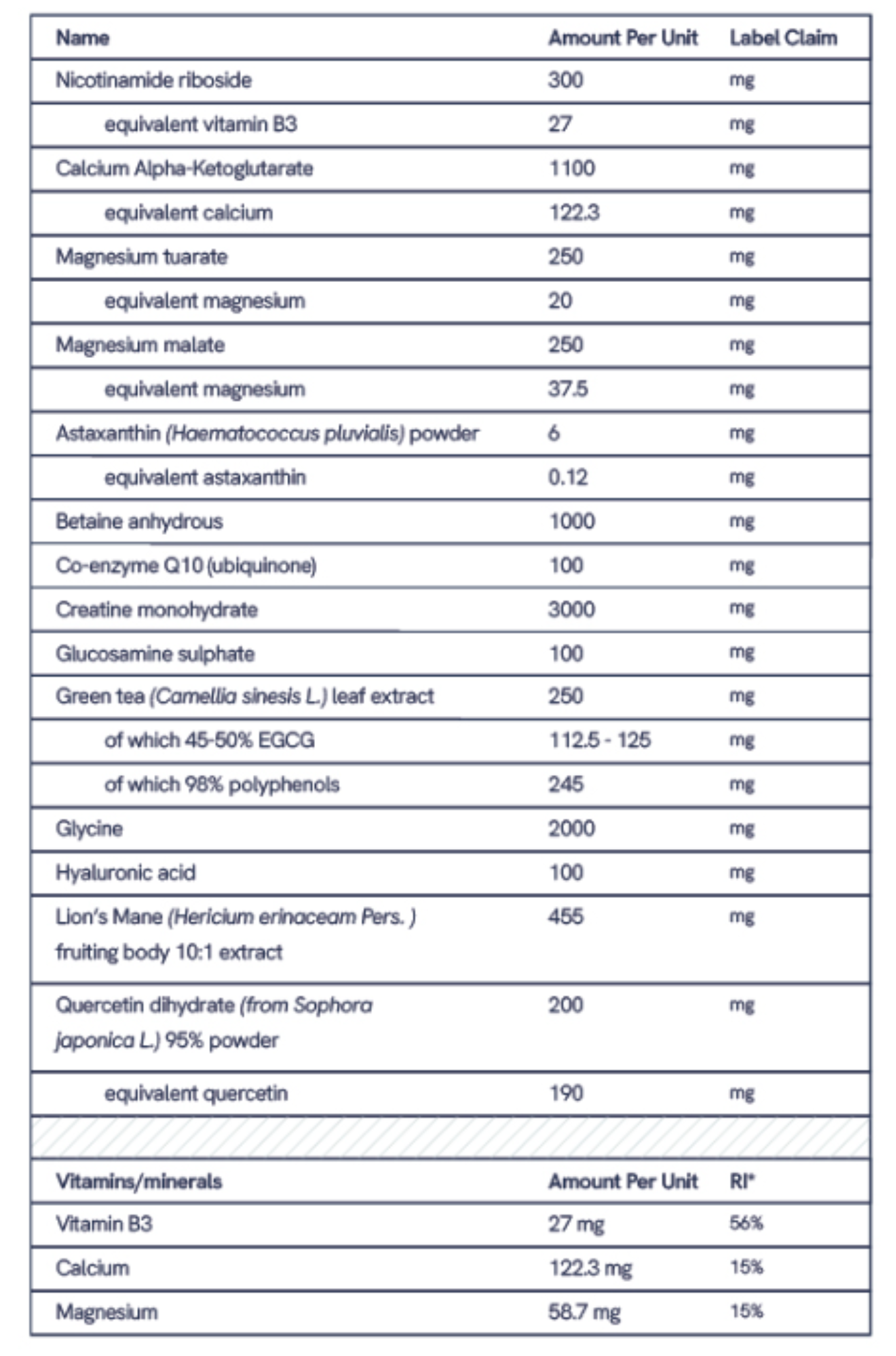
For transparency, Longevity One is not an energy drink. It is a daily drink powder with no caffeine and no caffeine source, mixed in 250 to 500 ml of water once a day. Its label prints every dose with its % NRV, and it carries authorised claims only for nutrients present at 15% of the reference intake or more per serving, the significant amount for products other than drinks in Annex XIII of Regulation (EU) No 1169/2011. For example, niacin, vitamin B6, folate, vitamin B12 and vitamin C contribute to the reduction of tiredness and fatigue. Magnesium contributes to a reduction of tiredness and fatigue. It is independently tested by Eurofins and NZVT certified, with every batch screened; our article on third-party testing explains what that involves.
If you find you need an energy drink most days to get through work, or your tiredness is new, severe or has lasted for weeks, talk to your GP. The label can tell you what is in the can, but not why you are tired.
Q&A: Energy Drink Labels
How do I find the caffeine content on an energy drink?
Look for the "High caffeine content" statement, which gives mg per 100 ml, or a caffeine line near the nutrition table. Multiply by the can size in ml and divide by 100. Some products give no amount at all; in one analysis of US products, 5 of 14 did not.1
Is the caffeine on an energy drink label accurate?
In a laboratory analysis, the products that stated an amount were within 15% of the label.1 Products that listed caffeine only as an ingredient or in a blend could not be checked. A stated number is better than none.
How much caffeine is in a 500 ml energy drink?
It depends on the mg per 100 ml. At 32 mg per 100 ml, a 500 ml can contains 160 mg. Up to 400 mg a day from all sources is not linked to adverse effects in healthy adults.2
What does "energy" mean on the nutrition table?
It means food energy in kcal and kJ, mostly from sugar in a sugared drink. It is not a measure of alertness. Sugar itself was followed by more fatigue within an hour in a meta-analysis.4
How much sugar is too much in an energy drink?
The EU reference intake for total sugars, set in Annex XIII of Regulation (EU) No 1169/2011, is 90 g a day for an average adult. A 500 ml can at 11 g per 100 ml provides 55 g, about 61% of that. Sugar did not improve mood in a meta-analysis of 31 studies.4
What does % NRV mean on an energy drink?
It is the share of the nutrient reference value in the stated amount, per 100 ml or per can. A high % NRV matters most if your intake of that vitamin is low.8 It does not tell you how you will feel.
Are the vitamins in energy drinks useful?
Niacin, vitamin B6 and vitamin B12 contribute to normal energy-yielding metabolism. The benefit of extra intake is clearest where status is low.8 In a well-fed adult, the caffeine explains most of the felt effect.5 Check the % NRV, then ask whether your diet already covers it.
Does taurine on the label do anything?
In a randomised trial, 2,000 mg of taurine did not explain the attention and reaction time changes seen with energy drink ingredients.5 Caffeine did. Taurine has no authorised health claim in Regulation (EU) No 432/2012.
Which sweeteners should I look for on the label?
You may see sucralose (E 955), acesulfame K (E 950), aspartame (E 951) and steviol glycosides, with E numbers as listed in Regulation (EC) No 1333/2008. In one trial, drinks with stevia, monk fruit or aspartame avoided the early blood sugar rise of a sugar drink.9 Sugar alcohols carry a laxative warning above 10%, under Annex III of Regulation (EU) No 1169/2011.
Why do labels show amounts per 100 ml?
Article 32 of Regulation (EU) No 1169/2011 requires the nutrition table per 100 ml, so you can compare products of different sizes. Per-can amounts are optional. Multiplying by the can size gives your actual intake. For caffeine that only works if an amount is stated, and 5 of 14 US products in one analysis did not state one.1
Frequently Asked Questions
Can I drink energy drinks if I take medication?
Ask your GP or pharmacist first and bring the can. The label of Longevity One advises consulting your doctor if you use medication. If you are pregnant or breastfeeding, the label already advises against high-caffeine drinks; ask your midwife or GP.
Is a sugar-free energy drink better?
It removes the sugar, and sweetened drinks avoided the early blood sugar rise of a sugar drink in one trial.9 The caffeine is usually the same, so check the mg per can either way.
What does Longevity One taste like, and does it have a caffeine warning?
It has a mango and pineapple flavour; mix one scoop in 250 to 500 ml of water, or into a smoothie or yogurt. It has no caffeine warning because it contains no caffeine. Like the vitamins on an energy drink label, its nutrients matter most where intake falls short.8
Why can I not find the caffeine amount on some cans?
Some products list caffeine only as an ingredient or hide it in a proprietary blend.1 Choose products that state mg per serving.
When should I talk to a doctor about needing energy drinks?
If you rely on them most days, or your tiredness is new, severe or has lasted for weeks, see your GP. A label cannot tell you why you are tired.
References
- Attipoe S, Leggit J, Deuster PA. Caffeine content in popular energy drinks and energy shots. Mil Med. 2016;181(9):1016-1020. View on PubMed ↗
- Wikoff D, Welsh BT, Henderson R, Brorby GP, Britt J, Myers E, et al. Systematic review of the potential adverse effects of caffeine consumption in healthy adults, pregnant women, adolescents, and children. Food Chem Toxicol. 2017;109(Pt 1):585-648. View on PubMed ↗
- Drake C, Roehrs T, Shambroom J, Roth T. Caffeine effects on sleep taken 0, 3, or 6 hours before going to bed. J Clin Sleep Med. 2013;9(11):1195-1200. View on PubMed ↗
- Mantantzis K, Schlaghecken F, Sünram-Lea SI, Maylor EA. Sugar rush or sugar crash? A meta-analysis of carbohydrate effects on mood. Neurosci Biobehav Rev. 2019;101:45-67. View on PubMed ↗
- Giles GE, Mahoney CR, Brunyé TT, Gardony AL, Taylor HA, Kanarek RB. Differential cognitive effects of energy drink ingredients: caffeine, taurine, and glucose. Pharmacol Biochem Behav. 2012;102(4):569-577. View on PubMed ↗
- Guest NS, VanDusseldorp TA, Nelson MT, Grgic J, Schoenfeld BJ, Jenkins NDM, et al. International society of sports nutrition position stand: caffeine and exercise performance. J Int Soc Sports Nutr. 2021;18(1):1. View on PubMed ↗
- Juliano LM, Griffiths RR. A critical review of caffeine withdrawal: empirical validation of symptoms and signs, incidence, severity, and associated features. Psychopharmacology (Berl). 2004;176(1):1-29. View on PubMed ↗
- Kennedy DO. B vitamins and the brain: mechanisms, dose and efficacy. A review. Nutrients. 2016;8(2):68. View on PubMed ↗
- Tey SL, Salleh NB, Henry J, Forde CG. Effects of aspartame-, monk fruit-, stevia- and sucrose-sweetened beverages on postprandial glucose, insulin and energy intake. Int J Obes (Lond). 2017;41(3):450-457. View on PubMed ↗
- Storey D, Lee A, Bornet F, Brouns F. Gastrointestinal tolerance of erythritol and xylitol ingested in a liquid. Eur J Clin Nutr. 2007;61(3):349-354. View on PubMed ↗
- Haskell CF, Kennedy DO, Wesnes KA, Milne AL, Scholey AB. A double-blind, placebo-controlled, multi-dose evaluation of the acute behavioural effects of guaraná in humans. J Psychopharmacol. 2007;21(1):65-70. View on PubMed ↗
Disclaimer: Educational content only. Not medical advice. Food supplements should not be used as a substitute for a varied, balanced diet and a healthy lifestyle. If you use medication, consult your doctor.