An EU organic logo on an energy drink means at least 95% of its farmed ingredients are certified organic, with limits on additives. It does not cap caffeine or sugar, and systematic reviews find little difference in nutrient content between organic and conventional foods. 'Natural' has no legal definition on a drink, so check caffeine, sugars and ingredients.
Key Takeaways
- A systematic review of 240 studies found no strong evidence that organic foods are more nutritious than conventional foods.1
- The risk of detectable pesticide residues was 30 percentage points lower in organic produce, though differences in exceeding legal limits were small.1
- A separate review of 55 good-quality studies found no evidence of a difference in nutrient quality between organic and conventional crops.2
- In a trial that tested energy drink ingredients separately, caffeine explained most of the short-term effect; a guarana trial suggested its effects may not be caffeine alone.3,4
- Sugar from fruit juice is still sugar, and sugar drinks were followed by more fatigue within an hour in a meta-analysis of 31 studies.5
- An EU warning on six artificial colours followed a randomised trial in nearly 300 children.6
A growing part of the energy drink shelf is organic, 'natural' or 'plant-powered'. The cans look different: matte colours, leaf symbols, words like guarana, green tea and fruit juice. The question for a label reader is what has actually changed inside. Below: what the EU organic logo certifies, what 'natural' does and does not mean, and how sugar, juice, plant extracts, colours and preservatives differ in these drinks. For a broader comparison of energy drinks with coffee and nutrient drinks, see how longevity drinks differ from coffee and energy drinks.
What does the EU organic logo on an energy drink mean?
The EU organic logo, the green leaf made of stars, can only appear on a product that meets the EU organic regulation, Regulation (EU) 2018/848, and is checked by a control body. Under Article 32, the label must also show the control body code and, in the same visual field as the logo, where the farmed ingredients came from: 'EU Agriculture', 'non-EU Agriculture' or 'EU/non-EU Agriculture'. Those details mean an inspector has checked the supply chain.
Under Article 30 of Regulation (EU) 2018/848, a processed food can be sold as organic only if at least 95% of its agricultural ingredients by weight are organic. Added water and salt are not taken into account when judging whether a product is made mainly from agricultural ingredients, so a drink that is mostly water can still be organic. The same regulation excludes genetically modified organisms and ionising radiation, limits pesticides, fertilisers and other external inputs to authorised products, and lets processed organic foods use only a limited list of additives and processing aids.
| On the label | What it confirms | What it does not tell you |
|---|---|---|
| EU organic logo | At least 95% of farmed ingredients organic; inspected supply chain | Less sugar, less caffeine or fewer calories |
| 'Natural' or 'naturally sourced' | Nothing defined in law for the whole drink | Any specific standard |
| 'Natural flavouring' | Flavouring from a natural source, under EU flavouring rules | That the drink tastes of the named fruit |
| 'Natural caffeine' or guarana | Caffeine from a plant source | How much caffeine is in the can |
| 'Sweetened with fruit juice' | Sugar from fruit rather than added sugar | Less sugar overall5 |
What organic rules mean for caffeine and vitamins
Under Annex II of Regulation (EU) 2018/848, added vitamins and minerals are allowed in organic processed food only where their use is directly legally required, so an organic energy drink is unlikely to list many added vitamins. Check the label for the caffeine source, such as coffee, green tea, yerba mate or guarana, and for the amount in mg. A separate article in this series covers the caffeine source in detail.
Is an organic energy drink more nutritious?
On the evidence, not in a way you would notice. A systematic review from Stanford compared organic and conventional foods in 17 studies in people and 223 studies of nutrient and contaminant levels in foods.1 It found no strong evidence that organic foods are significantly more nutritious. The only nutrient that was consistently higher in organic produce was phosphorus, and the difference was too small to matter. Studies of nutrient levels in blood, urine and other samples in adults did not find meaningful differences.1
An earlier systematic review from the London School of Hygiene and Tropical Medicine reached a similar conclusion.2 Of 162 studies identified over 50 years, 55 were of satisfactory quality. In those, conventional crops had more nitrogen, and organic crops had more phosphorus and higher acidity. For the other 8 of 11 nutrient categories, there was no evidence of a difference.2 An energy drink is mostly water, sugar or sweetener, caffeine and flavour, so whatever small differences exist in the raw crops are diluted further in the can. The farming method matters more for how the ingredients were grown than for what you get from drinking them.
Does organic mean fewer pesticide residues?
This is the clearest difference. In the Stanford review, the risk of detectable pesticide residues was 30 percentage points lower in organic than in conventional produce.1 Differences in the risk of exceeding legal maximum limits were small, because most conventional produce also stays within them. Two studies found lower pesticide levels in the urine of children eating organic diets.1 For a drink, the farmed ingredients are things like juice, tea, guarana and sugar cane, so the logo tells you about how those were grown. If you want less pesticide exposure, organic is a reasonable choice. Just know that you are choosing a farming method, and the logo says nothing about energy. Our non-toxic home guide covers everyday exposures more broadly.
What does 'natural' mean on an energy drink?
Legally, very little for the drink as a whole. There is no EU definition of a 'natural' drink. The word is controlled for flavourings under Article 16 of Regulation (EC) No 1334/2008: a 'natural flavouring' may contain only flavouring preparations or natural flavouring substances, and 'natural lemon flavouring' must be obtained at least 95% by weight from lemon. Beyond that, 'natural energy', 'naturally sourced' or 'made with natural ingredients' are marketing phrases. A drink can be called natural and still contain 40 g of sugar from juice, 150 mg of caffeine from guarana, and citric acid made by fermentation.
Natural caffeine sources
Many natural or organic energy drinks get caffeine from guarana, green tea, yerba mate or green coffee extract. Guarana seeds contain caffeine. In a double-blind, placebo-controlled trial, 26 adults took a standardised guarana extract at 37.5, 75, 150 or 300 mg; the lower doses gave more positive results on memory tasks and mood ratings than the higher ones, and the authors concluded that the effects cannot be attributed to caffeine alone.4 In a separate trial that tested energy drink ingredients one by one, caffeine, not taurine or glucose, explained the changes in attention and reaction time.3 The total in mg per can is what matters, and healthy adults can stay within 400 mg a day from all sources.7 That review was funded through an industry-supported scientific body; the EFSA scientific opinion on the safety of caffeine gives the same 400 mg figure.
Sugar and fruit juice: is natural sugar better?
Organic and natural energy drinks often use cane sugar, agave syrup or fruit juice instead of glucose syrup, or combine juice with stevia. 'No added sugar' can still mean a lot of sugar if the drink is made with juice, and the WHO guideline on sugars intake counts sugars naturally present in fruit juice as free sugars, like added sugar. The nutrition table shows total sugars per 100 ml whatever the source.
The source of the sugar does not change what it does to how you feel. A meta-analysis of 31 studies with 1,259 participants found that carbohydrate had no positive effect on any aspect of mood, and that within the first hour people reported more fatigue and less alertness than with placebo.5 Drinks sweetened with stevia or monk fruit, both plant-derived, avoid the early blood sugar rise that a sugar drink causes, according to a crossover trial in 30 healthy men, although glucose and insulin were higher after the next meal and the total response over three hours was similar.8 A plant-derived sweetener is still a purified extract, not a leaf or a fruit.

Plant extracts: what are they doing in the can?
Natural energy drinks often list ginseng, ashwagandha, rhodiola, maca, matcha or lion's mane. Some add these at meaningful amounts, others at levels closer to flavouring. None of these plants appears with an energy or focus claim in the EU list of authorised claims, Regulation (EU) No 432/2012, so the can cannot state that they give energy or improve focus. Of the plants commonly listed, matcha and other tea, coffee, guarana and yerba mate are the ones that supply caffeine. When an extract appears without an amount, you cannot tell how much is in the drink.
Colours and preservatives: what changes in natural drinks?
Many natural and organic drinks avoid artificial colours and use 'colouring foods' instead: concentrates of carrot, beetroot, spirulina or fruit, listed by name rather than as an E number. Some also avoid preservatives such as sodium benzoate and potassium sorbate, relying on pasteurisation or acidity instead.
There is a regulatory reason behind part of this trend. In a randomised, double-blind, placebo-controlled trial in Southampton, 153 three-year-olds and 144 eight- and nine-year-olds drank juice containing sodium benzoate and one of two mixes of artificial colours, or a placebo drink.6 Both mixes increased an overall hyperactivity score in the older children, and one mix did so in the younger ones; the effects were small.6 Following this work, foods and drinks in the EU that contain any of six specific colours must carry the statement 'may have an adverse effect on activity and attention in children', under Annex V of Regulation (EC) No 1333/2008. Energy drinks are not intended for children in any case, but the warning explains why many brands now avoid those colours.
So is an organic or natural energy drink better?
Only on some counts. If you care about farming methods and lower pesticide residues, an organic logo is a real, inspected standard, and organic produce is less likely to carry detectable residues.1 On nutrients, the evidence does not support a meaningful difference.2 For a gentler drink, the logo tells you nothing about caffeine or sugar, so you have to read those numbers yourself. And 'natural' on its own tells you almost nothing.
How do you compare organic and natural energy drinks?
- Look for the EU organic logo with a control body code. Without them, "organic" on the front is not a certification.
- Find caffeine in mg per can, whatever the source, and count it towards a daily total within 400 mg.7
- Read total sugars per 100 ml and per can. Juice sugars count.5
- Check whether plant extracts have stated amounts.
- Check colours: colouring foods are listed by name, additive colours by name or E number.
- Note the time of day. Caffeine late in the day affects sleep whatever its source.9
Our general guide to reading a supplement label covers doses, forms and red flags in more depth.
How our own formula fits
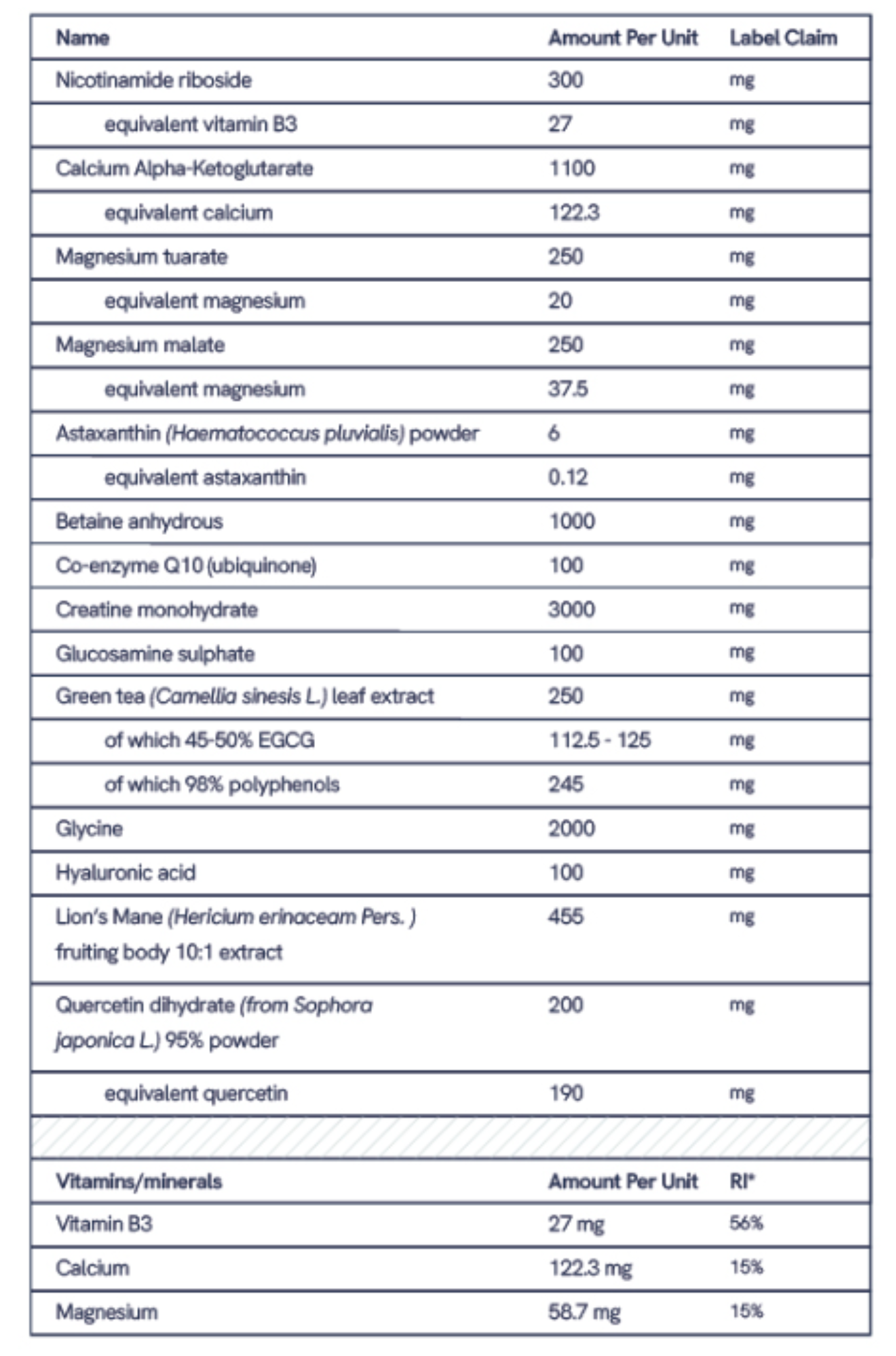
For transparency, Longevity One is not an energy drink and this article makes no organic or natural claim for it. It is a daily drink powder with no caffeine and no caffeine source, every dose printed on the label, mixed into 250 to 500 ml of water once a day. Niacin, vitamin B6, folate, vitamin B12 and vitamin C contribute to the reduction of tiredness and fatigue. Magnesium contributes to a reduction of tiredness and fatigue. These nutrients matter most where your intake falls short.10 It is independently tested by Eurofins and NZVT certified, with every batch screened, which is a different kind of check from an organic logo: it looks at what is in the finished product rather than how the ingredients were farmed.
If you feel tired most days for weeks, or the tiredness is new or severe, see your GP rather than switching drinks.
Q&A: Organic and Natural Energy Drinks
Are organic energy drinks healthier?
They are made with organically farmed ingredients and inspected against EU rules. Systematic reviews have not found meaningful differences in nutrient content between organic and conventional foods.1,2 The caffeine and sugar on the label matter more for how the drink affects you.
What does the EU organic logo mean on an energy drink?
Under Regulation (EU) 2018/848, at least 95% of the farmed ingredients are organic, the supply chain is inspected, and only a limited list of additives is allowed. It does not limit caffeine or sugar. Organic produce is less likely to carry detectable pesticide residues.1
Is 'natural' caffeine better than synthetic caffeine?
The caffeine molecule is the same whatever its source. Guarana extracts also contain other compounds, and one trial concluded that guarana's effects cannot be attributed to caffeine alone.4 The amount in mg per can is the number to check.
Do organic energy drinks have less caffeine?
Not necessarily. Organic rules govern how ingredients are farmed, not how much caffeine a drink contains. Keep total caffeine within 400 mg a day for healthy adults.7
Is fruit juice sugar better than added sugar in an energy drink?
Not for how you feel. A meta-analysis found sugar was followed by more fatigue and less alertness within an hour, whatever the drink.5 Juice sugars count towards total sugars on the label.
Are stevia-sweetened natural drinks better than sugared ones?
They avoid the early blood sugar rise of a sugar drink, though the total response over three hours was similar in a crossover trial.8 Stevia is plant-derived but is a purified extract. Taste is a fair reason to choose either.
Do natural energy drinks use artificial colours?
Many use colouring foods such as carrot or beetroot concentrate instead. Six artificial colours carry an EU warning that followed a trial in children.6 Check the ingredient list either way.
Do plant extracts like ginseng give energy?
No plant extract appears with an energy claim in Regulation (EU) No 432/2012. In a trial that tested energy drink ingredients separately, caffeine explained the changes in attention and reaction time.3 Look for stated amounts.
Does organic mean pesticide-free?
Not entirely. The risk of detectable residues was 30 percentage points lower in organic than in conventional produce.1 Most conventional produce also stays within legal limits.
Frequently Asked Questions
Can I drink organic or natural energy drinks if I take medication?
Ask your GP or pharmacist first and bring the can. If you are pregnant or breastfeeding, ask your midwife or GP.
Is "organic" on the front of the can enough?
No. Look for the EU organic logo with a control body code. The logo is the inspected standard; organic produce under it is less likely to carry detectable pesticide residues.1
What does Longevity One taste like?
It has a mango and pineapple flavour. Mix one level scoop in 250 to 500 ml of water, or into a smoothie or yogurt. Its nutrients work over time where intake falls short, not as a quick lift.10
Are natural energy drinks safe every day?
For healthy adults, total caffeine up to 400 mg a day from all sources is not linked to adverse effects.7 Watch the sugars line too, especially in juice-based drinks.
When should I see a doctor about tiredness?
If you feel tired most days for several weeks, or the tiredness is new or severe, see your GP. Changing drinks will not explain the cause.
References
- Smith-Spangler C, Brandeau ML, Hunter GE, Bavinger JC, Pearson M, Eschbach PJ, et al. Are organic foods safer or healthier than conventional alternatives?: a systematic review. Ann Intern Med. 2012;157(5):348-366. View on PubMed ↗
- Dangour AD, Dodhia SK, Hayter A, Allen E, Lock K, Uauy R. Nutritional quality of organic foods: a systematic review. Am J Clin Nutr. 2009;90(3):680-685. View on PubMed ↗
- Giles GE, Mahoney CR, Brunyé TT, Gardony AL, Taylor HA, Kanarek RB. Differential cognitive effects of energy drink ingredients: caffeine, taurine, and glucose. Pharmacol Biochem Behav. 2012;102(4):569-577. View on PubMed ↗
- Haskell CF, Kennedy DO, Wesnes KA, Milne AL, Scholey AB. A double-blind, placebo-controlled, multi-dose evaluation of the acute behavioural effects of guaraná in humans. J Psychopharmacol. 2007;21(1):65-70. View on PubMed ↗
- Mantantzis K, Schlaghecken F, Sünram-Lea SI, Maylor EA. Sugar rush or sugar crash? A meta-analysis of carbohydrate effects on mood. Neurosci Biobehav Rev. 2019;101:45-67. View on PubMed ↗
- McCann D, Barrett A, Cooper A, Crumpler D, Dalen L, Grimshaw K, et al. Food additives and hyperactive behaviour in 3-year-old and 8/9-year-old children in the community: a randomised, double-blinded, placebo-controlled trial. Lancet. 2007;370(9598):1560-1567. View on PubMed ↗
- Wikoff D, Welsh BT, Henderson R, Brorby GP, Britt J, Myers E, et al. Systematic review of the potential adverse effects of caffeine consumption in healthy adults, pregnant women, adolescents, and children. Food Chem Toxicol. 2017;109(Pt 1):585-648. View on PubMed ↗
- Tey SL, Salleh NB, Henry J, Forde CG. Effects of aspartame-, monk fruit-, stevia- and sucrose-sweetened beverages on postprandial glucose, insulin and energy intake. Int J Obes (Lond). 2017;41(3):450-457. View on PubMed ↗
- Drake C, Roehrs T, Shambroom J, Roth T. Caffeine effects on sleep taken 0, 3, or 6 hours before going to bed. J Clin Sleep Med. 2013;9(11):1195-1200. View on PubMed ↗
- Kennedy DO. B vitamins and the brain: mechanisms, dose and efficacy. A review. Nutrients. 2016;8(2):68. View on PubMed ↗
Disclaimer: Educational content only. Not medical advice. Food supplements should not be used as a substitute for a varied, balanced diet and a healthy lifestyle. If you use medication, consult your doctor.