Most adults need about 4 micrograms of vitamin B12 a day, according to EFSA, and the EU label reference is 2.5 micrograms. If your levels are fine, taking more is unlikely to make you feel more energetic. Plant-based eaters usually need a regular supplement or fortified foods, and adults over 50 absorb B12 from food less well. If you are often tired, ask your GP for a test first.
Key Takeaways
- EFSA set an adequate intake of 4 micrograms of vitamin B12 a day for adults; typical intakes in several EU countries range from 4.2 to 8.6 micrograms.1
- The body absorbs only about 1.5 to 2 micrograms of B12 per meal through its main route, so absorption falls as the dose per meal rises.2
- Doubling B12 intake raised blood B12 by about 11% in a dose-response meta-analysis, so large doses give diminishing returns.3
- Vegans who do not supplement are at especially high risk of low B12; in one trial, 50 micrograms a day restored adequate levels in vegans and vegetarians with marginal status.4,5
- In older people with mild deficiency, much higher oral doses were needed: 647 to 1,032 micrograms a day, which is a GP-led decision.6
- Extra B12 has not been shown to change cognitive function or mood in people without a clear deficiency.7
B12 is the vitamin people most often reach for when they feel tired, and supplement labels give little guidance on how much makes sense. One product offers 2.5 micrograms, the next 1,000. Our guide to B vitamins and energy metabolism explains what B12 does in the body. This article answers the narrower question: how much should you actually take, and when does the answer change?
How much B12 do you need each day?
Less than most supplements contain. In its 2015 review of dietary reference values, EFSA looked at four markers of B12 status together: serum B12, holotranscobalamin, methylmalonic acid and homocysteine. It found consistent evidence that an intake of 4 micrograms a day or more was associated with all four markers in the healthy range in adults, and set an adequate intake of 4 micrograms a day.1 EFSA noted that mean intakes in several EU countries ranged from 4.2 to 8.6 micrograms a day, so many people who eat animal foods already meet it from their diet. For pregnancy and breastfeeding, EFSA proposed 4.5 and 5 micrograms a day.1
You will also see a different number on labels. The nutrient reference value (NRV) used for EU labelling is 2.5 micrograms, and 15% of that, about 0.38 micrograms per daily serving, counts as a significant amount, both set in Regulation (EU) No 1169/2011 (Annex XIII). That threshold is what B12's authorised claims rest on. Those claims are: vitamin B12 contributes to the reduction of tiredness and fatigue, and vitamin B12 contributes to normal energy-yielding metabolism. The NRV is a labelling reference, not a personal target, which is why it sits below EFSA's adequate intake.
Why do supplements contain so much more than that?
Because of how B12 is absorbed. Most B12 is taken up through a carrier system that depends on a protein called intrinsic factor.2 This route is efficient but has a ceiling: it is estimated to be saturated at about 1.5 to 2 micrograms per meal, so the share of B12 you absorb falls as the amount per meal rises.2 High-dose supplements work around that ceiling with sheer quantity: oral doses in the hundreds of micrograms or more can still correct low levels, as trials in older people have shown.6
How much B12 do you absorb from food?
It depends on the food. In healthy people, average absorption has been measured at 42% for fish, 56% to 89% for sheep meat and 61% to 66% for chicken, while B12 in eggs seems to be poorly absorbed, at under 9%.2 Dietary reference values in some countries assume that adults absorb about half of the B12 in a mixed diet.2 Spreading B12 across meals, from food or a modest supplement, makes better use of the intrinsic factor route than one large dose.
What happens to your levels when you take more?
They rise, but slowly. A systematic review with dose-response meta-analyses pooled randomised trials and observational studies in healthy adults and older people. Across all studies, doubling B12 intake increased blood B12 concentrations by 11%, and lowered methylmalonic acid, a marker of how well cells use B12, by 7%.3 The increase was a little larger in older people (13%) than in younger adults (8%).3 In practical terms, going from 5 to 10 micrograms a day, or from 500 to 1,000, gives the same modest proportional gain. Very large doses are not ten times better than moderate ones.
Does extra B12 give you more energy?
Only if you were short of it. B12 has an important role in cellular metabolism, especially DNA synthesis, methylation and mitochondrial metabolism,8 and fatigue is one of the manifestations described when status or supply of B vitamins is not adequate.9 The review was funded by a pharmaceutical company that sells supplements, and four of its five authors worked there. That is the basis of the authorised tiredness claim. But a cofactor works like a key: once you have enough, more keys do not open more doors.
The trial evidence fits this. A 2021 systematic review and meta-analysis of 16 randomised trials with 6,276 participants looked at B12 alone, or B12 with folic acid with or without B6, in people without a clear deficiency. It found no effect on any area of cognitive function and no overall effect on mood scores. Only one study reported on fatigue without a known cause, so the authors could not pool fatigue results.7 So if your B12 status is fine, the honest answer to "how much B12 for energy?" is: the amount that keeps your intake adequate, not more.
How much B12 should you take on a plant-based diet?
This is where a supplement matters most. The usual dietary sources of B12 are animal foods such as meat, milk, eggs, fish and shellfish, and the plant foods tested in one review, such as dried laver seaweed, contained none or only traces.2 Most edible blue-green algae sold as supplements contain mainly pseudovitamin B12, which is inactive in humans, so they are not suitable B12 sources for vegans.2 Fortified foods, such as some plant drinks and breakfast cereals, are useful sources.2
A review of 40 studies that measured serum B12 found relatively high rates of deficiency among vegetarians, higher in vegans than in other vegetarians, and identified vegans who do not take B12 supplements as being at especially high risk.4 The authors advised vegetarians, especially vegans, to give strong consideration to B12 supplements.4
What dose has been tested in vegans and vegetarians?
A 12-week randomised, double-blind trial enrolled 40 vegans and vegetarians with marginal B12 status. One group took a sublingual dose of 50 micrograms a day (350 micrograms a week), the other a single sublingual dose of 2,000 micrograms once a week. Both groups reached adequate serum B12, with better levels of related markers such as methylmalonic acid and homocysteine, and there was no difference between the two doses.5 The authors concluded that 50 micrograms a day was enough to reach adequacy in this group, instead of the larger weekly dose.5 The trial was small and did not compare sublingual with swallowed tablets, so it tells you about dose more than about format.
How much B12 should you take after 50?
The concern shifts from intake to absorption. In large surveys in the United States and the United Kingdom, about 6% of people aged 60 and over were B12 deficient, and closer to 20% had marginal status in later life.10 In older people, reduced absorption of B12 bound to food becomes the main cause, often linked to reduced stomach acid, but most older adults can still absorb the free B12 in fortified foods and supplements.10 Depending on the definition used, subclinical low B12 status affects between 2.5% and 26% of the general population.8
For most people over 50 with normal levels, a supplement or fortified food that provides B12 every day is a sensible way to keep intake steady. If a blood test shows low status, the dose becomes a different question, and one for your GP.
How much is needed when levels are low?
Much more than the NRV. In a randomised, double-blind dose-finding trial, 120 older people with mild B12 deficiency took oral cyanocobalamin at 2.5, 100, 250, 500 or 1,000 micrograms a day for 16 weeks. Methylmalonic acid fell by 16%, 16%, 23%, 33% and 33% respectively, and daily doses of 647 to 1,032 micrograms produced 80% to 90% of the maximum estimated reduction.6 The authors concluded that the lowest oral dose to normalise mild deficiency was more than 200 times the recommended allowance.6
A Cochrane review of three randomised trials with 153 participants found that oral B12 at 1,000 micrograms a day gave serum B12 levels similar to injections, and one trial using 2,000 micrograms a day gave higher levels than injections. The evidence was of low quality, and the oral route cost less.11 These are doses for a confirmed shortfall, chosen and monitored by a doctor, not doses to take on a hunch.

Is there an upper limit for B12?
B12 is water-soluble, and the EFSA reference values used in this article set an adequate intake rather than an upper limit.1 In the Cochrane review, one trial reported no adverse events linked to the B12 with oral or injected B12, while in another, 2 of 30 people in the oral group left early because of adverse events; the authors rated this evidence as very low quality.11 The practical point is not that high doses are dangerous, but that they are unnecessary when your levels are fine. Because absorption falls as the dose rises,2,3 most of a very large dose passes through unused.
How much B12 should you take? A summary by situation
| Your situation | Dose range studied or recommended | What the evidence says |
|---|---|---|
| Adult eating animal foods, normal levels | Diet often provides 4.2 to 8.6 micrograms a day; adequate intake 4 micrograms1 | A supplement is optional; extra B12 has not been shown to improve mood or cognition7 |
| Label reference (NRV) | 2.5 micrograms; claims from about 0.38 micrograms per serving (Regulation (EU) No 1169/2011) | A labelling benchmark, not a personal target |
| Vegan or mostly plant-based, marginal status | 50 micrograms a day sublingual, or 2,000 micrograms once a week5 | Both restored adequate levels over 12 weeks5 |
| Over 50, normal levels | Daily B12 from fortified foods or a supplement10 | Free B12 is usually absorbed even when food-bound B12 is not10 |
| Low levels confirmed by a blood test | About 650 to 1,000 micrograms a day oral, under a GP6,11 | A medical decision; dose and follow-up set by your GP |
Daily, weekly or a shot?
For keeping intake adequate, daily is the simplest pattern because it works with the per-meal absorption ceiling.2 Weekly high doses can also work, as the plant-based trial showed.5 Drinkable B12 shots vary, so check the label for the B12 dose and for any caffeine. Injections are a medical matter for your GP. Pick the pattern you will keep up, and check the dose in micrograms on the label.
When should you test your B12 with your GP?
See your GP if you are tired most days for more than a few weeks, if your tiredness is new or severe, or if it comes with tingling, numbness, a sore tongue, unusual breathlessness, or changes in memory or mood. Also ask about a B12 test if you have followed a vegan diet for a long time without supplements, if you are over 60, or if you take a medicine long term and are unsure whether it affects B12. Blood markers such as serum B12, holotranscobalamin and methylmalonic acid help define status, though the exact cut-offs are still debated.8 Testing first means you get the right dose for you rather than a guess.
How do you read the B12 dose on a label?
Look for the amount in micrograms (often written as mcg or the symbol for micrograms) and the %NRV. Under Regulation (EU) No 1169/2011, 100% NRV is 2.5 micrograms, so 40,000% NRV is 1,000 micrograms. Check the form too: cyanocobalamin, methylcobalamin, hydroxocobalamin and adenosylcobalamin are all used, and our B vitamins guide covers the differences. Our guide on how to read a supplement label explains the %NRV column in more detail.
How much B12 is in Longevity One?
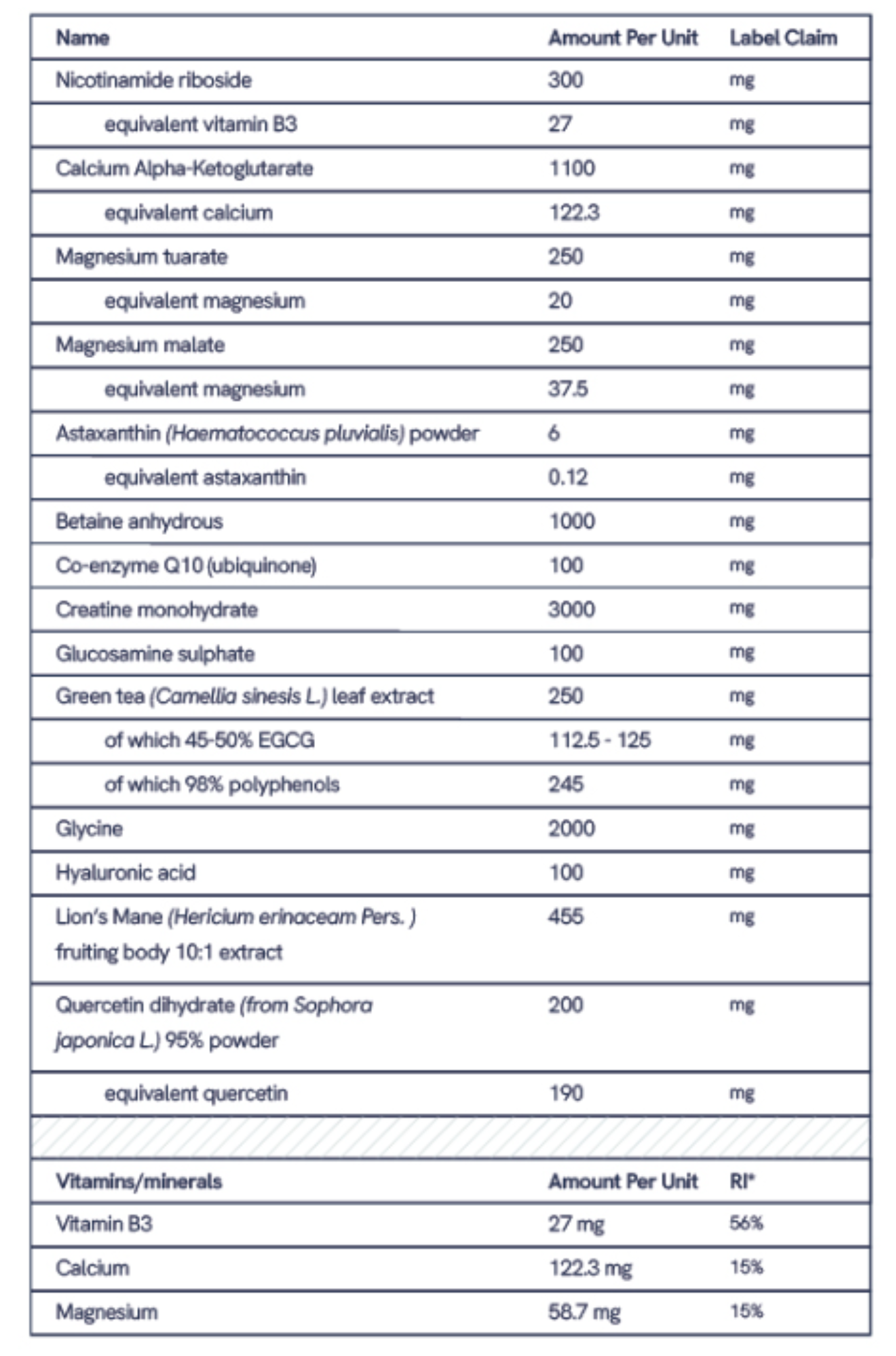
For transparency: Longevity One provides 2.5 micrograms of vitamin B12 as methylcobalamin per daily scoop, which is 100% of the NRV. That is a maintenance amount close to what the body absorbs efficiently in one sitting, not a high dose for low levels.2 At that level, vitamin B12 contributes to the reduction of tiredness and fatigue, and vitamin B12 contributes to normal energy-yielding metabolism. The formula also contains folate (300 micrograms) and vitamin B6 (1.4 mg). It is independently tested by Eurofins and NZVT certified. If a blood test shows low B12, follow your GP's advice on dose; a daily formula is not a substitute for that.
Q&A: B12 Dose and Energy
How much B12 should I take a day for energy?
If your levels are normal, enough to keep intake adequate: EFSA sets 4 micrograms a day for adults.1 More than that has not been shown to improve mood or cognitive function in people without a deficiency.7 If you are often tired, test before you choose a higher dose. Your GP can arrange it.
Is 1,000 micrograms of B12 too much?
It is far more than most people need for maintenance. Doses around 1,000 micrograms a day have been used to correct low levels under medical supervision.6,11 For people with normal levels, most of such a dose is not absorbed.2 A dose near the adequate intake is enough for maintenance.
Why is so little B12 absorbed from high-dose tablets?
The main absorption route through intrinsic factor saturates at about 1.5 to 2 micrograms per meal.2 Beyond that point, the share absorbed from each extra microgram is small. That is why high-dose products contain hundreds of micrograms.
Does taking more B12 raise my levels a lot?
Not proportionally. In a dose-response meta-analysis, doubling intake raised blood B12 by about 11%.3 Going from a moderate to a very high dose gives diminishing returns.
How much B12 do vegans need?
Vegans need a reliable source, from fortified foods or a supplement, because plant foods are not dependable sources.4 In a 12-week trial, 50 micrograms a day restored adequate levels in vegans and vegetarians with marginal status.5 Algae supplements are not suitable sources because most contain inactive forms.2 Check the dose in micrograms on the label. Fortified foods can add to that.
Do people over 50 need more B12?
They often absorb B12 from food less well, but can usually absorb the free B12 in supplements and fortified foods.10 About 6% of people aged 60 and over were deficient in large UK and US surveys.10 A test with your GP is the best way to know your status. Daily B12 from food or a supplement keeps intake steady.
How long does B12 take to work?
Blood levels rise over weeks. In the vegan trial, levels were measured over 90 days, and the older-adult dose trial ran for 16 weeks.5,6 If you were not low, you may notice no change at all.
Is a B12 injection better than tablets?
For correcting low levels, high-dose oral B12 gave similar blood levels to injections in a Cochrane review, at lower cost.11 The evidence was of low quality. Which route suits you is a decision for your GP.
Can B12 supplements make me feel more awake straight away?
No. B12 is a cofactor, not a stimulant, and effects on fatigue relate to correcting low status.9 A product that makes you feel more alert within minutes usually contains caffeine.
Is the NRV of 2.5 micrograms enough?
It is a labelling reference rather than a personal target. EFSA's adequate intake for adults is 4 micrograms a day.1 Food usually makes up the difference for people who eat animal foods.
Frequently Asked Questions
Can I take B12 with my medication?
The label advises consulting your doctor if you use medication. Ask your GP or pharmacist and bring the label. If you want your B12 checked, tests such as serum B12 and methylmalonic acid help define status.8
Should I take B12 every day or once a week?
Both can work. Daily doses suit the per-meal absorption ceiling, and a weekly 2,000-microgram dose also restored adequate levels in a plant-based trial.2,5 Choose the pattern you will keep up.
Can I get enough B12 from food alone?
If you eat animal foods regularly, usually yes: EFSA reports typical EU intakes of 4.2 to 8.6 micrograms a day.1 Vegans need fortified foods or a supplement.4
What does Longevity One taste like?
It has a mango and pineapple flavour. Mix one level scoop in 250 to 500 ml of water, or into a smoothie or yogurt.
Can I take B12 during pregnancy?
B12 needs rise slightly in pregnancy and breastfeeding, according to EFSA.1 Ask your GP or midwife which supplement and dose suit you. Longevity One is not suitable during pregnancy and breastfeeding.
References
- EFSA Panel on Dietetic Products, Nutrition, and Allergies (NDA). Scientific opinion on dietary reference values for cobalamin (vitamin B12). EFSA J. 2015;13(7):4150. View on PubMed ↗
- Watanabe F. Vitamin B12 sources and bioavailability. Exp Biol Med (Maywood). 2007;232(10):1266-1274. View on PubMed ↗
- Dullemeijer C, Souverein OW, Doets EL, van der Voet H, van Wijngaarden JP, de Boer WJ, et al. Systematic review with dose-response meta-analyses between vitamin B-12 intake and European Micronutrient Recommendations Aligned's prioritized biomarkers of vitamin B-12 including randomized controlled trials and observational studies in adults and elderly persons. Am J Clin Nutr. 2013;97(2):390-402. View on PubMed ↗
- Pawlak R, Lester SE, Babatunde T. The prevalence of cobalamin deficiency among vegetarians assessed by serum vitamin B12: a review of literature. Eur J Clin Nutr. 2014;68(5):541-548. View on PubMed ↗
- Del Bo' C, Riso P, Gardana C, Brusamolino A, Battezzati A, Ciappellano S. Effect of two different sublingual dosages of vitamin B12 on cobalamin nutritional status in vegans and vegetarians with a marginal deficiency: a randomized controlled trial. Clin Nutr. 2019;38(2):575-583. View on PubMed ↗
- Eussen SJ, de Groot LC, Clarke R, Schneede J, Ueland PM, Hoefnagels WH, et al. Oral cyanocobalamin supplementation in older people with vitamin B12 deficiency: a dose-finding trial. Arch Intern Med. 2005;165(10):1167-1172. View on PubMed ↗
- Markun S, Gravestock I, Jager L, Rosemann T, Pichierri G, Burgstaller JM. Effects of vitamin B12 supplementation on cognitive function, depressive symptoms, and fatigue: a systematic review, meta-analysis, and meta-regression. Nutrients. 2021;13(3):923. View on PubMed ↗
- Green R, Allen LH, Bjorke-Monsen AL, Brito A, Gueant JL, Miller JW, et al. Vitamin B12 deficiency. Nat Rev Dis Primers. 2017;3:17040. View on PubMed ↗
- Tardy AL, Pouteau E, Marquez D, Yilmaz C, Scholey A. Vitamins and minerals for energy, fatigue and cognition: a narrative review of the biochemical and clinical evidence. Nutrients. 2020;12(1):228. View on PubMed ↗
- Allen LH. How common is vitamin B-12 deficiency? Am J Clin Nutr. 2009;89(2):693S-696S. View on PubMed ↗
- Wang H, Li L, Qin LL, Song Y, Vidal-Alaball J, Liu TH. Oral vitamin B12 versus intramuscular vitamin B12 for vitamin B12 deficiency. Cochrane Database Syst Rev. 2018;3(3):CD004655. View on PubMed ↗
Disclaimer: Educational content only. Not medical advice. Supplements are not intended to diagnose, treat, cure, or prevent any disease. Consult a qualified healthcare professional if you have a medical condition or take medication.