For training, a pre-workout and an energy drink mostly do the same job, and caffeine is the active part of both. Energy drinks often add sugar, while pre-workouts usually carry more caffeine per serving. A daily formula is a different tool: no stimulant, taken every day for nutrients and creatine rather than for a lift before a session.
Key Takeaways
- The ISSN concludes that caffeine and carbohydrate are the main active nutrients in most energy drinks and shots.1
- Energy drinks improved aerobic performance mainly when they supplied more than 200 mg or more than 3 mg per kg of caffeine.1
- Across 100 top-selling pre-workouts, the average labelled caffeine was 254 mg per serving.2
- Short studies suggest multi-ingredient pre-workouts may help muscular endurance and mood, but results for strength and power are mixed.3
- Caffeine improves exercise performance at 3 to 6 mg per kg of body weight, whatever the format.4
- A standard pre-workout serving should be taken at least 13.2 hours before bed to avoid losing sleep.5
- Creatine has strong evidence, but it works through daily intake, which is why it fits a daily formula better than a pre-session drink.6,7
Twenty minutes before training, you have three options in the kitchen: a tub of pre-workout, a can of energy drink, and the daily powder you take with breakfast. They look similar, they all promise energy, and they are often sold side by side. In practice they do different jobs. Our article on how longevity drinks differ from coffee and energy drinks compares drink types for everyday use. This one answers the training question: which, if any, do you need before a session?
What do pre-workouts and energy drinks actually contain?
Both are built around caffeine. In a label analysis of the 100 top-selling pre-workouts, 86% contained caffeine, at an average of 254 mg per serving.2 The other common ingredients were beta-alanine (87%), citrulline (71%), tyrosine (63%), taurine (51%) and creatine (49%), and 44.3% of all ingredients sat in proprietary blends with no amount stated.2
Energy drinks share much of that list. The ISSN position stand on energy drinks and energy shots lists caffeine, taurine, B vitamins, vitamin C, electrolytes, sugars or sweeteners, tyrosine and L-theanine among common ingredients, with the prevalence of each ranging from 1.3% to 100%.1 Several of its authors work with supplement or nutrition companies. Its conclusion is the important part: based on current evidence, the main active ingredients in most energy drinks and shots appear to be caffeine and carbohydrate, and the added value of the other nutrients remains to be determined.1
How much caffeine is in each?
Pre-workouts usually carry more per serving. The average labelled amount across 100 products was 254 mg2, and laboratory tests of 15 products sold in Australia found 91 to 387 mg per serving, with only 6 of the 15 labels stating the amount at all.8 In the EU, under Regulation (EU) No 1169/2011, drinks with more than 150 mg of caffeine per litre must carry a high caffeine warning and state the amount per 100 ml, which lets you work out a can yourself. A drink labelled 32 mg per 100 ml, for example, provides 80 mg in a 250 ml can and 160 mg in a 500 ml can.
Is pre-workout better than an energy drink?
For most trainers, the honest answer is that neither is better in principle. The useful question is how much caffeine you get, and what else comes with it.
What the evidence says about caffeine
Caffeine itself is well studied. The ISSN position stand on caffeine concludes that it consistently improves exercise performance at 3 to 6 mg per kg of body weight, usually taken about 60 minutes before exercise, and that energy drinks and pre-workouts containing caffeine have both been shown to improve anaerobic and aerobic performance.4 Very high doses, around 9 mg per kg, bring frequent side effects and do not seem necessary.4
The energy drink position stand reaches a matching conclusion from the other side. Energy drinks improved acute aerobic performance largely in line with their caffeine content, above about 200 mg or 3 mg per kg, and drinks with at least 3 mg per kg of caffeine were most likely to help lower-body power.1 Taken 10 to 60 minutes before exercise, they improved focus, alertness, anaerobic performance or endurance at those doses.1 In other words, a can with too little caffeine is unlikely to do much for training, and a scoop with enough caffeine does the same job.
What the evidence says about pre-workout blends
A review of multi-ingredient pre-workouts found that taking one before exercise may improve muscular endurance and mood, with mixed results for force and power.3 Taken over weeks alongside a structured resistance programme, some studies reported larger gains in lean mass, but long-term effects on strength and endurance were less clear.3 Two limits stand out. Most safety studies lasted less than eight weeks, and proprietary blends make it hard to know which ingredient, if any, did the work.3
The sugar question
Many energy drinks contain sugar, and that changes the comparison. The ISSN notes that carbohydrate is one of the two main active nutrients in energy drinks, and advises considering the effect of regular high glycaemic carbohydrate intake on blood glucose and insulin.1 The ISSN counts that carbohydrate, alongside caffeine, among the main ergogenic nutrients in energy drinks.1 For alertness at rest, it is less helpful than people expect: a meta-analysis of 31 studies with 1,259 participants found that carbohydrate did not improve mood, and was linked to more fatigue and less alertness than placebo within the first hour.9 Sugar-free energy drinks remove the sugar but leave the caffeine as the active ingredient.
How do the three options compare?
| Pre-workout | Energy drink | Daily formula (no stimulant) | |
|---|---|---|---|
| Main active part | Caffeine, average 254 mg per labelled serving2 | Caffeine and, in sugared versions, carbohydrate1 | Vitamins, minerals and other nutrients; no caffeine |
| When to take it | About 60 minutes before training4 | 10 to 60 minutes before training1 | Once a day, at any regular time |
| What you notice | A clear lift within the hour | A clear lift; quicker with sugar | Nothing immediate |
| Evidence for training | Caffeine strong; blends mixed4,3 | Mainly from the caffeine content1 | Depends on the ingredients; creatine strong6 |
| Main downsides | High dose, label gaps, sleep8,5 | Sugar, several cans add up, sleep1,5 | Nothing to feel before a session |
| Best suited to | Hard sessions, early in the day | Occasional use when you already know the dose | Everyday nutrition, training or not |

What are the downsides of either one?
Sleep
Whatever the format, caffeine stays with you for many hours. A 2023 meta-analysis of 24 studies found that caffeine cut total sleep time by 45 minutes and sleep efficiency by 7%.5 To avoid losing sleep, the authors calculated that a standard 217.5 mg pre-workout serving should be taken at least 13.2 hours before bed, and a 250 ml coffee at least 8.8 hours before.5 For anyone who trains after work, that rules out a full serving of either product for the evening session.
The daily total
A systematic review of 381 studies supports up to 400 mg of caffeine a day from all sources as an intake not associated with overt adverse effects in healthy adults.10 The EFSA scientific opinion on the safety of caffeine uses the same daily figure for healthy adults outside pregnancy and considers single doses up to 200 mg not to raise safety concerns. A large pre-workout plus two coffees, or two large energy drinks plus a coffee, can pass 400 mg without much effort. The ISSN also warns that indiscriminate use of energy drinks, especially several servings a day or alongside other caffeinated drinks, may lead to adverse effects.1
Tolerance
Daily caffeine before every session reduces the benefit over time. In a randomised trial in low caffeine users, the performance benefit of a 3 mg per kg dose was no longer clear after four weeks of daily caffeine, while it remained in the placebo group.11 If you rely on caffeine for training, keeping it for the sessions that matter most is more effective than taking it every day.
Individual response
People clear caffeine at very different speeds, mainly because of variation in the liver enzyme CYP1A2, and caffeine also interacts with many medicines.12 One person feels a 160 mg can for an hour, another feels it at midnight. The format does not change that.
Who should skip both?
Some people are better off without a caffeinated pre-session product at all. The ISSN does not recommend energy drinks or shots for children, for anyone who is pregnant, trying to become pregnant or breastfeeding, or for people who are sensitive to caffeine, and it advises people with existing medical conditions who take medication to speak to their doctor first.1 If you are pregnant or breastfeeding and wondering about caffeine, ask your midwife or GP.
Others may simply find the trade-off poor. If you train in the evening, the sleep cost is hard to avoid.5 If you already drink three or four coffees a day, adding a scoop takes you past the daily figure.10 If caffeine leaves you shaky or unsettled, that is a sign of how your body handles it, and a smaller dose or none is the sensible answer.12
A simple training week
For a regular trainer with three or four sessions a week, one practical pattern is to keep caffeine for the one or two hardest sessions, take those early in the day, use a measured dose of about 3 mg per kg, and train without caffeine on the other days.4,11 Daily nutrition, including creatine if you use it, stays the same every day regardless of the session.7 This keeps the caffeine effect noticeable when you want it, and keeps it away from your sleep.
Where does a daily formula fit?
A daily formula does a different job from a pre-workout, so judge it on its own terms. Its job is the background: nutrients you need every day, whether or not you train. Some ingredients with strong training evidence also work this way. The IOC consensus statement lists creatine among the few supplements with good evidence of benefit6, and the ISSN creatine position stand notes that supplementation raises the creatine stored in muscle with regular intake.7 That makes it a better fit for a daily routine than for a drink taken 20 minutes before training. Several authors of that position stand also work with supplement companies.
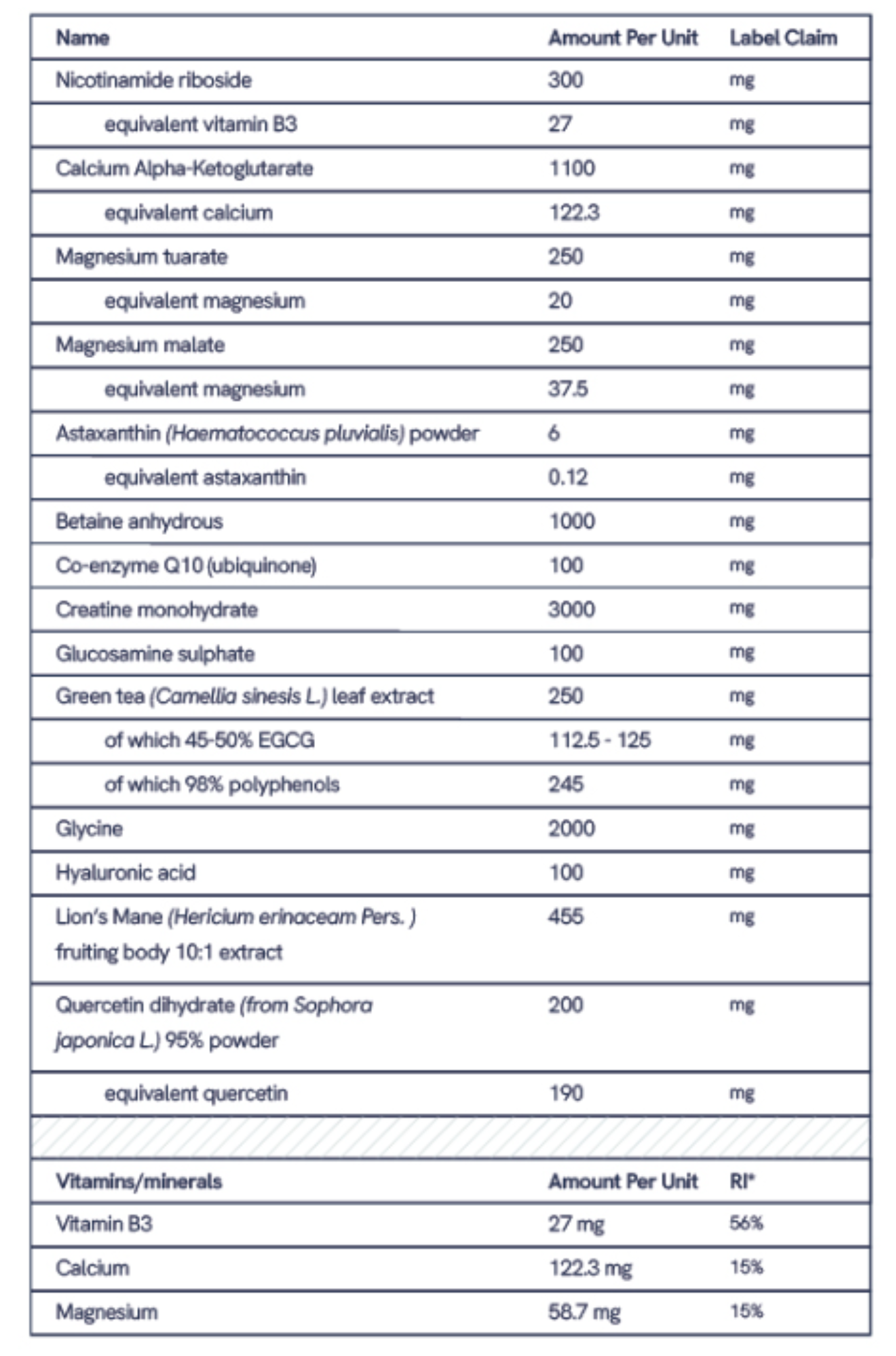
For transparency, Longevity One is a daily powder taken as one scoop in 250 to 500 ml of water. It contains no caffeine and no caffeine source. It contains 3,000 mg of creatine monohydrate. Creatine increases physical performance in successive bursts of short-term, high intensity exercise. Magnesium contributes to a reduction of tiredness and fatigue. Vitamin B6, vitamin B12 and vitamin C contribute to the reduction of tiredness and fatigue. It will not give you the lift of a pre-workout, and it is not meant to. Read more in Creatine Beyond the Gym.
How do you choose?
Most regular trainers do not need both a pre-workout and an energy drink. A simple way to decide:
- If you train hard early in the day and respond well to caffeine, a pre-workout or energy drink with a known caffeine dose of about 3 mg per kg is reasonable.4,1
- If you train in the evening, skip both or use a small dose, because of the sleep cost.5
- If the label does not state caffeine in mg per serving, do not use it.8
- Choose sugar-free if you only want alertness; choose some carbohydrate only if the session is long or hard.1,9
- Count every caffeine source in the day and stay under 400 mg.10
- For creatine, take it daily rather than as a pre-session drink.7
- If you compete under anti-doping rules, prefer batch-tested products.
Our guides on how to read a supplement label and third-party testing explain what to check before you buy any of the three.
Q&A: Pre-Workout vs Energy Drink
Is pre-workout better than an energy drink?
Not in principle. Both mainly work through caffeine, and energy drinks improved performance mostly when they supplied more than about 200 mg or 3 mg per kg.1 Pre-workouts usually carry more caffeine per serving, at an average of 254 mg across 100 products.2
Can I drink an energy drink instead of pre-workout?
Yes, if you know how much caffeine it contains. Caffeine improves exercise performance at 3 to 6 mg per kg, whatever the format.4
How long before a workout should I have an energy drink?
The ISSN reports benefits when energy drinks were taken 10 to 60 minutes before exercise.1 For caffeine in general, about 60 minutes is the most commonly studied timing.4
Is the sugar in energy drinks useful before training?
The ISSN lists carbohydrate, with caffeine, as one of the two main ergogenic nutrients in energy drinks.1 For alertness at rest, carbohydrate was linked to more fatigue in the first hour in a meta-analysis.9
Which is worse for sleep, pre-workout or an energy drink?
Whichever has more caffeine. A meta-analysis advised taking a standard 217.5 mg pre-workout serving at least 13.2 hours before bed.5
Do the extra ingredients in pre-workout do anything?
Some have their own evidence at the right dose, but the average beta-alanine content was below the effective dose, and many amounts were hidden in blends.2 Reviews of blends report mixed results beyond muscular endurance and mood.3
Can I take pre-workout and an energy drink together?
It is easy to pass 400 mg of caffeine that way, the daily figure a systematic review supports for healthy adults.10 The ISSN warns against several servings or combining them with other caffeine.1
Should creatine be taken before a workout?
Creatine supplementation works by raising the creatine stored in muscle with regular intake.7 That is why it is usually taken daily rather than as a pre-session drink.
Do I need any of these to train well?
No. The IOC consensus notes that only a few supplements, including caffeine and creatine, have good evidence, and that responses vary widely between people.6 Sleep, food and a good programme come first.
Frequently Asked Questions
Can I take pre-workout or energy drinks with medication?
Ask your GP or pharmacist first and bring the product label. Caffeine interacts with many medications.12 For Longevity One, the label advises consulting your doctor if you use medication.
Does Longevity One replace a pre-workout?
No. It contains no caffeine and is not designed to be felt before training. It is a daily formula. It contains 3,000 mg of creatine, and creatine is studied as a daily supplement that raises muscle creatine with regular intake.7
What does Longevity One taste like?
It has a mango and pineapple flavour. Mix one scoop into 250 to 500 ml of water, or into a smoothie or yogurt.
Are energy drinks suitable for teenagers?
The ISSN does not recommend energy drinks or shots for children and advises adolescents to be cautious and seek parental guidance.1
I need caffeine for every session. Is that a problem?
Daily use builds tolerance, so the benefit shrinks.11 If you feel too tired to train most days, look at sleep and recovery first, and see your GP if the tiredness is persistent, severe or new.
References
- Jagim AR, Harty PS, Tinsley GM, Kerksick CM, Gonzalez AM, Kreider RB, et al. International society of sports nutrition position stand: energy drinks and energy shots. J Int Soc Sports Nutr. 2023;20(1):2171314. View on PubMed ↗
- Jagim AR, Harty PS, Camic CL. Common ingredient profiles of multi-ingredient pre-workout supplements. Nutrients. 2019;11(2):254. View on PubMed ↗
- Harty PS, Zabriskie HA, Erickson JL, Molling PE, Kerksick CM, Jagim AR. Multi-ingredient pre-workout supplements, safety implications, and performance outcomes: a brief review. J Int Soc Sports Nutr. 2018;15(1):41. View on PubMed ↗
- Guest NS, VanDusseldorp TA, Nelson MT, Grgic J, Schoenfeld BJ, Jenkins NDM, et al. International society of sports nutrition position stand: caffeine and exercise performance. J Int Soc Sports Nutr. 2021;18(1):1. View on PubMed ↗
- Gardiner C, Weakley J, Burke LM, Roach GD, Sargent C, Maniar N, et al. The effect of caffeine on subsequent sleep: a systematic review and meta-analysis. Sleep Med Rev. 2023;69:101764. View on PubMed ↗
- Maughan RJ, Burke LM, Dvorak J, Larson-Meyer DE, Peeling P, Phillips SM, et al. IOC consensus statement: dietary supplements and the high-performance athlete. Br J Sports Med. 2018;52(7):439-455. View on PubMed ↗
- Kreider RB, Kalman DS, Antonio J, et al. International Society of Sports Nutrition position stand: safety and efficacy of creatine supplementation in exercise, sport, and medicine. J Int Soc Sports Nutr. 2017;14:18. View on PubMed ↗
- Desbrow B, Hall S, O'Connor H, Slater G, Barnes K, Grant G. Caffeine content of pre-workout supplements commonly used by Australian consumers. Drug Test Anal. 2019;11(3):523-529. View on PubMed ↗
- Mantantzis K, Schlaghecken F, Sünram-Lea SI, Maylor EA. Sugar rush or sugar crash? A meta-analysis of carbohydrate effects on mood. Neurosci Biobehav Rev. 2019;101:45-67. View on PubMed ↗
- Wikoff D, Welsh BT, Henderson R, Brorby GP, Britt J, Myers E, et al. Systematic review of the potential adverse effects of caffeine consumption in healthy adults, pregnant women, adolescents, and children. Food Chem Toxicol. 2017;109(Pt 1):585-648. View on PubMed ↗
- Beaumont R, Cordery P, Funnell M, Mears S, James L, Watson P. Chronic ingestion of a low dose of caffeine induces tolerance to the performance benefits of caffeine. J Sports Sci. 2017;35(19):1920-1927. View on PubMed ↗
- Nehlig A. Interindividual differences in caffeine metabolism and factors driving caffeine consumption. Pharmacol Rev. 2018;70(2):384-411. View on PubMed ↗
Disclaimer: Educational content only. Not medical advice. Food supplements should not be used as a substitute for a varied, balanced diet and a healthy lifestyle. If you use medication, consult your doctor.