No single "best" longevity supplement brand exists for everyone. The most credible brands share common traits: transparent ingredient dosing, third-party testing verification, regulatory-compliant claims, published Certificates of Analysis, and ingredients backed by human clinical research at clinically studied doses. Evaluate brands by evidence and transparency, not popularity or marketing budgets.
Key Takeaways
- The longevity supplement market is growing rapidly, with over 61% of adults in the United States now reporting dietary supplement use, up from approximately 52% a decade earlier.1
- Label inaccuracy remains a documented concern: analyses of supplement products have found that a substantial proportion contain ingredients not matching their stated labels.2,3
- Third-party testing by accredited laboratories (such as Eurofins, NSF, or NZVT) provides independent verification of ingredient identity, dose accuracy, and contaminant absence.
- Proprietary blends obscure individual ingredient doses, making it impossible for consumers to confirm whether clinically studied amounts are present.4
- Regulatory-compliant health claims (such as EFSA-approved claims in Europe) serve as a credibility signal. Brands making unsupported disease claims should be treated with caution.
- Only approximately 27% of supplement users take products following a healthcare professional's recommendation, highlighting the importance of independent evaluation skills.5
- Credibility is built through evidence, transparency, and testing, not through marketing claims, celebrity endorsements, or brand popularity rankings.
Why "Best Brand" Is the Wrong Question
When searching for the most effective longevity supplement brand, many consumers begin with a straightforward question: "Which brand is best?" While understandable, this framing misses the point. Individual nutritional needs vary based on age, sex, existing dietary intake, health status, and personal goals. A brand that excels for one person's requirements may be entirely unsuitable for another's.
Marketing budgets significantly distort brand perception. The most visible brands are not necessarily the most credible. Popularity on social media, influencer endorsements, and paid review placements can all create the appearance of authority without reflecting actual product quality. A 2025 analysis of supplement use trends in the United States found that supplement adoption continues to increase across all demographic groups, with use rising from 51.8% to 61.4% over approximately a decade.1 This growth has attracted many new market entrants, not all of which prioritise evidence or transparency.
The more productive question is: "Does this brand meet my criteria for evidence, transparency, and quality?" Shifting from brand loyalty to criteria-based evaluation empowers you to assess any product objectively, regardless of its market position or advertising spend.
The Five Pillars of Brand Credibility
Rather than ranking specific brands, it is more useful to understand the five pillars that distinguish credible supplement companies from those that rely primarily on marketing. These pillars apply regardless of whether a brand is large or small, well-known or niche.
Pillar 1: Evidence Basis
Credible longevity supplement brands formulate products around ingredients supported by human clinical research, not solely preclinical (animal or cell) studies. The gold standard is randomised controlled trial (RCT) data in human populations, ideally supported by systematic reviews or meta-analyses. When a brand highlights an ingredient, ask: has it been studied in humans, at the dose included in this product, for a relevant outcome?
This distinction matters because many ingredients that show promise in laboratory settings have failed to demonstrate comparable effects in human trials. A brand that transparently references human studies and acknowledges research limitations signals scientific integrity.
Pillar 2: Dose Transparency
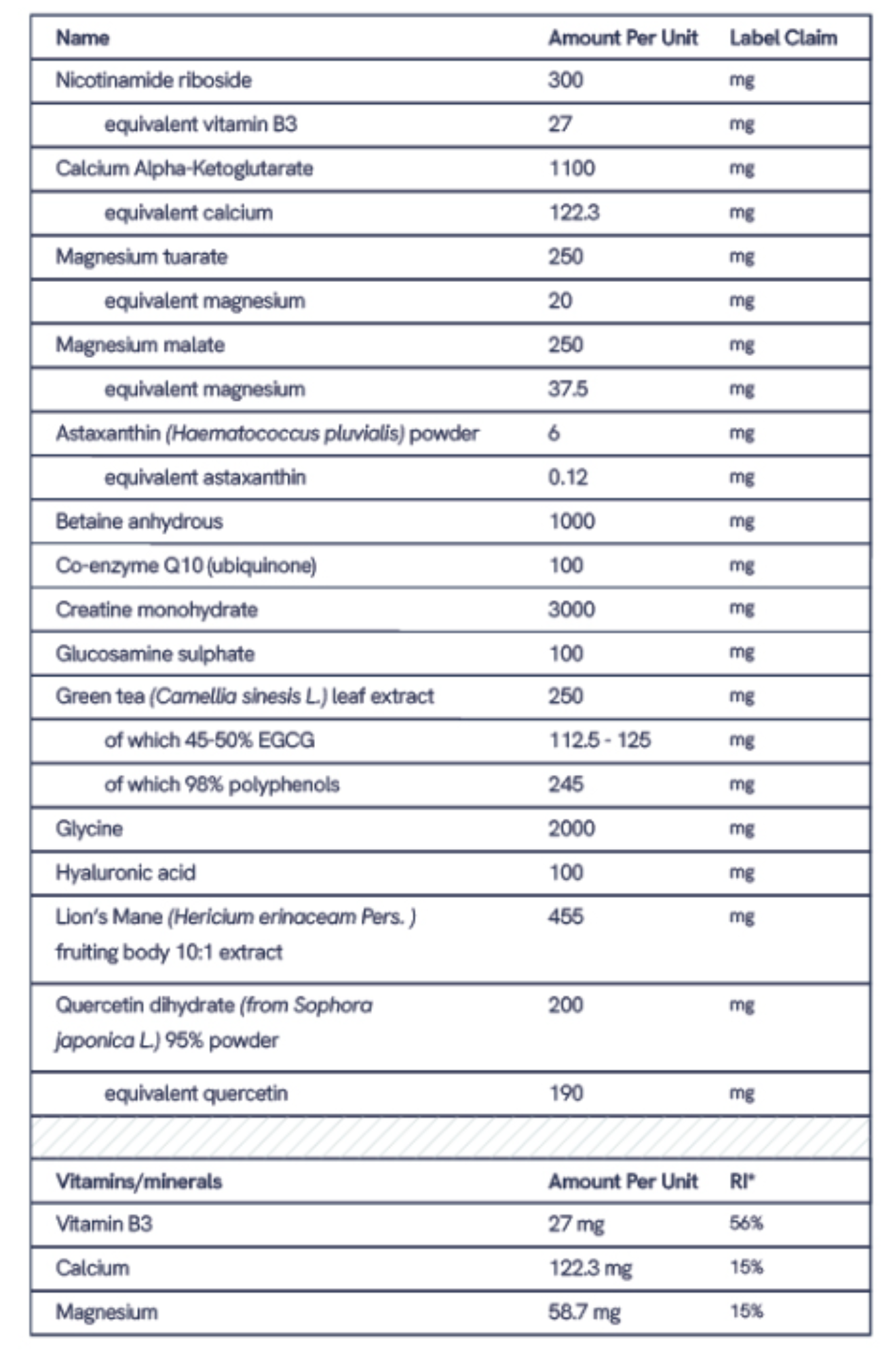
Full label disclosure means every ingredient is listed with its exact amount per serving. Products using proprietary blends list multiple ingredients under a single combined weight, making it impossible for consumers to determine the dose of any individual component. A 2023 review published in The Journal of Nutrition examined the implications of proprietary blends and noted that this labelling practice obscures whether clinically studied doses are present, limiting consumers' ability to make informed decisions.4
When evaluating a brand, look for a Supplement Facts panel that lists each ingredient individually with its specific dose. Compare these doses against amounts used in published human clinical trials.
Pillar 3: Third-Party Verification
Third-party testing involves an independent, accredited laboratory analysing a finished product to verify that it contains what its label states, at the declared dosage, and is free from contaminants such as heavy metals, microbial contamination, and residual solvents. Recognised verification programmes include NSF International, Eurofins, NZVT (doping-free certification), and Informed Sport.
The importance of this pillar is underscored by published research. A 2024 JAMA Network Open study analysed 30 weight-loss supplements marketed online and found that the majority had inaccurate labels, with some products containing ingredients not listed on the label and others missing declared ingredients entirely.2 A separate 2024 analysis of 44 weight-loss supplements sold on or near military installations found that 82% had inaccurate labels and none carried a third-party certification seal.3
While these studies focused on weight-loss products (a category with particularly high adulteration rates), they illustrate a broader principle: independent verification provides a layer of assurance that self-reported label information alone does not.
Pillar 4: Regulatory Compliance
In Europe, health claims on supplements are governed by EFSA (European Food Safety Authority) regulations. Only claims that have been scientifically evaluated and approved may appear on product labels. For example, approved claims such as "Vitamin C contributes to normal immune function" or "Magnesium contributes to normal energy-yielding metabolism" have undergone rigorous assessment.
Brands that make vague or extravagant claims (such as "reverses ageing," "cures fatigue," or "prevents disease") are not operating within regulatory frameworks. The presence or absence of disease-oriented language on a brand's website, packaging, and advertising is a reliable indicator of regulatory awareness. Credible brands frame their products in terms of supporting normal physiological functions, not treating or preventing health conditions.
Pillar 5: Manufacturing Standards
Good Manufacturing Practice (GMP) certification indicates that a facility follows standardised protocols for production, quality control, and record-keeping. GMP compliance is a regulatory requirement in many markets but is not uniformly enforced.6 Look for brands that voluntarily undergo additional manufacturing audits and that can provide documentation of their GMP status upon request. Supply chain transparency, including information about where raw materials are sourced and how they are tested upon receipt, adds further confidence.
How to Read Supplement Reviews Critically
Online reviews are among the first resources consumers consult when choosing a supplement brand. However, not all reviews carry equal weight, and understanding their limitations is essential for informed decision-making.
Genuine supplement reviews tend to describe specific, measured experiences over meaningful time periods. They acknowledge that results vary and avoid absolute language. In contrast, reviews that use identical phrasing across multiple products, promise dramatic results within days, or fail to mention any limitations should be viewed with caution. Incentivised reviews (where consumers receive free products or discounts in exchange for positive feedback) are common across e-commerce platforms.
A key principle: clinical evidence always outweighs anecdotal reviews. A brand may have thousands of five-star reviews, but if its key ingredients lack human trial data at the included doses, those reviews do not constitute scientific support. The most reliable approach is to triangulate: consult the published evidence for each ingredient, verify the brand's testing and transparency practices, and then consider consumer reviews as supplementary (not primary) information.
An NHANES-based analysis found that only approximately 27% of dietary supplements used by adults were taken following a doctor's recommendation.5 This means the vast majority of supplement decisions are consumer-driven, making critical evaluation skills especially important.
Brand Categories in the Longevity Supplement Market
Without naming specific competitors, the longevity supplement market can be broadly categorised into several brand types. Understanding these categories helps you identify where a given product fits and what trade-offs may be involved.
Research-led brands build formulations around published human evidence, disclose full ingredient doses, and invest in third-party testing. These brands tend to reference specific studies, publish Certificates of Analysis, and frame their communications within regulatory guidelines. Their products are typically positioned at a higher price point, reflecting testing and quality assurance costs.
Lifestyle and wellness brands often lead with marketing, aesthetic branding, and trend-driven ingredients. While some lifestyle brands maintain strong quality standards, others prioritise packaging and influencer partnerships over evidence depth. Evaluate these brands against the five pillars rather than their visual appeal.
Practitioner-grade brands are sold through healthcare professionals and often meet higher formulation standards. However, the term "practitioner-grade" is not a regulated designation, so it should be verified rather than taken at face value.
Direct-to-consumer brands use subscription models and often include personalisation features (questionnaires, app integration). Personalisation can be valuable when it is based on meaningful health data, but superficial quizzes that recommend the same products regardless of responses offer limited genuine customisation.
Mass-market brands prioritise accessibility and affordability. They may use well-researched ingredients but at lower doses or in less bioavailable forms. Cost per effective dose (the cost of achieving a clinically studied amount) is a more useful metric than cost per capsule when comparing these brands against premium alternatives.
What "Doctor Recommended" and "Clinically Studied" Actually Mean
Two phrases appear frequently in supplement marketing: "doctor recommended" and "clinically studied." Both require careful interpretation.
"Doctor recommended" typically means that at least one healthcare professional has endorsed the product, or that a survey showed some percentage of doctors recommend the ingredient category. It does not mean the specific product has been evaluated or prescribed in a clinical setting. Credible brands are transparent about what this endorsement entails.
"Clinically studied" can mean that one or more ingredients in the product have been studied in published research. However, this does not necessarily mean the product itself was tested, or that the included doses match those used in the studies. A product containing 50 mg of an ingredient studied at 500 mg can still technically claim "clinically studied ingredients." Look for brands that specify the doses used in relevant clinical trials and match them in their formulations.
A Brand Evaluation Checklist for 2026
The following ten-point checklist is designed as a practical resource you can apply when evaluating any longevity supplement brand. Each point reflects one or more of the five credibility pillars described above.
1. Published Certificate of Analysis (COA)? A COA from an accredited laboratory confirms the product has been independently tested. Ask the brand for a copy if it is not publicly available.
2. Named third-party laboratory? Brands that identify their testing laboratory (for example, Eurofins, NSF, or NZVT) demonstrate greater accountability than those that claim "third-party tested" without specifying who performed the testing.
3. Full ingredient doses on the label? Every active ingredient should appear with its individual dose per serving. Avoid products that hide doses behind proprietary blends.4
4. Human studies for key ingredients? The primary active ingredients should have published human clinical trial data. Brands that reference only animal studies or in vitro research as primary evidence are making unsupported extrapolations.
5. Regulatory-compliant claims only? In Europe, only EFSA-approved health claims should appear on labels and marketing. Globally, brands should avoid language that implies disease treatment or prevention.
6. GMP-certified manufacturing facility? Confirm the manufacturing facility holds current GMP certification from a recognised body.
7. Transparent "other ingredients" list? Excipients, fillers, coatings, and flow agents should be clearly listed. An absence of this information may indicate incomplete disclosure.
8. Realistic marketing language? Credible brands describe what evidence supports, acknowledge limitations, and avoid guarantee language. Watch for terms like "miracle," "breakthrough," "guaranteed results," or "anti-ageing cure."
9. Responsive to consumer questions? A brand that openly answers questions about sourcing, testing, dosing rationale, and ingredient selection demonstrates confidence in its product.
10. Independent reviews available? While no review source is perfect, the availability of independent, non-incentivised reviews across multiple platforms suggests a genuine consumer base.
How The Longevity Store Approaches These Principles
As an educational example of how these principles apply in practice, Longevity Complete is formulated with full dose transparency (no proprietary blends), includes ingredients with EFSA-approved health claims, and undergoes third-party testing through Eurofins with NZVT doping-free certification. The Certificate of Analysis is available to customers, and all health claims used in product communications are limited to those approved by EFSA. For instance, the approved claims that "Vitamin C, D, B6, B12, Folate, Zinc and Selenium contribute to normal immune function" and that "Magnesium, Vitamin B6 and B12 help reduce tiredness and fatigue" represent the exact boundary of what may be stated about the product's benefits.
This is not a claim of superiority over other brands. Rather, it illustrates what applying the five pillars looks like in practice. Every consumer should apply the same evaluation framework to any brand they consider, including this one.
Q&A Section
How do I know if a longevity supplement brand is credible?
Evaluate it against five criteria: evidence basis (human clinical trials for key ingredients), dose transparency (no proprietary blends), third-party verification (published COA from a named laboratory), regulatory compliance (EFSA-approved claims only, no disease language), and GMP-certified manufacturing. A brand that meets all five is more likely to be credible than one relying primarily on marketing.
Are more expensive supplement brands always better?
Not necessarily. Higher prices sometimes reflect genuine quality investments, including third-party testing, clinically studied doses, and premium ingredient forms. However, price can also reflect marketing spend, luxury packaging, or celebrity endorsements. The most useful metric is cost per effective dose: the cost of consuming ingredients at amounts shown to be relevant in published human research.
What does "clinically studied doses" actually mean?
It means the product contains individual ingredients at the same quantities used in published human clinical trials that demonstrated a measurable outcome. For example, if a study used 400 mg of magnesium per day and found it supported a specific function, a product claiming "clinically studied doses" should contain at least 400 mg of magnesium per serving. Always verify by comparing the label to the referenced study.
Should I trust supplement brand rankings online?
Approach rankings with caution. Many "top supplement brand" lists are commercially influenced, with brands paying for placement or affiliate programmes driving recommendations. More reliable than rankings are the objective criteria in the five pillars framework. Use rankings as a starting point for discovery, then apply your own evaluation.
What is the difference between third-party tested and GMP certified?
Third-party testing means an independent laboratory has analysed the finished product to verify its contents match the label and it is free from contaminants. GMP (Good Manufacturing Practice) certification means the manufacturing facility follows standardised production protocols. They are complementary: GMP addresses how the product is made, while third-party testing verifies what the finished product actually contains.6
How do I verify a brand's Certificate of Analysis?
Request the COA directly from the brand. A legitimate COA will identify the testing laboratory by name, include the laboratory's accreditation details, state the date of testing, list the specific tests performed (such as identity, potency, heavy metals, microbial), and show the results alongside specifications. If a brand cannot or will not provide a COA upon request, consider this a significant concern.
Are longevity supplement brands regulated?
Supplement brands are regulated, but the regulatory framework differs from pharmaceuticals. In Europe, EFSA governs which health claims can be made. In the United States, the FDA requires GMP compliance and can take action against adulterated or mislabelled products, but does not require pre-market approval.7 This means the responsibility for quality falls more heavily on manufacturers and consumers than in the pharmaceutical sector.
What red flags should I look for in brand marketing?
Major red flags include: disease treatment claims ("cures," "prevents," "reverses"), proprietary blends hiding ingredient doses, no mention of third-party testing, before-and-after photos with dramatic results, reliance on animal studies as primary evidence, "secret formula" framing, and refusal to disclose sourcing or manufacturing details. Each of these indicates either non-compliance or a lack of transparency.
Do doctors recommend specific longevity supplement brands?
Some healthcare professionals do recommend specific products based on ingredient quality, evidence, and their clinical experience. However, the phrase "doctor recommended" in marketing is often used loosely and may refer to a single endorsement or a survey of a small group. The most meaningful form of professional recommendation is a personalised one from your own healthcare provider, based on your individual health profile.
How often should I re-evaluate the brand I use?
Consider re-evaluating annually, or whenever a significant change occurs: new research on key ingredients, changes in your health status, updates to the product formulation, or a shift in the brand's testing or transparency practices. The longevity supplement field evolves as new human trial data becomes available, and your evaluation should evolve with it.
FAQ
What are the top longevity supplement brands?
There is no single authoritative ranking. The most credible longevity supplement brands share common characteristics: transparent dosing, third-party testing from named laboratories, regulatory-compliant health claims, and formulations built on human clinical research. Use the five pillars framework (evidence, transparency, testing, compliance, manufacturing standards) to evaluate any brand objectively.
Which longevity supplement brands are most effective?
Effectiveness depends on ingredient selection, dose accuracy, and individual needs. Brands that include ingredients at clinically studied doses, verified through third-party testing, are more likely to deliver the outcomes observed in published research. No brand can guarantee individual results, and effectiveness claims without supporting human data should be viewed sceptically.
How can I tell if supplement reviews are genuine?
Genuine reviews tend to describe specific experiences over realistic time frames, acknowledge variation, and include balanced perspectives. Red flags for unreliable reviews include identical language across multiple products, claims of dramatic overnight results, and no mention of any limitations. Always prioritise published clinical evidence over anecdotal reviews.5
What does a Certificate of Analysis (COA) tell me?
A COA from an accredited laboratory confirms the identity, potency, and purity of a supplement product. It verifies that the product contains the ingredients listed on the label at the declared doses and is free from specified contaminants such as heavy metals and microbial contamination. Brands that publish or provide COAs on request demonstrate a commitment to transparency.3
Why should I avoid supplements with proprietary blends?
Proprietary blends list multiple ingredients under a single combined weight without disclosing the individual dose of each. This makes it impossible to confirm whether any ingredient is present at a clinically studied amount.4 Full dose transparency allows you to compare the product directly against published research.
What are the leading longevity supplement options available today?
Leading longevity supplement options in 2026 typically include foundational nutrients with strong human evidence and regulatory-approved claims (vitamin D, magnesium, B vitamins, zinc, selenium, vitamin C, omega-3), alongside emerging research ingredients such as NAD+ precursors and CoQ10. The best option for any individual depends on their specific nutritional gaps, health goals, and existing dietary intake.
References
- Duan Y, Luo J, Gong J, Qi X, Zhang J. Trends in dietary supplement use among U.S. adults between 2011 and 2023. Eur J Nutr. 2025;64(1):49. View on PubMed ↗
- Crawford C, Avula B, Lindsey AT, Katragunta K, Khan IA, Deuster PA. Label accuracy of weight loss dietary supplements marketed online with military discounts. JAMA Netw Open. 2024;7(5):e249131. View on PubMed ↗
- Crawford C, Lindsey AT, Avula B, Katragunta K, Khan IA, Deuster PA. Label accuracy and quality of select weight-loss dietary supplements sold on or near US military bases. Nutrients. 2024;16(24):4369. View on PubMed ↗
- Saldanha LG, Dwyer JT, Hardy CJ, MacKay DJ. Perspectives on the use of proprietary blends in dietary supplements. J Nutr. 2023;153(5):1305-1308. View on PubMed ↗
- Liu L, Tao H, Xu J, Liu L, Nahata MC. Quantity, duration, adherence, and reasons for dietary supplement use among adults: results from NHANES 2011-2018. Nutrients. 2024;16(12):1830. View on PubMed ↗
- White CM. Continued risk of dietary supplements adulterated with approved and unapproved drugs: assessment of the US Food and Drug Administration's tainted supplements database 2007 through 2021. J Clin Pharmacol. 2022;62(8):928-934. View on PubMed ↗
- Tucker J, Fischer T, Upjohn L, Mazzera D, Kumar M. Unapproved pharmaceutical ingredients included in dietary supplements associated with US Food and Drug Administration warnings. JAMA Netw Open. 2018;1(6):e183337. View on PubMed ↗
- Crawford C, Avula B, Lindsey AT, et al. Analysis of select dietary supplement products marketed to support or boost the immune system. JAMA Netw Open. 2022;5(8):e2226040. View on PubMed ↗
- Cowan AE, Tooze JA, Gahche JJ, et al. Trends in overall and micronutrient-containing dietary supplement use in US adults and children, NHANES 2007-2018. J Nutr. 2022;152(12):2789-2801. View on PubMed ↗
Disclaimer: Educational content only. Not medical advice. Supplements are not intended to diagnose, treat, cure, or prevent any disease. Consult a qualified healthcare professional if you have a medical condition or take medication.